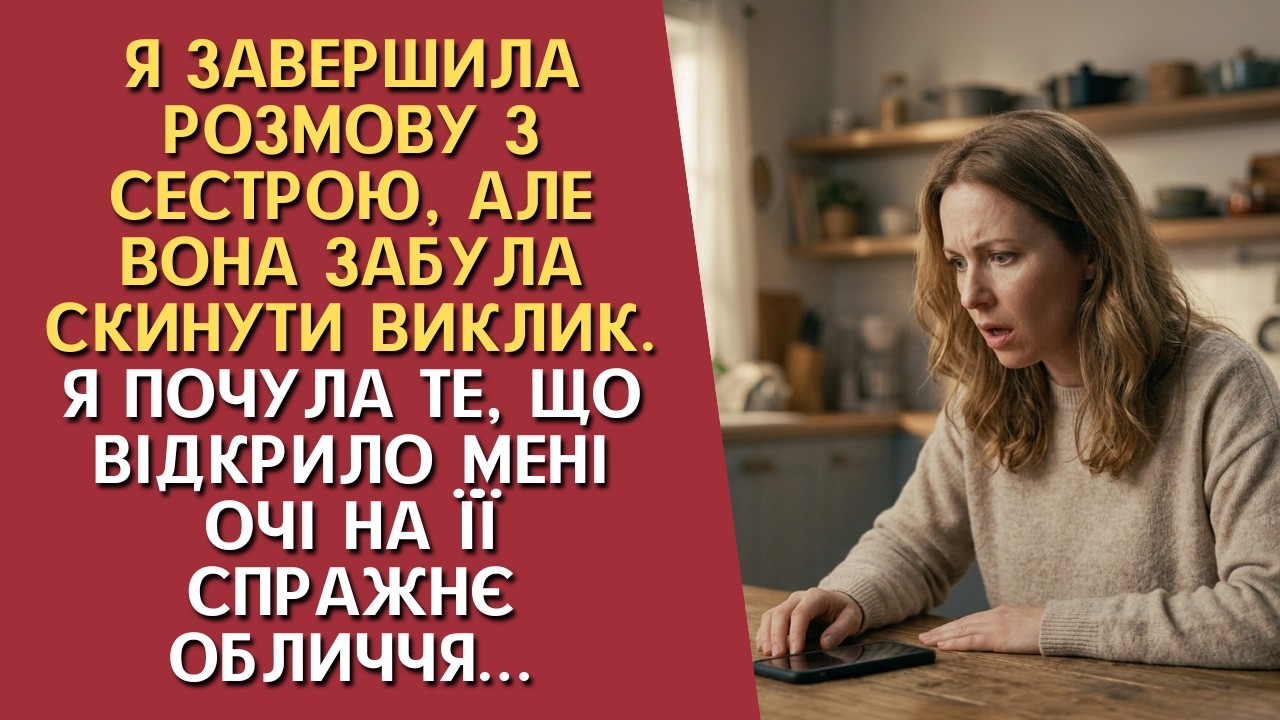
The call connected, but the screen didn’t go dark. Vera stood at the stove, stirring cocoa, the warm smell filling the Poltava apartment. She had called her younger sister Valentyna to ask a small favor—check the locks on the old village house after a storm. The conversation had been sweet, full of family warmth.
“Of course, Virochka. I’ll check everything. My girls and I walk right past your yard anyway. ”
“Thank you, dear.
Give the twins kisses from me. ”
“I will. Love you, sister. ”
Vera smiled and placed the phone on the table.
The screen still glowed—the old touchscreen had been acting up again. She turned back to the stove, reaching for a cup. Then Valentyna’s voice spat from the speaker, sharp and vicious. “She called just now, our fine Poltava lady.
Got fat on city food. All dressed up like some big madam. Asks me to check the locks on her mansion. Like I need to drag myself through the mud for her shack.
She sits there in the warm, and I should wipe her precious gates? I’m not going. I’ll tell her tomorrow everything is hanging fine. Let her calm down.
Really, she thinks she’s someone now. ”
The voice stopped abruptly. A muffled clatter, then silence. Valentyna had finally noticed the call was still live and slammed the phone down.
Vera stood frozen, the spoon still in her hand. The cocoa boiled over, hissing on the hot burner, filling the kitchen with the sharp smell of scorched milk. She didn’t move. The words had hit her like a fist to the chest.
She had given this woman everything. For years. ——
Back in Yablunivka, Vera had been known as the hardest-working woman in the village. Three cows, five adult pigs, two dozen squealing piglets, a massive vegetable garden, greenhouses full of tomatoes, and endless rows of jars in the cellar—pickles, lecho, stewed meat.
She did it all alone. Her husband had left for Kyiv ten years ago and never returned. She cried for a month, then wiped her face with her rough apron and kept working. Her younger sister Valentyna lived on the other side of the village in a crooked old house with her live-in partner Mykola, a lazy, sullen man who vanished at the first sight of work and reappeared exactly at dinner time.
Valentyna didn’t work. She collected small child benefits and occasional handouts and refused to plant a garden, saying it was beneath her dignity. “Virochka, how do you dig in that manure all day? ” Valentyna would say, pinching her thin lips, carefully wiping her cheap shoes with a handkerchief.
“You smell like silage and pigpen. Your hands are like rakes. A woman should take care of herself, and you’ve turned into some soulless tractor. ”
Vera never argued.
Valentyna was the younger sister, the spoiled one, their late mother’s favorite. And the twins—little Daryna and Sofiika—always looked so thin and pale, wearing other people’s hand-me-downs. Vera’s heart ached for them. So Valentyna came two or three times a week.
The scene was always the same. She would hover by the window, with a suffering look on her face, and start her familiar song. “Virochka, do you have some rice or thin vermicelli? Just a cup, to boil some soup for the girls.
We have three days until the child money comes, and Mykola’s salary is delayed again at the sawmill. I’ll pay you back from the first money, honestly. ”
Vera always opened the cupboard and handed over everything she had: heavy bags of buckwheat and pasta, sugar, jars of her own stewed meat, fresh cottage cheese, bottles of warm milk from her favorite cow Zirka. The twins would stand by the door, eyes wide.
“Aunt Vera has so much pasta! Mom, if only we had some. ”
Vera’s heart squeezed. She packed the bags, pressed warm pie into the girls’ hands, and sent them home.
She believed this was what family did. She believed her sister loved her. She never kept track of the debts. ——
After Artem appeared, everything shifted.
He came to the village in early spring, an engineer from Poltava leading a crew that was modernizing the old substation. Tall, quiet, with careful eyes. He was nothing like the local men. They met by accident.
His service SUV was stuck in the deep spring mud near Vera’s yard. She didn’t say much—just brought out a strong tow rope and stood in the muck herself, helping push the heavy vehicle out. Artem looked at her tired eyes and her rough, calloused hands and saw something he couldn’t name. The next morning, a huge bundle of wildflowers and a box of expensive city chocolates for Vasylka sat on her wooden porch.
He wasn’t afraid of hard work. After his shift, he came to her yard, split firewood, repaired the leaning fence the piglets kept digging under, helped haul hay. He looked at her like she was something precious, something to protect. After three months, he asked her to move to Poltava with him.
Vera couldn’t believe it. For the first time in years, a crack of light broke through her heavy world. The move was hard. She cried when the local farmer loaded her beloved cow Zirka into a truck.
The pigs and piglets were quickly sold to neighbors. Vasylka, who had just started college in Poltava, jumped with joy. Vera refused to sell the family house, though—it was her roots, her safe place. She and Artem boarded up the windows, hung new heavy locks, and kept it as a holiday home.
In the city, Vera slowly began to breathe. She learned to sleep past four in the morning. She changed her faded headscarves for a stylish haircut. She got a job as a pastry chef in a small bakery near the house.
Her skill was finally valued, not just taken for granted. And Valentyna became sweeter. She called regularly, her voice dripping with honey. She asked about prices in the city.
She mentioned the twins were growing fast and needed warm jackets. And Vera, feeling a strange, irrational guilt for her new comfortable life, sent package after package. Good clothes, expensive sweets, even tablets for the girls’ school. She believed family was family, no matter the distance.
——
The cocoa had burned black by the time Vasylka came into the kitchen. “Mom? What’s wrong? ”
Vera sobbed as she repeated what she had heard.
Vasylka’s face hardened. “Mom, stop crying. She’s not worth your little finger. ”
“But she’s my sister…”
“She’s been calling us greedy pigs for years,” Vasylka said coldly.
“Did you know the twins told their classmates you stuff us with scraps while you’re drowning in pig money? Cut her off, Mom. Cut her off like a rotten branch. ”
Vera stared at the black phone screen.
The pain in her chest slowly turned to ash. Something hard and cold settled in its place. She called Valentyna back. “Virochka!
” Valentyna answered instantly, her voice bright and sweet as if nothing had happened. “I was just thinking about you, I forgot to tell you—”
“Hang up the phone next time, Valya,” Vera said quietly. “Before you start pouring dirt on me and counting how fat I’ve gotten on city food. ”
The silence that followed was thick.
Then Valentyna started babbling, tripping over her words, choking on panic. “Verochka, you misunderstood! I wasn’t talking about you at all! Mykola and I were watching a series, there was a show and the characters were arguing, how could you think such a thing about your own blood, you’re my only sister….
”
Vera pressed the red button. The connection died. She sat down and wept until there was nothing left. She was crying for the sister she never really had.
——
Half a year passed. Vasylka passed her exams. Artem got a promotion. Vera became the head pastry chef at the bakery.
She had money in her account, real wages, money she didn’t have to beg for or hand over to anyone. Valentyna’s life collapsed without her sister’s free supermarket. Mykola got fired from the sawmill for drinking. The child benefits evaporated in two days.
And the pantry at Vera’s old house—full of jars and bags—was locked and empty. Valentyna sat on a bench by the village shop and spat her poison. “Our Vira got so greedy in the city. Got herself a rich man, spread her tail, and doesn’t want to know her own family.
Starves her own nieces. Won’t even send them candy. ”
But the village remembered Vera, up at four in the morning, bleeding through her calluses. “Shut your mouth, Valya,” old aunt Tonya snapped from the neighboring yard.
“Vera earned that farm with her own back. You only know how to walk around with your hand out. You were disgusted by her smell, and now you can’t sleep over her city money. No shame?
”
Even the gossips turned away from Valentyna. ——
The real blow came in May. A large agricultural company was buying up land around Yablunivka to build modern greenhouses and a processing plant. Prices near the highway skyrocketed.
Vera’s plot—with its solid house and huge garden—was right in the center of the planned development. The investors needed her land badly. Valentyna heard about it first. Her breath caught with greed.
“Listen,” Mykola said, nursing a hangover. “Your sister doesn’t know a thing. The house is standing empty. Let’s knock off the locks, climb in.
Tell the company you have a power of attorney, or you’re the only heir. Maybe we can get some cash advance before anything gets figured out. ”
That same warm May evening, Mykola took a crowbar to the new heavy locks. They screeched and gave way.
Valentyna walked into her sister’s dark house like she owned it. They emptied the cellar of whatever jars remained. Mykola brought in cheap beer, and Valentyna sprawled on the old sofa, already imagining herself as a wealthy landowner. She was a fool.
The company’s lawyers were not gullible provincials. They checked everything through the state registry before handing out a single kopeck. The electronic extract was clear: the only owner of the plot and the house was Vera. One sunny day, a polite young man in an immaculately tailored suit stood at Vera’s apartment door in Poltava.
“Good afternoon, Vira Antonivna. I’m Maksym, head of the legal department of the agricultural holding. We’re actively buying land in Yablunivka. Your plot is strategically important to us, and we’re prepared to offer an extremely generous premium for a quick deal.
But there’s a legal issue. Our specialists went to the site and found people living in your house. A woman identifying herself as Valentyna aggressively claims you gave her verbal rights to sell the property. She demanded a cash advance.
”
Vera stood in her apron, flour on her hands. “That’s a absolute lie,” she said quietly. “I gave her nothing. My house was locked.
”
“That’s what I thought,” Maksym nodded. “The company is willing to double the compensation for urgency. If you can come this Saturday, resolve the issue with the unlawful occupants, and sign the sale contract in the presence of our private notary, we’ll finalize everything. ”
Artem had been listening from the hallway.
He walked over, placed his hand on Vera’s shoulder, and answered calmly. “We’ll be there Saturday. Prepare the documents. ”
——
The rest of the week passed in a tense haze.
Vera walked like a wound-up spring. The old anger, which she thought had cooled, burned hot again. Valentyna had invaded her past, broken her locks, tried to steal what Vera had built with her own health and sweat. On Friday evening, Vera deliberately went to the supermarket.
She walked past the expensive delicatessen shelves and stopped in the grocery aisle. The cashier watched with quiet surprise as the well-dressed woman calmly checked out a package of the cheapest thin vermicelli and a bag of gray, low-grade rice. Vera paid, put the items in her stylish leather bag, and smiled faintly. ——
Saturday was warm and bright.
A solid SUV rolled up to Vera’s old house, followed by the company’s representative car. Vera stepped out in crisp light pants and a beige trench coat. She looked fresh, calm, absolutely sure. Next to her stood Artem and Vasylka.
A crowd of curious villagers already gathered around the fence. The smell of cheap beer and stale cigarette smoke leaked from the open windows of the house. Artem pushed the door. It wasn’t locked.
Inside, at the table in what used to be Vera’s bright clean room—now littered with empty beer cans—sat a bleary-eyed Mykola and Valentyna in a dirty, greasy robe. When she saw the lawyers and Artem, Mykola shrank. Valentyna jumped up, fear twisting into rage. “Oh, our fine Poltava lady decided to come back!
” she shrieked, pitching her voice so the whole street could hear. “Rolled up in your expensive car, but forgot about your own blood! We were here protecting your house from damp and thieves, guarding it day and night, and you want to sic the police on us? You came to sell the land and grab millions, and half of it is mine by the law of conscience!
My children are living in poverty here, and you’re stuffed to the throat! ”
Vera stood perfectly still and listened. No pity stirred in her chest. No guilt.
She looked calmly at the dirty room, at the broken locks lying in the hallway, at her sister, who was choking on her own spit. The lawyer Maksym and the notary laid out a thick folder of papers on the only clean corner of the table. “Vira Antonivna, everything is prepared. The full amount will be transferred to your bank account immediately after signing.
”
Vera took the pen and wrote her signature on every copy. The deal was closed. Her land now belonged to the company. The money in her account was more than enough to buy another excellent apartment in Poltava.
Valentyna stood frozen, breathing heavily, her eyes fixed on the signed documents. Her theatrical pride collapsed like a punctured balloon. “So… that’s it? ” she whimpered, her voice suddenly pathetic.
“Virochka, can’t you give us a little something? We’re sisters. We share the same blood. At least for the girls’ jackets.
”
Vera slowly unclasped her stylish bag. She took out two packages and placed them on the table in front of her stunned sister. A packet of the cheapest gray rice. A packet of thin vermicelli.
“That’s all I owe you, Valentyna,” Vera said quietly, her voice cold and firm. “You used to come to me asking for a glass of rice and vermicelli for the children. That’s all I’ll ever share with you now. Take it.
It’s enough for soup. ”
She paused. “I forgive you all your old debts. And I’m forgetting you completely, as if you never existed.
Don’t ever come near me or my family again. ”
The crowd outside approved loudly. Old aunt Tonya called out from the garden: “That’s what she deserves, the freeloader! ”
Valentyna stood pale as chalk, staring at the two pathetic packets.
For the first time, the truth sank in. Her own jealousy and greed had nailed shut the comfortable feeding trough she had been dipping into for years. There was no point screaming now. The whole village had witnessed her shame.
Vera turned and walked out. On the old porch where Artem had once left her wildflowers, she stopped and closed her eyes. She breathed in the May air, heavy with the scent of blooming cherry blossoms. Then she opened her eyes, smiled warmly at the man beside her and her daughter, and walked toward the car.
Behind her, the old life—the dirt, the insults, the endless taking—was already nothing more than a fading scent in the wind.