“I want everyone to meet my mother’s gold digger. ”
The words hit so hard I honestly thought I’d heard wrong. Then came the laughter. Not from everyone, but from enough people.
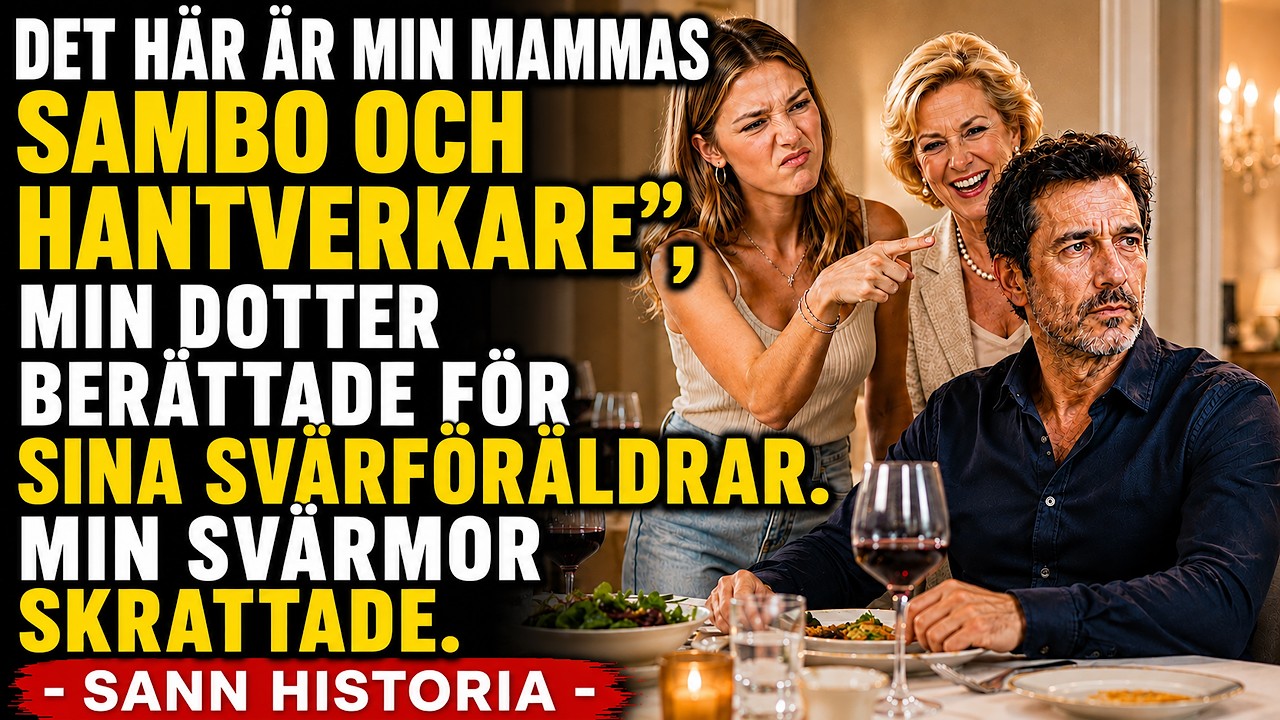
Enough to heat my face. Enough to make me want to disappear. I sat frozen at a round table in a private function room at a Scandic in central Stockholm, watching my stepdaughter Elin raise a champagne glass. She wasn’t nervous.
She wasn’t embarrassed. She was proud, the way people look when they think they’ve just delivered the perfect joke. “This is Anders,” she continued. “My mother’s husband.
” A few people nodded politely. Elin smiled wider. “Or as I like to call him, Mom’s gold digger. ”
My stomach tightened.
I glanced at my wife, Karin. She was laughing too. Not loudly, not cruelly, just enough. Enough for me to notice.
Somehow that hurt worse than Elin’s comment. Elin had never liked me. Karin was supposed to. I stared at the linen tablecloth.
At fifty-eight, I’d survived failed businesses, recessions, a brutal divorce, and a bad back that ached every time rain was coming. Yet one joke at a rehearsal dinner cut deeper than most of it. “Look at him,” Elin went on. “He married my mom and retired right after.
Pretty good setup, if you ask me. ”
I didn’t answer. I couldn’t. If I opened my mouth, I didn’t know what would come out.
Across the room, Viktor, Elin’s fiancé, looked uncomfortable. At least someone did. He opened his mouth like he wanted to say something, then closed it. I couldn’t blame him.
Nobody expects family drama fifteen minutes before dinner is served. Elin and I had done this dance for years. Small comments, small jabs, small reminders that I wasn’t her father, that I wasn’t really family. I’d ignored it, then tolerated it.
Eventually it became background noise. Or so I’d told myself. But sitting there that night, I realized those comments had been piling up inside me like snow on a roof. One storm at a time, until the weight was too much.
I looked around the room. Most of Viktor’s family didn’t know me. Why would they? I wasn’t the center of the wedding.
I was just the man married to the bride’s mother. They had no reason to question Elin’s version of me: a retired man living in his wife’s house, probably spending her money. A simple story. People love simple stories.
Reality is usually more complicated. Elin finally sat down. Conversations picked up. Forks clinked.
Waiters moved through the room like nothing had happened. But I couldn’t shake the feeling that something had shifted, not because of Elin, but because of Karin. The image of her laughing kept replaying in my head. Then I noticed movement across the room.
Viktor’s father, Sten Bergqvist, had been quiet through the whole exchange. Too quiet. He slowly set down his glass, and the room gradually noticed. Sten wasn’t a dramatic man.
When he stood up, people listened. He looked straight at Elin. No smile, no anger, just disappointment, the kind that’s somehow worse. “Elin,” he said calmly.
The room went quiet. Even a waiter stopped moving. Elin looked confused. “What?
”
Sten clasped his hands in front of him. “Young lady, I believe you just made a very serious mistake. ”
The room froze. Elin laughed nervously.
“What are you talking about? ”
Sten didn’t answer. He looked at me instead, a long, searching look, like he was remembering something. Then he picked up his jacket, put it on, and walked out.
The door closed behind him. Real silence. The kind that makes people suddenly very interested in their drinks. Elin looked around, embarrassed.
Viktor looked confused. Karin looked worried. And I sat there wondering why my heart was beating so fast. Sten wasn’t the type to make scenes.
Ever. If he’d reacted that strongly, something else was going on. Something I didn’t understand. The rest of the night felt strange.
Dinner was served, people talked, wedding plans continued, but the energy had changed. Around nine, I quietly excused myself. Nobody stopped me. Nobody asked me to stay.
I walked through the hotel lobby alone. Outside, the air was cool and damp. A light rain had started. I sat in my old Volvo for a while before starting the engine.
My phone stayed silent. No message from Elin. No message from Karin. Nothing.
That night I barely slept. Not because of Elin. Not even because of Karin. It was Sten.
The look on his face. The way he got up. What did Sten Bergqvist know that I didn’t? I sat alone in the kitchen.
Karin still hadn’t come home. She’d stayed to help with wedding preparations, or she just didn’t want to ride home with me. I wasn’t sure which bothered me more. Then my phone rang.
Sten. “Are you home? ” he asked. “Yes.
”
“We need to talk. ”
“On the phone? ”
“No. Breakfast tomorrow.
The café in Täby. Eight o’clock. ” He hung up. The next morning I woke before sunrise.
I showered, shaved, and drove to Täby. The café was exactly where it had always been, same discreet sign, same smell of coffee and fresh bread. Sten was already there. Corner table by the window.
Black coffee. He looked older than I remembered. Tired. We sat in silence for a moment.
Then he looked out the window. “You know what bothered me most last night? It wasn’t what Elin said. ”
“What was it?
”
“She believed it. ” He turned back to me. “She actually believes you live off Karin. ”
“How many times has she told that story?
”
“More than you’d think. ”
My stomach sank. “How often? ”
“Enough that people accept it as fact.
”
I stared at the table. A joke is one thing. A story is something else. This wasn’t a moment of bad taste.
It was a performance, repeated often enough that people accepted it as truth. Sten studied my face. “You really didn’t know. ”
“No.
”
Then he told me the rest. Elin had been telling people she would inherit Karin’s villa one day. Not just the villa, the money too. At Christmas she mentioned renovating “the property.
” My property. And last spring, she joked about how nice retirement would be once all of it was hers. I took a long breath. My coffee suddenly tasted bitter.
For the first time, a lot of things started falling into place. The expensive wedding venue. The casual spending. The confidence.
All the things I’d ignored because I wanted peace, because I loved Karin, because I’d convinced myself they didn’t matter. Sten looked straight at me. “Anders, she talks about your assets like they’re already hers. ”
Not Karin’s.
Mine. For years I’d been accused of marrying for money. Meanwhile, someone else had been quietly building plans around mine. When I got home, Karin still wasn’t there.
I went to my office, opened the filing cabinet, and pulled out a folder. Then another. If Elin thought she already owned part of my future, I needed to understand exactly how much of my past I’d already given her. The wedding venue alone had cost more than my first house down payment back in the eighties.
I found the contract. Two hundred and twenty thousand kronor, paid by me. I wrote it in a spreadsheet. Then the nursing program.
Elin had called Karin crying one winter night, said she couldn’t pay her fees, thought she’d have to quit. I didn’t hesitate. A hundred and thirty thousand kronor. Car repairs.
Forty-two thousand. Credit card debt. Ninety thousand. Apartment deposit after a bad breakup.
One hundred and five thousand. Medical bills. Seventy thousand. I kept writing numbers, and the spreadsheet grew longer and longer.
By lunchtime my stomach hurt. Not from the money, from the memories attached to it. Every number represented a phone call, a crisis, a request. And somewhere along the way, gratitude had turned into expectation.
The final total on the screen: two million, six hundred thousand kronor. Not life-changing for me. But that wasn’t the point. The point was what I’d expected back.
Not gratitude. Not praise. Just basic respect. Somehow that had been harder to get than money.
Halfway through a sandwich, my phone rang. An old friend named Gunilla, someone I knew through Karin. We chatted about the weather, retirement, the wedding. Then she said something that made me go still.
“You know, I’ve always admired Karin for supporting you after you retired. ”
I almost dropped the phone. “What? ”
A pause.
Then Gunilla sounded uncomfortable. “Wait, wasn’t that how it was? ”
I kept my voice calm. “What exactly have you heard?
”
She sighed. “Karin jokes about it. That she supports her retired husband. Honestly, I thought everyone knew.
”
I stared out the kitchen window. The pieces clicked into place. Elin’s comments. The confidence behind the insults.
The assumption that I lived off Karin. The story hadn’t started with Elin. It had started somewhere else. Karin knew exactly where the money came from.
She knew who paid the mortgage. She knew who funded the wedding. She knew whose name was on every major account. So why had she let people believe something else?
The answer came slowly. Not because she wanted to hurt me. Because it made life easier. Easier than correcting Elin.
Easier than creating conflict. Sometimes people don’t betray you with lies. They betray you by letting lies grow. Around four, Karin finally came home.
I heard her car pull in, heard the garage door, heard her footsteps. I stayed in my office. She knocked softly. “Are you okay?
”
“Just busy. ”
She smiled. “Wedding week. ”
“Yes.
”
She nodded and walked away. I listened to her steps fade down the hall. Then I opened the spreadsheet again. After a long moment, I picked up the phone and called my lawyer.
“Thomas, I need to review every financial arrangement related to my estate. My will. My prenuptial agreement. My power of attorney.
”
There was a pause. Then he said something that surprised me: “It’s about time. ”
Three days later, I put a letter on the kitchen counter before sunrise. No threats.
No accusations. Just one page explaining that, effective immediately, I would no longer finance Elin’s wedding or cover unexpected expenses. Future help would be discussed case by case. And I explained why, not because of a joke at a rehearsal dinner, but because I’d finally understood that generosity without boundaries becomes expectation.
And expectation becomes entitlement. I drove to a café and ate breakfast alone, watching my phone light up with calls. By the time I finished, Karin had called six times. I listened to her voicemail while walking to my car: “Anders, what is this?
What does this letter mean? ”
No anger. No satisfaction. Just certainty.
For the first time in years, I’d been completely clear. I got home around ten. Karin was waiting in the kitchen, arms crossed, the letter in her hand. “Say you don’t mean this.
”
“I mean it. ”
“You’re pulling wedding funding two weeks before the ceremony? ”
“I’m ending financial arrangements that should have ended a long time ago. ”
“So this is about Elin.
”
“No. This is about five years of trying to be accepted. Five years of paying bills and staying quiet. And you never corrected anyone who thought you supported me.
”
Her face changed. A small shift, barely visible, but I saw it. Recognition. She knew.
“It was just a joke,” she said. “Exactly. Just like Elin’s comment. Just like all the other comments.
Harmless. Except they piled up. ”
She looked exhausted. “I never thought it mattered.
”
“It did. ”
Her phone rang. Elin. Karin answered on the first ring.
I could hear Elin’s voice before Karin even reached the phone, loud, panicked, furious. “What is he doing? ”
I walked away. I didn’t need to hear the rest.
The calls continued all day. Sixteen missed calls from Elin. I didn’t answer a single one. Around six, the phone rang again.
This time it wasn’t Elin. It was Viktor. “Can we talk? ” He sounded embarrassed.
Almost guilty. “Sure. ”
“I’m not sure what’s going on between you and Elin. But I think you deserve to know something.
” He paused. “Elin assumed the wedding budget was secure. She thought you’d cover everything over. There are expenses she hasn’t told you about.
The engagement party. She booked a big event at Djursholm Golf Club next month. She already signed the contract. ”
“With what money?
”
The silence said enough. “Viktor. What else? ”
He hesitated.
“She talks about the villa. She tells people it will basically be hers one day. ”
I almost laughed. The villa wasn’t Karin’s.
It had never been Karin’s. I bought it seven years before I even met her. My lawyer had the deed, the prenuptial agreement, every document. Elin wasn’t planning around reality.
She was planning around assumptions. A printed invitation came three days later. Thick cardstock, gold lettering. Elin had called it “a celebration of family and new beginnings.
” I knew exactly what she was doing. She wanted an audience. She wanted pressure. She wanted a room full of people watching me so I’d feel forced to back down.
I almost didn’t go. It would have been easier to stay home. But sometimes avoidance doesn’t create peace. It just postpones the conflict.
The ballroom was packed. More people than I’d expected. Elin moved through the crowd like a politician at a campaign event. Viktor looked like a man on his way to a root canal.
When he saw me, he actually looked relieved. “Glad you came. ”
“Not sure I am. ”
He gave me the first genuine smile I’d seen from him in weeks.
I found a table in the back, far from the microphone. For about forty minutes, things were surprisingly normal. Then Elin walked up to the small stage and tapped her glass. “Thank you all for coming tonight.
I wanted this evening to be about gratitude. ”
I knew immediately that was a bad sign. Speeches about gratitude rarely end well when they follow a conflict. “Especially gratitude toward the people who support us.
” A few heads turned toward me. Elin kept going. At first she sounded emotional, almost sincere. Then her tone shifted.
“Unfortunately,” she said, “some people choose to turn their backs on family when they’re needed most. ”
The room went quiet. I noticed Viktor close his eyes for a second, like he already knew what was coming. Elin looked straight at me.
“I’ve recently learned that some people are only generous when it benefits them. ”
A murmur spread through the room. Not agreement, confusion. Elin kept going.
“When someone suddenly withdraws support for a wedding, what does that say about their character? ”
I sat still, hands folded. I said nothing. Sometimes people reveal more when you let them keep talking.
Elin took my silence for weakness. Big mistake. “The truth is,” she said, “family shouldn’t be abandoned just because someone gets their feelings hurt. ”
She had crossed a line.
Not because she insulted me. Because she rewrote reality. I hadn’t abandoned anyone. I’d refused to keep funding people who felt entitled to my help.
Before I could respond, another voice filled the room. “That’s enough, Elin. ”
Everyone turned. Sten rose slowly from his table near the stage.
No microphone. No fanfare. Just a calm, sixty-three-year-old businessman with a glass of sparkling water. Elin looked annoyed.
“Sten, this isn’t—”
“You’ve had your say. ” His voice wasn’t loud. It didn’t need to be. The room was already listening.
He looked out over the ballroom, then back at Elin. “I’ve spent weeks listening to stories about that man. ” He pointed at me. “Almost none of them were true.
”
Nobody moved. Nobody spoke. “Anders has never asked me for money. He’s never borrowed from me.
He’s never taken advantage of anyone. ” A faint smile. “The truth is the opposite. ”
Then he told them the real story.
Twenty years earlier, his company was about to go under. A single construction contract changed everything. One opportunity saved dozens of jobs. Anders Lindström never asked for recognition, never told anyone, never used it as leverage.
The room listened. Elin’s confidence began to fade. I watched it happen, piece by piece. Then Viktor stood up too.
That surprised everyone, including me. He looked nervous but determined. “I need to say something. ” Elin stiffened.
“No, Viktor. ”
He ignored her. “Anders never promised us unlimited money. He helped because he cared.
Elin and I made decisions based on assumptions. That’s on us. ”
The words landed like a hammer. Nobody expects honesty during a public confrontation.
Especially not honesty that hurts the person saying it. Then came the final blow nobody saw coming. A man in a dark suit walked toward the stage. The venue manager, mid-forties, professional and visibly uncomfortable.
He leaned in and whispered something to Elin. Her face changed color instantly. She whispered back. He shook his head.
She whispered again. He shook his head again, then handed her a folder. The room watched. Nobody understood.
But I did. The deposit. The missed payment. The balance that had come due.
Elin opened the folder, looked down, and went pale. For a moment, I almost felt sorry for her. Almost. Then I remembered the rehearsal dinner.
The years of comments. The assumptions. The public humiliation she’d tried to create here tonight. The venue manager walked away.
Elin stood frozen, speechless. She still held the microphone, but she had nothing left to say. Reality had finally caught up with her. And reality doesn’t negotiate.
Whispers spread through the ballroom. Nobody laughed. Nobody mocked her. That would have been cruel.
Instead, people simply understood that the story she’d been telling wasn’t true. And once that understanding moves through a room, you can’t put it back in the bottle. Elin handed the microphone to someone nearby, turned, and walked off the stage, fast, almost running. Karin followed immediately.
The ballroom stayed silent for several seconds. Then conversations slowly resumed, like after a storm. I stayed exactly where I’d been all night. At the table in the back.
Hands folded. Not triumphant. Not happy. Just tired.
In the days after the engagement party, the house felt strange. Not peaceful, quiet. There’s a difference. Peace feels earned.
Quiet can feel empty. Karin stayed with Elin for almost a week. Officially, she said Elin needed support. Maybe she did.
But I think Karin also needed time away from me. Time from the questions neither of us wanted to answer. I didn’t stop her. At my age, you learn that some conversations can’t be forced.
The wedding was postponed. Not cancelled, officially due to family circumstances. Nobody believed that, but nobody argued either. A month passed, then two.
Summer turned to autumn. Karin eventually came home. The first night she was back, we sat at the kitchen table after dinner. No TV.
No phones. Just us. After a long silence, Karin said, “I failed you. ”
The words hung in the air.
Heavy. Honest. “I should have stopped this years ago. I thought I was helping by keeping everyone happy.
”
“I know. ”
“No. ” Her eyes filled with quiet tears. “I kept choosing the easy conversation.
The easy joke. The easy silence. ”
She was right. Those small choices had stacked up, year after year, into something bigger.
Something harmful. “I never thought it would go this far,” she said. “Neither did I. ”
For the first time in weeks, we were talking about the real problem.
Not money. Not the wedding. Respect. A relationship can survive mistakes.
It’s much harder to survive contempt. The healing didn’t come quickly. Trust isn’t repaired like a broken window. It takes time, patience, consistency.
The kind of work that doesn’t make good stories. But it’s real. And real means something. Elin stayed away for almost a year.
Honestly, I wasn’t sure I’d ever hear from her again. Then the phone rang one Saturday morning. Her name on the screen. I stared at it for several seconds.
Then I answered. “Hello. ”
A pause. “Hi.
”
She sounded different. Older, not physically, but emotionally. Life had clearly been teaching her. And life is often a stricter teacher than any parent.
We talked for almost an hour. Not about the wedding. Not about money. Not about blame.
Mostly about reality. Mortgage payments, unexpected expenses, long work hours. All the things that look simple until you’re the one responsible for them. Finally, she went quiet.
Then she said something I’d honestly stopped expecting to hear. “I’m sorry. I was wrong about you. ”
I looked out the kitchen window.
The same window where I’d sat staring at spreadsheets in disappointment. The same window where I’d decided things needed to change. “I know,” I said. Oddly enough, that was enough.
We didn’t magically become best friends. That’s not how real life works. But things improved, slowly, carefully, with boundaries. The biggest change wasn’t financial.
It was emotional. No more assumptions. No more automatic rescues. No more treating generosity as an obligation.
If help was needed, we talked about it. If support was given, it was appreciated. Simple rules. Healthy rules.
The kind I should have set years earlier. When I look back, I don’t regret helping Elin. I don’t regret the money. Money comes and goes.
What I regret is teaching people that my kindness had no limits. Because when you never draw a line, people eventually stop seeing the sacrifice behind what you give. They start seeing it as something they’re owed. That’s a dangerous lesson.
Especially in a family. Life is quieter now. Not perfect, healthier. The older I get, the more I understand that peace isn’t something you find.
It’s something you protect. Sometimes that means saying yes. Sometimes it means saying no.
And sometimes it means finally standing up for yourself after years of silence.