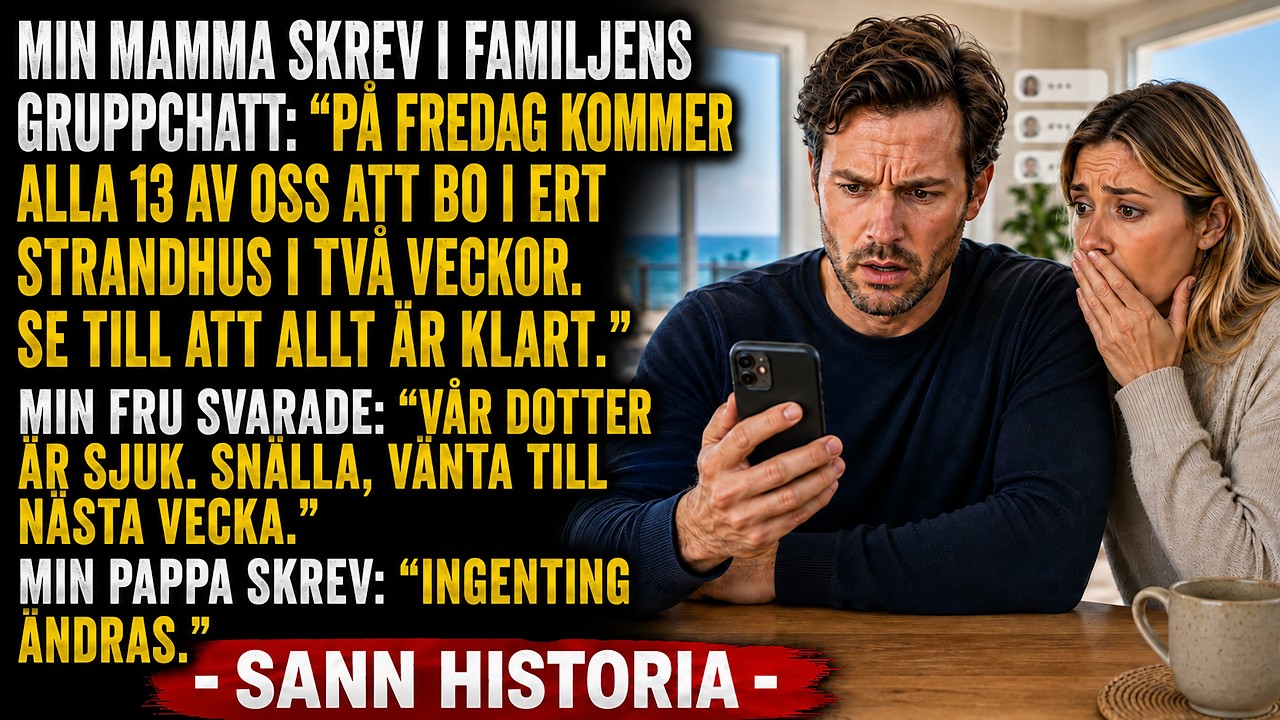
My daughter was fighting for breath when my mother announced that 13 relatives would be taking over our summer cottage by the sea for two weeks. My wife asked them to wait. My father refused. I wrote back one word: okay.
It was almost two in the morning on a Wednesday. I stood in our Stockholm kitchen holding a pharmacy bag like it contained something stronger than children’s paracetamol and a bottle of rehydration fluid. Elsa, my daughter, was two years and eight months old, diagnosed with pneumonia that afternoon. She lay on the couch with her cheek pressed against a folded blanket, her face flushed in the wrong kind of red.
Klara, my wife, sat beside her with her phone propped against a cushion, timing Elsa’s breaths per minute exactly as the pediatrician had shown her. I’d spent the day on my knees repairing a customer’s staircase, and my lower back reminded me of it. But I wasn’t going to sleep. Not with the doctor’s warning still heavy in my chest.
If her breathing got faster, if her lips changed color, if she stopped drinking water, we had to be at the children’s emergency room within an hour. That’s when my phone lit up on the kitchen counter. Family group chat. My mother had named it “Lindström’s Summer Week” three years earlier.
Usually it only filled with photos of grilled corn, new potatoes, and someone’s dog wearing sunglasses. This time it was different. “On Friday, all 13 of us are coming to stay at the summer cottage for two weeks. Make sure everything is ready.
”
I read the message twice. She hadn’t asked if the house was available. She hadn’t asked about Elsa, even though Klara had written in the same chat the day before that our daughter had a fever and we were heading to urgent care. Klara read over my shoulder.
I felt her go still. “She can’t be serious,” she said quietly, careful not to wake Elsa. She typed back herself, still hoping reason would work. “Elsa has pneumonia and needs quiet.
Can everyone wait until next week? ”
The answer came fast. Not from my mother, but from my father. “Fredrik has already taken time off.
Everyone has arranged their travel. Nothing changes. ”
Fredrik is my older brother. Fifty-one.
Drives a Volvo XC90 he can’t really afford, and has never in his life let a relative’s medical emergency get in the way of a vacation he’s already packed for mentally. My mother added a line right after. Something about bringing their own food and not being any trouble for the child. As if “no trouble” meant 13 people, four kids, three cars, and two dogs in a cottage with three bedrooms.
I stood there and counted through every summer before this one. The year they showed up two days early without saying anything. The year Fredrik took the biggest bedroom before we’d even unpacked the car. The year my mother taped a shopping list to our refrigerator as if I were staff.
My father had more than once called the place “our spot by the sea,” as if he’d ever hammered a single nail there. Klara didn’t push me in any direction. She just looked at Elsa, then at me, and said the only thing that truly mattered. “I’m not bringing her into a house full of people.
Not when she’s like this. ”
I knew exactly what would happen if I gave in like I always did. Klara would stay in Stockholm with a sick little girl while I drove five hours to host, mow the lawn, stock the fridge, and smooth everything over. It was the arrangement no one had ever voted on, but that everyone in my family had come to expect.
I typed one word: “Okay. ”
In Sweden, people like to imagine that family boundaries are quiet and civilized, that no one needs to raise their voice because everyone understands the rules without them being spoken. My family had always used that silence against me. If no one said the house wasn’t theirs, they treated it as if it were.
If no one said my weekend wasn’t free, they filled it. If no one said my wife was exhausted, they assumed she could keep smiling. That night, with Elsa’s breathing far too fast in the room next door, I understood that silence had stopped being politeness. It had become permission.
Klara hadn’t inherited the cottage as a luxury. Her parents had paid it off over 30 years, careful month by month. When they transferred it to her, they did so because they trusted us to keep it as a quiet place for our child. It wasn’t a hotel.
It wasn’t a family resort. It was the only place where Klara still felt close to her father after he’d grown too weak to walk down to the water. And somehow, over the years, my family had made it into something they spoke about as if Klara were just the woman holding the keys. Klara looked at me.
“Okay, as in they’re coming? ”
I put my phone face-down on the counter. “No,” I said. “Okay, as in I’m done discussing it.
”
I picked up the phone again, this time to call the man who managed the smart lock at the cottage. I left a message asking if he could meet me first thing in the morning. The guilt came almost immediately, just like it always did. My parents were in their seventies.
The trip was planned. Someone, somewhere, would call me the villain in this story before the weekend was even over. Then Elsa stirred. Her little hand found my finger and closed around it the way she had since she was a baby.
“Daddy, stay,” she said. Barely awake. Barely audible. That was all.
The entire argument was settled with three words from a two-year-old who knew nothing about summer cottages, family, or twenty years of me saying yes. I went upstairs and pulled out a gym bag. I packed clothes for two days without overthinking it. Overthinking was exactly how I always talked myself back into old patterns.
Klara came to the doorway with Elsa sleeping against her shoulder. “What are you going to do? ”
“Make sure the house is ready,” I said. But for the first time in my adult life, I wasn’t making it ready for my parents.
I left Stockholm just before five on Thursday morning. The drive to Böda on Öland takes about five hours, and I had plenty of time to sit with my decision. The phone kept vibrating all the way. But not one message asked how Elsa was.
“Buy low-fat milk, not full-fat. Make sure there are enough towels. Empty the big bedroom for your father, his back is bad. Check the grill’s gas cylinder.
Fredrik wants to tie the motorboat at the pier near the house. ”
Not one single message about my daughter. I understood the Swedish summer kultural obsession. A week by the water.
A chance to sit in the sun before the dark months return. But a child’s lungs don’t follow anyone’s vacation schedule. Pneumonia doesn’t wait politely until the relatives have finished their grilled food on the porch. Every time the phone vibrated with another instruction about towels or milk, I thought about Elsa’s small chest moving under the blanket, and Klara counting breaths as if each number were a prayer.
By the time I passed Norrköping, I’d rehearsed six different apologies. Sorry for the inconvenience. Sorry you drove so far. Sorry this is uncomfortable.
Then I heard Elsa’s voice again. Barely awake. “Daddy, stay. ”
It was the first time I realized the apology I owed wasn’t to my parents.
It was to my wife and daughter. For every year I’d let them share me with people who only called it family when they were taking something. The cottage itself had a history that had nothing to do with my side of the family, though you’d never know it from how my parents talked about it. Klara’s parents had built it in the late seventies.
New roof, rebuilt porch, every room repainted. Years of saving to finally remodel the kitchen. Klara and I had spent more vacations repairing that house than we had resting in it. My family had never contributed a single krona.
Fredrik once said, and I remember the words exactly: “Why would I spend my vacation fixing a vacation house? ”
Yet he was always first through the door once the work was done. The lock technician met me at the cottage around ten. He’d known my family for years, so I saw my request surprise him.
“New code on the front door,” I said. “Delete all old guest codes completely. Separate lock for the garage. And I want to verify the door camera works.
”
He raised his eyebrows but didn’t argue. “Family problems? ”
“Family boundaries. ”
It wasn’t witty.
It wasn’t a speech. It was just true. While he worked, I went through the house myself. Threw away anything in the fridge that could go bad.
Packed up some of Elsa’s things. Carried the porch chairs into the garage because rain was coming. I closed the curtains and set the thermostat to energy-saving mode. I didn’t cut off the electricity or water.
I wasn’t trying to harm anyone. I just wasn’t going to open the door. The cottage looked smaller than it ever did in my parents’ stories. In their version, it was endless.
Bedrooms for everyone. A freezer that existed for their convenience. A master bedroom that became theirs just because they expected it. In reality, it was a simple red wooden house with white trim.
A narrow porch. Sand that blew into the hallway no matter how often we swept. A kitchen where two people could barely pass each other without turning sideways. I walked slowly through every room.
In Elsa’s corner, the little wooden animals Klara had painted by hand still stood on the windowsill. In the hallway hung a framed photo of Klara’s parents on the beach in the eighties. Both young enough to think time was generous. Those were the people who had built this place.
Not my father. Not Fredrik. Not my mother with her room assignments and shopping lists. Before I left, I taped one sheet of paper to the inside of the front window, facing out.
“The cottage is closed. No guests this week. ”
My phone rang as I locked up. My father.
I almost let it go to voicemail. I answered anyway. He didn’t ask about Elsa either. “Did you fill the freezer?
”
“The cottage isn’t taking guests this week,” I said. There was a pause long enough that I could hear the television in the background at his house. “You’re not going to embarrass your mother like this,” he said. I felt the old reflex kick in.
The one that wanted to apologize before I’d even heard the full complaint. Then I looked at the little wooden rocking chair Klara had bought for Elsa last summer, still by the window where we’d left it. “This isn’t about mom being embarrassed,” I said. “Kids get sick,” he said.
“Families adapt. ”
“That’s exactly what I’m doing. ”
I hung up before he could answer. My hand shook a little afterward.
Forty-seven years old, and a phone call from my father could still do that. On the road to Växjö, where I was meeting Klara and Elsa at her parents’ house, my mother sent a room assignment in the family chat for all 13 people. As if nothing I’d said had registered. Fredrik, of course, got the biggest bedroom.
I read it at a rest stop along the E4. Instead of the guilt I’d expected, I felt something like clarity. I opened the lock app and deleted every remaining guest code. One by one, until the list showed only my name and Klara’s.
A notification appeared: “All guest access removed. ”
For the first time since that message had arrived in the chat two nights earlier, the silence from the house didn’t feel like something I needed to apologize for. On Friday afternoon, I was in Växjö with Klara and Elsa at her parents’ house. Elsa’s fever had gone down a little during the night.
She’d managed to keep down some water. It felt like the first good news in three days. At 15:17, my phone vibrated with a motion alert from the door camera at the cottage. I opened it without thinking.
There they were. Three cars pulling into the driveway. Fredrik in his Volvo. My parents behind him.
A cousin’s SUV with a small trailer full of beach chairs and coolers. Thirteen people got out over the next few minutes. Suitcases. Grocery bags.
Two dogs pulling at their leashes. I watched it all happen in silence on a six-inch screen from five hours away. At first, they thought the keypad was broken. I saw Fredrik punch in numbers, try again, shake his head.
My mother had her phone out. My father walked around the house looking for a side door that had never existed. The calls started almost immediately. I let the first two go to voicemail.
My mother’s voice sounded more confused than angry. “Johan, the keypad isn’t working. Call back. ”
Then Fredrik, sharper.
“Very funny. Send the new code. ”
Then my father, the one who actually got under my skin. “Your mother is standing in the heat.
Fix this now. ”
I sat with the phone in my hand, feeling the old pull to just make it stop. To send the code. To smooth it over one more time.
There were children out there. I didn’t want anyone stranded. So I sent one message to the whole chat: “The cottage is closed. There are hotels in Böda, Kalmar, and Färjestaden.
I told Dad yesterday. ”
I even named two hotels I knew had rooms. Whatever this was, I wasn’t leaving my own relatives on a parking lot without options. Then Leif got involved.
Leif is our neighbor across from the cottage. A retired mechanic who’s lived there longer than Klara’s parents owned the house. He doesn’t meddle in family affairs. But with 13 people and three cars blocking half the road, I guess he felt someone should say something.
Fredrik asked him if he had a spare key. “I don’t,” Leif said. “Johan removed the guest codes yesterday. ”
My mother said this was the family’s vacation home.
Leif corrected her calmly: “It belongs to Klara. Her parents owned it before her. ”
I heard that part secondhand. But apparently that sentence landed harder on Fredrik than anything I’d said on the phone.
It wasn’t an accusation. It was just a fact no one in my family liked hearing out loud. Leif added: “Johan said the place is closed because his little girl is sick. I thought everyone already knew that.
”
No one on the driveway wanted to admit they had known, and come anyway. That evening, Fredrik posted on Facebook. “My brother locked out our elderly parents and several children from the family summer cottage after they drove five hours. Some people forget where they come from.
”
Nothing about Elsa’s pneumonia. Nothing about Klara asking them to wait. Nothing about the cottage being hers. Or that I’d told my father the day before.
Or that I’d sent hotel names. Within an hour, relatives I hadn’t heard from in months were writing to me. One, whom I genuinely respected, called and asked, “Couldn’t you have handled this differently? ”
I started to wonder if she was right.
That night Elsa woke up coughing so hard I sat her upright against my chest to help her breathe. The phone was lighting up next to the bed with messages I didn’t read. Elsa pressed her face into my shirt and murmured the only thing that mattered: “No loud people, daddy. ”
I turned the phone off completely.
The locks, I realized, had been the easy part. The next morning, Elsa’s breathing hadn’t improved as the doctor had hoped. We took her back to urgent care in Växjö. The doctor listened to her lungs longer than I liked, moving the stethoscope from one spot to another.
Klara held our daughter’s hand. I stood uselessly against the wall, the way fathers do when all their skills have no place in the room. I could build a staircase. Renovate a porch.
Replace a roof. I couldn’t make my child’s breathing easier through sheer will. When the doctor finally said she could go home with careful monitoring and a new round of medication, Klara closed her eyes for a second. Relief looks a lot like exhaustion.
While Klara filled out paperwork, I sat in a plastic chair and scrolled my phone. Fredrik’s post had been shared in the larger family group. Aunts, uncles, cousins. Someone called me ungrateful.
Someone else used the word “cruel. ”
I sat there seriously considering opening the cottage the following week just to make the noise stop. Klara came back. She sat down beside me and must have read it in my face.
Instead of arguing, she reached into her bag and pulled out an old blue binder I hadn’t seen in years. I didn’t even know she’d kept it. Inside: receipts, bank statements, copies of payments. Screenshots of old text messages where people asked for loans.
Notes she’d mostly saved for our own taxes and budget. Everything showing every krona I’d ever sent to my family. The binder wasn’t built from bitterness. That’s what made me most ashamed.
It was tidy, careful, practical. The same way she handled everything that mattered. She’d kept it because Swedish taxes, bank transfers, renovation costs, and family loans all leave trails. Someone needed to know where our money went.
She’d never thrown the numbers at me during an argument. Never used them as a weapon. She’d just carried the truth until I was ready to see it. Every page felt like a year of marriage where I’d asked her to be patient.
One transfer here. A receipt from a hardware store there. A bank withdrawal with my father’s name. A message from Fredrik promising repayment.
By spring. By summer. After the next contract. Then never.
I’d called it all helping. Klara called it something else. And now our daughter was so sick I could finally see the difference between duty and love. We went through the binder together in that waiting room.
The total came to about 240,000 kronor over more than twenty years. Cash, materials, direct expenses. That didn’t include the thousands of unpaid hours I’d spent with a toolbox in my hand. Three memories stood out.
In 2008, Fredrik needed 60,000 kronor to keep his house. My father said, “You have it good. Your brother has children. ” Klara and I took the money from our kitchen renovation savings.
Fredrik promised to pay it back within two years. He never did. A few months later, he bought a used motorboat. In 2016, Klara and I had finally planned our own vacation.
Our first real one in years. Three days before we were supposed to leave, my parents’ garage roof started leaking. My father didn’t want to hire anyone. “Johan can do it.
” I canceled the trip, spent six days on the roof, and paid for materials myself. Klara spent our anniversary week alone in an empty house. And then there was the cottage itself. Slowly, it had become something that wasn’t quite Klara’s anymore, despite her name being the only one on the deed.
The first summer after her parents transferred it, my mother invited relatives without asking anyone. No one objected. I didn’t object. And then it became the pattern.
Fredrik brought friends on weekends. My mother stored her own sheets in the closet like she lived there. My father called the biggest bedroom “our room. ” Klara had silently become a guest in her own family’s house.
The money wasn’t what hurt most. It was understanding that I’d spent years buying peace with my parents using Klara’s time, Klara’s patience, and money that should have belonged to our little family. “I kept telling myself I was helping my family,” I said out loud. Klara didn’t look away.
“You were. You just forgot Elsa and I were part of it too. ”
When the doctor let Elsa go home, I carried her out to the car. She was too tired to react.
Her head fell to the side. Her breathing was still a little too fast for my taste. I thought about thirteen people trying to push into that house. Dogs barking.
Suitcases thumping against door frames. Kids running through the hallway while a two-year-old fought for air in the room next door. That’s when the last little bit of doubt about the locks disappeared. That evening, with Elsa finally settled, I sent a new message in the family chat.
“We need a family meeting in three weeks, Saturday afternoon at my house. I’ll explain everything once. After that, new rules are final. ”
My father responded almost immediately: “Good.
You owe everyone an apology. ”
He still thought I was inviting them over to surrender. Three weeks later, Elsa was almost herself again, chasing the neighbor’s cat along the fence and demanding snacks every twenty minutes. Seeing her run around the backyard made everything that came next a little easier.
The meeting took place on a Saturday afternoon at our house. Klara kept the food simple. Burgers from the grill, potato salad, soft drinks. No one came expecting a barbecue evening.
They came expecting an apology and a reopened cottage. My father sat down first, arms crossed. “Before we eat, your mother deserves to hear what you have to say. ”
I didn’t argue.
I walked around the table and placed a small stack of papers beside each adult. The first page had a single line at the top: “What we paid, what we gave, and what changes now. ”
I said openly that I wasn’t asking anyone to pay back a single krona. I just wanted it said out loud once, with numbers.
There’s a particular kind of silence that happens when a family realizes the person they’ve been relying on has stopped playing their assigned role. It’s not peaceful. It’s not respectful. It’s the sound of people reaching for the old handle and discovering the door is gone.
My father stared at the numbers like they were insults. My mother dabbed at her eyes with a napkin, but she didn’t question a single line. Fredrik looked angry at the paper—not because it was wrong, but because it was specific. “Fredrik house payments: 60,000 kronor.
Emergency mortgage payments: 125,000. Mom’s medical and dental costs over the years: 170,000. Materials for repairs at Mom and Dad’s house: 290,000. Food, electricity, repairs, and cleaning related solely to the cottage: almost 530,000.
Smaller loans never repaid. Total: roughly 2. 4 million kronor over twenty years. ”
Fredrik said I was treating family like a business transaction.
“No,” I said. “A business would have sent invoices. I never did. ”
He pushed harder.
The cottage had been used by the whole family for years, so locking everyone out was cruel. That’s when Klara spoke. “Using something for years doesn’t make it yours. ”
She placed a printed text message in front of him.
One he’d sent the previous summer. “Tell Klara to clear her things out of the big closet before we come. ”
“Why would I clear my belongings out of a house my parents gave me? ” she asked.
He had no answer. I said I wanted the Facebook post removed. He said it reflected how he honestly felt at the time. “Leave it up then,” I said.
“I’ll post the family chat screenshot right under it. ”
Fredrik went quiet. He knew exactly what was in that thread. Klara’s message about Elsa’s pneumonia.
My father’s response that nothing would change. One of my aunts sitting at the table looked at Fredrik. “That part you left out. ”
Fredrik muttered something about Facebook not being the place for every detail.
“Apparently it was the place for every detail that made Johan look bad,” she said. My father tried another angle. “After everything we did for you, this is how you treat us? ”
“I was raised by you.
I’m grateful,” I said. “But that doesn’t give you a lifelong claim on my wife’s house, our money, or our time. ”
My mother’s voice cracked. “We just tried to keep everyone together.
”
Klara answered calmly. “You tried to bring thirteen people into a house while our two-year-old had pneumonia. That wasn’t keeping us together. That was saying we didn’t matter.
”
My mother started crying. Something in me wanted to take it all back right there. Apologize. Pour her a drink.
Let the whole thing dissolve the way family fights in our house always had. Then I thought about Elsa, flinching at a phone ringtone, whispering “no loud people,” and I stayed seated. I laid out the new terms. No one uses the cottage without both Klara and me inviting them.
No more self-planned trips to a place that isn’t theirs. No more informal loans without paperwork. I’d still help with genuine medical emergencies. But I was done financing Fredrik’s lifestyle.
And anyone who used Elsa’s illness as leverage again would lose the right to visit us entirely. My father asked if I was choosing her family over my own. I looked through the kitchen window, past the photo of Klara’s parents, to Klara and Elsa stacking blocks in the living room. “No,” I said.
“I’m choosing the family I’m responsible for. ”
Then I asked the final question. “Can any of you name one single time you asked Klara before inviting people to her summer cottage? ”
No one answered.
No one screamed. No one needed to. Fredrik deleted his Facebook post right there at the table. Not because he’d changed his mind about anything, but because he didn’t want the chat screenshots under it.
Before my father left, he said I had torn the family apart. “No, Dad. I stopped pretending it wasn’t already broken. ”
Fredrik didn’t speak to me for almost five months after that afternoon.
It stung more than I expected. He’d used me for years, but he was still my brother. Some nights I lay awake wondering if I could have drawn the same line without drawing so much blood. What I noticed was how much lighter the rest of our life felt once the bleeding stopped.
The months after the meeting didn’t feel triumphant. Boundaries rarely feel triumphant when they’re new. They feel uncomfortable. Rude.
Unfinished. Some Sunday afternoons I’d look at my phone and miss the version of family I’d imagined we had. Then I remembered Klara sitting awake next to Elsa, counting breaths, while my parents argued about towels. Healing in our house looked ordinary.
It looked like paying our own bills without tensing up for someone else’s emergency. It looked like Klara leaving her book on the cottage coffee table, knowing no one would move it. It looked like Elsa building sandcastles and learning that when her parents said “quiet,” it actually became quiet. Money that used to disappear into other people’s crises started staying in our account.
Klara and I took an actual long weekend that spring. Just us. No garage roofs waiting for repair. No last-minute lists taped to someone else’s refrigerator.
My father never apologized. Not once. My mother sent stiff, careful texts around the holidays. They sounded more like duty than warmth.
I didn’t cut them off completely. I still called to check in. Asked about doctor’s appointments. But I stopped being the automatic answer to every problem that appeared in their lives.
When my father’s car broke down that winter, I gave him the number of a good mechanic instead of driving over with my toolbox. He wasn’t thrilled. He managed anyway. About six months after that conversation in our backyard, my mother called.
I braced myself like I always did. “Would it be all right,” she said, hesitating in a way I’d never heard from her, “if your father and I came by on Sunday afternoon? ”
It wasn’t an apology. I’ll be honest about that.
It wasn’t a movie moment. But it was the first time she’d actually asked instead of announced. I looked at Klara folding laundry on the couch. She gave me a small nod.
“Sunday between two and five works,” I said. “Elsa naps before that. ”
“We’ll come after her nap,” she said. Small.
Almost nothing, unless you knew our history. But it was real. The following spring, we drove back to the summer cottage for the first time since that Friday. The first visit wasn’t cinematic.
The wind was too strong. Elsa got sand in her shoes and cried dramatically for five minutes. I forgot the coffee filters. But the house felt like ours in a way it never had when I was busy hosting people who thought gratitude was something others owed them.
Klara opened the windows. I checked the water heater. Elsa ran in and out through the porch door until Klara laughed and said she was letting in every insect in both Småland and Öland. That evening, after Elsa fell asleep, Klara and I sat outside under blankets listening to the Baltic Sea moving in the darkness.
No one called to ask which room they’d get. No one asked if I’d bought the right milk. No one called the biggest bedroom theirs. Elsa was three now.
She ran down to the sand with a yellow plastic shovel like she owned the place—which, in a way that finally meant something, was true. I checked the front door lock before we went inside. More habit than anything. It didn’t feel like a weapon anymore.
It was just a lock. The same thing every house has. The simple, ordinary right to decide who comes through your own front door. I’ve thought a lot about what the real victory was in all of this.
It wasn’t the number in the binder. It wasn’t the image of thirteen confused people on a driveway. It was something quieter. It was making sure my daughter never grows up believing that love means letting people ignore what you need.
Klara came to stand beside me while Elsa kept digging. “Any regrets? ” she asked. I watched our girl throwing sand in every direction, laughing at nothing in particular.
“I regret waiting so long,” I said. If you’ve ever had to draw a boundary against your own family, you know it isn’t easy, and it doesn’t come out clean. But sometimes the people who love you most are the ones standing right in front of you, waiting for you to finally notice them.
Take care of those who respect your home and your heart.