I was walking past the kitchen when I heard my daughter’s voice. She was on the phone, pacing barefoot across the tile, one hand slicing the air. “She doesn’t even notice it. Her room stinks.
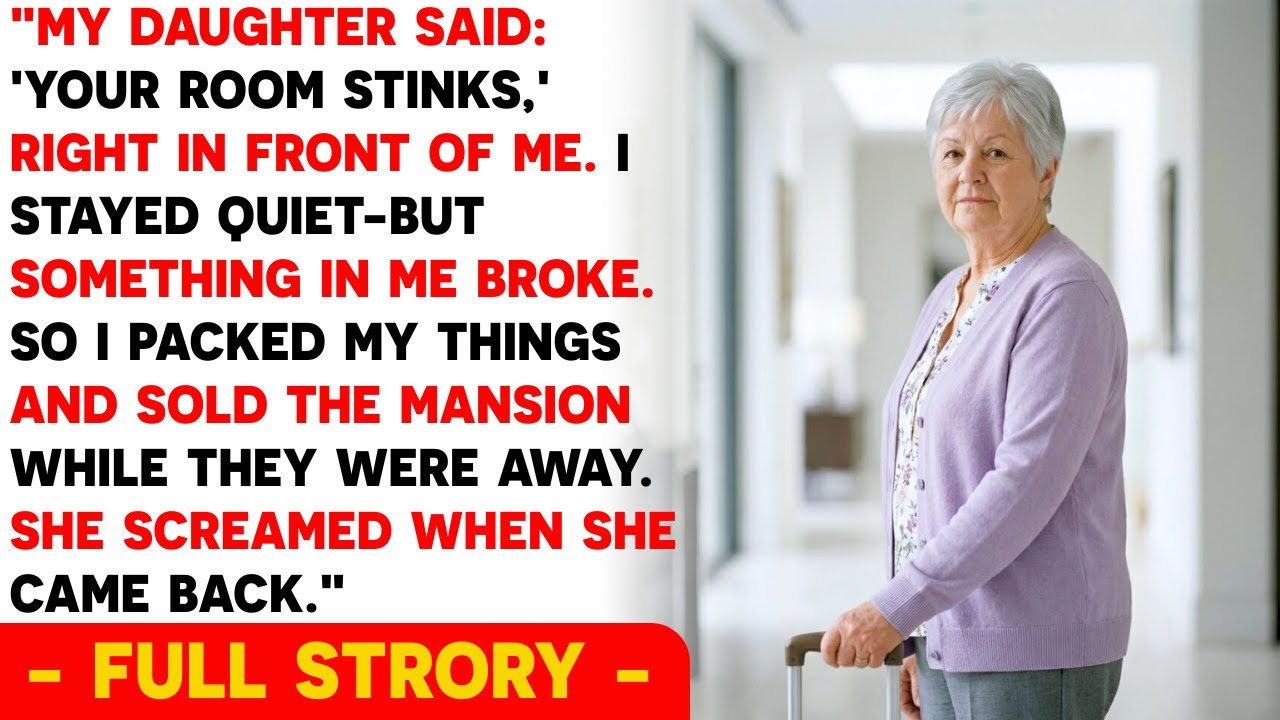
It’s like nursing home air. Heavy, like old fabric. Something medical. ”
She laughed.
A short, clipped sound I didn’t recognize. I stopped midstep. The chipped mug in my hand wobbled. I steadied it with my other palm, careful not to spill.
I was standing just outside the doorway. Not hidden. Not sneaking. Just there.
Paige didn’t look over. Didn’t lower her voice. “It’s seeping into the hallway. I’ve sprayed the whole bottom floor, but it clings to everything.
”
My heart didn’t race. It slowed. I backed away quiet. My slippers made no sound on the hardwood.
In the room they called the guest room, I closed the door softly and set down my tea. On the dresser sat a framed picture of Paige at seven, grinning, missing her front teeth. The girl who begged for one more lullaby. Who cried when I left for my night shift at Memorial Hospital.
Who whispered secrets in my ear with paint-stained fingers. Now she walked past me without touching my arm. She thanked me for folding laundry like I was a polite neighbor, not her mother. Three months ago, I turned seventy-seven.
Two weeks later, I had the stroke. Nothing dramatic, just enough to make walking unsteady and mornings uncertain. Paige called immediately. “You shouldn’t be alone, Mom.
You’ll stay with us just until things settle. ”
I remember a time when I never needed anyone’s permission to exist. For forty-two years, I worked night shifts as a nurse at Memorial. I brought babies into the world.
I held the hands of those leaving it. People trusted me with their first breaths and their last words. Now I needed permission to adjust the thermostat. I bought the pink linen dress five years ago, a retirement gift to myself.
Soft collar, delicate pleats, mother-of-pearl buttons down the front. I imagined wearing it to Sunday brunches in a quiet café with real tablecloths and sunlight through tall windows. I never wore it. The brunches never happened.
The friends passed on or moved away. And I moved into Paige’s guest room with a suitcase and a promise that it was only for a little while. I sold my condo. The money helped with the down payment on this house.
Paige’s name went on the mortgage, my savings covered the closing. At first, it felt like a shared home. I baked muffins. I watched Tyler and Zoe when Paige had meetings.
I paid the water bill without being asked. Then my boxes moved to the garage. My chair disappeared from the living room. My name vanished from the Wi-Fi password note.
I became the folded towels, the hot tea, the extra hand during school pickup. Paige never waited for my answer. She was already typing on her phone, halfway out the door in her tailored suit. Mason worked in finance.
He wasn’t unkind, just absent. Even when he sat right there at dinner, his eyes stayed on his plate or his phone. I told myself they were just busy, stretched thin. Parenting is hard.
Marriage is hard. I’d been there once with James before the cancer took him twenty years ago. But even excuses can’t warm cold stairs. Tyler is fifteen now, all gangly limbs and shy smiles.
He used to crawl into my lap for stories. Now he mumbles “Hey, Grandma” without looking up from his phone. Zoe is twelve. Last year she still asked me to braid her hair.
Now she closes her bedroom door when I walk past. I heard her tell a friend, “I can’t have anyone over. My grandma is staying with us. It’s complicated.
”
It wasn’t complicated when I paid for her summer camp or stayed up all night making her science fair volcano. I used to keep tomatoes by the kitchen window. A few pots of Roma, basil in a blue ceramic bowl from the old place. One afternoon, before Paige’s book club, she passed by while I was watering.
“Mom, do you mind moving these? They don’t really go with the aesthetic. ”
I moved them behind the shed where no one but the raccoons would see them. Less sun there.
I had to fight mildew and squirrels. The tomatoes never sweetened the way they used to. Still, I tended them daily. Talked to them when no one was listening.
I still baked. Muffins, banana bread, sugar cookies with lemon zest. I placed them on the counter warm just as the kids came down for school. They grabbed protein bars instead.
Cold things wrapped in plastic. The morning I made blueberry scones, Paige walked in scrolling through her phone. “Mom, you’re up early. ” “I made scones.
” She glanced at them. “We’re trying to cut carbs. ”
I wrapped the scones in foil and put them in the freezer next to last week’s banana bread. Paige lit a candle outside my door.
Designer glass jar, minimalist label. The scent said clean linen, but it smelled like bleach and apology. “Don’t take it personally,” she said when I asked. “Sometimes the hallway just feels stuffy.
”
I seem to nod a lot in this house. But I took it personally. When they closed the pantry door while I reached for oatmeal. When they re-washed dishes I’d already cleaned.
When I offered help and got that smile that says no but won’t say the word. James used to say I had a voice like warm honey. We danced in the kitchen after dinner, old Motown on the radio. He’d kiss my hand like we were in some old movie.
“My Loretta,” he’d say. “The most beautiful woman in the world. ”
Now I hum quietly under my breath, and sometimes I catch myself mid-note and stop, like I’m taking up too much space with just the vibration in my throat. At dinner one night, they discussed my doctor’s appointment.
Not with me. About me. “The neurologist said her recovery is plateauing,” Paige told Mason. “We should look into more regular care.
”
“I’m sitting right here,” I said. But my voice came out thinner than I intended. Paige blinked like she’d forgotten. “Of course, Mom.
We’re just concerned. ”
Later I overheard her on the phone with her friend Diane. “It’s getting worse. She lost her glasses three times last week.
I found them in the refrigerator once. ”
I wanted to explain. I’d put them down to help Zoe with a school project, and the refrigerator was the closest clean surface. But explanations sound like excuses when you’ve already been deemed incompetent.
Then came the candle. I started showering twice a day. Scrubbed with the lavender soap Paige had given me last Christmas, still in its gift box until then. I washed my nightgowns by hand and hung them in the bathroom, afraid my scent would contaminate the family’s clothes.
One night I couldn’t sleep. Tyler was in the kitchen making a sandwich. He asked if I wanted one. Then he said, “Mom’s been weird lately.
She keeps saying we need to present well because of Mason’s promotion. ” He hesitated, shoulders slumping. “I heard her talking to Dad about putting you in a home. A care place or something.
She said it would be better for everyone. ”
The kettle began to whistle. A thin, high sound like a distant scream. I turned it off with a hand that didn’t feel like my own.
“I told her it was messed up,” Tyler said fiercely. “Your family. ” I hugged him. This tall boy who still had traces of the child I used to read to.
He hugged me back, brief but real, then disappeared upstairs. On my birthday, no one remembered until dinner. Paige gasped over the store-bought cheesecake. “Oh my god, Mom, it’s your birthday.
I completely forgot. ” Mason offered a belated “Happy birthday, Loretta. ” Zoe hugged me, thin arms around my neck. “I’m sorry, Grandma.
I would have made you a card. ”
“It’s all right, sweetheart. It’s just a day. ”
Later, alone, I pulled out the pink linen dress.
I laid it on the bed, touched the fabric. On impulse, I put it on. It fit differently than it had five years ago. My body had changed.
But it still looked lovely. I’d chosen well. I stood before the mirror. Gray hair cut short for practicality.
Lines around my eyes and mouth. Hands spotted with age, but still strong. I looked like what I was: an old woman in a pretty dress. But something shifted inside me.
Some small spark that had been fading flickered back to life. I remembered who I was. Not just Paige’s mother or Tyler and Zoe’s grandmother. Not just an inconvenience in the guest room.
I was Loretta Dean. I had delivered babies and comforted the dying. I had loved a good man fiercely. I had raised a daughter and built a home.
And somehow I had let them take my dignity piece by piece until I barely recognized myself. I sat on the edge of the bed, still in the pink dress, and wrote a list in my notebook. Things I still owned. Things I still controlled.
Things no one could take from me unless I let them. At the top: my name. My memories. My choices.
The next morning, Paige rushed in late for a meeting. “Mom, can you pick up the dry cleaning today? And Zoe has a dentist appointment at four. ”
“No,” I said quietly.
She stopped mid-earring. “What? ”
“I have plans today. ” I took a sip of tea.
“I’m sure you can reschedule the dentist. ”
She stared at me, confusion wearing into irritation. “Mom, we talked about this—”
“I’ll help when I can. Not today.
”
After she left, I sat finishing my tea, feeling the small victory settle in my bones. It wasn’t much. But it was a beginning. That afternoon I put on the pink dress and took myself to lunch at a small French bistro downtown.
I sat alone at a table by the window, ordered a glass of white wine, and watched the world go by. The waiter called me madam and pulled out my chair. A woman at the next table complimented my dress. For two hours, I was not an inconvenience or an obligation.
I was simply a woman enjoying her lunch. That night I added another item to my list: courage. I wouldn’t continue to shrink myself to fit into spaces deliberately made too small for me. If I wasn’t welcome in this house, truly welcome, then I would find a place where I was.
I opened the drawer and took out the envelope marked “Title/Property. ” This house, the one my daughter called her own, was still legally mine. My name on every document. My savings in every brick.
I had let Paige believe it was hers because it seemed simpler. Perhaps that had been a mistake. The next morning I dressed carefully, did my makeup for the first time in months, and called a taxi. “Where are you going?
” Paige asked. “I have an appointment. ”
“Do you need me to drive you? ”
“No, thank you.
I’ve arranged transportation. ”
The confusion on her face would have been comical if it wasn’t so sad. The idea that I might have a life outside of her needs was foreign to her. My first stop was my lawyer’s office.
Raymond Teague’s office hadn’t changed in thirty years. Same leather chairs, same oak desk, same diplomas, dust in the corners. The man himself had aged, but his eyes were just as sharp. “Loretta Dean.
It’s been too long. ”
“Hello, Raymond. Thank you for seeing me. ” He was the husband of a woman I’d nursed through her final days, decades ago.
Some bonds don’t need constant tending to remain strong. “I need to understand exactly where I stand legally. With the house. ”
He nodded, unsurprised.
“I wondered when you’d come asking about that. Your daughter never filed the deed transfer. ”
“What does that mean? ”
“It means you still own the house outright.
Your name is on every page of the deed. That gives you full legal authority to sell or transfer it. ”
Relief washed through me, followed immediately by guilt. I told him about the candle.
The conversations. Tyler’s late-night confession. “I’ve become an inconvenience. Something to be managed rather than loved.
”
For the next hour we discussed my options. Sell. Transfer to a trust. By the time I left, I had a clearer picture of my rights.
That afternoon I climbed the stairs to the office Paige claimed as her own. I wasn’t sneaking. It was my house. But my heart still pounded as I turned the handle.
I went in for stamps. But a burgundy folder caught my eye first. Labeled in Paige’s handwriting: “Estate Planning. ”
I sat down and opened it.
A printout of my life insurance policy, highlighted, with notes in the margins. “Expires 2028. Verify premium. Confirm beneficiary.
”
Brochures for assisted living communities. One had a sticky note: “Mid-tier care. Decent reputation. Ask about Medicaid conversion.
”
A printed copy of my will, my signature on it, but Paige’s annotations beside it. “Property value 470K. ” “Remaining pension benefits. ” “Will need access if medical decline accelerates.
”
Bank statements. A letter from my doctor I’d never seen. A power of attorney form, partially filled out in Paige’s neat handwriting, awaiting only my signature. I sat there for a long time.
Not angry. Just emptied out, like someone had reached inside and scooped out whatever warmth remained. I copied everything. Every brochure, every note, every annotation.
Then I placed the folder under my bed between a box of scarves and a tin of birthday cards. My own daughter was planning my future without me. Calculating my worth. Preparing to take control of my life without my knowledge or consent.
I had a friend. Dr. Elaine Foster, my colleague at Memorial for nearly thirty years, now specializing in geriatric care. She showed up at my door on a Tuesday afternoon with tomatoes from her garden and a pot of basil.
“Loretta, how are you really? ”
The careful walls I’d built crumbled. Not dramatically. No tears.
Just a quiet collapse of pretense. “I’m invisible,” I said. “I’m fading away in my own home. ”
She took my hand.
“Tell me. ”
So I did. About the candle. About the folders.
About becoming furniture in a house I’d helped buy. When I finished, she said, “I’ve been wanting to tell you about a place. It’s called Horizon Gardens. A co-op for seniors.
Not like those depressing facilities. Everyone has their own space, but there are shared gardens, activities, a community. It’s for people who want independence but also connection. ”
She showed me photos.
Small cottages arranged around a courtyard. Gardens bursting with flowers. People playing cards, painting, laughing. “I joined their board last year.
A unit just opened up. One bedroom, private patio, south-facing windows. Just like your old condo. ”
Before I could respond, the front door opened.
Paige’s voice: “Mom, whose car is in the driveway? ”
She appeared in the doorway, polite but cool. I introduced them. Elaine left, pressing her card into my hand.
“Think about what I said. ”
I added her card to my growing folder. Another piece of my escape plan taking shape. I went back to Raymond.
Three visits in two weeks. Each time I told Paige I was going to physical therapy. She never questioned it. He recommended a trust.
“You transfer the house into a legal entity which you control. While you’re alive, you maintain full authority. After you’re gone, you decide who inherits. ”
He also told me the property had been appraised.
The number was much higher than I expected. “If you did decide to sell, you’d have more than enough to secure comfortable accommodations elsewhere and still have a significant amount left over. ”
We filed a revocation of any existing powers of attorney. Then we created a new one, naming someone I trusted implicitly.
Elaine. By the time I left, I had a plan. Concrete steps. A path forward that would protect me and, in a way, protect Paige from becoming the kind of daughter who would warehouse her mother for convenience.
I called Elaine. “I’d like to see that unit at Horizon Gardens. If it’s still available. ”
I could hear the smile in her voice.
“I’ll pick you up tomorrow at ten. ”
Horizon Gardens sat at the edge of the parkway, hidden behind tall crepe myrtles and a wooden fence painted pale yellow. I walked through the gate into a central courtyard and felt something shift inside me. The space was alive.
Flowering plants, raised beds, a fountain. People greeting each other by name. No one looked through me. No one seemed annoyed by my presence.
Margot Washington, at the front desk, greeted me like I was expected. “You’re welcome to walk through the common room. There’s no rush. ”
The scent in the air was real lavender, not a candle pretending.
Unit 8 was at the end of a brick walkway. A small cottage with a front porch big enough for a chair and a small table. Inside: a living area with large windows facing south, a small kitchen with a breakfast bar, a bedroom, a bathroom with grab bars already installed, but discreetly. Not like a hospital room.
I could already see where my reading chair would go. Where the small table from my condo would fit. Where I’d hang the photograph of Paige as a child. “What do you think?
” Elaine asked. “It feels like somewhere I could breathe. ”
Margot appeared in the doorway with an application. “If you’re serious, I’ll hold it for twenty-four hours.
”
“Yes,” I said before I could doubt myself. When I got home, I called Raymond. “I found a place. And I think I know what I want to do with the house.
”
“I’ll start the paperwork. This is the right decision, Loretta. ”
I started sorting in the closet. Not packing yet, just separating what mattered from what didn’t.
By the end of the week, I had boxes under my bed. Photographs. Books. My mother’s quilt.
The silver tea service James’s mother had given us. I walked taller. I spoke more directly. I stopped asking permission to adjust the thermostat.
Paige noticed. “You seem different lately. More present. ”
“Maybe I’m just finding my way back.
”
“Back to what? ”
“To myself. ”
Later that week, she came into my room. She rarely entered my space.
“Mom, maybe it’s time we talked about the future. Sometimes we need more structure as we age. Mason and I were looking at some really nice communities. Places where you’d have friends your own age.
Activities. Medical care if you needed it. ”
“That sounds like you’ve given it a lot of thought. ”
“We have.
It’s getting harder for you here, isn’t it? The stairs, the big house. And with my work schedule, I can’t always be there when you might need help. ”
“That’s very considerate.
But I’m quite capable of making my own decisions about my future. ”
A flash of impatience crossed her face. “Some of these places have waiting lists. The sooner we get you on them, the better.
”
After she left, I added another box under my bed. This one labeled: freedom. The next morning, Mason was at the kitchen island, a rare sight. “Paige mentioned she talked to you about the living arrangements.
It’s not that we don’t want you here—”
“You don’t have to explain. I understand perfectly. ”
Relief flooded his features. “Paige was worried you’d take it the wrong way.
”
“There’s no wrong way to take it, Mason. Everything is very clear. ”
I chose the moment for the confrontation carefully. Mason at work, the children at school.
Just the two of us at the kitchen table. “I consulted a lawyer,” I said. “About my legal options. ”
Her coffee mug halted halfway to her lips.
“Legal options for what? ”
“For the house. For my finances. For my future.
”
She set the mug down. “I don’t understand. We’ve been discussing your future—”
“No, Paige. You’ve been planning my future.
There’s a difference. You never asked what I wanted. ”
A flush crept up her neck. “That’s not fair.
We’ve only been thinking about what’s best for you. ”
“Best for me, or most convenient for you? I found the folder, Paige. ”
“The folder?
”
“The one in your office. Estate planning. My life insurance policy. My bank statements.
Brochures with your notes about Medicaid conversion. A power of attorney form you were planning to have me sign. ”
The color drained from her face. “You went through my private papers—”
“In my house.
The house I still own. I never transferred ownership to you, Paige. Your name isn’t on the deed. ”
She pushed back from the table.
“After everything we’ve done for you—”
“You took me in, Paige. I sold my condo to buy this house. I moved in because you said us living together as a family made sense. And then you systematically made me feel like an intruder in my own home.
The candle outside my door. Moving my plants. Planning to ship me off while calculating how to access my savings. ”
She crossed her arms.
“Fine. Yes, I’ve been looking into options. Someone has to. You had a stroke, Mom.
You need help. ”
“I had a minor stroke over two years ago. I’ve recovered remarkably well, according to my doctor, whose assessment I found in your file. I’m perfectly capable of living independently.
”
“So what, you’re going to sell the house out from under us? ”
“I’m moving out. I found a place that suits me better. A co-op for seniors called Horizon Gardens.
I’ve already been approved. ”
She blinked. “A retirement home. You’re choosing some institution.
”
“It’s not institutional. It’s a community of independent adults who respect each other. The house will be placed in a trust. You and Mason will have six months to decide if you want to buy it at fair market value, or find somewhere else.
”
“You can’t be serious. ”
“I’ve never been more serious about anything in my life. ”
She sank back into her chair. “What about the kids?
”
“They’ll be welcome to visit me anytime. My door will always be open to them. ”
“I never meant for you to feel unwelcome. ”
“I know.
But intention and impact are different things, Paige. ”
Later, Mason came home early. I heard them arguing. Then he knocked on my door.
“Paige told me about your decision. We can fix this. ”
“This isn’t about attention, Mason. It’s about being respected.
”
“At your age, living alone isn’t ideal. What if you fall? ”
“At Horizon Gardens, I’ll have neighbors who actually check on each other. When was the last time either of you came into my room just to see how I was doing?
Not to ask me to watch the kids or pick up dry cleaning? ”
He had the decency to look uncomfortable. “We’ve been busy. ”
“I raised Paige alone while working night shifts.
I helped James through cancer treatment while managing a household. Busy isn’t new to me. But we make time for what we value. ”
He stood up, defensive.
“We can’t afford to buy this house at market value right now. ”
And there it was. The real concern. Finances.
Convenience. “The trust gives you six months. Raymond will explain everything. ”
Paige had a conference.
Mason had a client meeting. The kids had a soccer tournament. They left early Friday, all rushed and shouting, and the door slammed behind them. I waited fifteen minutes.
Boiled water. Drank tea. Then I opened the window and let the morning air touch my face. By ten, Margot and a retired contractor named Harold Jenkins from the co-op pulled into the driveway.
Elaine arrived minutes later. They helped me carry out boxes, two suitcases, and the tomato pots from behind the shed. I didn’t take everything. Just what mattered.
My quilt. The photo of Paige at seven. The pink linen dress. A shoebox of letters from people who remembered me before I became wallpaper.
By noon, the van was loaded. “Do you want to leave a note? ” Elaine asked. I placed a folded note in the center of the kitchen counter.
“The house has been placed in a trust. You have six months to decide whether to purchase it or move. Raymond Teague has all the details. I’ve moved to a place where I’m welcome.
Please don’t call until you’re ready to truly see me. — Mom”
I didn’t leave a phone number or address. Raymond had those. Then I walked to the front door.
I didn’t turn back, not even once. My new home was smaller than the room I’d left, but it expanded around me like a deep breath. One bedroom, one bathroom, a kitchenette opening into a living area, and a small patio where the morning sun fell in golden rectangles. Margot helped me arrange the furniture.
My reading chair by the window. James’s bookshelf against the wall. Harold hung curtains and installed a bird feeder. Elaine organized my kitchen, occasionally asking where I’d prefer something.
They asked. Such a simple thing. But it brought tears to my eyes. By evening, the essential unpacking was done.
Elaine stayed for Chinese food, eaten straight from containers while sitting on cushions on the floor. “To new beginnings,” she said. “To being seen. ”
After she left, I sat alone in my new living room.
No footsteps overhead. No hushed arguments behind closed doors. No sense of tiptoeing through someone else’s space. Just me breathing freely for the first time in years.
Morning brought Harold with a housewarming gift: a potted mint plant. “For tea. ” He’d been at Horizon Gardens for eight years since his wife passed, ran the garden committee, and could help set up my patio planters. Over the following days, I met my neighbors.
Georgia Wilson, tending roses. Beverly Chen, practicing tai chi. Marcus Elliot, walking his small terrier. Each greeted me by name.
Each welcomed me without reservation. “Your Elaine’s friend from Memorial, right? ” Georgia asked. “The night nurse.
”
“Yes,” I said, surprised to be identified by my profession rather than my age. “Thank goodness. We need more medical people around here. ”
Raymond called that evening.
“They’re back. Your daughter is upset. She’s threatening legal action. Claims you’re not of sound mind.
”
“Can she do anything? ”
“Not successfully. We’ve documented your competence thoroughly. The trust is ironclad.
She wants your address. Your phone number. ”
“Do you think she’s ready to really talk to me? To listen?
”
“No. Not yet. ”
“Then don’t give them to her. ”
My phone rang repeatedly that night.
Paige, Mason, even the children’s numbers flashed. I let them all go to voicemail. Not out of spite. Because I needed this boundary.
The messages varied. Shock. Anger. Pleading.
“How could you do this to us? ” “Please come home, Mom. ” “We’re worried about you. Just let us know you’re okay.
”
Then a text from an unknown number. “Grandma, it’s Tyler. Mom doesn’t know I’m texting you. Where are you?
Are you okay? ”
My heart squeezed. “I’m fine, sweetheart. I’ve moved to a place of my own.
I’ll explain everything when things calm down. ”
“Mom is freaking out. Dad keeps making calls to lawyers. ”
“This isn’t about punishing anyone.
It’s about me needing to be somewhere I’m respected. ”
“Was it because of what I told you about them wanting to put you in a home? ”
“No, Tyler. It was many things over a long time.
None of it is your fault. ”
“Can I see you? ”
“Yes. But let’s give it a week or two for things to settle.
”
“Okay. I miss you. ”
Three simple words. “I miss you too, sweetheart.
”
That night I attended a potluck in the common room. I brought lemon bars made in my new oven. I sat with Georgia, Beverly, and Marcus, talking about books and politics and the best way to keep squirrels out of tomato plants. No one asked why I’d moved there.
No one treated me like I was fragile. I was just Loretta. The new resident. The former night nurse.
The maker of excellent lemon bars. The knock came three sharp wraps carrying determination. I’d been expecting it. Paige stood on my small porch, arms crossed.
Behind her, Mason waited by the car. “May I come in? ”
She entered, taking in my new home with quick assessing glances, looking for proof that I couldn’t possibly be better off here. Instead, she saw curtains blowing in the breeze, fresh flowers on the table, my reading chair positioned perfectly.
A home small but complete. “So this is where you disappeared to. ”
“This is where I moved to. I left a note.
”
“A note? After everything we’ve done for you, you left a note and vanished. ”
“Please sit down. Would you like some tea?
”
“I don’t want tea. I want an explanation. ”
I sat in my chair. “I’ve already explained.
Before I left and in my note. I needed to be somewhere I was welcomed, not merely accommodated. ”
“We welcomed you. We adjusted our entire lives to make space for you.
”
“Did you? Or did you allow me to exist in the periphery of your lives? Useful when convenient, invisible when not. ”
She paced.
“So you’re punishing us. Taking away our home because you felt underappreciated. ”
“The house was always mine, Paige. I never transferred the deed.
But I’m not punishing anyone. I’m choosing what’s best for me. ”
“Why didn’t you just talk to us? Tell us you were unhappy?
”
“Paige, I tried for two years. I made myself smaller and quieter and less demanding. I watched you plan my future without consulting me. The candle outside my door.
The folder with the power of attorney form. Were those also out of context? ”
She sank onto the sofa. “We were trying to protect you.
”
“No, Paige. You were trying to manage me. There’s a difference. ”
We sat in silence.
Then she looked around again, taking in details she’d missed. The photos of her and James on the mantel. The afghan her grandmother crocheted. The familiar teapot.
“You seem settled,” she admitted. “I am. For the first time in years, I feel like myself again. ”
“The kids miss you.
Especially Tyler. ”
“I miss them too. They’re welcome here anytime. ”
“Just not me?
”
“You too, Paige. But only if you can see me as I am. A person with worth, not just an aging parent to be managed. I’m still your mother.
I still love you. But I won’t be diminished anymore. ”
She stood, gathering her composure. At the door, she hesitated.
“I never meant for you to feel unwelcome. I’m sorry if that’s how it came across. ”
It wasn’t quite the recognition I’d hoped for. But it was a start.
“I know. Intention and impact are different things. ”
She nodded, and then she was gone. My phone buzzed with a text from Tyler.
“Is it okay if I come see you this weekend? ”
“I’d love that. I’ll make chocolate chip cookies. ”
Tyler came on Saturday.
He told his mom he had chess club. He stood on my porch, backpack slung over one shoulder, taller than I remembered. “I just wanted to see if you were okay. ”
Before I could answer, he stepped forward and wrapped his arms around me.
Not the polite hug teenagers give relatives. Something real. He looked around. “It smells like cookies.
”
“It could. If we make some. ”
We stood elbow to elbow in my small kitchen. He cracked eggs too hard, spilled flour on the floor, ate dough straight from the spoon.
I didn’t correct a thing. “You were always there,” he said while the cookies baked. “At every game, at all the school things. I never really noticed.
I’m sorry. ”
“It’s all right. You’re noticing now. ”
Two hours passed.
At the door, he grabbed a second cookie for the road. “Can I come again next week? ”
“Anytime. But only if you want to.
”
The following week, he came again, and the week after that. On his fourth visit, he brought Zoe. She stood awkwardly, suspicious. “It’s small.
”
“Yes. But it’s just right for one person. ”
“Grandma has cookies,” Tyler said. Her resistance lasted through half a cookie.
By the end of the visit, she was showing me pictures on her phone, asking if I’d help her learn to knit. As they were leaving, Zoe hesitated. “Mom said you left because you were mad at her. ”
“I left because I needed my own space.
It wasn’t about being angry. It was about being happy. ”
“Are you happy? ”
I looked around my small sunlit home.
At the tomato plants flourishing on the patio. At the watercolor on the easel, a new hobby encouraged by Beverly. “Yes. I’m very happy.
”
She nodded. “Good. That’s good. I miss you at breakfast.
Mom’s pancakes aren’t as good as yours. ”
That night I received a text from Paige. “The kids came home happy. Thank you for that.
”
“They’re wonderful people. You’ve raised them well. ”
A pause. “They miss you.
We all do. In our way. ”
“My door is always open. When you’re ready.
”
Six months passed. The seasons changed. My tomatoes yielded a small harvest. My lavender attracted bees and butterflies.
I made friends. I joined committees. I found my voice again. Paige and Mason decided to buy the house.
Raymond arranged favorable terms through the trust. And then one crisp autumn day, Paige came by herself. She stood on my porch with a bakery box. “I brought coffee cake.
From Muller’s. Your favorite. ”
We sat at my small table, the cake between us like a peace offering. “The house is ours now,” she said.
“Officially. The closing was yesterday. ”
“I’m glad. It’s a good home for your family.
”
She traced a pattern on the tablecloth. “I’ve been thinking about why you left. I didn’t see you, Mom. I was so busy managing everything that I stopped seeing the person in front of me.
”
The admission hung in the air, unexpected and precious. “Thank you for saying that. ”
“I’m not saying I understand everything or handled it right. But I’m trying to see it from your perspective.
I’m sorry for making you feel unwelcome. For planning your future without including you. ”
I reached across the table and took her hand. “I’m sorry too.
For not speaking up sooner. For letting resentment build instead of addressing problems directly. ”
“So where do we go from here? ”
“Forward.
Separately but connected. On new terms. ”
She nodded, a tentative smile forming. “I’d like that.
”
We ate coffee cake and talked about the children, her work, my watercolor hobby. Not everything was resolved. Some hurts are too deep for one conversation to heal. But it was a beginning.
As she was leaving, she paused. “Will you come for Thanksgiving? ”
“The kids would love it. And so would I.
”
“I’d be honored. ”
“As a guest, not a helper. ”
She smiled, understanding the distinction. “As our guest of honor.
”
After she left, I sat on my patio, watching the sun slant across the lavender. Six months ago, I’d left a house where I was tolerated. Now I had a home where I was welcomed. And bridges being carefully rebuilt to the people I loved.
That evening I took out the pink linen dress, still hanging in its garment bag. I slipped it on. It fit differently now. My body had changed again, growing stronger from daily walks and gardening.
But it still looked lovely. I’d chosen well. I looked in the mirror and saw not just an old woman in a pretty dress, but a person who had reclaimed her dignity. Who had demanded respect and created a life worth living.
Tomorrow, I’d wear it to the community’s monthly dinner dance. Harold had asked if I might save him a waltz. Georgia had promised to introduce me to her brother, a retired doctor with a passion for jazz. But tonight, I sat on my patio with a glass of wine, listening to the evening sounds of my new neighborhood.
Distant laughter from the common room. Soft conversations on nearby porches. The wind in the crepe myrtles. All around me, my lavender bloomed in the fading light, filling the air with sweetness.
Not masking anything. Just being exactly what it was meant to be. Just like me.