The blue police light swept across the dark mall windows and cut across Iryna’s face. She still held the phone to her ear so hard that a red mark stayed on her cheek afterward. Behind her, patrol officers spoke into radios, and a search dog pulled its handler toward the next wing. Her daughter was not there.
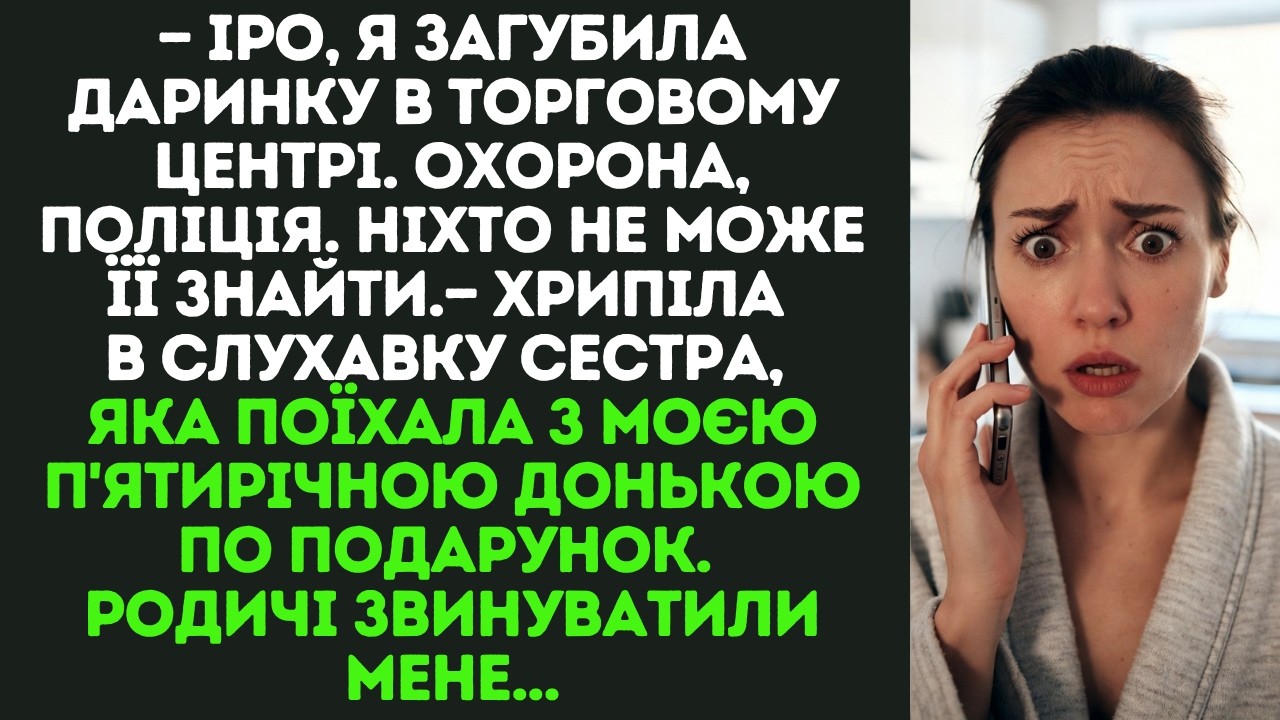
“Khrystyna, listen to me. How long were you lying to me? When did you lose her? ”
Khrystyna’s voice came apart.
“I don’t know. I don’t know. ”
Iryna stared at the black windows on the second floor. Somewhere behind them, her five-year-old daughter had been missing for hours.
And her sister still wasn’t giving her a straight answer. Iryna and Khrystyna were sisters, five years apart. Khrystyna had spent her adult life trying to figure out who she was—four jobs in two years, one failed startup, no children. She loved Daryna the way people love what’s missing in their own lives: too hard, too tense.
Three days before Daryna’s birthday, Khrystyna called, excited. “Iryna, let me take her to pick out a gift. Alone. Without you.
”
Iryna hesitated. She trusted her sister, mostly, but something in her chest always tightened when Daryna was alone with Khrystyna for more than ten minutes. Still, she said yes. One hour.
Gift only. Khrystyna arrived fifteen minutes early. She pinned a unicorn pin to Daryna’s jacket in the car, and Daryna laughed, twisting to see it in the rearview mirror. At 2:00 they walked into the mall.
At 2:40 Khrystyna looked away to answer a phone call near the toy counter. When she turned back, Daryna was gone. Then Iryna’s phone pinged: “Running late, eating ice cream, everything is fine. ” She smiled between client calls and didn’t answer.
At 3:10, when they should have been home, Iryna texted: “Where are you? ”
“Still picking the gift. Daryna can’t decide between two dolls. ”
At 4:30, annoyed: “Khrystyna, this is too much for a gift.
”
“Sorry, we stopped at the kids’ corner. She wants to play more. I’ll bring her by dinner. ”
Iryna did not know each message was typed with shaking fingers by a woman who had already been running through the mall for two hours, checking under counters and in dressing rooms.
At 5:00, Iryna was home setting the table. Another text: “Standing in line for cake, be patient. ” She showed Oleg. He shrugged.
“Khrystyna always stretches everything an hour longer. ”
At 7:00, Iryna texted sharply: “It’s late. Daryna needs to sleep. Bring her now.
” No answer. She called. The first two calls were declined. On the third, Khrystyna answered, and Iryna heard a raw, broken voice.
“Iryna. I… I lost Daryna. ”
The plate fell from Iryna’s hand and shattered on the tile.
She didn’t look down. “What do you mean you lost her? ”
Oleg looked up from his phone and went pale. At 7:50 Iryna ran into the mall.
Khrystyna was standing at the information desk, pale, mascara smeared, clutching her phone. Iryna grabbed her by the shoulder. “Where is my child? ”
“I don’t know.
I looked everywhere. I—”
“How many hours did you lie to me about ice cream and cake? ”
Khrystyna couldn’t speak. Police arrived at 10 p.
m. A young lieutenant took statements and ordered a full search—every shop, every service room, every storage closet—with security, two patrol units, and a dog. The first sweep ended at midnight. The second at 2:00 a.
m. Nothing. Iryna sat on the curb outside. Oleg stood beside her, silent, then exploded.
“How could you let her go alone with Khrystyna? You knew she’s irresponsible. ”
Iryna looked at him for a few seconds, said nothing, and walked back into the mall. At 3:00 a.
m. , unable to sit still, Iryna went to Khrystyna, who was hunched on a bench by the information desk, holding her phone like it might break. “Give it to me. ”
Khrystyna handed it over without looking up.
Iryna opened the call log to understand the timeline—how long her sister had searched alone before sending that first lie. What she found stopped her cold. The first call after Daryna disappeared was not to her. At 2:43 p.
m. , two minutes after losing Daryna, Khrystyna had called their mother, Valentina Petrivna. The call lasted eleven minutes. The first text about ice cream came after that call.
Their mother had known her granddaughter was missing five hours before Iryna did. She never called. At 4:00 a. m.
, Valentina arrived. She was composed, as if a lost child were a minor inconvenience. She hugged Khrystyna, stroked her back, and looked at Iryna with cold eyes. They sat in an empty mall café.
Valentina wrapped her hands around a paper cup of tea, not drinking. Then she spoke, not to comfort, but to blame. “You knew what Khrystyna is like. She’s not suited for children.
Why would you let your child go alone with a person who can’t even take care of herself? ”
“Mom, she lost my daughter, and you’re defending her? ”
“We’re thinking about Daryna. But you always need someone to blame instead of a solution.
”
Khrystyna said nothing. She stared at the table, shoulders trembling. Iryna walked outside and hit her car hood with her palm until it hurt, then went back inside. At 5:00 a.
m. , a police officer asked Khrystyna whether she had a history of panicking in crisis. Valentina said, “This has happened in our family before. Twenty-two years ago, Khrystyna got lost at the train station for an entire night.
I didn’t call anyone either. I searched alone. I was afraid of what people would say. ”
Khrystyna lifted her head, stunned.
“I didn’t know that. You never told me. ”
“I did. You must have been too young to remember.
We both suffered. ”
Iryna watched her mother and felt something colder than anger: a clear, flat horror. Khrystyna had repeated the exact same behavior—search alone, hide it, fear shame more than fear for the child—because that was what her mother had modeled for her twenty-two years ago. At 6:00 a.
m. , the head of mall security, a man around fifty, pulled Iryna aside, away from her mother and sister. He held a maintenance tablet. “I need to tell you something before the police report comes back.
The cameras in the west wing—the service area and the cleaning supply storage—have been down for three weeks. The repair request was never signed off. Management was cutting costs. ”
Iryna’s nails dug into her palms.
“So if she’s in there, you have no footage. ”
“No. I’m very sorry. ”
Iryna stood in the empty corridor under the dim emergency lights, thinking about how many people had stayed silent.
Khrystyna for three hours, lying about ice cream. Their mother for twenty-two years about the train station. The cameras for three weeks because someone didn’t sign a piece of paper. At 6:15 a.
m. , the security head’s phone rang. He held up his hand, listened for a few seconds, and exhaled. “Found her.
Alive. She was sleeping in the cleaning supply closet, behind the shelves with the mops. ”
Iryna didn’t remember running. She only remembered hurting her shoulder on a doorframe and not feeling it.
A cleaning woman in a blue apron had found Daryna ten minutes earlier. The girl sat with her knees pulled to her chest, wrapped in her jacket with the crooked unicorn pin. She didn’t cry when she saw her mother. She just raised her arms.
When Iryna picked her up, small fingers dug into her neck. “Mommy’s here. Mommy’s here. ”
Daryna didn’t answer.
She didn’t say a single word that morning, not to her mother, not to the paramedic who examined her. Physically, she was okay—dehydrated and chilled from the night on a cold storage floor. They went to Valentina’s apartment, the nearest place to warm Daryna up. Khrystyna walked behind everyone, arms wrapped around herself, not daring to come closer.
Oleg was silent the whole ride, staring out the window, never asking how his wife was. Iryna laid Daryna on the couch and wrapped her in a blanket. Valentina clattered cups in the kitchen, louder than necessary. Iryna went to get a clean towel from the sideboard in the hallway.
That’s when she saw the key. The one her mother always wore around her neck. It lay on the sideboard, forgotten from the night before. Iryna didn’t plan to look.
But her hand moved on its own, and the drawer opened easily. Instead of the apartment documents her mother always talked about, there was a thin folder with yellowed corners. On the cover, in blue ink: “Khrystyna. Psychological evaluation.
2004. ”
Khrystyna had been seven then. Iryna stood with a towel in one hand and the folder in the other. She heard her mother set down cups in the kitchen.
She opened it anyway. It was a child psychologist’s report, written right after the train station incident. The language was clinical. “The child is developing an anxious reaction pattern to crisis situations, caused by inconsistent adult behavior during a moment of danger.
Recommended: avoid leaving the child alone with responsibility for others under stressful conditions in the future. There is a risk of disorganized, panicked behavior instead of seeking help. ”
Iryna read the last sentence twice. “Avoid leaving the child alone with responsibility for others.
” Her mother hadn’t suspected. She had known. In writing, with a specialist’s signature, twenty-two years ago, that Khrystyna would not call for help in a crisis. She would hide the truth and run in circles.
And still, Valentina had spent years pushing Khrystyna to “practice” with Daryna, to feel needed, to prove herself. Iryna walked into the kitchen holding the folder. “Mom. What is this?
”
Valentina turned, saw it, and a cup fell from her hand, shattering on the tile. She didn’t bend to pick it up. “That’s not your business. It’s old.
It means nothing. ”
Iryna put the folder on the table, opened it to the page, slid it toward her mother. “It says here, in black and white: do not leave Khrystyna alone with responsibility for a child in a crisis. You read this.
You signed for it. And you kept pushing her to do exactly that. ”
Khrystyna walked in at that moment. She stopped in the doorway, hand on the frame.
“What does it say? ”
Iryna slid the folder toward her. Khrystyna took it with both hands, trembling so hard the paper rustled. She read slowly, moving her lips.
Then she raised her head. “Twenty-two years. You knew something was wrong with me in a crisis, and you never told me. You let me think I was just useless.
You let me think it was my fault. ”
“Khrystyna, everything I did was for you. ”
“For me? ” She stepped back, pressing the folder to her chest.
“You let me take Daryna for a whole day, knowing I could do exactly what I did. You knew. And you stayed quiet. ”
Valentina didn’t answer.
She sat down heavily, put her head in her hands. For the first time that morning, she looked like an old, lost person who understood that her silence had cost more than she could admit. Khrystyna turned and walked out. A moment later, the front door closed.
Daryna spoke for the first time four days later—not to her mother, but to the child psychologist Iryna had started taking her to twice a week. The first word was “scared. ” The second was “dark. ” She slept with a nightlight, and if Iryna left the room even for a minute, Daryna called for her in a frightened voice.
Khrystyna didn’t come to the house for three weeks. When she finally called, her voice was quieter, slower, without its usual nervous speed. “I made an appointment with a therapist. ”
Iryna didn’t know what to say.
She said okay and hung up earlier than usual. Valentina sent one message during all that time: “I didn’t want to hurt anyone. ” Iryna didn’t reply. That evening, Oleg said, “Well, now we know whose fault it is.
We can forget about it and move on. ”
Iryna looked at him for so long he put down his phone. “The first thing you did that night was ask why I let Daryna go alone with my sister. Not how she was.
Not where she was. Whose fault it was. ”
He opened his mouth, then closed it. Iryna sat by Daryna’s bed that night, watching the nightlight flicker on the wall.
She wasn’t only thinking about her mother or her sister. She was thinking about Oleg. How his first instinct in the worst night of her life was to find someone to blame. She had noticed it before.
She just hadn’t wanted to name it, because naming it would mean admitting something about her marriage she wasn’t ready to face. She didn’t know if she could forgive her mother for hiding the truth about Khrystyna, or for not telling her that Daryna was missing. She didn’t know if Khrystyna would ever become someone who calls the police in a crisis instead of running through corridors alone. She didn’t know if her marriage would survive the winter.
She knew only one thing: Daryna was sleeping beside her, breathing evenly. And tomorrow would come, and she would have to keep living with all the things she now knew.