I was stirring a pot of pasta sauce on a quiet Saturday evening when the doorbell rang. I assumed it was a delivery, maybe a neighbor. Nothing that required me to wipe my hands twice before answering. Instead, I opened the door to find a young woman standing on my porch, visibly nervous, glancing at the house number beside my door as though double-checking she had the right address.
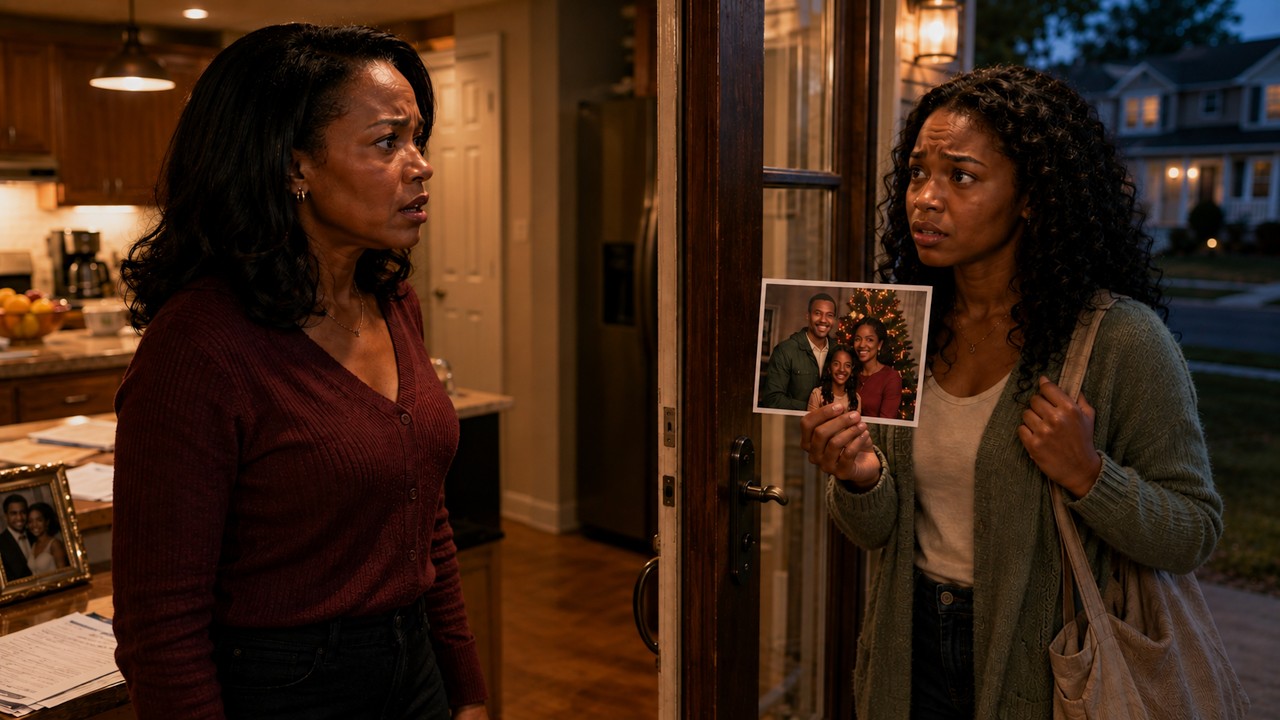
She asked if I was Sarah Bennett. I said yes. She took a breath, the kind you take right before you say something you’ve been rehearsing for days, and told me her name was Ava Williams. She said she was Daniel’s daughter.
I smiled, confused, assuming there had been some mistake. Then she said four more words that I will never forget: his other daughter. My husband had been hiding a second family for 14 years. I just didn’t know it yet.
My name is Sarah Bennett and I’m 39 years old. I work as a senior elementary school counselor outside Raleigh, North Carolina. A job I’ve dedicated the better part of 15 years to, spending my days helping children navigate everything from playground conflicts to far more serious situations at home that no child that age should have to carry alone. I’ve always thought of myself as someone with a fairly reliable read on people, someone who notices the small signs when something isn’t quite right.
It’s strange in hindsight that the one place I failed to notice those signs was inside my own marriage. I need to say clearly before I tell you the rest of this story that I don’t think of myself as foolish for not seeing what was happening. I’ve turned that question over more times than I can count in the months since Ava first appeared on my porch, wondering whether I simply chose not to look or whether Daniel was genuinely remarkably skilled at making sure I never had reason to. I’ve come to believe it’s the second one, but I understand why people hear a story like mine and wonder how someone could possibly not know.
Daniel and I had been married for 14 years by the time Ava knocked on my porch. He works as a regional pharmaceutical sales executive, a career that has always required significant travel, weeks at a time, sometimes driving between hospital systems and physician offices spread across half the Southeast. Publicly, he’s exactly the kind of person people describe as a catch. Charming without being showy about it, successful in a way that felt earned rather than flashy.
Generous with his time and his money. The kind of man who remembered the names of his colleagues’ children, who tipped well, who made everyone in a room feel like he was genuinely glad to be talking to them. I want to be honest about something else, too. My biggest flaw, if I’m asked to name one clearly, has always been a tendency to give people more benefit of the doubt than the situation sometimes warranted.
It’s part of what makes me good at my job, honestly. The ability to see the reasonable explanation behind someone’s difficult behavior rather than assuming the worst. For years, that same instinct served my marriage well, or at least I believed it did. I’ve come to understand more recently that the same quality that makes me good at helping frightened seven-year-olds feel safe also made me remarkably easy to deceive if the person doing the deceiving understood exactly which explanations I was inclined to accept without much question.
Our marriage from the outside and from most angles on the inside as well looked genuinely happy. Daniel remembered our anniversary every year without needing a reminder, usually surprising me with something thoughtful rather than expensive. A weekend trip to a bed and breakfast we’d both loved. A first edition of a book by an author I mentioned loving months earlier.
When he traveled for work, he called me every single night without fail. Sometimes just for a few minutes to say good night, sometimes for longer conversations about our days. He sent flowers on days that had no particular significance at all, just as he’d say because he was thinking of me. I share all of this because I need you to understand that I wasn’t living inside some obviously broken marriage, waiting for a single dramatic confrontation to finally reveal what everyone else could already see.
I was living inside what felt most days like a genuinely good partnership. Looking back now though, there were details, small inconsistencies scattered across those 14 years that I explained away so easily at the time that I barely remembered noticing them as anything unusual until Ava’s visit forced me to go back through my memory and examine each one properly. There was the second phone, for instance, a separate device from the one he used for our daily calls and texts, which he explained as a work necessity, something his company required for compliance reasons related to handling sensitive account information. It sounded entirely plausible.
Pharmaceutical sales, as far as I understood it, did involve a fair amount of regulatory paperwork, and I had no particular reason to question something that fit so neatly into the world he described to me for years. There was also a specific weekend, the same weekend every single year, that Daniel always took off for what he called the Williams account, a client relationship, he explained, that required an annual in-person visit to maintain. I never thought much of it. Businesses have annual obligations.
I had my own recurring conferences for school counselors that pulled me away for a weekend here and there. And it never occurred to me to question why his particular weekend never moved year after year, always falling around the same time in late spring. At one point, several years into our marriage, I noticed a recurring payment on one of our shared financial statements. A modest but consistent amount sent monthly to a woman’s name that meant nothing to me.
When I asked Daniel about it, he explained easily and without hesitation that she was a longtime client, someone he’d helped set up a payment plan for a product his company distributed. Nothing unusual in an industry where relationships with certain accounts sometimes required this kind of flexibility. I remember accepting the explanation, filing it away, and genuinely not thinking about it again for years. There was a particular city, too, one Daniel traveled to somewhat regularly for work, that he always discouraged me from visiting alongside him, even when I occasionally suggested turning one of his business trips into a small getaway for the two of us.
“There’s really nothing there,” he’d say, just office parks and highway exits. “You’d be bored the whole time. ” I believed him. I had no reason not to.
And then there was a single moment years before Ava’s visit that I still think about more than almost any other. We were lying in bed one night, half asleep, and Daniel murmured something into the dark. A name clearly said with warmth, clearly not meant for my ears. Ava, he said softly.
The way you say a name you love. Then he caught himself, went quiet, and I asked, half joking, half genuinely curious, who Ava was. He paused just a beat too long before answering. “A client,” he said.
“New account. Sorry, work’s been on my mind. ” I remember believing him completely. That’s the real tragedy at the center of this story, more than any single lie Daniel told.
It’s how completely, how easily I believed every single explanation because I had built my entire understanding of our marriage on the assumption that he had no reason to deceive me. Which brings us back to that Saturday evening, to the young woman standing nervously on my porch, glancing at the house number as though checking it against something written on a slip of paper in her pocket. “How old are you? ” I asked her once the initial shock of her introduction had settled enough for me to form a coherent question.
“19,” she said. I did the math almost automatically, the way you do when a number suddenly matters more than it ever has before. Daniel and I had been married for 14 years. If Ava was 19, she would have been born 5 years before our wedding.
For a brief strange moment, something almost like relief passed through me. Maybe, I thought, Daniel had a child before we met, someone he’d simply never told me about. A painful omission certainly, but not the kind of active ongoing deception her words seemed to be suggesting. “Why did you come here?
” I asked her. Ava’s answer landed heavier than I expected. “Because my mother finally told me the truth,” she said. She reached into the bag she was carrying and pulled out a photograph, holding it out toward me with a hand that wasn’t entirely steady.
I took it, and the moment I looked down at the image, I felt something in my chest go completely still. It was a Christmas photo. Daniel standing in front of a decorated tree I didn’t recognize, his arm around a woman I’d never seen before. Ava beside them, all three smiling in that easy, familiar way people smile in photos taken inside homes they know well.
Homes that feel like theirs. I recognized Daniel’s jacket immediately, a dark green one I’d given him for his birthday only a year and a half earlier. I recognized the watch on his wrist, the one I’d had engraved for our 10th anniversary. The date stamped in the corner of the photograph was only 6 months old.
My hands started shaking before I fully understood why. “Does your father have another wife? ” I heard myself ask, the question coming out before I’d fully thought through what I was actually asking. Ava looked at me with genuine confusion.
“You mean you? ” she said. The silence that followed felt like it lasted much longer than it probably actually did. I invited her inside, mostly because I didn’t think either of us should be standing on a porch when the rest of this conversation happened.
We sat at my kitchen table, the same table where Daniel and I had eaten dinner together only the night before, and Ava told me everything she knew, carefully, and I could tell with real difficulty, watching my face after nearly every sentence, as though checking whether she should keep going. Daniel hadn’t simply had an affair that resulted in a child he’d hidden from me for 19 years. Devastating as that alone would have been, he had maintained an entire second household. An ongoing relationship with Ava’s mother, Rachel, that had continued alongside our marriage for the entire duration.
He had paid their rent for years. He attended Ava’s birthdays, every single one she could remember, showing up with presents and staying long enough to sing along, blowing out candles, being by every account Ava gave me a present and involved father in that household, not an absent one. He had taken vacations with them, small trips during weekends I had believed were work obligations or golf trips with colleagues. He had supported Ava financially through school, helped her move into her college dorm the previous fall, had what Ava described as a genuinely warm, close relationship with her, one built over 19 years of consistent presence rather than sporadic, guilt-driven visits.
That detail there, more than almost anything else Ava told me that evening, is what broke something loose in me that I don’t think ever fully settled back into place. Daniel hadn’t simply been hiding a mistake from years earlier, some brief lapse he’d managed to keep buried. He had constructed and carefully maintained an entire second life, present and functioning and full of genuine relationships running in parallel to the one he’d built with me for the entire length of our marriage. I didn’t confront Daniel that night, though every instinct in me wanted to.
I’ve thought about why in the days and weeks since, and I think the honest answer is that some part of me still needed to understand the full shape of what I was dealing with before I could face him directly. I’ve spent my career teaching children the importance of gathering the full picture before reacting to something painful. It felt strangely like the only useful instinct I had left in that moment. I asked Ava if she would be willing to stay a little longer that first night, not because I needed her to convince me further, but because some part of me simply didn’t want to be alone with what I just learned.
We sat together at that kitchen table for nearly two more hours, long after the pasta sauce had gone cold and forgotten on the stove behind us. She told me about her childhood, carefully watching my reactions as she went, describing a father who showed up for piano recitals and school science fairs, who taught her to drive in an empty parking lot on Sunday mornings, who called her every week, even during the stretches when his visits grew less frequent. Every detail she offered landed like a small separate wound. Not because any of it was cruel in its own right, but because I recognized with a growing, sickening clarity that these were the exact same small rituals Daniel had shared with me.
The same patience teaching someone to parallel park. The same habit of calling just to check in on an ordinary Tuesday. He hadn’t simply divided his time between two households. He apparently, without much difficulty, built two nearly identical versions of fatherhood and partnership, offering each of us a complete convincing copy of the same devotion.
Before Ava left that night, she asked if she could give me her phone number in case I had questions later, in case I needed anything clarified once the shock had settled enough for me to think clearly. I remember standing in my doorway watching her walk to her car, this young woman I’d known for only a few hours who had upended everything I understood about my own marriage, and feeling strangely no anger toward her at all, only toward the man who had made her necessary in the first place. Over the following week, working quietly and mostly late at night after Daniel had gone to sleep, I went back through years of our shared financial records, credit card statements, old calendar entries, email archives I hadn’t opened in years. What I found piece by piece confirmed and then expanded everything Ava had told me.
Daniel had been paying for a second apartment, separate from the modest rental Ava had described, for 11 years. A monthly payment disguised within our finances under a category I’d always assumed was related to his business expenses. Hotel reservations that I believed were tied to legitimate work trips lined up again and again with the exact dates Ava mentioned for family vacations, birthdays, school events. Calendar entries labeled with client initials that, once I cross-referenced them against Ava’s timeline, clearly corresponded to milestones in her life rather than any business account.
I want to be clear about something because I think it matters for understanding the specific shape of this betrayal. This wasn’t a secret affair conducted furtively during stolen weekends, the kind of thing that, as devastating as it would have been, at least fits a familiar shape. Daniel had built and sustained an entire second household, complete with its own rhythms and relationships and history, running invisibly alongside the life he shared with me for the entire 14 years of our marriage. I remember sitting alone in my car outside our bank’s branch office, a folder of printed statements on the passenger seat beside me, trying to understand how a person manages this kind of arrangement logistically for over a decade without a single seam ever showing.
I’d always assumed, the way most people probably do, that a secret this large would eventually collapse under its own weight, that the sheer difficulty of maintaining two separate calendars, two separate sets of birthdays and anniversaries and holidays, would eventually produce some obvious contradiction I couldn’t have missed. What I came to understand instead, going through year after year of overlapping dates, was that Daniel hadn’t been careless at all. He’d been remarkably disciplined about it, treating the maintenance of both households with the same methodical attention he brought to his sales territories at work, tracking obligations, anticipating conflicts before they arose, adjusting travel schedules months in advance to avoid any dates that might create suspicion on either side. It wasn’t an accident that I never caught him.
It was the product of years of careful, deliberate planning, and understanding that made the betrayal feel, if anything, even more calculated than I had initially believed. When Daniel came home the following Tuesday evening, I was sitting at the kitchen table, the photograph Ava had given me placed face up in front of the chair where he always sat. I didn’t raise my voice when he walked in. I didn’t want this conversation to become something either of us could later frame as an emotional overreaction rather than what it actually was.
I asked him, as he set down his bag near the door, “Who is Ava? ”
I watched his entire body change. He froze just for a moment, his expression shifting through something I’d never seen on his face before. A kind of controlled panic that told me more clearly than any words could have exactly how much he already understood about what this conversation was going to be.
I slid the photograph across the table. “Who is Rachel? ” I asked. He didn’t answer right away.
I let the silence sit between us for as long as it needed. “How long? ” I finally asked. He tried at first to soften what he was about to admit, the way I imagine people do when they’ve had years to rehearse various versions of this conversation in their head without ever actually expecting to have it.
“It’s complicated,” he said. “No,” I told him, my voice steadier than I felt. “It’s actually very simple. You had another family.
”
He didn’t deny it after that. He couldn’t. Not with the photograph sitting between us, not with whatever he could see in my face making clear that I already knew more than he might have hoped. What he did instead was try to minimize the shape of it.
The way people sometimes reach for smaller words when they’re afraid of the larger truth. “I loved you both,” he said, as though that single sentence could somehow soften 14 years of careful, deliberate deception. “Then why did you lie to both of us? ” I asked.
He didn’t have an answer for that. I don’t think honestly he’d ever expected to need one. Over the following days, as I pushed for a fuller understanding of what had actually happened, a detail emerged that reframed the entire situation for me, one that Ava herself hadn’t fully known until recently either. Years earlier, Daniel had made a promise to Rachel: a promise that once Ava graduated high school, once she was settled and old enough to not be as disrupted by a major family change, he would finally leave me and build an honest, unified life with the two of them.
Ava had graduated high school the previous spring. Daniel hadn’t left. He’d simply continued exactly as he had for years before, splitting his time and his loyalty between two households, offering the same reassurances to both, apparently believing with a level of confidence I still find difficult to fully comprehend that this arrangement could continue indefinitely without anyone demanding it end. It was that broken promise, more than anything else, that had finally pushed Rachel to tell Ava the truth.
Rachel had spent years believing, or at least hoping, that Daniel’s plan was real, that there was an end point coming, some future in which her relationship with him would finally be allowed to exist openly instead of in careful secrecy. When Ava’s graduation came and went, with nothing changing, Rachel understood finally and completely that the promise had never been anything more than a way to keep her patient. This detail matters, I think, because it reframes Ava’s visit to my door in a way that changed how I felt about her almost immediately. She hadn’t come to expose Daniel out of anger or to disrupt my life out of some desire to finally claim her place in it.
She came because she too had spent her entire life being lied to, told a story about an absent, complicated father who traveled too much for work to be as present as he wished he could be. When the truth was that he had simply been dividing himself between two families, offering each one a version of presence carefully calibrated to keep the whole arrangement from collapsing. Ava wasn’t a villain in this story, and she wasn’t a weapon someone had aimed at my marriage. She was, in a very real sense, a mirror.
Both of us had been deceived by the same man in remarkably similar ways, each of us believing we understood our own family clearly while an entire second reality existed just outside our view. Several weeks after that first conversation with Daniel, I finally met Rachel in person at a small coffee shop we both agreed on, neutral ground that neither of us had any particular history with. I want to be honest that I approached that meeting expecting something closer to hostility, some version of the dramatic confrontation these situations are so often portrayed as demanding. What actually happened was quieter and, in its own way, harder to sit through than shouting would have been.
She arrived a few minutes before I did, already seated at a corner table. And I remember being struck in that first moment of seeing her by how ordinary she looked. Not in an unkind sense. I think some part of me had spent weeks unconsciously building her into something larger than life, a rival, a mystery, the other woman in a story I was still struggling to fully believe was my own.
Instead, I found a tired, guarded woman roughly my own age, turning a coffee cup slowly between her hands, who looked, if anything, just as uncertain about this meeting as I felt. “I hated you for years,” Rachel told me early in our conversation, her voice carrying more exhaustion than anger. “Why? ” I asked, genuinely wanting to understand.
“Because he told me you were the reason he couldn’t leave. That you wouldn’t survive a divorce, that you needed him too much, that leaving would destroy you completely, and that he just needed more time before he could do it without ruining your life. ”
I asked her gently how she’d first found out about me, curious whether her discovery had unfolded anything like mine had. She told me she’d known about my existence almost from the beginning, that Daniel had never hidden the fact of our marriage from her the way he’d hidden her existence from me.
What she hadn’t known for years was the full texture of it, how deeply involved he still was in my life, how far from “complicated but distant” our actual marriage really was. She’d built her own version of me in her mind, too, she admitted, someone she’d imagined as cold or absent or somehow deserving of being left behind because that was the story Daniel needed her to believe in order for his arrangement to keep functioning. “I don’t think either of us actually knew who the other one was,” she said at one point. And I remember thinking that was probably the truest thing either of us said that entire afternoon.
I sat with that for a long moment, understanding with a kind of sick clarity exactly what Daniel had done. He had told Rachel that I was too fragile to survive without him, using my supposed dependency as the justification for staying in our marriage while continuing his relationship with her on the side. And I understood without needing to ask that he had almost certainly told me some parallel version of a lie about her, describing Rachel as simply a complicated part of his past, someone he still felt obligated to support, but had no real ongoing relationship with beyond old loyalty. Both of us had been fed carefully different versions of the same fundamental lie.
Each one constructed specifically to keep us both patient, both reasonably content, both unlikely to ask the kinds of questions that might have unraveled everything years earlier. Daniel hadn’t simply been unfaithful. He had spent 14 years actively managing two separate realities, telling each of us exactly what we needed to hear to keep believing his version of events. The professional consequences, when they eventually arrived, came without any effort on my part to orchestrate them.
Daniel had a company awards dinner scheduled a few months after Ava’s initial visit, an event he’d been anticipating for most of the year, expecting it to include the announcement of a major promotion he’d been working toward. I had no intention of attending, and I certainly wasn’t looking for any dramatic public reckoning to unfold there. But in the process of untangling our shared finances during those difficult weeks, I discovered that Daniel had been using company travel accounts and expense reports to help fund portions of his second household, submitting certain trips and expenses as client-related business travel when they had actually been visits to Rachel and Ava. I didn’t report this to his employer.
I want to be clear about that because I think it matters. What happened instead was simply the natural result of an internal audit his company had already begun conducting for unrelated compliance reasons. An audit that, once it started examining his expense patterns more closely, uncovered exactly the kind of irregularities that any competent review would eventually find. His promotion was quietly withdrawn.
Questions began circulating among his colleagues about the discrepancies in his travel records. None of this happened because I sought revenge. It happened because the structure Daniel had built to sustain his second life for so many years had always depended on nobody looking too closely. And once people finally did, for entirely unrelated reasons, it simply couldn’t hold up under that scrutiny.
Daniel lost the promotion. He lost the reputation he’d carefully built within his company over more than a decade. He lost his marriage once I filed for divorce a few weeks after our confrontation. He lost Rachel’s trust as well, once she understood alongside me the full extent of how completely he had managed and manipulated both of us.
He lost Ava’s trust, or at least a significant portion of it, though she has told me since that she still loves him in the complicated, layered way children often continue to love parents who have deeply disappointed them. He lost several friendships along the way, too. People who had known him for years and found themselves, once the full story became clear, unable to look past what he’d done to two entire families for so long. None of this happened overnight, and none of it happened through any dramatic act of destruction on my part.
I didn’t try to financially ruin him during the divorce, despite having every legal ground to pursue a far more aggressive settlement than I ultimately did. I simply stopped protecting him. I stopped covering for the inconsistencies I’d spent years quietly explaining away. I stopped offering him the benefit of the doubt that had allowed this entire arrangement to continue undetected for so long.
Once that protection was gone, the rest of the consequences arrived on their own, gradually, exactly the way consequences tend to when they’re finally allowed to catch up with someone. I want to mention too that the divorce process itself brought its own quiet difficulties that had little to do with Daniel directly. Several mutual friends struggled initially to know how to respond, some of them defaulting to an awkward neutrality that felt, in its own way, almost as painful as outright taking his side would have been. A few reached out only to Daniel in those early weeks, apparently uncertain how to approach me, or perhaps simply more comfortable maintaining the version of our marriage they’d always known rather than confronting what had actually happened underneath it.
I understood eventually that this wasn’t really about loyalty to him so much as it was about the discomfort people feel when a story this complicated doesn’t fit into any of the familiar shapes they know how to respond to. A few of those friendships never fully recovered. Others surprised me. People I hadn’t been especially close to before who showed up consistently once they understood what I was actually navigating, bringing dinner on nights I clearly hadn’t eaten, sitting with me through the parts of the divorce process that required more patience than I had left to offer myself.
The relationship I’ve built with Ava since that first difficult evening has become unexpectedly one of the more meaningful parts of my life since the divorce. We aren’t mother and daughter, and I don’t think either one of us has ever tried to force that particular framing onto what we have. But we share something unusual, a specific, particular understanding of what it feels like to have been lied to by the same person in remarkably similar ways. Over the past year, we’ve developed small rituals of our own: an occasional Sunday morning coffee, text messages about nothing in particular.
The kind of low-stakes, ordinary connection that in its own quiet way has become one of the more unexpected comforts to come out of everything. “I’m sorry I brought this to your door,” Ava told me once several months after that first visit, sitting across from me at the same kitchen table where I’d first confronted Daniel. “I didn’t break your marriage,” I told her. “He did.
”
I meant it completely. Ava didn’t create the lie that shaped 14 years of my life. She simply stopped being willing to keep living inside it herself. And in doing so, she gave me the chance to stop living inside it, too.
In the months since, my life has settled into something quieter and honestly more peaceful than I expected it could feel this soon after everything fell apart. I moved into a smaller home closer to the school where I work, filled with furniture and small decisions that reflect exactly what I want without needing to account for anyone else’s preferences. I started traveling again. Small trips at first, a weekend in Charleston with an old college friend.
Then longer ones, a solo trip to the coast of Maine that I talked about taking for years without ever quite finding the time. Work, too, became a kind of quiet anchor during that period in a way I hadn’t fully expected. I found myself more than once sitting across from a child at school who was navigating their own confusing family situation, a divorce, a parent who’d moved away, a household reshaping itself into something unfamiliar, and recognizing with a strange kind of clarity how much more genuinely I understood what I was helping them process. I’ve always cared deeply for my students, but there was a difference after everything with Daniel, and how directly I could sit with a child’s confusion without needing to reach for language I hadn’t fully lived myself.
One of my colleagues mentioned gently that she’d noticed a change in how I approached certain conversations with students that fall. More patience, she said, more willingness to simply let a child’s confusion exist in the room without rushing to resolve it. I hadn’t set out to become better at my job because of what happened, but I think in some quiet way I did. I spend more time now with the friends who showed up for me during those difficult early weeks.
The ones who sat with me on my kitchen floor when I couldn’t fully process what had happened, who didn’t need me to explain every detail before offering their support. I’ve stopped, somewhere along the way, checking Daniel’s location or wondering where he might actually be during any given evening, a habit I didn’t even fully realize I’d developed until I noticed with some relief that I’d finally stopped doing it. I sleep peacefully now in a way I hadn’t fully realized I wasn’t sleeping before. Ava visits occasionally, usually every month or so.
Sometimes just for coffee, sometimes for longer conversations that range across everything from her classes to her complicated ongoing relationship with her father. I attended her college graduation last spring, sitting a respectful distance from where Daniel sat with Rachel, and I want to be honest that I expected the day to feel strange, possibly even painful. Instead, I found I simply felt proud of her, genuinely and without complication. The way you feel proud of someone you’ve come to care about entirely apart from whatever tangled history originally connected you.
For 14 years, I thought the worst thing my husband did was lie to me about small, isolated things. A client here, a work trip there. Small inconsistencies I always managed to explain away before they added up to anything larger. I was wrong.
The worst thing Daniel did wasn’t any single lie. It was convincing me for all those years that I had to compete with a woman who didn’t even know she was competing with me while simultaneously convincing her that she was competing with someone equally unaware of the arrangement he’d built around both of us. Ava didn’t knock on my door to destroy my marriage. She knocked because she needed the truth after 19 years of being given a carefully incomplete version of her own life.
And sometimes, I’ve come to understand, the truth arrives at your doorstep wearing the face of someone you never expected to meet. Someone who turns out to be less an intruder into your life than a fellow traveler through the same deception, arriving finally to help you both find your way out of it together. I learned through all of this that betrayal doesn’t always arrive with a dramatic confession, some tearful admission delivered by the person who actually did the deceiving. Sometimes it arrives quietly, rings your doorbell on an ordinary Saturday evening, and simply asks you to finally look clearly and completely at the life you thought you already knew.
But once the truth is finally out in the open, however it arrives, you get to decide what happens next. If someone had told me, a year before Ava first appeared on my porch, that I would one day sit comfortably in a graduation crowd beside the woman my husband had built a second life with, watching his other daughter cross a stage while he sat several rows away, I don’t think I would have believed that version of the story could ever feel peaceful rather than painful. But it did. By then, none of us were living inside his carefully separate versions of events anymore.
We were simply three people, finally free of the stories he told each of us for so long, sitting in the same sunlight, watching a young woman none of us needed to compete over begin the next chapter of a life that, for the first time in a very long while, belongs entirely honestly to her. And for the first time in a very long while, I finally feel like the life I’m building belongs entirely honestly to me.