Two weeks before my wedding, my fiancé stood in front of his best friends and said something I will never forget. “Don’t bother congratulating us,” he said, smiling like it was a joke. “This marriage is temporary. Save your wishes for when Chloe and I actually get married.
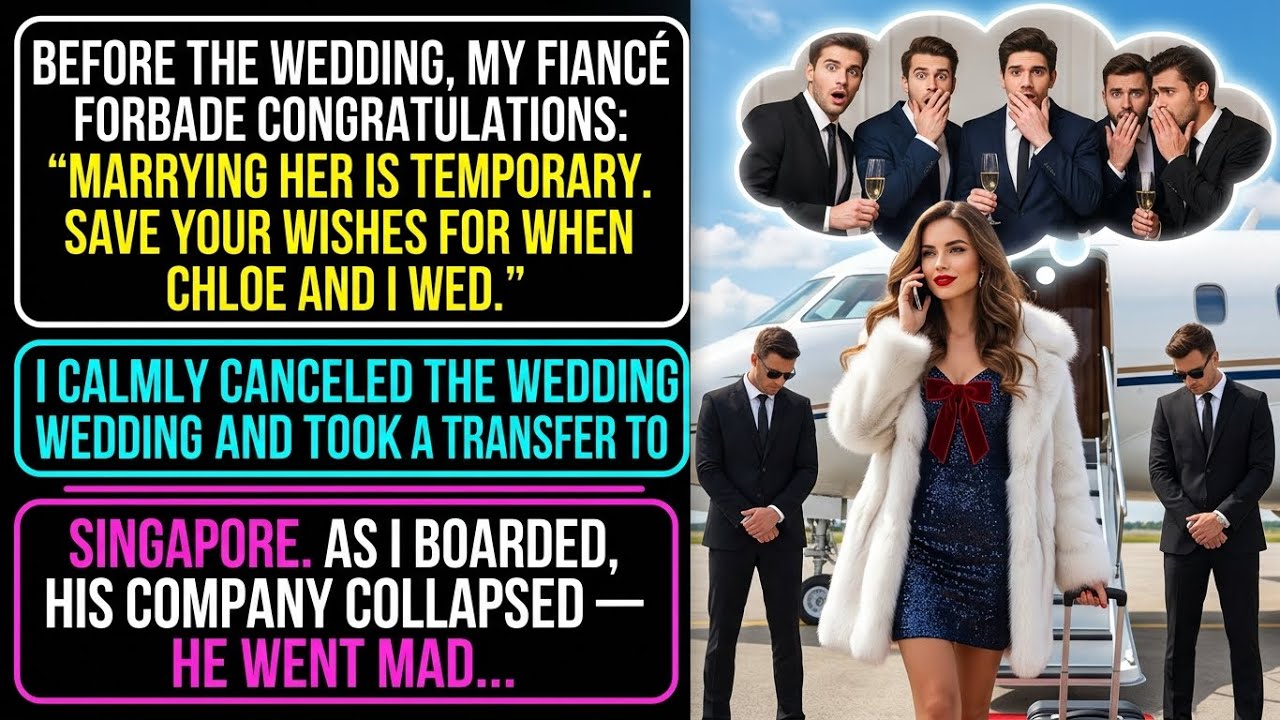
”
The room went silent. Glasses stopped halfway to lips. And I was standing right there, holding a tray of champagne, wearing the engagement ring he had given me four months earlier. He didn’t whisper it.
He said it loud enough for me to hear. I didn’t drop the tray. I didn’t cry. I didn’t scream his name across the room like people expect in these moments.
I just stood there for a few seconds, feeling something inside me go completely still and completely clear at the same time. I set the tray down on the nearest table, walked to the coat rack, took my jacket, and left the restaurant without saying a single word. He didn’t even notice I was gone until 40 minutes later. My name is Elena, and this is how one sentence ended an engagement, ended a company, and ended a man’s entire future without me ever raising my voice.
Three years ago, I met Daniel at a business conference in New York. He was charming, ambitious, the kind of man who filled a room just by walking into it. He ran a growing logistics company his father had built, and I worked in international trade. We understood each other’s world, or so I thought.
He proposed on a rooftop in the spring, surrounded by candles his assistant had arranged. I said yes without hesitation. My family loved him. My friends loved him.
Even my mother, who trusted almost no one, told me I had found a good one. For two years, everything looked perfect from the outside. But there was one thing I never questioned closely enough: Chloe. Chloe was his father’s business partner’s daughter.
Beautiful, well-connected, from a family that could open doors Daniel’s own father never could. She was always just a friend, always just business, always somehow present at every important event in Daniel’s life. I told myself it was nothing. I told myself I was being insecure.
I told myself a lot of things that, looking back now, I already knew weren’t true. There were signals I chose to ignore. Daniel would take calls from Chloe late at night and step outside to answer them. He’d say it was work.
He’d get quiet whenever her name came up, then quickly change the subject. Once, I found a message on his laptop screen—just a notification, nothing more—that said, “Can’t wait until this wedding thing is over. ”
I asked him about it. He laughed it off.
He said it was a joke between old friends, that I was overthinking things, that I needed to trust him more. So I did. I trusted him more. I stopped asking questions.
I planned our wedding, sent the invitations, picked the flowers, tried on the dress three times until it was perfect. I didn’t know that while I was building a future, he was already planning an exit. The night it happened was supposed to be a simple engagement dinner. Close friends, a private room at his favorite restaurant, warm lighting, easy laughter.
I had just come back from the kitchen with a tray of drinks when I heard him talking to his groomsmen. “Don’t bother congratulating us,” he said, raising his glass with a grin. “This marriage is temporary. Save your wishes for when Chloe and I actually get married.
”
The men around him laughed nervously. A couple of them glanced toward me, then quickly looked away. Someone tried to change the subject. Daniel didn’t notice me standing there, or maybe he did, and he simply didn’t care.
That night, I didn’t cry myself to sleep. I didn’t call my mother to vent. I sat at my kitchen table with a cup of tea that went cold, and I made a decision. I wasn’t going to fight for a man who had already decided I wasn’t worth fighting for.
I wasn’t going to beg, threaten, or demand an explanation. I was simply going to remove myself from a story that was never really about me in the first place. The next morning, Daniel called 17 times. He showed up at my apartment, insisting it was a joke that went too far, that I was twisting his words, that Chloe meant nothing to him.
I let him talk. I didn’t argue. I didn’t cry in front of him. I simply told him the wedding was canceled and closed the door.
What he didn’t know was that I already had a plan forming. Not a plan for revenge—not yet. A plan for myself. Two months before all of this happened, my company had offered me a leadership position at our new branch in Singapore.
I had turned it down because I didn’t want to leave Daniel behind. That night, sitting alone in my apartment, I opened my email and wrote back a single line: “I accept the position. I can be there within 3 weeks. ”
My manager replied within the hour, thrilled.
I spent the next several days quietly closing my life in a way no one around me even noticed. I returned the wedding dress. I canceled the venue. I gave away furniture, sold my car, and told my landlord I wouldn’t be renewing my lease.
Daniel kept calling, kept apologizing, kept insisting that Chloe was just a friend and that his words had been misunderstood. I stopped answering after the tenth call. The day I boarded my flight to Singapore, I felt something I hadn’t felt in months: lightness. As the plane lifted off the ground, I looked out the window at the city shrinking beneath me, and for the first time in a long time, I smiled without forcing it.
I had no idea that back on the ground, Daniel’s entire world was about to fall apart. What I didn’t know—what I only found out weeks later through old mutual friends—was that Daniel’s company had been quietly struggling for almost a year. His father’s biggest client, the one that supplied nearly half their contracts, was owned by Chloe’s family. And it turned out that client had only stayed loyal to Daniel’s company because of the expected marriage between Daniel and Chloe.
A business alliance disguised as young love. When word got out that Daniel had humiliated his fiancée in public, and that the wedding to Chloe never actually happened either—because Chloe herself was disgusted by what he’d said and done—the client pulled out entirely. Other partners, sensing instability, followed. Within 6 weeks of my leaving, Daniel’s company lost three major contracts.
Within 3 months, it filed for restructuring. His father, humiliated and furious, publicly blamed Daniel for destroying everything he had spent 30 years building. Daniel didn’t just lose me. He lost the woman he thought would replace me.
He lost his company. And he lost the respect of everyone who once admired him. The messages started coming again months later. Long, desperate texts at strange hours.
Emails with subject lines like, “Please, just let me explain. ” A voicemail where his voice cracked as he admitted he had made the worst mistake of his life. He told me Chloe had walked away from him the moment she realized what kind of man he really was. Someone willing to humiliate the woman standing right in front of him just to keep business connections happy.
He told me the company was gone. That his father barely spoke to him anymore. That he was staying in a small rented apartment far from the penthouse we once dreamed of sharing. I read every message.
I listened to every voicemail. And then, calmly, I did something I never thought I would have the strength to do. I blocked his number. Not out of hatred, not out of cruelty, but because I finally understood that closure doesn’t come from someone else’s apology.
It comes from choosing peace, even when the other person is still drowning in the consequences of their own choices. Singapore gave me something Daniel never could: a fresh start built entirely on my own terms. Within a year, I was promoted to regional director. I built a small circle of genuine friends who valued me without knowing anything about my past.
I traveled to places I had only dreamed about. I learned to enjoy dinners alone, mornings without checking someone else’s mood, decisions that were entirely mine to make. I won’t pretend it was easy. There were nights I still felt the sting of humiliation from that dinner.
The memory of his voice saying “temporary” while I stood there holding a tray of champagne. But every time that memory surfaced, I reminded myself of one simple truth: he revealed exactly who he was in front of witnesses before I made the mistake of marrying him. That wasn’t a tragedy. That was a gift wrapped in humiliation, but a gift nonetheless.
The version of me who boarded that plane to Singapore was broken in a quiet, contained way. The version of me standing here now, two years later, is not. I saw Daniel one more time, 18 months after that dinner. I had flown back for a cousin’s wedding, and by pure chance, he was there too, invited by a mutual acquaintance who didn’t know our full history.
He looked older than I remembered. Tired. The confidence that once filled every room he entered was gone, replaced by something smaller, quieter. He approached me carefully, almost afraid.
“You look happy,” he said. “I am,” I told him. And I meant it completely. He tried to apologize again, right there in that hallway, his voice low and careful.
I let him finish this time. Then I said the only thing that felt true:
“You didn’t destroy me that night, Daniel. You freed me. I hope one day you understand the difference.
”
I didn’t wait for his response. I walked back into the wedding, back to my life, and I never looked back. Today, Daniel works a modest position at a company that isn’t his own. His father’s business was eventually sold to cover its debts.
Chloe married someone else entirely, someone who never once treated her as a business arrangement. And me? I’m still in Singapore, still building the career and the life I once thought I had to sacrifice for love. I met someone new eventually.
Someone who has never once made me feel like an inconvenience, a placeholder, or a temporary arrangement. Every time I think back to that dinner, to the tray of champagne, to his voice saying those words in front of everyone, I don’t feel anger anymore. I feel gratitude, because he showed me his true self before I said “I do. ”
And walking away that night wasn’t weakness.
It was the strongest decision I ever made. If someone shows you who they really are—even once, even briefly—believe them. Don’t wait for a second humiliation to confirm what the first one already proved. Sometimes the bravest thing you can do isn’t to fight, scream, or demand answers.
Sometimes it’s to quietly close the door, pack your bags, and choose yourself. Because the people who truly value you will never make you feel temporary. And the ones who do? They don’t deserve your tears.
They deserve your silence, your distance, and eventually your peace. If you’ve ever had to walk away from someone who made you feel small, remember this: leaving isn’t losing. Sometimes, it’s the beginning of everything you were always meant to have.