The first sound I heard after surgery wasn’t a nurse’s greeting or the beep of a monitor. It was my daughter’s voice, coming through the phone the doctor held. “Oops, old hag is dead. She won’t survive after the surgery.
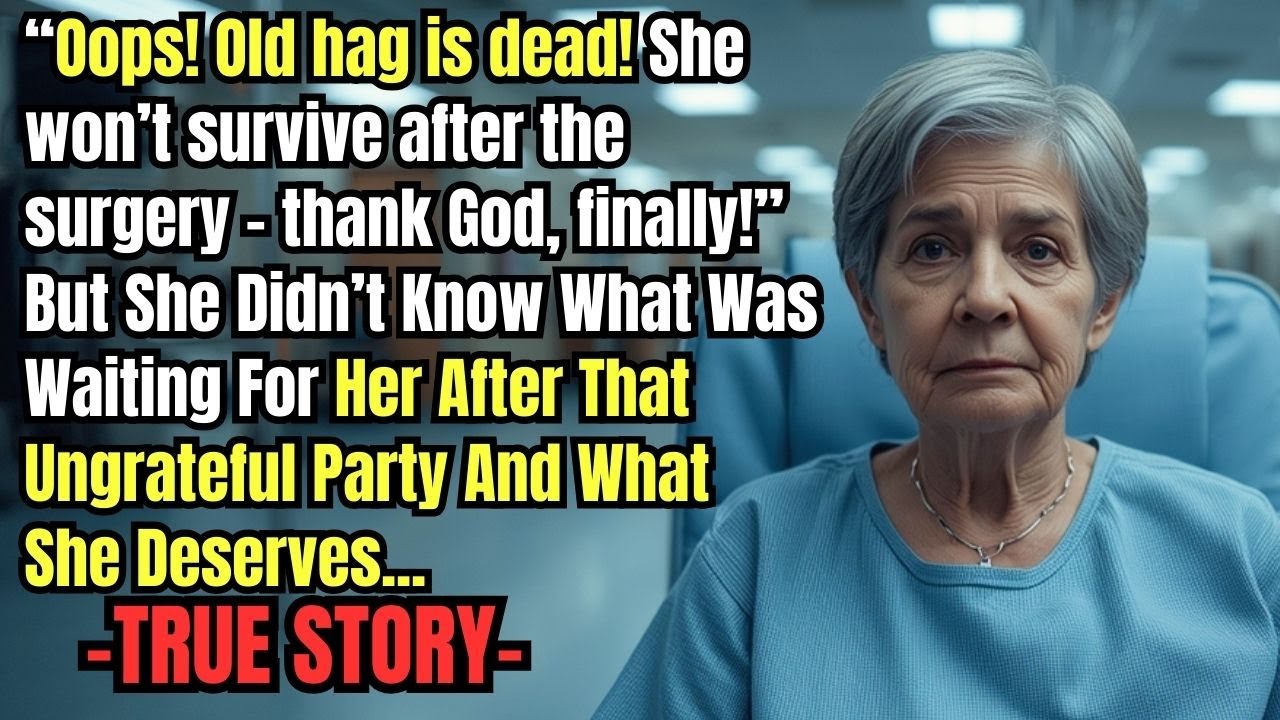
Thank God. Finally. ”
I was still trapped under the weight of anesthesia, my chest torn open and stitched back together. I couldn’t move.
I couldn’t speak. But I could hear everything. Melissa’s voice was full of relief, triumph, and something crueler than hatred. She was laughing.
Around her, I could hear the noise of a party, music, clinking glasses, voices raised in celebration. Dr. Aaron Whitlock held the phone close to my bed. I could feel the tension in his voice as he spoke to someone on the other end.
“She said it exactly like this,” he said. “And they’re celebrating right now. They’re drinking and laughing while she is lying here barely breathing. ”
I felt a tear slide down my face.
He saw it. He leaned over me, his face close to mine, his voice barely a whisper. “Ma’am, can you hear me? ”
I blinked.
Once. Slowly. His jaw tightened. “They think you’re gone, but you’re not,” he said.
“And I swear to you, Ramona, we will make this right. ”
I should have been surprised by my daughter’s cruelty. But I wasn’t. Not truly.
Mothers know their children, even the ones who stop loving them. The hatred between us didn’t happen overnight. It grew quietly, stubbornly, year after year. Melissa’s childhood should have been warm and simple.
Her father loved her tenderly when he was sober, calling her his little miracle. But when he drank, which was often, he pushed me aside and told her she was the only good thing in that house. She learned to see me as the enemy standing between her and the love she deserved. The seed of that belief sprouted when she was eight.
I had promised to watch her school recital, but a five-year-old girl was brought into the ER that afternoon, bleeding and trembling after being stabbed by her own father. I couldn’t walk away. By the time I reached the school, Melissa was sitting alone on the empty stage, her face streaked with tears. Her classmates had told her, “Your mom cares more about strangers than she cares about you.
” She believed them. When she was sixteen, she stole two hundred dollars from a neighbor. I made her return it and apologize. She looked at me with shame and fury, as if I had humiliated her on purpose.
From that moment, she stopped seeing me as her mother. She saw me as a barrier. She was embarrassed by me. Her friends’ mothers wore heels and drove clean SUVs.
I wore scrubs and drove a dented old sedan. When she was seventeen, she looked at me like I was a stranger and said, “You make me ashamed every single day. ”
When I was diagnosed with thyroid cancer, she never visited. She told a mutual friend, “Old people exaggerate.
It’s probably nothing. ”
The cruelest thing she ever said to me happened in my kitchen. She said it so casually I thought she was joking. “If you died, at least I’d get something from you.
”
She wasn’t joking. I loved my daughter with my whole life. She mistook my sacrifices for neglect, my discipline for cruelty, my poverty for failure. She convinced herself that I hadn’t loved her enough, even though I loved her more than my own life.
The doctors said my heart surgery couldn’t wait. Any delay could turn fatal. While I lay in pre-op, my daughter wasn’t praying for me. She was putting a plan into motion.
Months earlier, she had quietly purchased a $500,000 life insurance policy with herself as the sole beneficiary. She told the agent her mother was in poor health and probably wouldn’t last long. When the insurance paperwork arrived in the mail, she snatched it before I could read it, kissing my cheek and saying she would handle the boring paperwork. The next part of her plan was even more calculated.
She found an old permission slip I had signed, scanned my signature, and placed it onto a “Do Not Resuscitate” form. She made one mistake: a DNR requires two signatures, the patient’s and a witness’s. Her forged document had only one. She also bribed a temporary physician with $8,000 in cash, telling him to let me go if anything went wrong.
“Just say her heart never came back,” she whispered. But fate intervened. Just hours before my surgery, that corrupt doctor was pulled away for an emergency trauma case. My case was reassigned to Dr.
Aaron Whitlock, the hospital’s senior cardiothoracic surgeon, a man known for being meticulous and annoyingly thorough. When Aaron opened my file, he noticed things didn’t add up. The DNR form had no witness signature, making it invalid. A nervous nurse mentioned that Melissa had handed someone a thick envelope in the hallway.
Aaron suspected elder abuse. He asked Melissa gentle questions about my wishes. Her answers were rehearsed and disinterested. When he stepped away, he turned on his voice recorder and captured her words: “I just want it to be peaceful.
She’s already lived long enough. ”
Aaron saved the recording. He didn’t yet realize who I was to him. But he would soon remember the frightened nine-year-old boy I once held in my arms after his father broke his ribs.
While I lay unconscious, my daughter was hosting a party she proudly called “Freedom Night. ” Her living room pulsed with laser lights and EDM bass. Glitter covered the floor. Champagne bottles lined the counter.
Twenty guests dressed as if attending a liberation celebration. Melissa, wearing a sequined gold dress, went live on her phone and typed the caption, “Free at last. ”
Her friends laughed and joked. “Good riddance.
She dragged you down for years. ” “Sell her stuff before she’s even cold. ”
My granddaughter Avery, whose hand I once held while teaching her to cross the street, muttered, “Grandma always smelled like hospitals. She always looked pathetic.
”
No one corrected her. They all laughed. The darkest moment came when Melissa grabbed a small cedar box, the one that contained a certificate proving that her late father’s organs had saved three people. She rolled her eyes and said, “Trash.
Burn it. ” She tossed the certificate toward a candle. One woman in the corner stiffened. Her name was Ruth Callaway.
She had come to the party thinking it was just an adult night out. But when she saw that certificate, something clicked. When Ruth was nine years old, she had been in a horrific bus accident. She was pinned under a seat, bleeding, certain she was going to die.
A woman in a nurse’s uniform crawled through the wreckage and held her hand, whispering that help was on the way. That woman was me. Ruth reached for her phone and began recording everything. Back in the hospital, I lay in my bed, barely able to blink.
Dr. Whitlock’s phone rang again. Melissa’s voice came through the speaker. “She should have died sooner,” she laughed.
“The insurance money will be released in 48 hours. ”
I heard the clink of glasses. Another cheer. Then: “This is the first night I felt free in years.
”
My breath hitched. Aaron noticed. He moved to the corner of the room and dialed a number. “Sheriff Hill,” he said.
“It’s Dr. Whitlock. I need to file an immediate concern involving potential elder abuse. No, involving attempted homicide.
”
There was a pause. Then he added, “Yes, the patient is Ramona Bennett, 74, post-cardiac surgery. Sheriff, it’s her daughter. ”
The sheriff’s voice trembled.
“Dr. Whitlock, is this the same Ramona Bennett from the East River accident of 1999? ”
Aaron hesitated. “Yes, I believe so.
”
The sheriff exhaled. “She saved my life when I was 18. I’ll be there in 20 minutes. ”
The next two weeks passed slowly and painfully.
My daughter never called. Not once. No friends visited. No relatives came.
The only sign of my family was a TikTok video my granddaughter posted, captioned “Freedom Night,” with four thousand views. The only two people who stood by me were strangers. Dr. Whitlock checked on me even when he wasn’t scheduled.
And Bella, a young nurse’s aid, cared for me as if I were her own grandmother. She brushed my hair, hummed songs while changing my sheets, and brought me warm blankets. On my fourth day awake, she sat at the edge of my bed and asked if my daughter had come by. I shook my head.
She whispered, “Then you have me and Dr. Aaron. And we won’t let anything happen to you. ”
That was when the tears came.
Every day was pain. Trembling legs. Screaming ribs. A raw throat.
But every time I wanted to give up, I heard Melissa’s voice: “She should have died sooner. ” Those words became the fuel that kept me alive. On the ninth day, Dr. Whitlock found me sitting up without assistance.
“You’re getting stronger,” he murmured. “No,” I whispered. “I’m getting ready. ”
Two days after my surgery, Melissa’s party spilled into a second night.
She was drunk on champagne and cruelty, wearing her sequin dress, raising a glass. “To the death of Ramona Bennett! ” she shouted. Her friends cheered.
But before their glasses touched their lips, a thunderous voice shattered the room. “Police! Everyone, stay where you are! ”
The music stopped.
Someone screamed. Sheriff Thomas Hill stood in the doorway, his badge gleaming. Melissa tried to smile. “Officers, is there a problem?
”
“Yes,” the sheriff said. “There is. ”
Ruth Callaway stepped forward, her phone clutched in her shaking hands. “Sheriff Hill,” she whispered.
“I have something you need to see. ”
Melissa lunged. “You little snitch! ” But two officers blocked her.
The sheriff watched Ruth’s video. The cruel jokes. The raised glasses. The moment Melissa dropped her father’s organ donor certificate and said, “Trash.
Burn it. ”
Then Dr. Whitlock entered the room, holding a folder and a tablet. “I’m here to provide medical evidence regarding the attempted killing of my patient, Ramona Bennett.
”
He presented the forged DNR. He played the audio recording of the bribe. He testified about the nurse who witnessed the cash payment. Melissa’s face collapsed into horror.
“No, you don’t understand. ”
Sheriff Hill stepped forward. “Melissa Bennett, you are under arrest for attempted homicide and insurance fraud. ”
As the handcuffs clicked, he leaned in close and said, “You don’t get to decide when a good woman dies.
”
At trial, the judge sentenced Melissa to 25 years in the Tennessee Department of Corrections for attempted homicide, insurance fraud, and aggravated elder abuse with evidence of premeditation. Her nail salon closed within a week. Avery was sentenced to 300 hours of community service at a nursing home. The doctor she bribed lost his medical license.
I rewrote my will, removing Melissa completely. I divided everything three ways: one part for Ruth, who recorded the truth; one part for a foundation helping abused children; and one part for the cardiac unit. When Dr. Whitlock came to say goodbye, he handed me a photograph.
His voice broke when he whispered, “Mrs. Bennett, you saved me twice. ”
He was the boy. The one whose ribs his father broke.
The one I held in my arms. And now he had saved me. On the last day of my hospital stay, I stood by the window overlooking Nashville as the sun set. The city glowed below me, alive and unbroken.
I said the words that had been waiting inside me since the day Melissa lifted her glass: “They wanted me dead so they could be free. But I lived so they would have to face the truth. ”
I was still standing. Still breathing.
Still here. That was my justice.