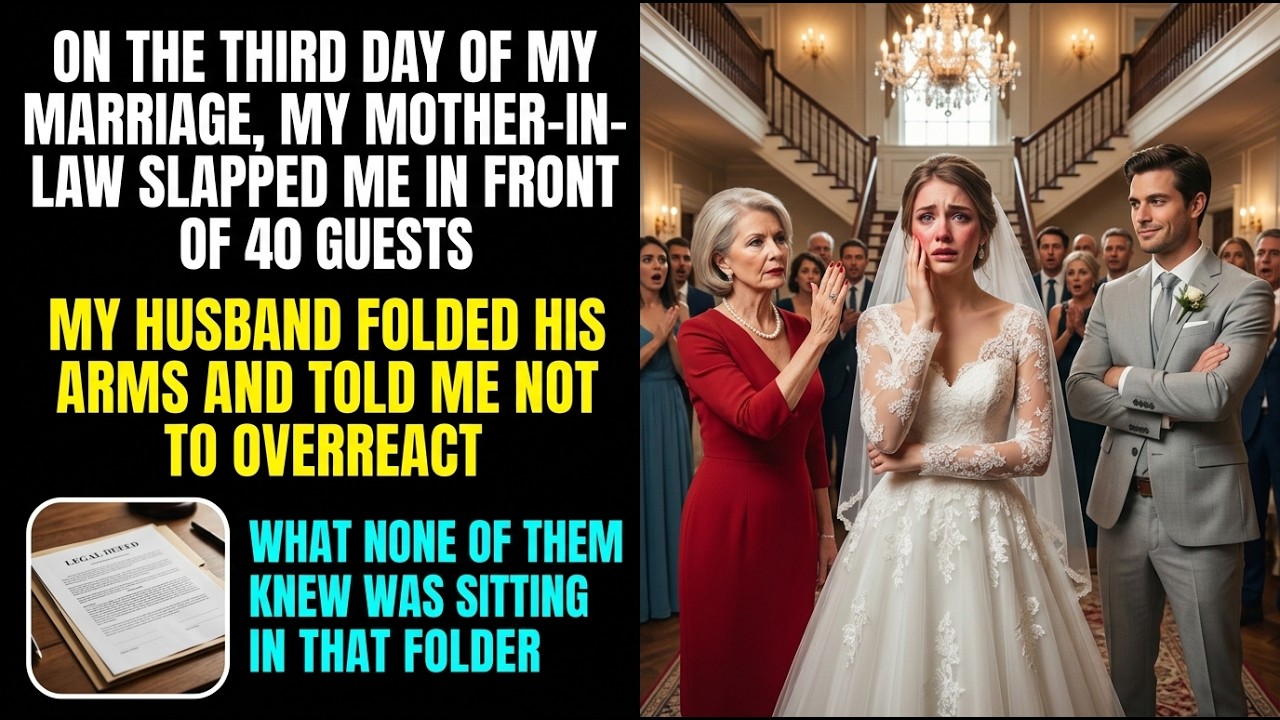
Daniel folded his arms and looked at me across the table. Behind him, forty guests sat frozen, someone’s dropped glass still ringing in the silence. My cheek burned where his mother’s hand had connected, and my ears were still ringing when he said, “It’s just a slap. Don’t overreact.
”
I had been married for exactly three days. What none of them knew, as I stood there at the brunch table with my veil still pinned in my hair, was that I owned the roof over their heads. Fifteen of his family members were living in a house that belonged to me, and I never once mentioned it. Eight days after that slap, I sold it.
I met Daniel two years earlier at a friend’s dinner party. He was charming, attentive, the kind of man who remembered how you took your coffee after hearing it once. What I didn’t fully understand then was that Daniel came from a large, tightly bound family—parents, aunts, uncles, cousins, all clustered together in one sprawling property outside the city. Fifteen people, three generations, one roof.
That property had been in my family for two generations. My father, before he passed, transferred the deed into my name alone as part of my inheritance. I wasn’t someone who led with money or property. I lived quietly, worked my job, and let people get to know me before they knew what I had.
When Daniel and I got engaged, his mother, Vivian, made it clear from day one that she saw me as an outsider marrying into her family. Every conversation was a small test I somehow kept failing. My clothes were too plain. My cooking wasn’t how Daniel liked it.
My opinions were met with a tight smile and a change of subject. Daniel always had the same response. “That’s just how she is. Give her time.
”
I gave her two years of time. I told myself that once we were married, things would settle. They didn’t. They escalated.
The wedding itself was beautiful. For one afternoon, I believed I had found the life I wanted. But the cracks started showing before the flowers were even taken down. On our first night as a married couple, Vivian called eleven times asking where Daniel was.
On the second day, she showed up unannounced at our private breakfast and rearranged the dishes because I had set them wrong. Daniel laughed it off both times. “She just misses having me around. Be patient.
”
I kept being patient. I told myself this was temporary, that every new marriage had an adjustment period. But patience has a limit, and mine was tested on the third day during what should have been a joyful family brunch. I made one comment, a light, harmless joke about how Daniel needed to learn to do his own laundry now.
Vivian’s face changed in an instant. She stood up from her chair, walked around the table, and slapped me across the face. For a moment, nobody moved. I stood there with my hand pressed to my burning cheek, waiting for my husband to stand up, to say something, to defend me.
Instead, Daniel folded his arms. “It’s just a slap. Don’t overreact. ”
Behind him, I saw his aunts exchange looks.
Not shock—amusement. As if this was expected. As if I was the outsider who simply hadn’t learned her place yet. I didn’t cry.
I didn’t scream. I picked up my napkin, wiped the tears that had welled up despite myself, and quietly excused myself from the table. I walked to the guest bathroom, locked the door, and sat on the edge of the tub for twenty minutes, staring at nothing. In those twenty minutes, something in me went completely still.
Not broken—still. The kind of stillness that comes right before a decision. I realized Daniel had shown me exactly who he was. Not through the slap, but through his response to it.
He had chosen his mother’s comfort over my dignity in front of every single person who mattered. And he had done it instantly, without hesitation. I thought about the two years I had spent being patient. I thought about every time I had swallowed my discomfort to keep the peace.
And I thought about the deed sitting in a folder in my home office. The deed to the house where fifteen of Daniel’s relatives lived rent-free, because I had never once mentioned that the property was mine and mine alone. I walked out of that bathroom with my face still red, and a plan already forming in my mind. I didn’t confront anyone that day.
I didn’t raise my voice or demand an apology. I smiled through the rest of the brunch, kissed Daniel goodbye when he left for work the next morning, and went straight to my father’s old attorney, a man named Harold who had handled our family’s affairs for thirty years. I told him everything. The slap.
The comment. The years of small humiliations I had buried to keep the peace. Harold had known me since I was a child. He didn’t ask me to reconsider.
He simply pulled the property file and confirmed what I already knew. The house was mine, solely mine, purchased outright by my father, and never once touched by any part of Daniel’s family financially. They had been living there on an informal, unwritten arrangement—a favor extended by my father years ago, one I had quietly continued out of politeness after his passing. There was no lease, no legal claim, nothing binding me to let them stay.
Over the next several days, I moved carefully and quietly. I didn’t tell Daniel. I didn’t tell Vivian. I met with a realtor Harold trusted, had the property appraised, and listed it under a private, off-market sale to a buyer who wanted immediate occupancy—a young family relocating for work, eager to move in within weeks.
I gave the family notice through Harold’s office, formally and legally, exactly as the law required. Sixty days to vacate. Not an act of cruelty, an act of simply reclaiming what had always been mine. Eight days after the slap, the papers were signed.
The sale was final. Daniel found out the same way his family did—through a formal notice delivered to the house, informing all occupants that the property had been sold and outlining the vacate timeline. I didn’t hide behind the paperwork. That evening, I sat him down and told him myself, calmly.
“The house was mine,” I said. “My father left it to me before we ever met. I let your family live there because I loved you and I wanted peace. But peace only works when it goes both ways.
”
Daniel was stunned. He accused me of being vindictive, of punishing his whole family for one moment of tension. I let him finish. Then I asked him one question.
“Where were you standing when your mother slapped me? ”
He didn’t answer, because there was nothing to say. He had been standing exactly where he always stood—beside her, not beside me. Vivian called that night, furious, demanding I reverse the sale, insisting the family had nowhere else to go.
I told her, gently but firmly, that I hoped they would find something wonderful and that I wished them well. Then I ended the call. I didn’t do this out of hatred. I did it because I finally understood that respect isn’t something you can beg for.
It costs you everything you thought you wanted. The following weeks were difficult but clarifying. Daniel’s family scrambled to find new arrangements. Some moved in with other relatives.
Some found rentals of their own. It was disruptive, yes, but it was also fair. They had simply been living in a home that was never theirs to claim, under an arrangement built on my quiet generosity—generosity that had been repaid with a slap and a shrug. Daniel and I separated a month later.
He told friends I had overreacted, the same word he used at that brunch table. But something had shifted in the people around us. His own cousin, who had been at the brunch, reached out privately to tell me she thought what his mother did was wrong and that Daniel’s response had been worse. I moved into a smaller place on my own.
Quieter. Simpler. Entirely mine. For the first time since the wedding, I could breathe without wondering whose comfort I was supposed to sacrifice next.
Daniel reached out months later with something close to an apology—not a full one, but an acknowledgement that he should have said something that day. I thanked him for saying it. I didn’t go back. Some sentences, once spoken, cannot be unheard.
“It’s just a slap, don’t overreact” was one of them. Respect isn’t measured by grand declarations of love. It’s measured by the small moments, the ones where someone has to choose between your dignity and their comfort. Daniel made his choice in less than five seconds, in front of forty people, without even hesitating.
I didn’t sell that house out of revenge. I sold it because I finally understood that peace built on my silence was never really peace at all.


