
In the annals of Wild West history, there are few characters as notorious and terrifying as Frank Stilwell. A man of indomitable will and profound cruelty, he earned a reputation as the most callous outlaw to ever roam the border. His name caused terror in the hearts of law-abiding citizens, and his actions left a trail of blood and fear across the Arizona Territory.
But who was Frank Stilwell really? What made him such a merciless killer, and how was he able to evade justice for so long? In this video, we delve into the life and crimes of this notorious character, uncovering the dark heart of a man whose name will forever be associated with violence and terror.
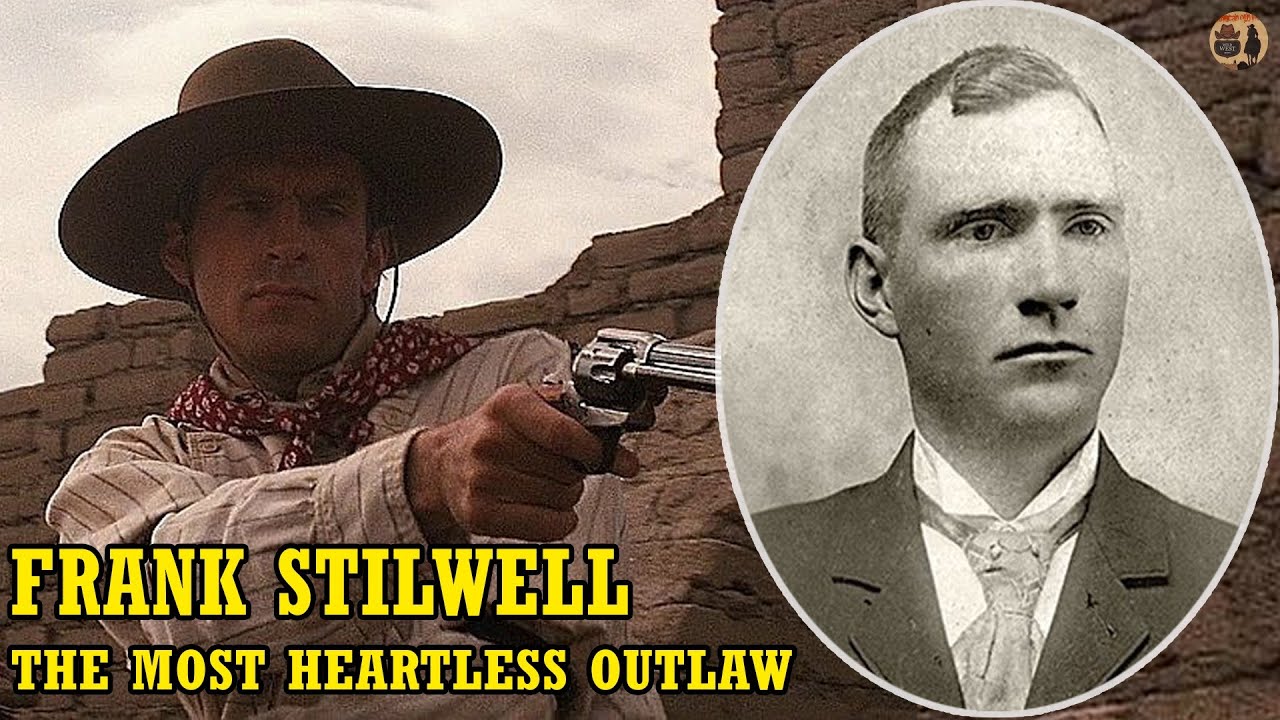 Frank C. Stilwell was born in Iowa in 1856, the son of William Henry Stilwell and Charlotte B. Sarah Winfrey.
His family moved to the Kansas Territory when he was young, settling near Palmyra on the Santa Fe Trail. It was here that Frank would spend most of his youth, watching as the frontier widened and conflict with the Native Americans escalated. In 1863, when Frank was just seven years old, his parents divorced.
William was left with three sons, Jack, Millard, and Frank, while Charlotte took two girls, Elizabeth and Mary. It was a difficult time for young Frank, who struggled to accept his parents’ separation, and the fracture of his family would leave deep scars that perhaps contributed to the hardened man he would later become.
Frank’s father, William, served in the Union Army during the Civil War. He was a Private in Company B of the 18th Missouri Volunteer Infantry, under the command of General William Tecumseh Sherman. William participated in Sherman’s infamous March to the Sea, a brutal campaign that helped bring the war to an end.
Frank’s brother, Simpson, also known as Jack Stilwell, was an Indian fighter, scout, Deputy Marshal of the United States, police judge, and United States commissioner. Interestingly, while Frank’s brother is known for his tough stance on crime and his unwavering dedication to justice, Frank himself would take a very different path, one that would lead him into the darkest corners of the outlaw underworld.
In 1877, Frank and his brother Simpson traveled from the Dakota and Indiana territories to Prescott, Arizona Territory. While in Prescott, Frank worked at a nearby Miller’s Ranch. It is here that he would commit his first act of violence.
On October 18th, 1877, Frank argued with the newly hired chef, Jesus Bega. The argument grew increasingly fierce, and Frank, in a fit of rage, took a gun and shot Bega in the lung, killing him. This incident would set the stage for Frank to sink into a life of crime.
Despite the severity of the act, Frank was later acquitted on the grounds of self-defense, a verdict that would only embolden him and reinforce his belief that he could act with impunity.
After the first shooting, Frank left Miller’s Ranch and began working as a teamster for C. H. Haml.
Frank later claimed to be mining in Mojave County, but his mining projects would also be marked with violence. On November 9th, 1879, Frank disputed a mining claim with Colonel John Van Hooton. The dispute turned violent, and Van Hooton was brutally beaten with a rock.
He died of his wounds, and Frank Stilwell and James Cassidy were charged with murder. Despite the charges, Frank and Cassidy escaped the grand jury indictment due to a lack of evidence. But this was not the end of Frank’s troubles.
 In the 1880 census, Frank listed himself as 24 years old and lived in Charleston, working as a firefighter. Frank also reported that he was born in Texas, but this could be a lie. Frank many times changed his identity and falsified information about himself, making it difficult for authorities to track his true history and movements.
On September 8th, 1881, a passenger stage on the Sandy Bob line in the Tombstone area, bound for Bisbee, Arizona, was robbed by masked robbers. On their way to Bisbee, they robbed all of the passengers of their valuables and stole a safe worth about $2,500. The driver overheard one of the robbers use the word “sugar” to describe the money, which prompted Virgil Earp and his team to track down the robbers.
While under arrest, Fred Dodge, an undercover agent for Wells Fargo and Company, discovered an unusual shoe print left by someone wearing custom-repaired high heels. Earp tracked the shoe to a shoe repair shop in Bisbee, which was known to offer wide-leg boots, and they were able to link the footprint to Frank Stilwell. When Stilwell arrived at Bisbee with his partner Pete Spence, he was arrested by Virgil Earp, Wyatt Earp, and Billy Breakenridge for the evidence gathered earlier.
Judge Wells Spicer placed a $7,000 settlement on Stilwell to be paid by C. H. Haml.
At the preliminary hearing, Stilwell and Spence presented several witnesses supporting their alibi. The use of the word “sugar” to describe money and the unique shoeprints was not enough to convict Stilwell, and Judge Spicer dropped the charge due to insufficient evidence, just as he had done with Doc Holliday earlier that year. Despite the lack of evidence, many historians believe that Frank Stilwell was actually involved in the Sandy Bob line robbery.
In the Wild West of Arizona, tensions ran high as the Earp brothers, Virgil and Wyatt, continued their relentless pursuit of the notorious Cowboy gang. On October 13th, just two weeks after Frank Stilwell was acquitted, Virgil, as Deputy Marshal of the United States, filed new federal charges against Stilwell and his accomplice Pete Spence for interfering with a mail carrier. Earp believed Stilwell and Spence were responsible for a series of robberies, including the recent Sandy Bob line robbery.
Both were immediately taken to the Territorial Prison in Tucson to await trial. While Virgil was away in Tucson, he sent his brother Wyatt to take his place as assistant city marshal at Tombstone. But the Cowboys saw this as an opportunity to strike back.
On October 18th, Frank McLaury, a friend of Stilwell and Spence and a member of the Cowboy gang, confronted Morgan Earp, another member of the Earp family, and warned him that if they tried to capture his friend again, they would be killed.
The situation was tense, and the newspapers fanned the flames by reporting inaccurately. They claimed that Stilwell and Spence were arrested for another stage robbery near Contention City on October 8th, although both were in custody in Tucson at the time. This led to the erroneous conclusion that Earp was targeting innocent men and that Stilwell and Spence were being falsely prosecuted.
The case was eventually dropped due to insufficient evidence, much to the chagrin of Earp and the citizens of Tombstone. But the Cowboys would soon learn that the law isn’t something to break, as the stage had been set for a showdown at the O. K.
 Corral.
The day after the brutal assassination of Morgan Earp, investigator Dr. H. M.
Matthews launched a tense investigation. Marietta Duarte, the wife of notorious outlaw Pete Spence, made a 𝓈𝒽𝓸𝒸𝓀𝒾𝓃𝑔 confession. She revealed that her husband had returned home just an hour after the shooting, along with Frank Stilwell, Indian Charlie, Frederick Bode, and an unidentified accomplice.
She also revealed that her husband had threatened her with force if she divulged any information to the authorities. Witnesses confirmed that Frank Stilwell was seen fleeing the crime scene. It is believed that Stilwell, Frederick Bode, Florentino, Indian Charlie, and Pete Spence were all involved in the assassination of Morgan Earp.
Meanwhile, Pete Spence surrendered and was guarded in Behan’s prison.
Faced with a broken legal system, Wyatt Earp believed he needed to deal with the problem on his own. He believed that the only way to avenge the deaths of his brothers was to track down the attackers and 𝓀𝒾𝓁𝓁 them. The Earp brothers had been targeted by a group of ruthless outlaws, and Wyatt knew he couldn’t count on the courts to bring justice.
With a heavy heart, Wyatt was willing to risk anything to ensure that his brother’s killers paid the ultimate price.
The tension between the Earps and the Cowboys was at its peak. On March 20th, Wyatt Earp received word that his brother Virgil was being targeted by Frank Stilwell, Ike Clanton, Hank Swell, and another Cowboy. They were planning to 𝓀𝒾𝓁𝓁 Virgil to avenge the death of their friend at the O.
K. Corral. Wyatt knew he had to act quickly, so he assembled a team of deputies, including Warren Earp, Doc Holliday, Turkey Creek Jack Johnson, and Sherman McMaster, along with Virgil and his wife Allie, to board the train to Tucson.
They were all fully armed, determined to protect Virgil at all costs.
 When they arrived in Tucson, Wyatt and his group saw Stilwell and the Cowboys. The tension could be felt in the air. Virgil later told the San Francisco Examiner, “Most of the first men we met on the platform were Stilwell and his friends, armed with weapons.
They joined the crowd as soon as they saw me being escorted, and the boys took me to the hotel for dinner.” During dinner, Wyatt and his team watched over Virgil and Allie, ready for action at any moment. As the train left the station, gunshots rang out.
Witnesses saw armed men fleeing but did not identify anyone. Wyatt later claimed that he had seen Stilwell and Ike Clanton, and that when he and his men approached, the two men fled. Stilwell staggered, and Wyatt caught him.
In a story published in the Denver Republic, Wyatt testified that he shot Stilwell as he tried to push the barrel of his shotgun away. Ike Clanton managed to escape justice and went to the press to tell his story.
Ike testified that he and Stilwell had gone to Tucson to clear their names from federal charges related to Stilwell’s involvement in the robbery of the Bisbee stage in 1881. But that was not the real reason for their trip. It was later revealed that the real motive behind their journey was to get revenge on Virgil Earp, who they believed played a role in Stilwell’s arrest.
Ike also testified that Stilwell had disappeared from the hotel before he was found dead near the tracks with multiple gunshot wounds. However, witnesses reported seeing Stilwell and his gang armed with weapons on the platform, waiting for Virgil to arrive. Some say that Clanton and Stilwell were at the train station to meet a witness named McDowell, who would testify before a grand jury.
When they realized that the Earps were there, they knew that trouble was brewing.
Stilwell’s body was discovered the next day along the tracks, riddled with bullet holes. Eyewitnesses report seeing Clanton and Stilwell together before the shooting. It has been suggested that Stilwell’s poor shooting skills led to his untimely death.
One thing is for sure: the Earp brothers had become the target of ruthless Cowboys who would use any means to seek revenge. The Earps knew that they must stay vigilant and protect themselves. The Wild West was truly wild, and the Earps were right in the middle of it.
The funeral of Frank Stilwell, the man accused of being involved in the assassination of Morgan Earp, was a somber event. On March 28th, 1882, the Tucson Weekly Citizen reported that Stilwell’s coffin had been delivered to the grave by an express carriage without an escort present. It was a sad and lonely ending for a man who lived a full life of violence and crime.
Stilwell was originally buried in the Old City of Tucson Cemetery. When the cemetery was moved, most of the residents were reburied in a mass grave at Evergreen Cemetery in Tucson. And so, the story of Frank Stilwell, a man whose name became synonymous with heartlessness and terror, came to a quiet and unceremonious end, a fitting conclusion for a life defined by bloodshed and lawlessness.


