The first honeysuckle along the fence opened up three weeks before they sent me away. I remember that because it was the last thing I saw in my own yard that felt like mine. My daughter Shelby hugged me at the airport and told me the whole family had chipped in for a trip so I could rest. She held on too long.
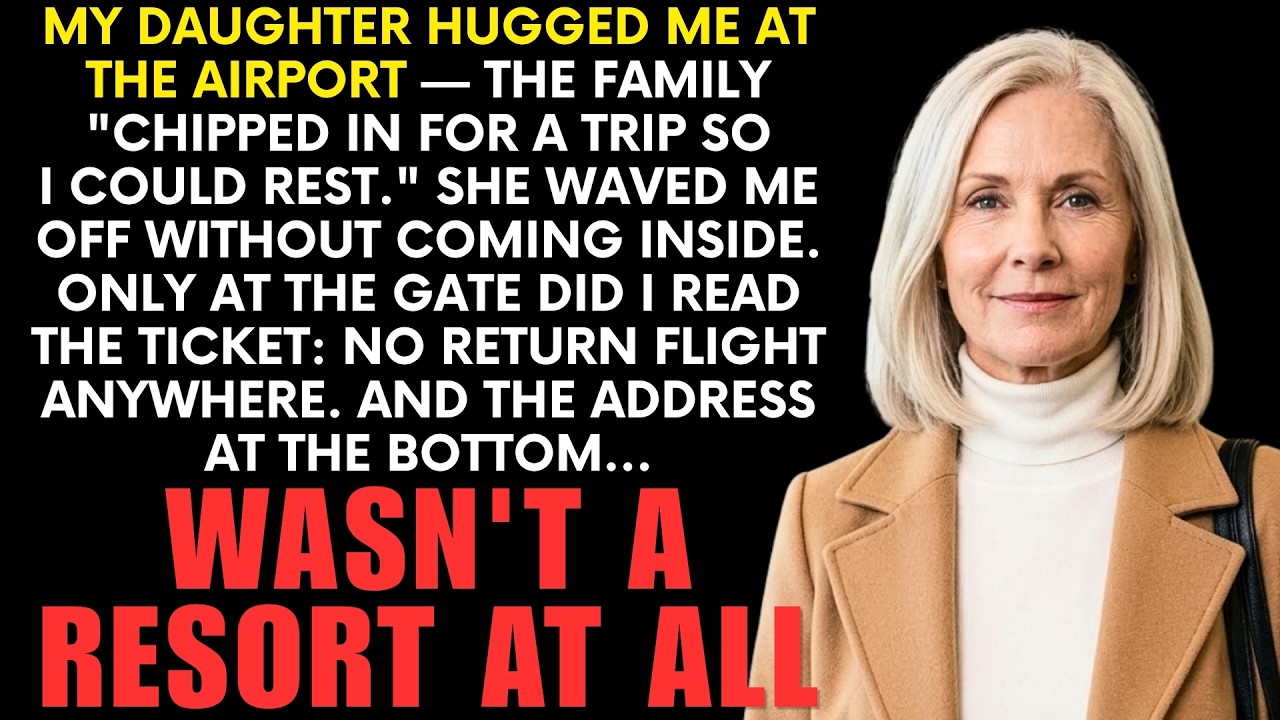
Her hands were trembling when she let go. She waved from the curb without ever coming inside the terminal. At the gate, I read the ticket. One way.
No return flight. The address at the bottom was not a resort. I had spent 35 years as a speech-language pathologist evaluating cognitive function. I knew how to chart a decline.
I knew how to test capacity. And I was about to prove exactly how sharp I still was. I worked at Arkansas Children’s Hospital for 35 years. I administered the Montreal Cognitive Assessment hundreds of times.
I wrote reports, testified in competency hearings, and charted the line between can and cannot for over 600 patients. Ed, my husband, knew every mailbox on his mail route. He died of a heart attack in 2020, at 64. Six years gone now.
We bought the Craftsman bungalow on Maple Ridge Drive in 1996 for $84,000 and paid it off in 2014. The house is worth $335,000 today, free and clear. After Ed died, I planted honeysuckle along the front fence. I needed something alive where he used to stand and wave at the neighbors.
The vine grew thick in four years. You could smell it from the sidewalk by May. In late April, Shelby called. She said she, Ray, Boyd, and even a friend named Gretchen had all chipped in to send me to a desert resort in Tucson for a week.
She booked everything. I was touched. I hadn’t taken a vacation since Ed died. When I asked the name of the resort, she said it was a surprise.
I let it go. She was my daughter. She would not send me somewhere bad. On May 8th, Shelby drove me to the airport.
She hugged me at curbside, pressed her chin into my shoulder, and told me she loved me. Then she looked anywhere but at my face and drove off without looking back. I made it through security and read the printed itinerary. Flight 1847, one passenger, one way.
No return confirmation. The accommodation address on Saguaro Ridge Road. I typed it into my phone. Saguaro Ridge Senior Care Community.
Specialized memory care and assisted living for adults 55 and older. Not a resort. An assisted living facility. My fingers went cold.
My suitcase was already checked. Shelby had dropped me off. My car was home in the garage. I could have walked out, called a cab, gone home.
But I needed to know how deep it went. I boarded the plane. Before the door closed, I called Boyd, my younger brother. He picked up on the fourth ring.
“Boyd, Shelby booked me a one-way ticket to an assisted living facility. What is happening? ”
He paused, then said, “Tabitha, just go. They know what’s best for you.
”
“I have not been forgetting things, Boyd. ”
“You left the stove on last month. ”
“The pilot light went out because the igniter needs replacing. That is a maintenance issue, not a memory issue.
”
He hung up. I landed in Tucson at 4:42. Dry heat hit me at the door. A cab took me 13 miles northwest to a compound of beige stucco buildings behind a locked gate.
The front desk had a manila folder with my name on it. Intake form listing Shelby Langford Merritt as responsible party and Tabitha Langford as new resident, memory care unit. They asked me to sign admission paperwork. I read the first page.
“I am not signing anything. ”
The coordinator blinked. “Your daughter mentioned you might be confused at first. ”
“I am a certified speech-language pathologist with 35 years of clinical experience.
I am not confused. I am furious. There is a substantial difference. ”
That evening, I connected to the facility’s guest Wi-Fi and opened my bank app.
My savings balance was $3,200. One week earlier, it had been $127,000. I scrolled through the transaction history. May 6th, two days before my flight: a wire transfer of $94,000 to an account I did not recognize.
Authorization signature: Shelby Langford Merritt. Status designation beside her name: guardian. Between May 7th and May 10th, six smaller transfers totaling $29,800. Grand total moved out of my account: $123,800.
Guardian. She was listed as my guardian. I had never signed a guardianship form. I had never been evaluated.
Never been notified. Never been given a single chance to respond before my autonomy was erased. The next day, I asked the facility’s social worker, a young woman named Carmen, to use the landline. She looked at my file, then at me.
“You seem very alert for a memory care admission. ”
“That is because I do not belong here. ”
I called the Pulaski County Circuit Clerk’s Office. I found a case lookup line and entered my name.
Case number 60 PR 2026 1847. Emergency temporary guardianship filed May 8th, 2026, at 2:47 p. m. My flight had pushed back from the gate at 2:15.
Shelby waited exactly 32 minutes after my plane was airborne, then filed. The petition stated I posed a risk of financial self-harm. Grounds: progressive cognitive decline, disorientation, inability to manage my affairs. Supporting exhibits: an affidavit from Boyd.
An evaluation letter from a Dr. Leland Kendall. I had never heard of Dr. Leland Kendall.
No one by that name had ever examined me. No physician, no psychologist, no clinician of any kind had assessed my cognitive function in over a decade. I made a list in my head. Step one: prove I am competent.
Step two: get home. Step three: get a lawyer. Step four: get my money back. Step five: get my life back.
I asked Carmen for a cognitive screening. The facility psychologist administered a Montreal Cognitive Assessment. I had given this exact test at least 400 times. I scored 29 out of 30.
I lost one point on a serial seven subtraction — I said 85 before correcting to 86. Clinically insignificant. The psychologist sat back. “Miss Langford, this is a very strong score.
”
“I know. I spent 35 years administering that test. ”
I pulled my laminated ACH badge from my tote bag and set it on the table. I called June Ridley, my old colleague from Children’s, 22 years of working side by side.
“Tabitha, where are you? Shelby told everyone at church you went to a spa in Sedona. ”
“I am in an assisted living facility in Tucson. Shelby sent me here on a one-way ticket.
She filed guardianship papers. My accounts have been drained. ”
June didn’t hesitate. Within two hours she wired $800 to a Western Union in Tucson.
I took a cab there, picked it up, and bought a one-way ticket back to Little Rock on Southwest Airlines. I told the Saguaro Ridge staff I was leaving. The front desk coordinator tried to stop me. “I am not a prisoner.
Arkansas law does not allow involuntary civil commitment to an assisted living facility. I am walking out this door. ”
Five days after Shelby dropped me at the curb, I boarded the plane home with my own ticket. I took a cab from the airport to Maple Ridge Drive.
The Craftsman bungalow sat at the end of the block. The front door lock had been changed. My key didn’t fit. A laminated notice was taped to the glass: Property under guardianship management.
I tried the back door. New lock. The garage side door. New lock.
Then I walked around to the fence. The honeysuckle was gone. The entire vine, four years of growth, ripped out. Bare cedar posts and raw dirt where roots had been torn from the ground.
I planted that honeysuckle the spring after Ed died. It was the first thing I did when I couldn’t stand looking at bare wood anymore. Now it was dirt and splinters. I stood on my own porch, locked out of the house I had owned for thirty years.
June drove me to the Pulaski County Courthouse. I requested the guardianship case file. 17 pages. I sat in the records room and read every word.
Exhibit A: Boyd’s affidavit. “I have observed my sister become increasingly confused over the past 6 months. She has left the stove on multiple times, called family members by incorrect names, and become lost while driving. ”
Every sentence was a lie.
Boyd saw me twice a month. None of that had happened. Exhibit B: Dr. Leland Kendall, D.
C. — doctor of chiropractic — one paragraph on letterhead. “Based on my assessment, it is my professional opinion that Ms. Langford lacks the cognitive capacity to manage her personal and financial affairs.
”
No scores. No methodology. No date of examination. Exhibit C: Shelby’s financial plan as guardian.
Disbursed: $34,000 for emergency guardian expenses. I photographed every page. 17 pages, 34 photographs. That was when I stopped being a concerned mother and started being a case file.
June knew a lawyer. Wallace Hargrave, elder law, 25 years of guardianship and elder abuse litigation. I brought him the photographs. He read them twice.
“This is textbook elder financial exploitation. The evaluation letter was from a chiropractor, not a qualified physician. The $94,000 transfer predated the guardianship filing by two days. And there’s no evidence you received notice.
We file a petition to terminate and restore your rights. Then we pursue a criminal referral. ”
On May 27th, Hargrave filed the petition. It requested termination of Shelby’s appointment, an independent medical evaluation by a board-certified neuropsychologist, a full accounting of all financial transactions, and appointment of a guardian ad litem.
Shelby was served on May 28th. That evening, she called me at June’s house. “Mom, what are you doing? We were trying to help you.
”
“You sent me to an assisted living facility on a one-way ticket, Shelby. ”
“You needed it. You’ve been confused. Everyone can see it.
”
“Name one person besides Boyd who has seen me confused. ”
Silence. Seven seconds. “If you fight this, it’s going to tear this family apart.
”
“You already did that on May 8th. ”
Dr. Alma Voss, board-certified neuropsychologist, evaluated me June 3rd. Three hours of testing.
MoCA 29 out of 30. Trail making, Rey auditory verbal learning, Boston naming 60 out of 60, clock drawing perfect. Functional assessment: independent in all activities of daily living. Her conclusion: “Ms.
Langford demonstrates intact cognitive functioning across all assessed domains. She is fully capable of managing her personal and financial affairs. ”
Hargrave subpoenaed Dr. Kendall.
In his deposition, he admitted he never met me, never spoke to me, never examined me. He wrote the evaluation letter based on a ten-minute phone call from Shelby. His fee was $350. I never once wrote a report on a patient I had not personally examined.
Not once. Not for $350. Not for any amount. The bank records came next.
The $94,000 went to a joint account in Shelby and Ray’s names. The additional $29,800 went to their creditors. $62,000 to Shelby’s student loans. $28,000 to their mortgage.
$18,000 cash withdrawals. $15,800 across four credit cards. Total removed from my accounts: $123,800. Not one dollar went to my care.
The facility placement Shelby listed as $12,000 in her guardian plan actually cost $2,400. She listed five times the real cost and pocketed the difference. Hargrave found something else. A durable power of attorney naming Shelby as my agent, dated March 13th.
My signature was on the last page. Except it wasn’t my signature. I sign my name the same way I have since I was 18 — left slant, a distinct lowercase B, a soft curve on the L. This signature slanted right.
The B had a full loop. It was a forgery, notarized by Gretchen Hale, witnessed by Raymond Merritt. I was in Memphis at the Arkansas Speech-Language Hearing Association conference on March 13th. I had the hotel receipt and the registration badge to prove it.
I went to see Boyd. He lived in a one-bedroom apartment above a hardware store in Conway. He sat in his recliner and told me about Martha. Lewy body dementia.
Two years of watching her vanish. She forgot how to write a check, then how to dress herself, then his name. She died in 2023, leaving him $47,000 in medical bills. “When Shelby came to me in March and said you were getting confused, I believed her.
I had watched it happen to Martha. The same words, the same signs. And she said she would pay off my medical bills from your accounts. ”
He signed a sworn affidavit full of lies for $47,000.
On July 15th, a week before the hearing, Shelby called again. “Mom, please drop this. We can work it out as a family. ”
“This stopped being a family matter when you put me on a one-way flight to an assisted living facility.
”
“If you take me to court, you will never see your grandchildren again. I will make sure of it. ”
“You sent me to a memory care unit in Arizona. You drained $123,000 from my accounts.
You submitted a forged power of attorney. And now you’re threatening me with my grandchildren? ”
She hung up. July 22nd.
Pulaski County Probate Court, Room 3B. I wore my lavender cardigan and gray tailored slacks, my tote bag with the ACH badge clipped to the strap. June sat in the gallery. Across the aisle sat Shelby, Ray, Boyd, and Gretchen Hale.
Hargrave presented the evidence in sequence. The one-way boarding pass. The petition filed 32 minutes after my flight left the gate. Dr.
Kendall’s deposition. Dr. Voss’s evaluation. The bank records.
The forged power of attorney. He let Shelby’s text message hang in the air: “We chipped in so you could rest. ”
Boyd took the stand. He repeated the affidavit claims in a flat monotone.
Then Hargrave asked about Martha. Boyd’s composure broke apart like wet paper. “I thought it was happening again. I could not watch it happen to Tabitha.
”
Hargrave asked if Shelby promised to pay his medical bills. Boyd admitted it. Fear is a human thing. Signing a false affidavit to erase your sister’s legal rights for $47,000 is something else entirely.
Shelby took the stand. Her attorney tried to guide her through her prepared statement. Then Hargrave asked about the $94,000 transfer made two days before the guardianship was filed, before she had legal authority. Shelby’s jaw tightened.
She cracked from the bottom up. “She’s old. She doesn’t need a three-bedroom house all to herself. She doesn’t need $127,000 sitting in a savings account doing nothing.
We are her family. That money should be helping us. ”
The courtroom went still. She kept going.
“She has everything and we have nothing. I dropped out of law school because she wouldn’t help me pay tuition. ”
I sat still. I didn’t raise my voice.
The judge looked at me. “Miss Langford, do you wish to respond? ”
“Your Honor, I have nothing to add. ”
The judge recessed for fifteen minutes.
When she returned, she terminated the emergency guardianship, restored all my rights and legal capacity, ordered Shelby to return all misappropriated funds within 60 days, and referred the matter to the prosecuting attorney for investigation of financial exploitation of an endangered person. The gavel came down once. In the hallway, Ray pulled Shelby toward the elevator. She was crying — not the practice tears, the real ones, the ones that come when control shatters.
Gretchen disappeared through the stairwell. Boyd stood by the water fountain, opened his mouth, and said nothing. I walked past him without stopping. June drove me home.
Hargrave had arranged a locksmith, contingent on the ruling. I put two brass keys on my keychain. I opened my front door. The house smelled like dust and closed windows, but the walls were mine.
Three months after the hearing, Shelby and Ray returned $118,000 of the $123,800. They were each charged with two counts of financial exploitation of an endangered person, a Class B felony carrying up to 20 years per count. Gretchen pleaded guilty to notary fraud and forgery. Her notary commission was revoked.
Benton and Associates fired her. Boyd was not charged. The prosecuting attorney noted he was a manipulated participant, not an orchestrator. I replanted honeysuckle along the front fence.
Three new plants. Thin and young. They’ll take two years to fill in. I have time.
Shelby hasn’t called since the hearing. No apology, no explanation. I sent birthday cards to Lily and Carter in September. No response.
Boyd called once in August. He left a voicemail. “Tabitha, I’m sorry. I should have…” Then he trailed off, and the recording ended.
I haven’t returned the call. I may someday. I haven’t decided. Grief can make a person weak, but weakness is not permission.
June comes over every Thursday for coffee. I joined a watercolor class. I had the front porch repainted the same blue Ed picked in 1996. Some things last.
Late October. I sit on the front porch in the afternoon light. The new honeysuckle is just a tangle of green stems along the fence. No blossoms yet.
But the roots are holding. You can see that in the way the leaves reach toward the sun. I open my tote bag. The boarding pass is still inside, creased and softened at the folds.
One way. Little Rock to Tucson. Saguaro Ridge Senior Care Community. I fold it back along the same lines and tuck it away.
They said I needed rest. They were half right. I needed to rest my trust in people who had never earned it. I clip my hospital badge to the strap.
Not because I need it. Because it reminds me of who I was for 35 years, before anyone tried to tell me I was less than that. 29 out of 30. That was my score.
And the one point I missed, I caught my own mistake and corrected it in under two seconds. I can think clearly. I can think clearly enough to know the difference between a family that loves you and a family that inventories you.