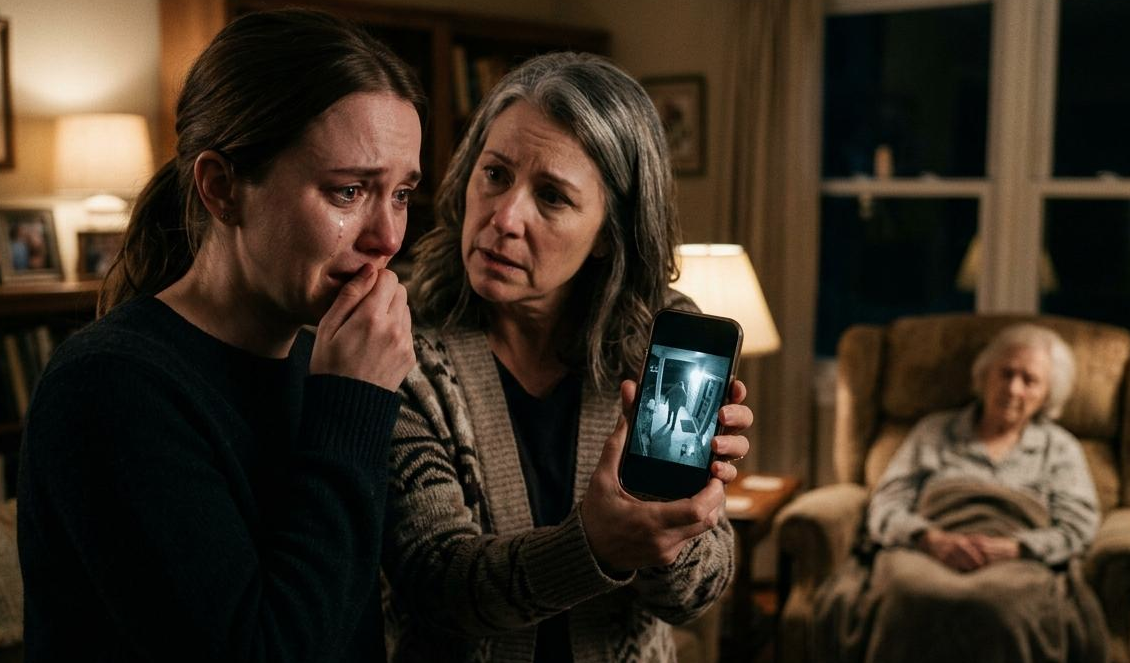
My brother told me my name wasn’t on the trust. It never was, he said. Dad fixed that two years ago when he realized I was just waiting for him to die. He said it at the kitchen table of the house we grew up in, loud enough for the home health aide to hear every word.

He said it while our father lay forty minutes away, three days after a massive stroke had taken his speech and movement. Only his heartbeat remained. I didn’t cry. I didn’t raise my voice.
I picked up my coffee mug, took a slow sip, and set it down with a click that echoed like a gavel. “Okay, Marcus,” I said. And I left. I drove to a motel twelve minutes from the hospital.
I sat on the edge of the bed with my coat still on and stared at a water stain on the ceiling until it stopped looking like my father’s face. Then I opened my laptop and started working. Let me back up. My father built his business the way men of his generation did—quietly, stubbornly, without ever asking for help.
Thirty-one years of Whitmore Transport, a logistics company he started out of a rented garage with one used truck and four clients. By the time I was in college, it had twelve trucks, a small warehouse, and a reputation solid enough that two competitors had tried to buy him out. He always said no. He used to tell me that the day he sold was the day he admitted he’d only ever been building someone else’s future.
Marcus had seven years on me, and he wore those years like a crown. He was the son. He got the handshake introductions at company events. He got the summer internships.
He got an office with his name on a temporary plaque that stayed up for eleven years—until it didn’t feel temporary anymore. I got a college fund and the sincere suggestion that I find something stable. I did. I got a finance degree, spent six years at an accounting firm, and came back four years ago when my father’s hand started shaking and I realized nobody was actually watching the books.
What I found when I started looking was not good. Marcus had been pulling from the operating accounts in increments small enough to avoid automatic flags. Two thousand here, three thousand five hundred there, always coded to vendor categories that existed on paper but not in practice. Over eighteen months, I traced just under two hundred forty thousand dollars.
I didn’t confront him. I didn’t tell my father, who was already starting to have days where the fog came in and stayed. Instead, I built a parallel set of records—clean, dated, sourced—on an encrypted drive. And I waited.
I didn’t know yet what I was waiting for. Then my father had his stroke. He collapsed in the warehouse on a Tuesday morning. The neurologist used words like significant impairment and prolonged recovery, and once, in a quieter voice, may not regain full capacity.
My father was alive. He could track movement with his eyes, but he could not speak, could not write, could not squeeze my hand back. Marcus arrived at the hospital four hours after I called him. He showed up in a jacket I didn’t recognize—expensive, fitted, the kind you buy when you’re expecting to be seen.
He stood in the doorway of my father’s room for about ninety seconds, nodded once, and said, “We need to talk about transitional management of the estate. ”
I should have known then. Within the week, Marcus had located a document—a durable power of attorney, he said—signed by our father eight months prior, designating Marcus as sole agent for all financial and business decisions in the event of incapacitation. He showed it to me in the kitchen of our father’s house, where Marcus had already moved himself in with a woman named Sienna, his girlfriend of four months.
She had begun referring to the guest bedroom as “our room. ”
I looked at the document. The signature was my father’s, or close enough that I couldn’t say so on sight. But the date troubled me.
Eight months ago, my father had been managing fine. He was slowing down, but he was clear. He had no reason to hand Marcus anything. Nothing had changed yet.
And my father was careful with paper. He had a lawyer he’d used for twenty years—Gerald Okafor, whose office was twelve minutes from the warehouse. Any real document would have Gerald’s notary stamp. This one had a notary stamp from a UPS store in a strip mall.
I said, “I’d like a copy of this. ”
Marcus said, “I’ll have my attorney send it over. ”
His attorney. My father’s son had hired his own attorney.
I drove to Gerald’s office the next morning without an appointment. Gerald had known me since I was nine. He came out of a client meeting when his assistant told him I was there, and he sat across from me with the expression of a man diffusing something. He told me that my father had, in fact, come to see him eight months prior.
He had wanted to update his estate planning. He had established a revocable living trust holding the business, the house, and an investment account containing just over one point two million dollars. He had also wanted to discuss a power of attorney. What my father had not done, Gerald said carefully, was give that power of attorney to Marcus.
He had drafted one initially. Then, six weeks later, my father had returned to Gerald’s office alone, sat down, and said he’d changed his mind. Gerald showed me the revocation—dated, clean, bearing Gerald’s own notary stamp, not a strip mall’s. Marcus had a forgery.
I sat in Gerald’s office for a long time after he finished talking. I drank the water he offered me slowly, thinking about what Marcus had already done with eleven days of unchecked financial control. Then I asked Gerald what I could do right now, today, to stop a wire transfer if Marcus tried one. Gerald told me.
Then he slid a folder across the desk. My father had been very specific about the trust structure. The business and primary assets were held jointly between me and Marcus. But there was a separate provision Gerald had drafted personally—a forfeiture clause.
If either beneficiary attempted to access trust assets through fraudulent means, he would forfeit his entire share. Not just the asset he touched. The whole estate. To the other beneficiary.
To me. My father had known. He hadn’t confronted Marcus. He hadn’t cut him out.
He had quietly built the floor so that if Marcus ever jumped, the fall would be his own. “He told me he hoped he’d never need it,” Gerald said. “But he wanted to make sure you were protected. ”
I thanked him and asked him not to contact Marcus or flag anything yet.
I needed a few days. Gerald nodded. He had known my father a long time. Back in the motel, I went through everything.
The embezzlement records. The revocation. The forfeiture clause. And the new discovery: Marcus had submitted a change of authorized signatory request to the company’s bank three days after the stroke, using the forged POA as his authority.
The bank had placed a seventy-two-hour review hold—standard for any signatory change on an account over a certain size. That hold expired in forty-one hours. I didn’t go to the police. Not because I couldn’t, but because I’d watched enough of these situations to know how they played out.
Marcus would claim the document was legitimate. He would hire people to argue over handwriting analysis. He would drag it into civil court for years while he lived in my father’s house with Sienna and ran the company into the ground. My father would come home to a legal war and an empty account.
I wanted something cleaner. I called the bank’s fraud department directly—the actual financial crimes division. I told them I had evidence of a forged power of attorney being used to alter account authorization on a trust account. I gave them the account number.
I gave them Gerald’s contact information and told them to verify the revocation. I told them I wasn’t asking them to freeze the account yet. I was asking them to let the review hold expire normally and to document every action Marcus took from that point forward. The investigator I spoke to—a quiet, thorough woman—said they would assign an examiner.
If I could provide additional documentation, it would strengthen the file considerably. I spent the next six hours organizing everything into a single package. The embezzlement records. The revocation.
The forfeiture clause. A side-by-side comparison of my father’s real signature against the one on the forged document. I emailed it to the investigator and to Gerald. Then I thought about what Marcus would do next.
He was going to move fast. He was underwater—I’d found evidence of two personal loans and a vendor payment that had gone to a private lender registered in Nevada. He needed liquidation before anyone started pulling threads. He would go for the investment account first.
One point two million dollars sitting in a trust brokerage, accessible with the right paperwork and a forged signature. I needed him to do exactly that. I called Gerald. I told him I needed him to do something uncomfortable but entirely legal.
I needed him to call Marcus. The next morning, Gerald called Marcus and told him there was a complication with the trust documentation that needed resolving before any financial actions could be authorized. A technical error in the filing. Nothing substantive.
Just a procedural gap. He needed Marcus to come in and sign a clarifying affidavit before the bank hold cleared. It needed to happen in person. It was routine.
Marcus, who had never trusted Gerald, and who was now in a position where every hour cost him something, decided agreeing was safer than refusing. He scheduled the meeting for the next afternoon. I wasn’t in Gerald’s office when Marcus arrived. I was in the parking structure across the street, sitting in my car with Gerald’s associate patched in on a conference line, listening through a small digital recorder Gerald had placed on his desk with Marcus’s full knowledge—standard practice for any meeting involving estate matters, Gerald mentioned casually.
It was true. And useful. Marcus came in with his own attorney, a young man in a sharp suit who asked pointed questions about the affidavit. Gerald answered them patiently.
The affidavit was simple: a confirmation that Marcus was acting as authorized agent under a valid power of attorney in connection with specific described assets. A restatement of what he was already claiming. Marcus signed it. His attorney countersigned as witness.
Gerald thanked them both and showed them out. I sat in my car for a moment after the line went quiet. I thought about my father’s hands—the way they looked when he was checking an invoice, careful and deliberate. I thought about how he had sat in Gerald’s office, quietly, without drama, and made sure the thing Marcus was doing right now would seal itself.
I called the bank investigator. Marcus had just signed a sworn affidavit reaffirming the fraudulent POA. The hold expired in six hours. I expected him to attempt a wire transfer of the full investment account balance.
I would like someone present when he did. She said she would make some calls. I drove to the bank and sat in the parking lot in the late afternoon light, watching through the glass lobby wall as Marcus walked in twenty minutes before closing. He was alone.
I could see the back of him—the same expensive jacket, the set of his shoulders. He was doing what every person who has made a large irreversible decision looks like from a distance: very still, very deliberate, trying not to telegraph the size of what he was doing. He stayed at the desk for eleven minutes. Then the doors to the back of the bank opened, and two people in dark suits walked out.
They were not bank employees. One was the investigator I had spoken to. The other introduced himself, I learned later, as a special agent with the FBI’s financial crimes unit, which has jurisdiction over wire fraud involving federally insured institutions. Marcus turned around.
I got out of my car and walked through the lobby doors just as Marcus was looking from the agents to the bank manager to the document on the desk in front of him—the full transfer authorization he had just submitted. One point two million dollars from the Whitmore family trust investment account to a personal account in his name. He saw me. For a second, his face did something I had never seen it do.
It went completely blank. Not angry, not calculating. Just empty. Like the version of himself that had always been in charge had stepped out of the room without warning.
I stopped a few feet away. “Hi, Marcus. ”
He found his voice. He said my name the way he always had, like it was a small thing.
“You have no idea what you’re doing. This is Dad’s money, and I am his designated agent. It’s all legal. You can ask anyone.
”
“The POA was revoked,” I said. “Gerald filed the revocation six weeks after it was drafted. The document you’ve been using is a forgery, and you just signed a sworn affidavit this afternoon reaffirming it. That’s fraud.
The wire you just submitted makes it federal. ”
He stared at me. I reached into my bag and put a single sheet of paper on the counter next to his transfer request. A copy of the forfeiture clause.
I had highlighted the relevant paragraph. I gave him enough time to read it. “Dad built this in,” I said. “He knew, Marcus.
He knew, and he didn’t say anything because that’s how he was. He just built the floor. ”
The investigator stepped forward and began explaining what would happen next in the calm, factual tone of someone who has done this many times. Marcus’s attorney would need to be present.
The transfer had been flagged and would not process. An examination of all account activity going back eighteen months was being initiated. The affidavit signed that afternoon had been witnessed and recorded and would be entered as evidence. Marcus turned to me one more time.
There was something in his face that might have been the beginning of a plea—or might have been the last effort of the version of himself who always expected things to tilt his way. He said my name again, differently this time. “Go call your attorney,” I said. And I turned and walked back out through the lobby into the early evening air.
I stood in the parking lot for a moment with my hands in my pockets and my face tipped toward the sky, which was doing something pale and silver over the tree line. And I breathed. Sienna left the house that night. She took three bags and a lamp.
I didn’t stop her. There was nothing in that house that was hers. I drove to the hospital and sat in the chair next to my father’s bed for a long time without saying anything. The monitors made their steady sounds.
His hands rested on the blanket, quieter than they had ever been when he was building things. I put mine over one of them and just sat there. I told him Gerald sent his regards. I told him the trust was intact.
I told him the company would be fine—I had already been in contact with the warehouse manager, the fleet was maintained, the accounts were current except for the ones I would be untangling over the next several months. I told him I understood now why he hadn’t said anything. Why he had just quietly built the protection and let Marcus make his own choices. Because confrontation would have turned it into a war, and wars cost everything.
My father had never believed in paying more than something was worth. His fingers moved slightly under mine. Maybe involuntary. Maybe not.
I chose to believe what I wanted to believe—that he had heard me. The formal investigation took four months. The charges filed included wire fraud, forgery of a legal instrument, misappropriation of fiduciary assets, and several related counts connected to the embezzlement I had documented. Marcus’s attorney negotiated through the process, but the forfeiture clause did its work without any additional action from me.
By the time the legal mechanics resolved, Marcus’s share of the estate had reverted to mine automatically, exactly as my father had written it. Marcus lost the business interest he had spent eleven years treating like a birthright. He lost the house, which remained in the trust and which I spent three weekends cleaning and airing out, room by room, until it smelled like itself again. He lost the one point two million dollars he had tried to move in the nine seconds between submitting the wire and being interrupted—because it had never been his to begin with.
He did not go quietly. He sent several emails through his attorney that were formal in language and furious in tone. He filed a counter complaint with the state bar against Gerald that was reviewed and dismissed. He left me a voicemail once at two in the morning.
I didn’t listen to it for a week. When I finally did, I sat with it for a long time, because underneath the anger there was something else—something that sounded like the seven-year-old version of a person who had been told his whole life that he was the heir and had built an entire self out of that and was now watching it come apart. I don’t have a clean word for what I felt. I did not call him back.
My father came home from the rehabilitation facility on a Thursday in the fall, fourteen weeks after the stroke. He walked with a cane and tired easily, and his speech was slower—deliberate and careful in a new way. The neurologist said there would be continued improvement. Gerald came for dinner the first week he was home.
They sat at the kitchen table for two hours, and I made food and didn’t interrupt them, because some conversations are for the people who have been having them for thirty years. Later, when Gerald had gone and my father was in the living room in the chair he’d had since before I was born, I sat on the couch across from him. We were quiet together in the way we had always been comfortable being quiet. The lamp cast the room in the same light it had always cast it.
After a while, my father looked at me—slow and steady—and he said my name. Just my name. Not as a question. Not as the start of a sentence.
Just the sound of it, the way you say something when you want to acknowledge that it exists, that it is real, that it matters. “I know, Dad,” I said. “I know. ”
Sometimes the most dangerous thing a greedy person can do is underestimate the one they pushed out the door.
Because the door doesn’t lock from the outside. And some of us were paying attention the whole time.