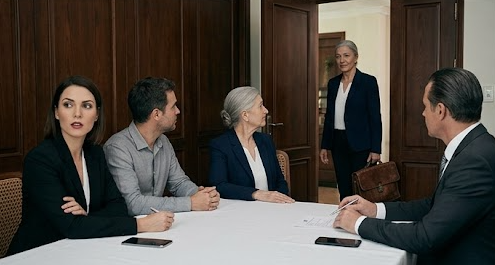
When Vanessa told me to sit down, it wasn’t an invitation. It was a command, and I knew it before she even finished the sentence. Caleb stood behind her with his arms crossed, watching me the way you watch a problem you intend to solve rather than a person you intend to hear. They had laid everything out on the table; a bank notice with red lettering, printed emails, overdue statements.
My life, already summarized into evidence. “What is going on? ” I asked quietly. “Do not play innocent.
This is because of you,” Vanessa snapped back. “You always do this. You pretend to be calm while everything around you falls apart. ”
Then she said the sentence she knew would sting.
“You live like it is 50 years ago, and it makes me look like I came from nothing. ”
Caleb cleared his throat, the way he does when he wants to sound reasonable. “Jane, you don’t really understand credit or timelines, so it’s better if you don’t interfere. ” He glanced pointedly at my purse.
“And with your condition, it’s probably safer if you don’t hold on to your keys tonight. ”
“Those are mine,” I said. Vanessa reached across the table and took my car keys, my house keys, and my phone in one motion, dropping them into her pocket. “You are agitated,” she said loudly, as if narrating for an invisible audience.
“You are not thinking clearly. ”
When I took a step toward her, she raised her voice. “See, this is exactly what I mean. You are not stable tonight.
I am doing this to protect you. ”
Caleb added quietly, “If you calm down and do as we ask, this will be easier for everyone. ”
He wasn’t asking for peace. He was asking for compliance without accountability.
“Give me my phone,” I said again. Vanessa laughed, not with humor but with irritation. “You don’t need it. You’ll just make things worse.
”
She placed her hand on my arm and steered me toward the hallway. “Mom, stay in your room tonight,” she said, her voice suddenly gentle in the way that feels more dangerous than shouting. “Do not come out and do not embarrass us anymore. ”
I stopped in front of my bedroom door.
“You can’t do this. ”
Caleb leaned in close enough that I could smell his cologne. “If you start yelling, we will tell them you’re confused. And people believe daughters, especially when mothers get old.
”
The word old landed harder than any insult because it was the justification for everything they were about to do. Vanessa pushed me inside. Closed the door. And I heard the lock turn from the outside with a sound that was unmistakable and final.
I stood there with my hand on the doorknob, trying it once, twice, before understanding that this was no longer an argument. It was confinement. I didn’t scream. Screaming would have given them exactly what they needed; proof that I was unstable.
So I sat down on the edge of the bed, my heart pounding hard, but my thoughts strangely clear. They weren’t trying to calm me. They were trying to contain me. The papers on the table, the notices, the rehearsed lines, all of it pointed to one conclusion: by morning, they planned to put something in front of me to sign while I was tired, frightened, and isolated.
I pressed my palms together and breathed slowly. Fear was there, but I didn’t let it run me. Because somewhere beneath the shock, another memory surfaced. Not of my daughter, but of myself, years ago, sitting in an attorney’s office after a minor surgery, insisting on safeguards I had hoped I would never need.
Clauses meant for emergencies. For worst cases. For moments when love is used as leverage. As the house fell quiet outside my door, I understood something with surprising clarity.
This night was not about discipline or protection. It was about access. And while they believed they had locked me in, they had forgotten one important thing. I had prepared for being underestimated.
And that preparation was still very much within reach. I grew up in Nebraska in a house where money was counted twice before it was spent and pride was the only thing we were allowed to have in excess. My parents didn’t talk about feelings. They talked about responsibility, about showing up, about not letting the world see you bleed.
If you needed something, you worked for it. If you were tired, you rested quietly. If you were afraid, you swallowed it and kept moving. That was the language of my childhood.
I didn’t learn how to ask. I learned how to endure. When I married, I believed I had finally built something solid enough to soften those edges. But life doesn’t ask for your belief before it intervenes.
My husband became ill slowly, the kind of illness that doesn’t announce itself with drama but drains you over years. Appointment by appointment. Bill by bill. By the time he died, I had already learned how to function in constant crisis without letting it show.
Vanessa was too young to understand why her father disappeared piece by piece, and too young to see that when he was gone, I became everything. The income. The schedule. The discipline.
The calm face that couldn’t afford to break. I went back to work full-time. First as an office clerk, then inch by inch into accounting because numbers made sense when nothing else did. They didn’t pity you.
They responded to effort and accuracy. I loved my daughter in the only language I trusted: preparation. I paid her school fees on time, every time. I took her to the dentist and the doctor without complaint.
I bought her a used car outright so she wouldn’t begin adulthood chained to debt. I didn’t surprise her with gifts or gush about her achievements to strangers. Not because I wasn’t proud, but because pride to me was private. I believed then that real love didn’t need an audience.
I believed if I built a stable floor under her feet, she wouldn’t need applause to stand tall. But Vanessa grew up in a different world, one where love is often measured by how visible it is. Other mothers hugged in public, posted photos, wrote long captions about sacrifice and joy. I didn’t.
I wore practical clothes. I spoke directly. I didn’t soften truths or decorate effort with praise. I thought consistency was enough.
I thought security would translate into gratitude. I didn’t realize that to Vanessa, my quiet strength felt like distance. Where I thought I was protecting her dignity, she felt unseen. Where I believed I was respecting her privacy, she believed I was withholding affection.
As she got older, the shift became noticeable. She compared. She measured. She watched her friends receive help from parents who made it look easy and generous.
And she watched me continue to live simply, even when I could have spent more. My restraint embarrassed her. My refusal to perform motherhood made her feel ordinary. She wanted to be seen as someone who came from abundance, not discipline.
And because I didn’t need her, because I managed my own life without leaning on her emotionally or financially, she began to feel unnecessary. That’s a truth people don’t like to admit: some children resent parents who remain whole. My independence didn’t make her feel secure. It made her feel irrelevant.
I opened my retirement accounts with one promise to myself. I would never become a burden. I had seen what dependency did to families. I had lived through illness and loss and knew how quickly love can turn into obligation.
I saved so Vanessa would never have to choose between caring for me and living her life. I didn’t tell her that every contribution was an act of restraint, that every dollar saved was a way of loving her without tying her down. I assumed she would understand one day. Two years ago, after a minor fall and a routine eye surgery, Vanessa suggested I sign a limited power of attorney.
She framed it as care. Just in case. Just paperwork. Just to help if I was tired or recovering.
I agreed because I trusted her and because I believed preparation was wisdom, not weakness. I never imagined that same document would later be used to question my autonomy. At the time, nothing changed. I still paid my bills.
I still tracked my accounts. I still lived independently. And that, I now understand, was the problem. Vanessa wanted to be needed.
She wanted to feel like the capable one, the rescuer, the adult in control. My continued competence denied her that role. The more I managed my own affairs, the more she framed it as stubbornness. The more clearly I kept my boundaries, the more she described them as confusion.
She began to speak about me as if decline were inevitable, as if it were only a matter of time before she would have to step in and take over. In her mind, my strength was an obstacle to her authority. I endured the small dismissals because I believed love meant patience. I stayed quiet because I didn’t want to embarrass her or make her feel like she came from hardship.
I convinced myself that enduring misunderstanding was the price of keeping peace. What I didn’t see was that my silence was being reinterpreted as permission. My independence, instead of being respected, was being challenged. And the more I proved I could stand on my own, the more Vanessa seemed determined to prove that I should not.
I used to believe that being needed was the same as being loved. That belief kept me blind longer than I care to admit. It took years to understand that Vanessa didn’t resent me because I failed her, but because I refused to fail myself. She didn’t hate my mistakes.
She hated my independence. She hated that I woke up every morning capable, coherent, and unwilling to collapse into the role she wanted to assign me. I didn’t need saving. And to her, that was an unforgivable crime.
Caleb never raised his voice. That was how he made everything sound reasonable, inevitable, already decided. While Vanessa burned hot and loud, Caleb stayed cool, speaking in careful phrases that framed every violation as efficiency. He liked words like paperwork and process.
He liked to say things were just procedural, as if language itself could strip actions of their consequences. “We’re under a lot of pressure,” he told Vanessa more than once, always when I was within earshot. “The notice is serious. Late payments look bad.
People talk. ”
When he spoke to me directly, his tone softened like a man explaining something obvious to someone he believed couldn’t quite keep up. “Jane, this isn’t personal. It’s just paperwork, just procedure.
”
It was Caleb who first framed my savings as leverage instead of protection. “Your mother keeps money to control you,” he told Vanessa, his voice low and confident. “If she really trusted you, she would make things easier. ”
Vanessa absorbed that quickly.
It gave shape to her resentment. My caution became manipulation. My independence became domination. Every financial stress became my fault by default.
If a payment was late, it was because I hadn’t helped enough. If a bill arrived with red ink, it was because I was holding back. The power of attorney became Caleb’s favorite tool. He referred to it constantly as if it were a solution to everything.
“That document exists to make things smooth,” he said. “It helps us handle things quickly so you’re not bothered. ”
Each comment was delivered gently, wrapped in concern, but the message underneath was clear. My involvement was an obstacle.
Soon the questions shifted. They were no longer asking whether I would help. They were asking how to help themselves. Caleb asked for account numbers.
He asked what bank I used. He suggested it might be easier if funds were transferred temporarily, just for flexibility, just to avoid delays. “We can put it back,” he said. “This is just until things settle.
”
When I hesitated, he smiled thinly. “You’re overthinking again. ”
The gaslighting came in layers. If I questioned a request, Vanessa said I was being sensitive.
If I said I didn’t remember agreeing to something, Caleb nodded sympathetically. “Memory can be tricky under stress. ”
If I expressed discomfort, they exchanged looks and spoke about me as if I weren’t there. “She gets like this when she’s tired.
She worries too much. It’s probably her age. ”
Each comment chipped away at the legitimacy of my own perception. What they didn’t know was that I remembered very clearly the day I signed that power of attorney.
Two years earlier, after a minor eye surgery. Vanessa had insisted it was just in case, that it would make her feel better knowing she could help if I needed it. The lawyer had been thorough, explaining limits, safeguards, and something he called an abuse trigger. A clause designed to activate protections if authority was being misused.
He had also given me a phrase, a verbal code that could immediately suspend the document if spoken to the right parties. I remembered nodding politely, thinking it unnecessary. I never imagined I would need protection from my own child. That memory returned to me slowly, piece by piece, as Caleb continued to push.
He asked more directly now. He wanted passwords. He wanted access. He said it would speed things up.
He said it would avoid embarrassment. He said we were all on the same team. Vanessa echoed him, her voice tight with stress. “Why are you making this harder?
” she snapped once. “Do you want us to lose everything? ”
I watched them carefully. I noticed how Caleb always spoke after Vanessa grew emotional, how he stepped in to translate her anger into strategy.
He didn’t inflame her. He focused her. He turned her fear into momentum. This wasn’t chaos.
This was a plan. The realization settled over me quietly. They weren’t trying to help me manage. They were trying to remove me from the process entirely.
The power of attorney wasn’t a backup. It was a bypass. And the more I resisted, the more they spoke about my stability, my clarity, my ability to decide. That was when I remembered the exact words the lawyer had used.
“This clause exists because abuse doesn’t always look like violence. Sometimes it looks like concern. ”
At the time, I had smiled and told him I trusted my family. Now, listening to Caleb describe efficiency while asking for my autonomy, I understood how naive that had been.
I didn’t confront them. Not yet. I stored the memory carefully, the way I had always stored important things without announcement. I let Caleb believe his reasoning was working.
I let Vanessa believe her pressure was effective. They thought they were closing in. They didn’t know they were waking something I had spent my life keeping dormant. That night, locked in my bedroom with no keys and no phone, I replayed every conversation, every phrase, every assumption they had made about my passivity.
I thought about the clause. I thought about the code. I thought about how carefully I had been taught to protect myself, and how long I had refused to believe I would ever need to. Caleb believed he had converted family into a system he could manage.
He believed he had turned love into leverage. What he didn’t realize was that systems cut both ways. And by morning, the paperwork he trusted so completely would become the very thing that ended his control. Vanessa opened the bedroom door the next morning without apology, without hesitation, as if locking me in overnight had been a reasonable step in a process I had already agreed to.
Caleb was already at the table, papers laid out neatly, a pen placed on top like an offering. “Sign this. You owe me,” Vanessa said, sliding the stack of documents toward me. Caleb pushed the pen closer.
“Once this is signed, everything settles down. ”
I looked at the papers without touching them. “What happens to me in all this? ”
Vanessa didn’t blink.
“You’re old,” she said. “What do you need so much for? ”
I flipped through the pages. The margins were marked.
Dates were filled in. There were attachments I had never seen. An email chain printed near the back, drafts to a lender with my name already listed as guarantor. A checklist with boxes ticked off.
Income verified. Assets confirmed. Appointment scheduled. My stomach tightened.
This wasn’t preparation. This was execution. “You’ve already started this,” I said. Caleb hesitated for half a second, just long enough to reveal the truth, then shrugged.
“Whether you sign or not, things are already pretty far along. ”
I asked Veronica how they had my signature on documents I’d never seen. “You gave us permission,” she said. “Stop acting like a victim.
”
Then she said it. “You’re not a person in this. You’re a tool. You were always the foundation.
Foundations don’t get opinions. ”
Something inside me went very still. Not numb. Not broken.
Just finished. I didn’t cry. I didn’t raise my voice. If I begged, it would only confirm the role they had assigned me.
If I argued, they would call it instability. If I resisted openly, they would escalate. So I did the one thing they didn’t expect. I closed the folder carefully and aligned the papers.
I placed the pen back where Caleb had set it. “Give me time,” I said evenly. “I’ll do this the right way. ”
“There is no time,” Vanessa snapped.
“We’re already late,” Caleb added. “The lender won’t wait. ”
“I’ll handle it through proper channels,” I repeated. My voice didn’t shake.
The calm in it seemed to unsettle them more than anger would have. Vanessa stood abruptly, her chair scraping against the floor. “Don’t make this harder than it needs to be. We are doing this.
”
I nodded. Not in agreement. In acknowledgment that the conversation was over. They mistook it for surrender.
I saw it in the way Vanessa exhaled, the way Caleb relaxed his shoulders. They believed the door had closed behind me. They didn’t realize I had just closed a different one. I went back to the bedroom without another word.
My heart was steady now. The fear from the night before had burned away, leaving clarity in its place. I was no longer fighting to be loved. I was choosing to be safe.
Vanessa locked the door again that second night, quieter this time, as if repetition made it reasonable. She took my keys from the dresser, my phone from the nightstand. “Just sleep,” she said. “We’ll talk in the morning.
”
The lock turned with the same dull click. But the sound didn’t scare me the way it had the night before. Fear needs uncertainty to survive. And by then, I understood exactly what they were doing.
The silence had been built into my life deliberately. Years earlier, when I signed that limited power of attorney, the attorney had insisted on safeguards I barely noticed at the time. Elder monitoring was one of them. A simple check-in protocol tied to my accounts and medical file.
Not invasive. Not dramatic. Just confirmation that I was reachable and consenting. Miss the window, and the system did what it was designed to do.
I had never missed it before. That night, I let the check-in pass. Morning came with the sound of footsteps outside my door and the scrape of chairs being moved in the kitchen. I was sitting upright when the knock came, firm and unfamiliar, followed by a voice asking if everyone was all right inside.
Vanessa answered too quickly, her tone bright and brittle. She said her mother was confused, that I had been agitated, that they were managing it. Caleb added a layer of concern, talking about stress and memory and how difficult it can be to care for an aging parent. The knock came again.
A woman introduced herself. Another voice joined her, calm, official. They asked to see me. Vanessa hesitated just long enough to give herself away, then unlocked the door with a forced smile.
“She’s resting. She gets overwhelmed. ”
The door opened. I stood up and walked forward on my own.
I didn’t rush. I didn’t cling to the frame. I met their eyes and said my name clearly. When Vanessa began to speak over me, explaining, apologizing, narrating, I raised my hand slightly and said the phrase I had been told to remember.
It was a code, simple and unremarkable to anyone else. But it landed like a switch being flipped. The woman nodded once. The man beside her wrote something down.
They asked if I felt safe. They asked if I had access to my belongings. They asked about the locks, the keys, the phone. Vanessa laughed nervously.
“We were just trying to protect her. ”
Caleb said, “Misunderstandings happen. ”
But the questions didn’t stop. They asked to see the power of attorney.
They asked who had control of my accounts. They asked why I had been unable to check in. The room shifted as the answers stopped lining up. I watched the story slip out of Vanessa’s hands.
She tried again, talking about my age, my stress, my confusion. The woman listened, then looked at me. “Do you consent to this arrangement? ”
“No,” I said.
The word felt clean and complete. What happened next was not loud or dramatic. It was procedural. The abuse trigger clause was activated.
The one my attorney had insisted on. The one I had never expected to need. The power of attorney was suspended, pending review. Control reverted immediately.
Questions became instructions. Keys were requested. My phone was returned. Caleb’s explanations grew shorter.
Vanessa’s voice shook. They were asked why a door had been locked. They were asked why I had been isolated. The answers sounded thin even to themselves.
By the time the officers left, the house felt hollowed out, stripped of certainty. I didn’t feel triumphant. I felt steady. The system had done exactly what it was meant to do.
Not punish. Not accuse. Just remove the advantage of control. Vanessa unraveled quickly once the locks lost their power.
The moment the authorities left and the paperwork began moving without her control, she turned on me with a ferocity that felt almost rehearsed. “You ruined my life! ” she screamed, following me down the hallway as I packed. “Everything was finally lined up and you destroyed it.
”
I listened without interrupting because it was important for me to hear exactly what she thought she had lost. It was never me. It was never our relationship. It was the money, the leverage, the certainty she believed she deserved.
Caleb didn’t defend her for long. Stress peeled his composure away, layer by layer, until what remained was calculation without polish. “You told me she would sign,” he snapped at Vanessa in front of the caseworker who had stayed behind to finish notes. “You said she always caves.
”
“Don’t put this on me! ” Vanessa yelled. “You said you had it handled. ”
Their arguments spilled out into the open, ugly and unfiltered.
They fought about timing. About embarrassment. About how close they had been to approval. About who pushed too hard and who miscalculated.
Not once did either of them mention concern for me. Not once did they ask if I was frightened or hurt. The mask they wore as a united front slipped completely, and underneath it there was nothing but resentment and fear of loss. When they noticed the caseworker listening, they tried to recover.
Vanessa’s voice cracked into something softer, almost childlike. She said she was overwhelmed, that she had been under pressure, that she never meant to hurt me. Caleb spoke about misunderstandings, about financial stress, about how easy it is for things to get out of hand. But the damage was already done.
The questions that followed weren’t kind. They were precise. About documents prepared without consent. About access to accounts.
About isolation. About the locked door. Every answer opened another gap in their story. I didn’t need to accuse them.
Their own words did that for me. The caseworker took notes, asked for copies, asked for timelines. Caleb’s confidence drained visibly as he realized how much of their planning was documented, how many drafts and emails and scanned forms existed without my authorization. When there was finally a pause, I spoke.
Not to them, but into the quiet that followed their collapse. “I didn’t destroy your future,” I said calmly. “I stopped paying for your contempt. ”
The words weren’t sharp.
They were final. Vanessa froze as if hearing something she couldn’t argue with. Caleb looked away. The consequences unfolded without drama.
The prepared loan file was flagged. The power of attorney remained suspended. Notes were made about isolation and coercion. No one was arrested.
No one was shouted at. Accountability doesn’t always arrive with noise. Sometimes it arrives with records and follow-ups and the removal of access. I gathered my things while they stood there, no longer sure what they were allowed to say to me.
Vanessa followed me to the door, her anger spent, replaced by panic. “You can’t do this,” she said weakly. “You’re my mother. ”
“Being your mother doesn’t mean being your resource,” I replied.
Caleb said nothing. He had already retreated inward, recalculating a future that no longer included my compliance. As I stepped outside, I felt no joy in their unraveling. What I felt was relief, the kind that comes when a burden you have been carrying quietly is finally set down.
They had believed that love meant access, that family meant entitlement, that silence meant permission. That belief collapsed the moment the money was locked away. What remained was who they truly were when they could no longer take. I drove away knowing I would not need to explain myself again.
The truth had already done the work. I met with Martin Hail on a quiet weekday morning. He reviewed the suspension of the power of attorney, confirmed its full revocation, and documented the pattern of coercion with calm efficiency. He helped me reinforce my financial safeguards, updated beneficiary designations, and placed layered security on every account.
Nothing could move without my presence, my identification, my consent. When he finished, he slid the folder back to me. “You’re protected now. ”
I realized how rarely anyone had ever said that to me without asking something in return.
I didn’t return to Vanessa’s house. I didn’t need closure from a place that had already shown me what it was. I moved into Silverbrook Senior Community the following week with two suitcases and a box of documents. Not because I was running, but because I was choosing.
Silverbrook was modest and clean, a place that asked about my routines instead of my assets. The staff learned my name quickly. Neighbors waved without curiosity. No one calculated what I could offer.
The first night I slept there, I slept through the dark without listening for footsteps outside my door. I set my life into a rhythm that belonged to me. Mornings with coffee and a book. Walks along paths where people talked about gardens and weather, not leverage and deadlines.
I felt lighter, not because I had escaped something loud, but because I had stepped out of something corrosive. For the first time in years, I was not bracing myself. With the help of Martin and my adviser, I redirected part of my savings. A donation to a nonprofit that protects seniors from financial exploitation, because I knew how quickly quiet people can be cornered.
Another to a scholarship fund for women returning to school later in life, because independence should never expire. I didn’t announce it. Giving felt better when it wasn’t demanded. Vanessa called once the dust settled.
Her voice was softer, careful, practiced. She said she wanted to talk, to resolve things, to find a way forward. She didn’t apologize. She spoke about stress, about misunderstandings, about how complicated finances can be.
I listened until she paused. Then I asked her what she wanted from the conversation. The silence that followed answered me. She spoke again, circling back to logistics, to options, to ways things could still be worked out.
I told her I loved her and that I would not discuss money again. The call ended without anger. Without relief. But with something solid in place.
Weeks passed. The urgency that once filled every room receded. I heard through others that the house deal had collapsed, that the marriage strained under the weight of plans built on assumptions. I didn’t celebrate.
Consequences don’t require applause. They arrive when they’re ready. One afternoon, I stood by my window at Silverbrook and watched the light settle across the courtyard. I thought about the night Vanessa took my keys, about the click of the lock, about how quickly authority can be misused when someone believes they are entitled to another person’s future.
I also thought about how long I had been preparing without knowing it. The accounts I opened to avoid being a burden. The documents I kept in order. The clause I never imagined I would need.
None of it was accidental. It was the quiet work of a woman who refused to become invisible. Vanessa called again months later, asking to meet. I told her I was open to seeing her if we could talk without conditions.
She agreed. Whether that would last, I didn’t know. What mattered was that I no longer needed to trade myself for peace. I learned something important in the aftermath.
Justice doesn’t always roar. Sometimes it whispers and locks doors that should never have been opened. Sometimes it looks like a small apartment where no one counts your worth. Sometimes it is the simple act of keeping your keys.
When my daughter locked me in my room and took them, she forgot one thing. I had been securing my future for years. And by morning, everything had already changed.