Growing up with Nathan meant learning that the truth didn’t matter if he got to speak first. He was the golden child, the charming firstborn who could twist anything to his advantage. I was the quieter one, the sensitive one who kept to himself. Neighbors saw a perfect older brother.
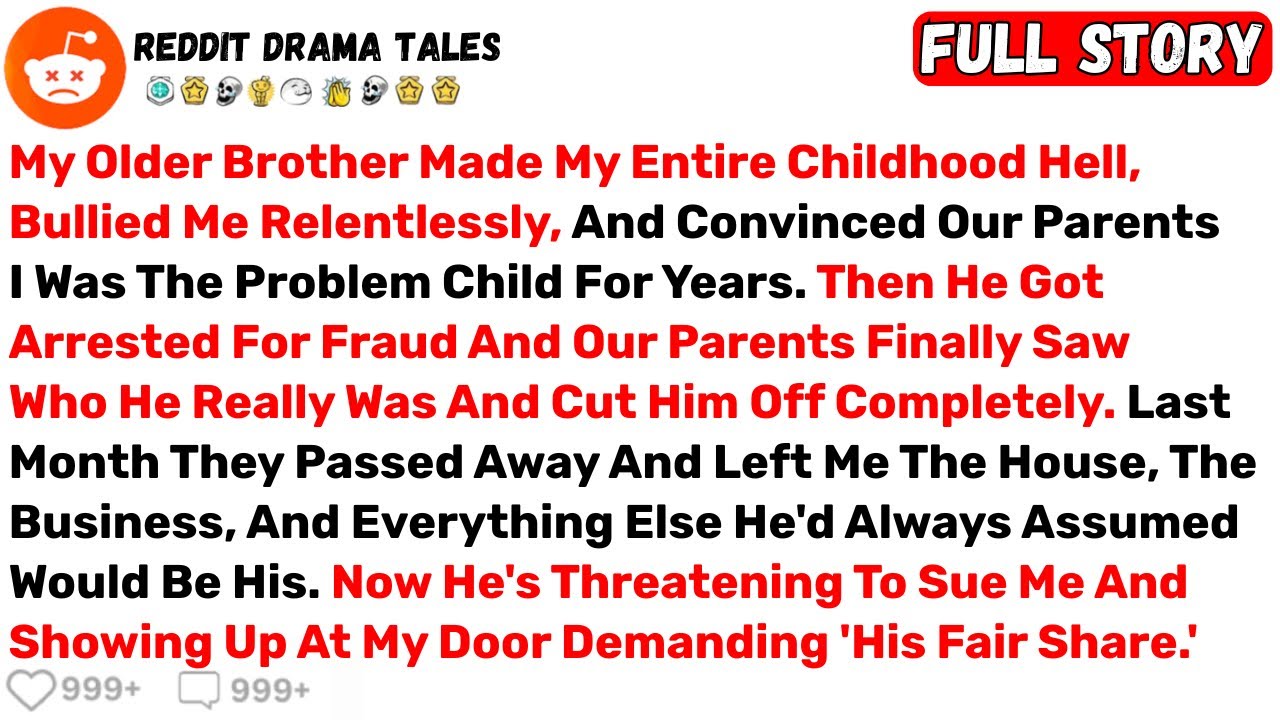
I saw a weapon of humiliation, a psychological warfare expert who broke a lamp and watched me get grounded for two weeks while he grinned from the hallway like a wolf. When I tried to tell my parents what was happening, they waved it off. “He’s just teasing,” Mom would say. “You need to toughen up,” Dad would add.
By the time I was fifteen, Nathan had convinced most of the family that I was lazy, ungrateful, and impossible. If I got a B on a test, he joked that even the dumb kids in his class managed A’s. When I got into graphic design, he announced at dinner that I was studying how to draw cartoons for a living. Everyone laughed.
I stopped trying to explain. College out of state was my first real escape. I built a small design business from nothing, made friends who actually liked me, and slowly started to feel like I was worth something. But every visit home reset that progress.
Nathan, working for our dad’s company on sheer nepotism, would talk loudly over dinners about real business and real work. Once he raised a glass in a toast. “To David,” he smirked. “May your dream of designing comic book ads finally pay the rent.
”
No matter how far I got, part of me kept waiting for them to finally admit they were wrong about me. It never came. Not until Nathan got arrested. My cousin Ben called about a year ago.
“Did you hear about Nathan? ” My stomach dropped. I expected an accident or worse. But Nathan had been indicted for wire fraud.
For two years, he’d been skimming from vendors, creating fake shell companies, routing payments through them to steal thousands from my dad’s own business. When the court documents came out and the local news picked it up, my parents couldn’t hide from the truth. Nathan wasn’t a saint. He was just good at pretending.
My father aged ten years in a month. My mother stopped hosting Sunday dinners. For the first time in my life, they turned to me. They listened.
They started showing up. It was too little, but not too late. When they passed a few months ago, within weeks of each other—my father from a stress-induced heart attack, my mother from pure heartbreak—they left everything to me. The house.
The company. Their savings. Their final letter said I’d always been the steady one, and that they could see it now. Nathan wasn’t mentioned.
He found out quickly. The first message came two weeks after the funeral. A single line: “We need to talk about what’s mine. ” Then a voicemail.
Then he showed up pounding on my door, calling me a poisoner, a manipulator, claiming the business was his birthright. He told me he was going to sue, that I had no right to the house, that Dad had only cut him out because I’d turned him against him. When I didn’t open the door, he started calling cousins and aunts, telling them our parents had been confused near the end, that I’d isolated them, that I’d played the long game to make myself look good. Some of them believed him.
An aunt sent me a cold text. “If this is how you treat family, David, I don’t know who you are anymore. ”
Then my car windshield was smashed. Someone spray-painted the word “thief” across my gate.
Police reports went nowhere. But the worst came when Claire, my mother’s sweet old friend, called me. Nathan had come to her house unannounced, asking her to sign an affidavit claiming my mother had expressed confusion about the will before she died. Claire refused, but she warned me he’d already convinced at least two other people I hadn’t spoken to in years.
I was furious. At Nathan, but also at myself for still clinging to the fantasy that we could be brothers, that grief would change him. It hadn’t. He was rewriting history like it was a business strategy.
The moment that broke me came on a warm Saturday afternoon. I was sorting through old photo albums when the doorbell rang. I opened the door, expecting yelling. Instead, Nathan stood there in a tailored gray blazer, sunglasses perched on his head, a manila envelope in his hand.
“David,” he said coolly. “You’ve got two options. Either we split everything like grown-ups, or I ruin you. ” When I told him he’d already tried, he chuckled.
“No, that was just the preview. ” He handed me the envelope and walked away. Inside were printed fake emails. Someone had created a Gmail account in my father’s name, crafting messages that suggested my dad had been coerced into rewriting the will.
There were references to pressure and regret, and an attached statement supposedly from my mother, claiming she was concerned about my influence. It was laughably bad. The grammar was off, the tone wrong. But to a judge who never knew my parents, it could plant enough doubt to throw everything into chaos.
I sat on my couch for hours, staring at the envelope like a loaded weapon. I called a lawyer the next day. We fought back, but Nathan escalated. He filed a formal petition to contest the estate, citing undue influence.
His team submitted the fake emails. I went through depositions while he showed up at my office, at my cafes, feeding lies to my employees and vendors. Then he targeted Julia, my father’s former assistant of nearly two decades, who had testified in my support. A week after her testimony, someone broke into her car.
They left a manila envelope on the seat with screenshots of her son’s social media, her home address, and a single line: “Perjury has consequences. ”
She called me sobbing. That was the moment I knew Nathan had crossed a line he couldn’t come back from. I sat on the floor of my hallway for over an hour that night, back against the cold wall, thinking about how we got here.
I remembered being seventeen, Nathan drunk-crashing the car we shared and convincing my parents I had taken it without permission, watching the fury in my dad’s eyes. Nathan played video games upstairs without a care that night. I sat in the kitchen, wondering if it would always be like this. That night, I decided it wouldn’t be.
I fired my lawyer. He was competent, but he saw this as just another messy inheritance dispute. I needed someone who saw Nathan for what he was. After three weeks and dozens of consultations, I found Fiona Romani, a former prosecutor known for her tenacity.
She didn’t blink at the fake emails. She didn’t flinch at the intimidation tactics. She just leaned forward and said, “Let’s bury him in truth. ”
I rebuilt everything while we prepared.
I started therapy. My therapist said something that stuck: I’d spent my whole life surviving my brother’s presence, and it was time to build a life in his absence. I started framing my own artwork on the walls, hosting dinners for friends, sleeping again. The house began to feel like a home.
Fiona and I built a counteroffensive. Not just legal rebuttals, but a full documentation package of who Nathan really was. We gathered security footage of his harassment, testimonies from people he’d intimidated, bank statements. I reached out to Leonard, my father’s old business partner, who remembered catching Nathan altering invoice data years ago.
He wrote a sworn statement and dug up old emails proving he had flagged the suspicious transactions. One by one, others stepped forward. Claire testified about the attempted bribery. Julia bravely submitted her affidavit.
Even old teachers sent letters about Nathan’s history of manipulation. But I needed one more piece. In my parents’ home office, I found an old external hard drive in a drawer labeled “dad work stuff. ” Inside was a folder named “contingency.
” It held three audio recordings, private conversations between my father and mother from the last months of their lives. In one, my dad said clearly, “I want to make sure David has everything. Nathan’s already had his share. He took it the day he betrayed us.
” In another, my mom said I’d always been the one who stayed, the one who listened, and she didn’t want me to think they didn’t see me. In the final one, weeks before they passed, my dad said, “If Nathan contests this, it only proves we made the right choice. ”
I sat frozen at my desk, tears streaming down my face. They knew.
They understood. They saw me. And now I had their voices to prove it. The confrontation came three days before the trial.
Nathan showed up unannounced, but this time I opened the door. He looked smaller than before, the arrogance dampened. He started with the usual plea. “This doesn’t have to go to court.
Just brothers, one-on-one. ” I reminded him that Mom and Dad were clear enough to leave him out of the will. He insisted I’d poisoned them. I told him he’d finally revealed who he always was, and our parents couldn’t ignore it anymore.
He threatened to sue, to bring statements and people to his side. I listed his failures: the people he harassed, the fake Gmail accounts, the shell companies, the consulting fees, even the poorly anonymized email he used to pitch the smear article. Then I handed him an envelope. Inside were a cease and desist listing every documented instance of his harassment, a motion for an IRS audit with highlights of his shell corporations, and a printed transcript of the audio recordings.
“I have the originals,” I said. “Authenticated, admissible, and scheduled for submission the morning of the trial. ” He was pale. “You planned all this,” he whispered.
I nodded. “You taught me how. ” He turned, walked to his car, and drove away slowly, swallowed by the trees. On the trial date, Nathan didn’t show up.
His lawyers filed a motion to withdraw the contest without explanation. The judge asked if I wanted to proceed with my defamation counterclaim. I looked around the courtroom at Julia in the back row, at Leonard who had made the trip, at the life I had rebuilt. “No, your honor,” I said.
“We’re satisfied. ” The estate was ruled uncontested. Everything remained mine. A week later, the IRS called to thank me for the documentation.
That same month, Nathan sold his car and his house. One shell company shut down. Word spread. A second fraud investigation was opened.
The last I heard, he moved to an isolated rental out of state under someone else’s name. I still think about him sometimes, not with hatred, but with clarity. He spent his life building a house of mirrors—shiny on the outside, hollow behind every reflection. When the truth finally broke through, there was nowhere left for him to hide.
As for me, I still live in the house my parents left me. I keep their letters in a drawer. Their photos hang in the hallway. And every time I walk past the mirror now, I recognize the man looking back.
I’m no longer the brother in the background. I’m the one who stayed, the one who stood up, the one who finally got to speak. He spent his life trying to erase me, but in the end, I was the one who wrote the last chapter.