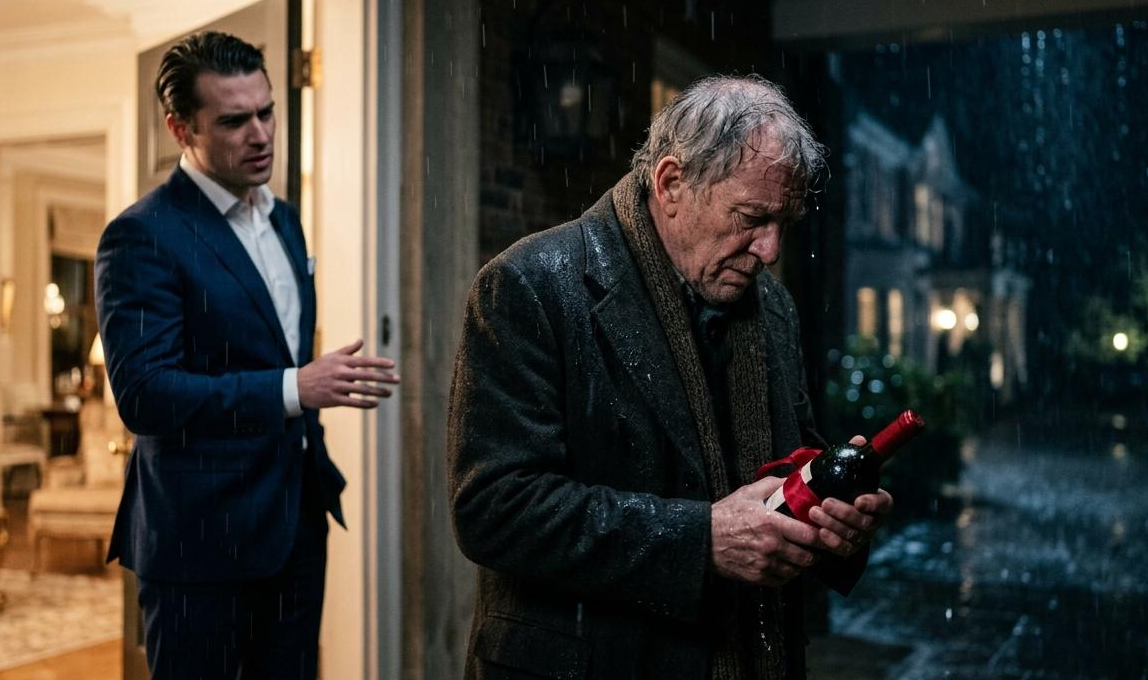
Katrina’s chair scraped hard against the floor as she stood up. Her face tightened in a way I recognized too well, and she screamed, “Don’t fight with my husband in our house. Shut up or get out. ”
The words landed like a slap.

For a brief second, I wondered if I had misheard her. But then I saw the look in her eyes, and I knew she meant every word. It had all started with something small. We were sitting at the dinner table, just the three of us.
Katrina across from me, Peter beside her, his voice growing louder as he talked about his day, about how everyone else was incompetent, how the world was full of people who needed to be put in their place. I did not raise my voice. I did not criticize him. I simply said calmly, “Peter, maybe you could lower your voice a little.
”
That was all it took. Peter did not shout. He did not need to. He leaned back slightly, folded his arms, and smiled at me with a thin, amused expression, the kind of smile men wear when they believe they have already won.
Katrina was still breathing hard, glaring at me as if I were a stranger who had wandered in off the street. Peter tilted his head and said quietly, “You always do this, May. You walk into a home and suddenly there’s tension. You have a talent for ruining families.
”
His words were smooth, practiced, and cruel in a way that did not need volume to cut deep. Katrina nodded as if he had spoken a truth she had been waiting years to hear out loud. I looked at my daughter, the child I once held through fevers and nightmares. The girl I taught to tie her shoes and balance a checkbook.
And I realized she was not seeing me anymore. She was seeing a problem, an embarrassment, a reminder of things she wanted to forget. She crossed her arms and said, “We were finally having a peaceful evening until you opened your mouth. You always have to stir things up.
”
Peter leaned forward slightly. “You should be grateful we even let you sit at this table. Other parents your age end up alone because no one can stand them. ”
He said it gently, as if offering advice.
And that was what made it so poisonous. Katrina did not object. She did not defend me. Instead, she added, “You always make everything about you.
This is our house, our rules, and you don’t get to disrespect my husband here. ”
I wanted to remind her that I had not disrespected anyone, that I had spoken as softly as a person could. But I knew it would not matter. Logic has no place where contempt has already taken root.
Peter watched me closely, measuring whether his words were landing. And when he saw that I was not responding the way he expected, his smile widened. “See, she does this every time. Plays the victim.
That’s how she controls people. ”
The irony of being accused of control while being told to shut up or leave was not lost on me. But I did not point it out. I had learned that confronting lies does not always weaken them.
What hurt most was not the shouting, not even the insults, but the certainty with which my daughter spoke, as if she had rehearsed these lines in her head long before this dinner. She told me I was lucky they tolerated me, that I should know my place, that if I wanted peace, I needed to stop causing problems. I finally looked at Peter and said very quietly, “I never meant to fight. ”
He shrugged.
“Intent doesn’t matter when the damage is always the same. ”
Katrina turned away from me then, signaling that the conversation was over, that my feelings were irrelevant. In that moment, sitting at that table, I felt the last thread of hope loosen inside me. I realized I was no longer fighting to be understood.
I was fighting to survive with my dignity intact. It had not always been this way. I became a widow when Katrina was still young enough to believe that promises could keep a man alive. Her father died suddenly, leaving behind a stack of unpaid bills, a quiet house, and a child who looked at me every night as if I were the last solid thing in her world.
I learned very quickly that grief did not excuse responsibility. I packed mine away where it would not interfere with what needed to be done. I went back to work as a bookkeeper, then as an accountant, because numbers were honest in a way people were not. I made lists, budgets, plans.
I saved where others spent, repaired where others replaced, and said no more often than yes. Katrina did not grow up with lavish birthday parties or closets full of clothes. Other mothers baked cupcakes and hugged their children in front of everyone. I packed nutritious lunches and reminded her to bring a jacket.
I did not know how to perform affection. I knew how to provide safety. When she wanted to go to college, I calculated how to make it happen. When she needed a car, I bought a used one outright so she would not start her life buried in debt.
I attended her school meetings and expected her to meet the standards I set. Katrina learned early that I did not praise easily. Compliments felt unnecessary to me when effort was expected. She watched other mothers gush and applaud while I nodded and said, “Good.
Now keep going. ”
I believed that consistency mattered more than enthusiasm. I did not understand that children often want their parents to sound like cheerleaders, not managers. I did not understand how much she longed to be seen as special, not just responsible.
As she grew older, that difference widened. Katrina became acutely aware of appearances. She wanted to fit in, to be admired. I remained practical, quiet, unimpressed by flash.
When she complained that I embarrassed her by dressing plainly or speaking too directly, I dismissed it as teenage sensitivity. What I did not see was that my refusal to perform motherhood the way others did made her feel exposed. In her mind, I was not just different. I was a liability.
Still, I never abandoned her. Even when she married Peter, a man whose charm felt rehearsed to me, I stayed quiet. I offered help when asked, money when needed, and distance when requested. I thought that was respect.
I thought restraint would earn trust. It did not. Twelve years earlier, before the shouting became routine, there was one night that changed everything. Katrina and Peter had been married less than two years then.
I was visiting for the weekend, sleeping in the small guest room down the hall, when I heard raised voices through the walls. I told myself it was none of my business. Then I heard a sharp sound, the kind that does not belong to words, followed by Katrina crying out in surprise more than pain. I opened the door and saw her on the floor, one hand braced against the coffee table, her face flushed and stunned.
Peter stood over her, breathing hard, his fists clenched. He said it was an accident. He said she had provoked him. He said he was under pressure at work and anyone would have snapped.
Katrina looked at me then, not with anger, not yet, but with something like a plea, as if she wanted me to see it the way she needed to see it. I helped her up, asked if she was hurt. She nodded no too quickly. Peter kept talking, filling the room with reasons and justifications.
And I realized with a cold clarity that this moment would either be buried or it would be named. I had buried too many things in my life already. I stepped into the kitchen and called the police. When the officers arrived, the house changed shape.
Neighbors came out onto their porches. Katrina sat on the couch, arms wrapped around herself, answering questions she did not want to answer. Peter’s tone softened, his words careful now, crafted for witnesses. No one was arrested, but the message was clear enough.
When they left, the silence that followed was worse than the shouting that had come before. Katrina did not thank me. She turned on me with a fury I had never seen before and said, “How could you do this to me? ”
I thought she meant the shove, the fear, the humiliation.
But she meant the call. She meant the exposure. She meant the neighbors. “You made everything worse,” she said.
“You made us a spectacle. ”
In the days that followed, she told me I had betrayed her, that I had chosen drama over family, that marriage was complicated and I had no right to interfere. When I tried to explain that I had acted out of fear for her safety, she cut me off. “You didn’t protect me,” she said.
“You humiliated me. ”
Later, when things seemed calm again, when Peter returned with apologies and promises, Katrina confronted me with the sentence that would echo in my head for years. “You made me look like a woman who couldn’t keep her husband. ”
In that moment, I saw the truth I had been circling without naming.
She did not hate me because I had heard her. She hated me because I had forced her to see herself as vulnerable. And vulnerability was the one thing she could not forgive. From then on, the story shifted.
Peter’s shove became stress. His temper became frustration. My call became the real offense. I was labeled dramatic, intrusive, destructive.
There was no version of my presence that did not feel like a threat to the narrative Katrina needed to survive. That night taught Peter something too. He learned that I would not look away. So he reframed me slowly and carefully as the problem.
He suggested I exaggerated. He hinted that I enjoyed conflict. He told Katrina that I wanted control. It worked because it gave her an explanation that preserved her pride.
If I was the villain, she did not have to be the victim. When I moved in with them later, the abuse lived in words chosen carefully enough to be denied afterward. Katrina would sigh when I entered a room, roll her eyes when I spoke, exchange looks with Peter that said everything without saying anything at all. If I asked a simple question, she answered as if I were slow.
If I stayed silent, she accused me of sulking. Peter perfected the art of quiet dominance. He never raised his voice with me. Instead, he leaned close and spoke just low enough that only I could hear him.
“You should be grateful we let you stay here,” he would say, his expression neutral, almost bored. “Most parents your age don’t get this kind of kindness. ”
When I looked to Katrina for reassurance, she would look away. That night at the dinner table, when she screamed at me, it felt less like an argument and more like a verdict that had been waiting years to be announced.
“Shut up or get out! ”
The room went quiet in that peculiar way it does when something irreversible has been said. I could hear my own breathing, slow and even. My body refused to panic.
Peter did not rush to comfort her. He waited until her words settled. Then he added his own calmly, deliberately, like a man tightening a knot. “Honestly,” he said, glancing at me as if I were an object left in the wrong place, “if you disappeared tomorrow, this house would finally feel peaceful.
”
He said it without anger, without cruelty in his tone. And that was what made it so devastating. It was not a threat. It was a conclusion he had already reached.
Katrina nodded slightly, as if he had articulated something she had been afraid to say out loud. My first instinct was to explain, to remind Katrina of the years when it was just the two of us, of the nights I stayed up balancing accounts so she could sleep without worry. But those memories belong to me now. I understood that offering them would not bring me closer.
It would only give them more to dismiss. So I stayed quiet. And Katrina mistook my calm for defeat. “See, this is what I mean,” she said, throwing her hands up.
“You never say anything when it matters. ”
The irony almost made me smile. When I spoke, I was accused of causing problems. When I stayed silent, I was accused of withholding.
There was no version of me that fit the role she needed me to play. As they continued talking, justifying themselves, listing my supposed flaws as if presenting evidence, something inside me shifted. I stopped listening to the words and started paying attention to the pattern. They were not angry because I had done something wrong.
They were angry because I existed outside their control. My presence challenged the story they told themselves, that they were kind, reasonable people burdened by a difficult old woman. Peter leaned forward and said, “We’ve been patient long enough. This situation isn’t healthy.
”
Katrina added, “I need to protect my marriage. ”
That sentence landed heavily because it reframed everything. I was not her mother in that statement. I was a threat to be managed.
I realized then that I had been hoping for something that no longer existed. Hope had kept me enduring small humiliations, convincing myself they were temporary. In that moment, hope became a liability. And I felt an unexpected sense of relief.
Not from being told to leave, but from the clarity of knowing that nothing I did would restore what had already been lost. I no longer had to perform, to soften myself, to prove my worth. For the first time in years, I saw the situation as it was, not as I wished it to be. Katrina waited for me to beg.
I could see it in her posture, the slight pause, the expectation that I would scramble to reassure her. When I did not, confusion flickered across her face. Peter frowned, sensing a shift he could not quite name. I met their eyes and felt no urge to defend myself.
Defending myself would mean accepting their authority to judge me. I no longer accepted that. When I finally spoke, my voice was steady. “I hear you,” I said, not as an apology, but as an acknowledgement.
Peter scoffed. Katrina looked away. They assumed this was the end of the conversation, that I would retreat to my room and absorb the blow quietly, as I always had. They did not know that something fundamental had changed.
I walked back to my room that night with a strange sense of calm. The walls no longer felt like a prison. They felt temporary. I sat on the edge of the bed and replayed the evening in my mind, not to punish myself, but to understand it fully.
They had drawn a line. And in doing so, they had given me something I had not realized I needed: permission to stop trying. The preparation had begun years earlier. In the quiet aftermath of the night the police stood in Katrina’s living room, I had started planning.
Not out of revenge, but out of clarity. I realized that love without structure was not protection. Silence without boundaries was not peace. If I wanted to age with dignity, I needed to prepare for the version of my future where my voice would no longer be welcomed.
The attorney I chose was not a dramatic man. He listened more than he spoke. When I told him what had happened, I did not embellish. I described the shove, the police visit, and my daughter’s reaction afterward.
He nodded and said something that stayed with me. “Planning is not punishment. It is clarity. ”
Together we created a living trust.
It included clear ethical conditions written in plain language. Any beneficiary was required to maintain a relationship free from physical or emotional abuse toward me. Verbal expulsion, humiliation, or coercion were explicitly defined as violations. I did not hide these conditions.
I told Katrina I had arranged my affairs and that certain standards mattered to me. She laughed it off, calling me dramatic. Peter smiled politely and said nothing. I also asked my attorney about recording conversations.
In our state, one-party consent was legal. I did not record secretly out of malice. I recorded openly, telling them it helped me remember. That was true.
Memory can be manipulated when you are told repeatedly that your experience is wrong. The recordings were not weapons. They were anchors. Years passed.
The trust remained unchanged, reviewed annually, adjusted only for practical reasons. I never added clauses in anger. I never removed anyone impulsively. I simply lived, observed, and documented.
After the night Katrina told me to shut up or get out, I knew the conditions had been met. Not in a technical sense, but in a moral one. Still, I did nothing immediately. I called my attorney the next morning and asked him to review the material I had.
He listened to the recordings carefully. When he finished, he closed the folder and said, “This is clear. ”
A week later, he came to the house. Katrina was surprised to see him, clearly assuming this was about updating a will.
Peter offered him a seat, confident, relaxed. My attorney explained that he was there to clarify the current standing of my living trust. Katrina frowned, already impatient. Peter crossed his arms, his confidence beginning to thin.
The attorney read the relevant section aloud, slowly, deliberately. He read the definitions of emotional abuse. He read the clause about verbal expulsion. He referenced dates, times, and documentation.
He did not raise his voice. He simply stated facts. Katrina interrupted, saying this was ridiculous, that families fight, that nothing serious had happened. My attorney held up a hand and continued reading.
When he reached the conclusion, the room felt smaller. “Based on documented violations of the trust’s ethical conditions,” he said, “Katrina and Peter are hereby removed as beneficiaries. ”
The words hung in the air, heavy and unmistakable. Peter stood up abruptly, his chair scraping loudly against the floor.
Katrina stared at me as if she were seeing me for the first time. “This is a trap,” Peter said. “You planned this. ”
My attorney responded calmly that the trust had been established years earlier and that the conditions were clear and unchanged.
Katrina turned to me, her face pale. “Mom, you didn’t have to do this. We’re family. ”
I looked at her and felt no urge to defend myself.
“I didn’t do this to you,” I said quietly. “I prepared for myself. ”
That was the truth. I had not waited for them to fail.
I had simply refused to ignore the pattern when they did. Peter argued. Katrina cried. Neither changed the outcome.
When the attorney left, the house was silent in a way it had never been before. The power dynamic had shifted, not because I had taken something from them, but because they could no longer pretend their actions were inconsequential. I stood up slowly and said nothing more. There was nothing left to explain.
The trust had told the truth when my voice was no longer heard. I returned to my room and closed the door, not in defeat, but in completion. Katrina’s voice broke the silence first. “So that’s it!
” she screamed, her words shaking. “You choose strangers over your own daughter? ”
Her face twisted as if the pain had finally found a way out. And for a moment, I saw the child she used to be, the one who needed reassurance more than pride.
But that moment passed quickly, replaced by accusation. Peter did not move toward her. He stepped back, as if distance might absolve him. “This is insane,” he said sharply.
“This is all because you couldn’t keep your mouth shut years ago. ”
He pointed at me, his finger trembling not with rage, but with fear. “You turned her against me. You always wanted control.
”
Katrina turned to him, stunned. “Against you? ” she cried. “You said we were fine.
You said she was just being dramatic. ”
Peter’s jaw tightened. “I said what I had to say. You were the one who kept her here.
You were the one who let this happen. ”
The shift was sudden and unmistakable. The man who once spoke of unity now spoke only of survival. He grabbed his jacket from the chair.
“I’m not dealing with this. I won’t be punished for her issues. ”
Katrina reached for him. “You’re not leaving,” she said, her voice cracking.
“You can’t leave now. ”
Peter hesitated for only a second, then looked at her with something like irritation. “I need space. This is too much.
”
He did not look back at me as he walked out. The door closed behind him with a finality that echoed through the house. In that sound, I heard years of denial collapse. Katrina turned toward me, her anger dissolving into something raw and frightened.
“Mom,” she said, her voice lower now, almost pleading. “You didn’t have to do this. We could have worked it out. ”
I watched her carefully, noting how quickly her words shifted once the consequences became real.
I waited because I understood something she did not yet see. “I didn’t choose anyone over you,” I said finally, my voice steady. “I didn’t choose at all. I stopped enduring.
”
Katrina shook her head violently. “That’s not fair. You’re my mother. You’re supposed to forgive.
”
I felt a quiet sadness settle in my chest. “I forgave more than you know,” I replied. “What I stopped doing was pretending that forgiveness meant accepting harm. ”
She stared at me as if I were speaking a foreign language.
For the first time, the story she had built began to crack. She paced the room, listing everything she had done for me, every sacrifice she believed she had made. I listened, recognizing the familiar pattern of bargaining. When that failed, her voice turned sharp again.
“You ruined my marriage. ”
The sentence landed heavily, not because it was new, but because it was finally hollow. “I didn’t ruin anything,” I said quietly. “I stepped out of the lie that was holding it together.
”
That was when she stopped pacing and looked at me with something close to fear. Without me as the scapegoat, the problems she had blamed on my presence had nowhere to hide. Hours passed without resolution. Peter did not return.
Katrina sat at the table staring at nothing. I watched her and felt no triumph. What I felt was a deep, aching clarity. This was the consequence of choosing denial over truth for too long.
When I finally stood to leave the room, Katrina looked up at me, her eyes red and swollen. “What happens now? ” she asked, her voice barely audible. I paused, choosing my words carefully.
“Now you live with what’s real. Just like I had to. ”
I did not offer comfort she was not ready to accept. I did not promise reconciliation.
I simply told the truth. I did not stay long after that night. I packed quietly, choosing only what belonged to me. Not because I was angry, but because I was finished.
Katrina watched from the doorway, her face unreadable, as if she were still waiting for me to change my mind, to return to the version of myself she could manage. I did not give her that. I gave her silence. Not the wounded kind, but the kind that comes after a decision has already been made.
In the weeks that followed, I put the last pieces of my affairs in order. A portion of my assets was directed to a foundation that supports women escaping abusive homes. I knew how easy it was for harm to hide behind closed doors and polite explanations. I also made sure a small but meaningful gift went to the neighbor who had once stood on her porch twelve years earlier, phone in hand, waiting with me until the police arrived.
She never asked questions, never spread rumors. She simply showed up when it mattered. Katrina called once late at night, her voice tight and uncertain. She did not apologize.
She asked questions that circled around the truth without touching it. She wanted to know if things could ever go back to the way they were. I told her gently that I was not interested in going backward. That conversation ended without resolution, but it did not haunt me.
I had learned that not every ending needs agreement to be complete. Peter did not reach out at all. From what I heard, he framed the situation as an overreaction, an unfortunate consequence of my rigidity. That did not surprise me.
Men like him need a villain to avoid accountability. It no longer concerned me. I moved into a small, quiet place of my own. Nothing extravagant.
For the first time in years, I slept without tension in my shoulders, without rehearsing conversations in my head. I did not feel victorious. I felt intact. People often assume that justice must look loud to be satisfying.
That was never what I wanted. I did not need Katrina to beg or Peter to suffer. What I needed was to stop sacrificing my dignity in the hope of being tolerated. The satisfaction came not from what they lost, but from what I reclaimed.
My sense of self. My right to define my own reality. My freedom from a role that demanded my erasure. There are moments, of course, when grief returns unexpectedly.
I grieve the daughter I thought I had. But grief no longer controls my decisions. It walks beside me now. Acknowledged, but not obeyed.
On my last visit to collect a few remaining items, Katrina stood in the hallway watching me as if she were seeing a stranger. “I never thought it would end like this,” she said quietly. I met her eyes and felt no anger, only a calm certainty. “Neither did I.
But endings are not always failures. Sometimes they are corrections. ”
She did not respond. Some truths take longer to settle.
As I drove away, I did not look back at the house. It no longer represented home to me. Home, I had learned, was not a place where I was merely allowed to exist. It was a place where my presence did not require justification.
That understanding came late in my life, but it came clearly, and it changed everything. When someone tells you to get out, pay attention. Not because they have power over you, but because they are revealing who they are willing to be to keep their comfort intact. Katrina told me to shut up or leave.
And in doing so, she forgot one important thing. I had been preparing for that moment for a very long time. I did not walk away defeated. I walked away ready, carrying with me the one thing no one had managed to take.
My dignity, intact. And finally, my own.