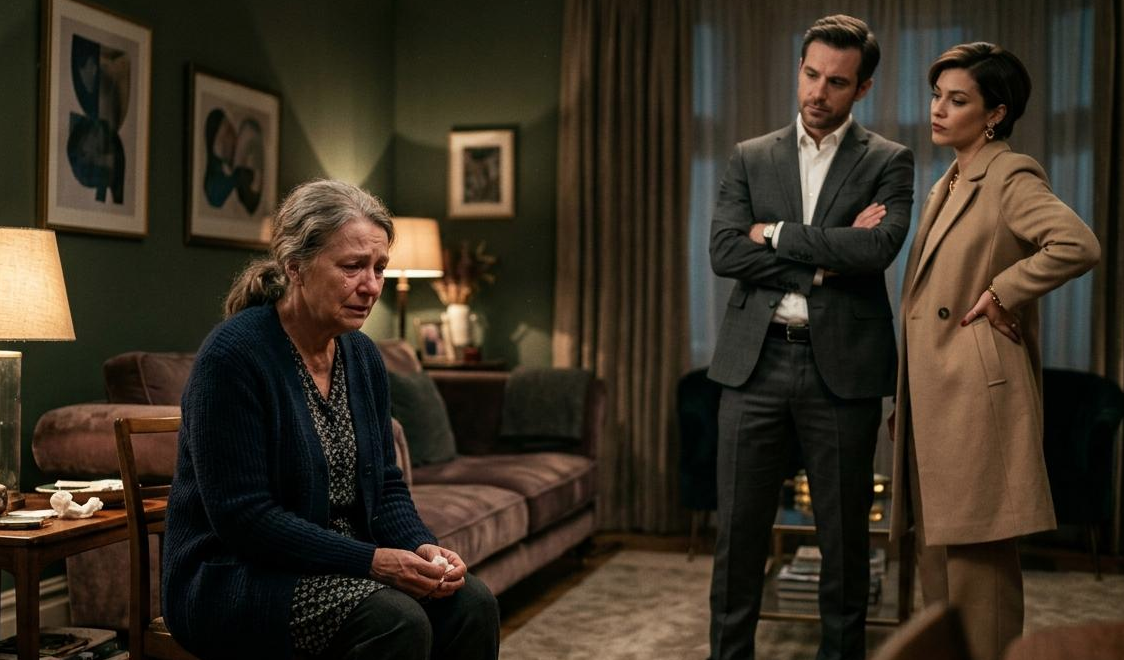
My father sent me that text the day after my mother’s funeral. “Your mother’s funeral was yesterday. Stop hiding behind grief. Cancel the rest of your leave and be at your desk Monday or don’t come back.

”
I didn’t respond. That was eight months ago. Now he’s begging me not to hand the company he built to the one person he betrayed. Let me start by saying something that’s going to sound strange.
My father is not a bad person. He built a company from a folding table in a rented warehouse. He employed 200 people. He coached my little league team and taught me how to drive stick in a parking lot behind a Lowe’s when I was fifteen.
Hold that in your head while I tell you what he did, because if you think of him as just a villain, you’ll miss the point of all of this. My name is Caleb. I’m 34, and until eight months ago, I was the director of operations at Whitfield Industrial Supply, a mid-size industrial distribution company based out of Charlotte. My dad, Ray, founded it back in 1998 with my Uncle Martin, my mom’s brother.
They grew it from nothing into a company doing north of $40 million a year. Warehouses, fleet trucks, vendor contracts across 11 states. A real blue-collar success story. I joined right out of college.
Not because my dad pressured me, but because I genuinely loved the business. I spent twelve years rebuilding our logistics systems, digitizing inventory management, renegotiating vendor contracts. I’m not bragging. I’m telling you this because it matters later.
My parents divorced when I was 26. It was ugly, most divorces are. Not dramatic, just sad and slow. My mom, Linda, got the house in the settlement.
My dad got the company. About 18 months after the divorce was finalized, he married Denise. Denise is 42, sharp, polished, and works a room like she’s running for office. She came from pharmaceutical sales and brought that energy into my dad’s life.
Within a year, she’d redecorated his house, restructured his social circle, and started offering suggestions about the company. My dad ate it up. He’d spent 30 years making decisions alone. Having someone whisper strategy in his ear felt like partnership.
I get it. I didn’t like it, but I got it. Then came Troy. Troy Callaway is Denise’s younger brother.
38, business degree from a school I’d never heard of, zero experience in distribution or logistics. Denise pitched him to my dad as a fresh perspective for business development. My dad created a VP title for him about 14 months ago, Vice President of Business Development. I remember reading the internal announcement email and just sitting there for a solid minute.
Here’s the thing about Troy. He’s not dumb. He’s actually pretty likable. He just has no idea what he’s doing in industrial supply, and instead of learning, he came in acting like he’d been there for years.
He’d schedule meetings with vendors I’d spent a decade cultivating and renegotiate terms without telling me. I brought it to my dad twice. Both times he said, “Give him room to grow, Caleb. He’s family now.
”
Family. Right. I started keeping a folder on my desktop called Troy. Just notes, dates, contracts he’d touched, vendors who’d called me confused about new terms they hadn’t agreed to.
I didn’t know what I was going to do with it yet. I just knew something felt off. And I learned a long time ago that when something feels off, you document first and decide later. But I kept my head down because my mom was sick.
Pancreatic cancer, diagnosed 14 months before she died. Stage three when they caught it. She fought like you’d expect someone like her to fight, quietly, practically, without making it anyone else’s problem. I drove to her place three nights a week after work.
I sat with her during chemo. I handled her insurance paperwork because the system is designed to break you when you’re already breaking. My dad came to see her exactly once during her treatment. Once.
They were divorced, sure, but she was the mother of his only child and they’d been together for 23 years. He sent flowers to the hospital. Denise picked them out. I know because the card said “Ray and Denise Whitfield,” and my mother looked at it and said, “Well, at least she has good taste in lilies.
”
That was my mom. Dry as dust even at the end. She died on a Thursday in October. I was holding her hand.
Uncle Martin was on the other side of the bed. My dad was at a trade show in Atlanta. I called him that night. He said he was sorry.
He said he’d be at the funeral. He was. He sat in the third row with Denise, stayed for 20 minutes at the reception, and left. I didn’t have the energy to feel anything about it.
I didn’t cry at the funeral. I don’t know why. I cried plenty in the months before, sitting in hospital hallways and in my car in the parking garage at work. But at the service itself, I just felt hollow, like someone had scooped everything out and left the shape of me standing there in a suit, shaking hands.
I took bereavement leave. The company policy gives five days. I requested two weeks because I was also handling her estate. She’d left me the house, some savings, and a lot of paperwork.
HR approved it without issue. Three days into my leave, I got the text from my father. I’m going to write it out exactly as it appeared on my screen because I’ve read it probably 400 times and I’ve memorized every word. “Your mother’s funeral was yesterday.
Stop hiding behind grief. Cancel the rest of your leave and be at your desk Monday or don’t come back. ”
I sat on my mom’s couch in her living room, surrounded by boxes of her things, and I read it three times. Then I set the phone down on the coffee table and I didn’t respond.
I didn’t respond that night. I didn’t respond the next morning. I haven’t responded to this day. But here’s the part I need to tell you about.
Three days before my mom died, she was having a clear afternoon. Lucid, calm, almost herself. She asked me to sit down and she told me something she’d been carrying for years. She said there was a Manila envelope in the bottom drawer of her nightstand behind a box of old photographs.
She said it had to do with Martin, with how my dad forced him out of the company back in 2016. She said, “I should have given these to your uncle years ago. I was too afraid of what it would do, but your father won’t make it right and I can’t leave without knowing someone will. ”
I told her I’d take care of it.
That night, after my dad’s text, I walked into her bedroom. I opened the nightstand drawer. I moved the box of photographs and pulled out a thick Manila envelope with my uncle’s name written on the front in my mother’s handwriting. I held it in my hands for a long time.
I hadn’t opened it yet. I opened the envelope the next morning. I made coffee first, used my mom’s old drip machine, the one with the cracked handle she never replaced because “it still works fine. Caleb, don’t be wasteful.
” I sat at her kitchen table with the envelope in front of me and drank half the cup before I touched it. Inside were photocopies. My mom had been thorough. She’d copied everything and organized it with those little colored tabs she used for everything.
There was a cover letter she’d written to Martin that she never sent, dated 2019. Three years she’d sat on this. Here’s what the documents showed. When my dad forced Martin out of the company in 2016, the buyout was based on a business valuation.
Martin held 40% of the company. The valuation came back at a number that made Martin’s stake worth about $1. 6 million. It was a down year.
A couple of big contracts had ended, revenue was soft. Martin took the deal because my mom begged him to avoid a lawsuit. She didn’t want the family torn apart. What Martin didn’t know, what my mother found in my dad’s home office two years later while they were still married, was that at the time of the valuation, my dad had already signed a major distribution contract with a national construction supply chain.
The contract was worth $2. 3 million annually and would have transformed the company’s valuation. My dad had signed it six weeks before the buyout was finalized. He never disclosed it.
The appraiser never saw it. Martin’s 40% should have been worth close to double what he received. My mother’s unsent letter to Martin said it plainly. “Ray hid the Ranger contract.
He signed it before your buyout closed and never told the appraiser. I found the original in his filing cabinet. I’m sorry I didn’t tell you sooner. I was afraid.
”
I sat with that for a long time. My dad, the guy who coached Little League, who built something real, had cheated his own partner, his wife’s brother. And my mom had known and carried it because she loved both of them too much to light the match. I didn’t call Martin yet.
I wasn’t ready. I needed to think. But I also needed to understand what was happening at the company right now, because my dad’s text wasn’t just cruel. It was strategic.
He wanted me back at my desk or gone. There was no middle ground. And when Ray Whitfield draws a line like that, there’s usually a reason. So I started digging.
I still had remote access to the company systems. My credentials hadn’t been deactivated. I was technically still on approved leave. I logged into the ERP platform and started pulling reports, vendor contracts, purchase orders, payment histories, the stuff I’d managed for over a decade.
What I found made the envelope look like a warm-up. Troy had renegotiated contracts with four of our mid-tier vendors over the past eight months. In every case, the new terms were worse for us. Higher per-unit costs, shorter payment windows, reduced volume discounts.
On paper, it looked like incompetence, a guy who didn’t know the industry making bad deals because he didn’t understand leverage. But there was a pattern. Every renegotiated contract included a new consulting fee paid to an outside firm called Callaway Strategic Partners LLC. I looked it up.
It was registered in Delaware seven months ago. The registered agent was a legal service company, but the operating agreement, which Troy had apparently uploaded to our shared vendor management folder because he’s exactly that careless, listed two members: Denise Callaway Whitfield and Troy Callaway. They’d set up a shell company. The vendors were paying consulting fees to Denise and Troy’s LLC in exchange for the renegotiated contracts.
The vendors got better terms from us. Denise and Troy got paid on the side. And the company, my dad’s company, the one Martin helped build, the one I’d spent twelve years holding together, absorbed the loss. I’m not a forensic accountant, but I’ve been reading contracts and P&L statements since I was 22.
The total skimmed across those four vendor relationships over eight months was somewhere around $340,000. Not enough to sink the company. Enough to be a felony. I saved everything.
Screenshots, downloaded files, timestamps. I put it all on an encrypted drive, and I sat back in my mom’s kitchen chair, and I thought about my dad sitting at a trade show in Atlanta while his wife and her brother robbed him blind. Part of me wanted to call him right then. Just dial the number and say, “Dad, they’re stealing from you.
” Because despite everything, the text, the funeral, the years of Denise slowly edging me out, he was still my father. And this was still his company. But then I thought about Martin. I thought about $1.
6 million when it should have been $3 million. I thought about my mother carrying that secret until it ate her up inside, and how the last meaningful thing she asked me to do was make it right. So I didn’t call my dad. Instead, I called my buddy Derek.
Derek Song, employment attorney. The kind of guy who reads contracts for fun and thinks “reasonable” is the most dangerous word in the English language. We’ve been friends since college. He’d been at my mom’s funeral.
He was the first person I called who wasn’t family. “I need to talk to you about something,” I said. “Not as a friend. As a lawyer.
”
“That bad? ” he said. “Worse. ”
We met for dinner that Friday.
I brought the envelope and the encrypted drive. Derek spent two hours going through everything while his pad thai got cold. When he was done, he leaned back and said, “Your dad is exposed on two fronts. The buyout fraud gives Martin grounds for a substantial claim.
The kickback scheme is criminal. If this goes to the right people, Ray loses the company either way. ”
“I don’t want him to lose the company,” I said. Derek looked at me like I’d said something in a language he didn’t speak.
“Then what do you want? ”
I told him I wanted to make it right, the way my mom asked me to. Not revenge. Not destruction.
Just right. Derek nodded. “Okay. Then we need to be very careful about how we do this.
And you need to talk to Martin. ”
He was right, but I wasn’t ready for that conversation yet. When I got home that night, back to my own apartment, not my mom’s house, I checked my phone. Three missed calls from a number at the office.
Not my dad’s cell, the main line. I didn’t return them. Then I opened my email and saw something that made me set the phone down very carefully on the counter. It was a company-wide announcement from HR, CC’d to my work email.
Effective immediately, Troy Callaway had been promoted to Chief Operating Officer. My old responsibilities were being transitioned to his oversight. They hadn’t fired me. They’d just erased me.
And they’d done it while I was burying my mother. I didn’t call Martin for another two weeks. I know that sounds like a long time, but I needed to make sure I understood the full picture before I brought him into this. Martin’s a good man, steady, principled, the kind of guy who tips 30% and remembers your kids’ names.
But he’d also been carrying anger about the buyout for eight years. And if I came to him half-prepared, he might do something reactive. I needed him calm. I needed him strategic.
So I spent those two weeks doing something I’m actually very good at: reading the numbers. I still had system access. Nobody had thought to revoke it, probably because nobody at the company understood how much of the digital infrastructure I’d personally built. The ERP login, the vendor management platform, the cloud-based document storage, I’d implemented all of it.
My credentials were baked into the architecture. Troy could barely find the shared drive, let alone think to lock me out of it. I pulled everything. Eight months of vendor contracts, payment records, the Callaway Strategic Partners invoices, internal communications about Troy’s business development initiatives.
I cross-referenced the consulting fees against our actual cost increases and built a spreadsheet showing exactly how much the company had lost. The number came to $347,000 and change. I also found two more vendors in Troy’s pipeline who were about to sign similar deals. If those went through, the annual bleed would push past $600,000.
Then I went deeper. I accessed the board meeting minutes and found something that made the hair on my arm stand up. Denise had convinced my dad to restructure the company’s ownership through a new family trust, The Whitfield Family Legacy Trust, she called it. Under the new structure, Ray would transfer his shares into the trust.
The co-trustees would be Ray and Denise. If Ray became incapacitated or died, Denise would become sole trustee with full control of the company. I wasn’t named anywhere in the trust documents. Not as a trustee, not as a beneficiary, not as anything.
My dad had written me out. Or more accurately, Denise had written me out and my dad had signed where she told him to sign. I saved all of it, every document, every email, every board minute. Derek reviewed everything and started building a legal framework.
“Martin has a fraud claim for the buyout,” he said. “The kickback scheme gives the board grounds to remove Denise and Troy immediately. And the trust restructuring, while legal, shows a pattern of financial manipulation that any judge would find relevant. ”
“What does Martin need to do?
” I asked. “He needs to decide if he wants the company back. ”
I called Martin on a Saturday morning. I asked if I could come over.
He lives about 40 minutes outside Charlotte, on a piece of land he bought after the buyout. A house with a shop out back where he restores old motorcycles. It’s the most Martin thing imaginable. We sat on his back porch with coffee and I laid it all out.
The envelope, my mom’s letter, the Ranger contract, the buyout fraud. I watched his face while he read. He didn’t say anything for a long time. His jaw tightened.
He set the letter down and looked out at his yard, and I could see him working through about eight years of anger in 60 seconds. “Your mother knew,” he said quietly. “She couldn’t figure out how to tell you without blowing everything up. She was trying to protect the family.
She was always doing that, even when the family didn’t deserve it. ”
Then I told him about Denise and Troy, the shell company, the kickback scheme, the trust restructuring. I showed him the spreadsheet. I showed him the board minutes.
He went very still. “They’re looting it,” he said. “Yes. ”
“And Ray doesn’t know?
”
“Honestly, I don’t know. He might know about some of it and not care. He might be completely blind. Either way, the result is the same.
”
Martin leaned forward, elbows on his knees. “What are you asking me to do, Caleb? ”
“I’m asking you if you want your company back. ”
He looked at me for a long time, not suspicious, just measuring.
Martin’s like that. He doesn’t rush decisions. “I don’t want to destroy your father,” he said. “Neither do I.
But my mom asked me to make this right. And right means you get what you were owed, and the people stealing from the company get removed. If we do this correctly, the company survives. Dad keeps a minority stake.
He just doesn’t get to run it anymore. ”
Martin sat with that. Then he said, “I’ll need my own lawyer. Derek can recommend someone.
Corporate litigation, not employment. ”
“And you’d stay at the company? ”
“If you’ll have me. ”
He almost smiled.
“Kid, you’re the only reason that place still runs. ”
Over the next six weeks, we built the case. Martin retained an attorney named Pauline Vickers, a corporate litigator out of Raleigh who spoke softly and carried precedent like a weapon. Between Pauline and Derek, we structured a two-track approach.
Track one: Martin’s fraud claim regarding the buyout, supported by my mother’s documents and the hidden Ranger contract. This gave Martin leverage to demand a renegotiation of his original stake. Track two: the kickback scheme, which would be presented to the board as grounds for immediate termination of Troy and Denise’s involvement with the company, plus potential referral to law enforcement. The idea was simple.
Use both tracks simultaneously. The fraud claim puts Ray on his heels. The kickback exposure removes his support structure. With Denise and Troy gone and his legal position weakened, Ray either negotiates a fair transfer of controlling interest to Martin or he faces litigation on both fronts.
Litigation he would almost certainly lose. During those six weeks, I acted normal. I responded to a few company emails about transition logistics. I didn’t fight the COO announcement.
I didn’t confront anyone. I let them think I’d given up. Denise sent me a text during this period. It said, “Caleb, I know things have been difficult.
Just know we’re thinking of you and there’s always a place for you here when you’re ready. ”
I read it, set my phone down, and went for a run. Troy posted a photo on LinkedIn of himself in what used to be my office. New nameplate on the desk.
The caption said, “Excited to step into this new chapter at Whitfield Industrial Supply. Growth mindset. ” He’d misspelled “industrial” in a hashtag. I screenshot it for the file.
Then, on a Tuesday evening about five months after my mom died, my dad called me. Not a text. An actual phone call. I let it ring twice, then answered.
“Caleb. ” His voice was flat, business-like. “I wanted to let you know officially, we’ve moved Troy into your role. The board approved it last week.
I held off as long as I could, but I need someone in that seat. ”
“Okay,” I said. “I need you to come in and sign separation paperwork. HR has a package put together.
It’s fair. ”
“Okay,” I said again. There was a pause. I think he expected me to argue, to yell, to say something about the text he’d sent or the funeral or twenty years of working for him.
I didn’t give him any of it. “You made your choice, son,” he said. And I could hear it in his voice. Not cruelty exactly, but the absolute certainty of a man who has never once considered that he might be wrong.
“Yeah,” I said. “I did. ”
I hung up. Then I texted Martin.
“They just officially replaced me. We’re clear to move. ”
Martin replied with one word. “Good.
”
The letter went out on a Wednesday. Pauline’s firm sent it via certified mail to Ray at the company’s registered address and to his home. Two copies, same contents. The letter outlined, in meticulous legal language, Martin Pryor’s claim regarding the 2016 buyout.
Specifically, the material non-disclosure of the Ranger contract during the valuation period. It included a demand for renegotiation of the buyout terms, an independent reevaluation of Martin’s original stake, and a formal request for Martin’s reinstatement as a shareholder with controlling interest proportionate to his original 40%, adjusted for the concealed asset. It did not mention the kickback scheme. That was deliberate.
Pauline wanted to separate the two issues. Give him one problem at a time, she said. Let him sit with the buyout claim before we introduce the second front. People make worse decisions when they’re already off balance.
I wasn’t copied on the letter. My name appeared nowhere in it. As far as Ray would know, Martin had discovered the fraud independently. The less Ray connected me to this, the better, at least for now.
I found out later from Gail what happened when the letter arrived. Gail Ostrowski is Whitfield’s controller. She’s been with the company for 19 years, longer than me. She’d watched Troy stumble through vendor meetings and Denise redecorate the executive suite, and she’d kept her mouth shut because she’s a professional and because she needed the job.
But when the letter arrived and Ray stormed into the office with his face the color of a fire hydrant, Gail was the one who pieced together what was happening. Ray called an emergency board meeting. According to Gail, he spent the first 20 minutes trying to convince the board that Martin’s claim was baseless, a shakedown from a bitter ex-partner. But Pauline had attached the supporting documents: copies of the Ranger contract with Ray’s signature dated six weeks before the buyout closed.
The appraiser’s report showing the contract was never disclosed. My mother’s letter, with her handwriting authenticated by a document examiner Pauline had retained. The board members, four people who’d known Ray for decades, sat in that conference room and read the evidence. And one by one, Gail said, they stopped looking at Ray and started looking at the table.
Nobody accused him of anything directly, but the chairman, a retired manufacturing executive named Howard Pell, said something that Gail told me she’d never forget. “Ray, I think you need to take this seriously and respond through counsel. Because if this goes to litigation, I’m not sure this board can stand behind you. ”
Ray didn’t respond to the letter for nine days.
During that time, he called me twice. I didn’t answer. He left one voicemail. His voice was different now, not commanding, not flat.
Tight, controlled, like a man holding something heavy and trying not to let anyone see his arms shaking. “Caleb, I need to talk to you. It’s about Martin. Call me back.
”
I didn’t call back. I forwarded the voicemail to Derek. On day eight, Denise called me. That one I answered because I needed to hear what she was going to say.
“Caleb, hi. I know we haven’t spoken in a while. ” Her voice was warm, concerned. She was good at this.
“Your dad is really stressed right now. I think Martin has gotten some bad legal advice and is making claims that could hurt the company. Your dad could really use your support. ”
“My support?
” I said. “You know this company better than anyone. If you could talk to Martin, maybe calm things down. He’s always listened to you.
”
I almost laughed. She wanted me to be her firefighter. The guy she’d spent two years edging out. The guy whose office her brother was currently sitting in.
The guy whose inheritance she’d rewritten out of existence. She wanted me to go talk Martin out of the thing that would save the company from her. “I appreciate the call, Denise,” I said. “But I think this is between Martin and my dad.
”
“Caleb, please. This could destroy everything Ray built. ”
“Yeah,” I said. “It could.
”
I hung up. On day nine, Ray’s attorney responded to Pauline’s letter. The response was defensive but not aggressive. It acknowledged the concerns raised and proposed mediation.
Pauline had expected this. “He’s buying time,” she told Martin and me on a conference call. “He knows the documents are real. He’s hoping this stays quiet.
”
“It won’t,” Martin said. “No,” Pauline agreed. “It won’t, because now we introduce track two. ”
The next morning, Pauline sent a second letter.
This one went to every member of the Whitfield Industrial Supply Board of Directors. It detailed the Callaway Strategic Partners kickback scheme, the shell company, the vendor contracts, the consulting fees, the $347,000 in diverted funds. It included the operating agreement listing Denise and Troy as members, the invoices, and the payment records. It also included a formal demand for an independent investigation and the immediate suspension of Troy Callaway and Denise Whitfield from any company roles pending the outcome.
Pauline sent this letter at 8:00 a. m. on a Thursday. By 10:00 a.
m. , Howard Pell had called an emergency board session. By noon, Gail told me later, Troy was sitting in the conference room being asked questions he couldn’t answer about an LLC he apparently thought nobody would ever find. He kept saying it was legitimate consulting.
Gail said he kept saying Denise told him it was standard in the industry. The board asked him which industry. He didn’t have an answer. By 3:00 p.
m. , the board had voted unanimously to suspend Troy and refer the matter to outside counsel for investigation. Denise was informed that her access to company premises and systems was revoked effective immediately. And here’s the part that still sits with me.
At 4:47 p. m. that Thursday, my phone rang. It was my dad.
I answered. He didn’t yell. He didn’t threaten. His voice sounded like it had been scraped with sandpaper.
“Did you know about this? About Denise and Troy? ”
I could have lied. I could have played dumb and let him think the board discovered it independently.
But I was tired of lies. My mom had been tired of lies. That’s what started all of this. “Yes,” I said.
Silence. Long enough that I checked to make sure the call was still connected. “How long? ”
“Long enough.
”
Another silence. Then, “And Martin, the buyout claim, that’s you, too. ”
It wasn’t a question. “Mom found the Ranger contract,” I said.
“She asked me to make it right. ”
I heard him take a breath. Then the line went dead. That night, Martin called me.
“Pauline just heard from Ray’s attorney,” he said. “They want to negotiate. ”
The first domino had fallen, and every single one behind it was already leaning. The negotiation took three weeks.
It could have taken three months, honestly, but Ray didn’t have the leverage to drag it out. Pauline had structured this so that every delay cost him something. The board had already retained independent counsel to investigate the kickback scheme. If Ray stonewalled Martin’s buyout claim, Pauline would file the lawsuit, and once that became public, the company’s vendor relationships, banking lines, and insurance renewals would all be at risk.
Ray understood business well enough to see the math. Martin didn’t want to destroy him. I need to be clear about that. Martin wanted what was fair.
So did Pauline, who turned out to be the kind of lawyer who could make “fair” sound like the most threatening word in the English language. Here’s what they agreed to. Martin’s original buyout was recalculated using the company’s actual value at the time, including the Ranger contract. The revised valuation put his 40% stake at just over $3.
1 million, nearly double the $1. 6 million he’d received. Rather than paying the difference in cash, which would have crippled the company, Ray agreed to transfer 51% of company shares to Martin, controlling interest. Ray retained 29%.
The remaining 20% stayed in a company stock plan that benefited long-term employees. The Whitfield Family Legacy Trust that Denise had created was dissolved entirely. Martin became chairman of the board. He asked me to come back as chief operating officer.
I said yes. Troy was terminated. The board’s outside counsel completed their investigation and confirmed the kickback scheme. The total diverted through Callaway Strategic Partners, once they audited everything, came to $391,000, more than my initial estimate.
Troy was given the option of repaying the full amount or facing criminal referral. He repaid it. His parents reportedly helped him cover it, which tells you something about the Callaway family’s resources and their priorities. Denise was a different situation.
Because she was Ray’s wife, her involvement was legally tangled with his. Pauline made it simple. As part of the negotiation, Ray agreed that Denise would have no role, no title, no access, and no equity interest in the company going forward. What happened in their marriage was their business.
What happened in the company was ours. As for my dad, and this is the part that people usually want to hear about, we had one real conversation. It happened about two weeks after the deal closed at a coffee shop near his house. He asked me to meet him.
I agreed because, despite everything, he’s still my father, and I owed my mom at least the attempt. He looked older. That’s the first thing I noticed. He’d aged five years in two months.
His hand shook a little when he picked up his coffee. We sat by the window and he looked at me and said, “I built that company from nothing. ”
“You built it with Martin,” I said. He flinched.
Not big, just a small tightening around the eyes. “Martin didn’t have the vision. ”
“Martin had 40% of the sweat equity, and you had a $2. 3 million contract to cheat him out of what he was owed.
Mom knew. She spent years carrying that. ”
He stared at his coffee. “Your mother should have come to me.
”
“And said what? ‘Ray, I found proof you defrauded my brother. ’ What would you have done? ”
He didn’t answer.
“You sent me a text the day after her funeral telling me to stop hiding behind grief. You gave my job to a guy who was robbing you. You let your wife write me out of the trust. I’m not telling you this to punish you.
I’m telling you because I need you to hear it just once from someone who isn’t trying to sell you something. ”
He looked at me for a long time. I could see him fighting with himself. Ray Whitfield doesn’t apologize.
He reframes, redirects, moves forward. It’s how he built a business, and it’s how he lost his family. “I shouldn’t have sent that text,” he said finally, quietly, like it cost him something. “No,” I said.
“You shouldn’t have. ”
That was about as close to reconciliation as we’re going to get, and I’ve made peace with that. That was eight months ago. Here’s where everyone is now.
Martin runs the company. He’s good at it, better than I expected, honestly. He kept most of the staff, brought in a real VP of business development from outside the industry, and has been methodically repairing the vendor relationships Troy damaged. Revenue is up 11%.
He put a photo of my mom on the wall in the main office next to the original photo of him and Ray from 1998. I walk past it every morning. I’m COO, the job I was already doing, just with the actual title and the authority to go with it. Gail is still our controller, and she’s the backbone of the operation.
She told me once, over drinks after a particularly long quarter close, that she’d been keeping her own file on Troy’s vendor deals for months before everything went down. “I didn’t know who to give it to,” she said. “Your father wouldn’t have listened. ”
Troy moved back to Raleigh.
Last I heard, he’s working in medical device sales. I don’t think about him much. Denise and my dad are still married, as far as I know. We don’t talk.
I hear things through the grapevine. They travel a lot now, which makes sense. When you’ve lost control of the thing that defined you for 25 years, you either sit with that or you keep moving. My dad was never the sitting type.
He still has his minority stake. He still gets distributions. He just doesn’t have a vote anymore. I wonder sometimes if he understands the irony.
That’s almost exactly the position he put Martin in, except Martin didn’t even get the stake. Derek took me out for a beer the week everything finalized. We sat at a brewery near his office, and he said, “You know, most people in your position would have burned the whole thing down. ”
“My mom didn’t want it burned down,” I said.
“She wanted it fixed. ”
“And you? ”
I thought about it. I wanted to be the kind of person she thought I was.
He clinked his glass against mine. “I think you cleared that bar. ”
I drive by my mom’s house sometimes. I haven’t sold it yet.
I mow the lawn every two weeks, and I keep her drip coffee maker on the counter even though I’ve got a better one at my place. The cracked handle still works fine. Don’t be wasteful. The envelope is in my desk drawer at the office now.
The one with Martin’s name on it in my mother’s handwriting. I keep it there because it reminds me of something she told me once, years ago, long before she got sick, back when I was 23 and frustrated with my dad about something I can’t even remember now. She said, “Your father builds things, Caleb. He just doesn’t always know what they cost.
”
She was right. She was right about most things. I just wish she’d been around to see it get fixed.