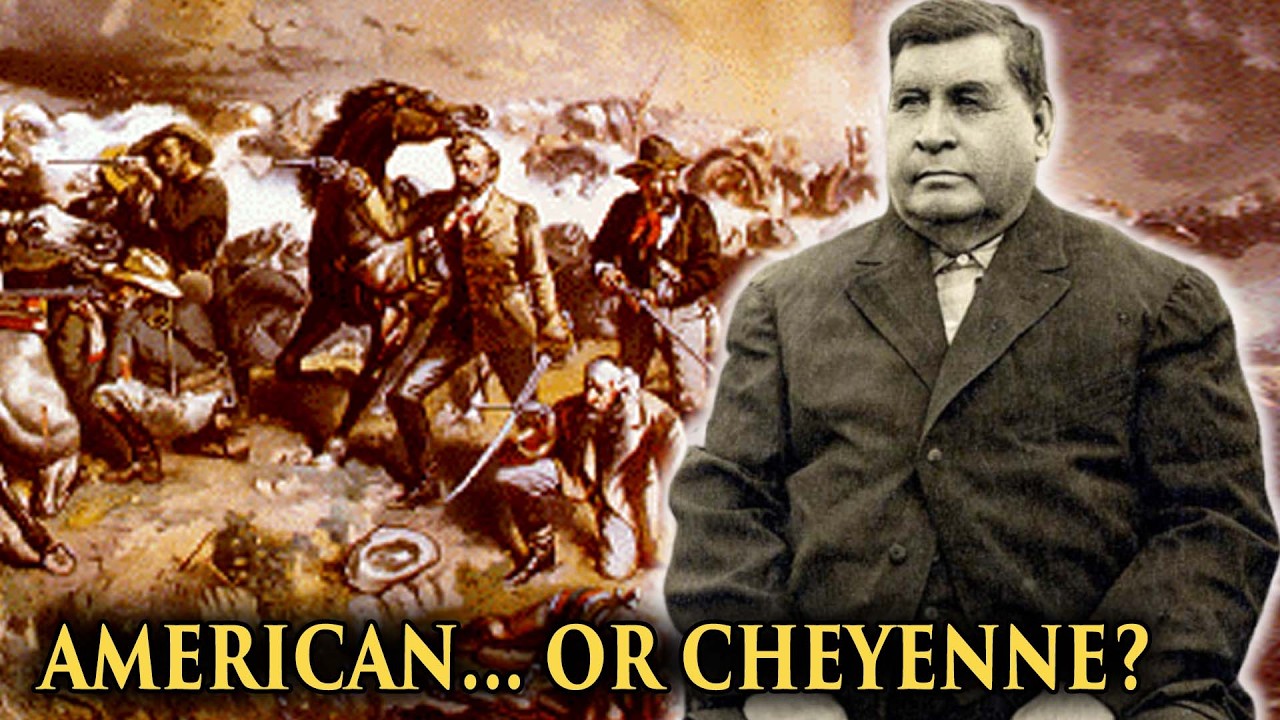
George Bent lived a life split between two worlds: born to a prominent Anglo-American fur trader and a Cheyenne mother, he fought for the Confederacy during the Civil War, survived the Sand Creek Massacre, and ultimately became one of the most important recorders of Cheyenne history. His path from soldier to cultural intermediary offers a rare firsthand view of the Plains conflicts from an indigenous perspective, and historians today owe much of what they know about that era to his writings. Bent was born at Bent’s Fort, a major trading post in present-day Colorado operated by his father, William Bent, a fur trader originally from St. Louis.
His mother was Owl Woman, daughter of White Thunder, a respected Cheyenne leader and keeper of the tribe’s sacred medicine arrows. Because Cheyenne society followed a matrilineal kinship system, George was considered Cheyenne from birth, regardless of his mixed ancestry. Growing up, Bent and his siblings spoke both Cheyenne and English, moving between the trading post environment and Cheyenne society. His early cultural education came largely from his mother and her extended family.
After Owl Woman’s death around 1847, her younger sisters, Yellow Woman and Island, helped raise the children, following Cheyenne customs of shared family responsibility. At age 10, Bent’s father sent him east for formal schooling, first to Kansas City and later to Webster College for boys near St. Louis. This education immersed him in American culture, but it also positioned him at a distance from the Cheyenne world he had known as a child.
When the Civil War began, Bent joined the Missouri State Guard, a force aligned with the Confederacy under Sterling Price. He took part in the Battle of Wilson’s Creek in August 1861, the First Battle of Lexington in September 1861, and later the Battle of Pea Ridge. When cavalry units were reorganized, he became associated with Landis’s Battery of the Missouri Light Artillery and was involved in operations around Corinth, Mississippi. Bent’s military service ended in 1862 under unclear circumstances.
Historical accounts suggest he either left his unit voluntarily or was taken into custody. After returning to St. Louis, then under Union control, he was briefly held at Gratiot Street Prison but was released after taking an oath of allegiance to the Union. His release was likely facilitated by Robert Campbell, a well-connected figure in St.
Louis who had overseen Bent’s affairs during his school years. Bent returned to his father’s ranch in Colorado Territory, but the region was deeply divided in its loyalties, and individuals associated with the Confederacy often faced suspicion. In response to that tense environment, Bent chose to leave and rejoin his mother’s Cheyenne relatives, living among them and embracing that identity more fully. In 1864, Bent played an important role as a translator between the Cheyenne and US authorities.
He assisted in drafting messages sent by Black Kettle to Major Edward Wynkoop at Fort Lyon, proposing the return of settler captives in exchange for peace discussions. These efforts led to the release of four captives, a young woman and three children, and opened the door for further dialogue. Black Kettle and several Cheyenne leaders were subsequently escorted to Denver to meet with territorial officials. Despite those diplomatic efforts, events took a devastating turn.
Bent was present at the Cheyenne and Arapaho encampment along Sand Creek in present-day southeastern Colorado when the Sand Creek Massacre occurred on November 29, 1864. The camp had been engaged in peace negotiations and believed it was under the protection of the US Army. However, a force led by John Chivington attacked the village, resulting in the loss of many lives. Bent managed to escape by moving along the creek and taking cover in natural depressions along the banks.
During the chaos, he sustained an injury to his hip but survived. Along with other survivors, he made his way across the plains to reach Cheyenne encampments along the Smoky Hill River, where he reunited with his friend Edmund Guerrier, who helped him return to the Bent family ranch at Big Timbers to recover. In the aftermath of Sand Creek, many Cheyenne and Arapaho leaders reassessed their position toward the United States. The event undermined trust in negotiation efforts and contributed to a broader shift in strategy among some groups.
Bent, along with his brothers and relatives, became associated with the Dog Soldiers, a Cheyenne military society known for its strong stance in defending tribal autonomy. In early 1865, Bent joined a large Cheyenne force that moved against the town of Julesburg, Colorado, an event remembered as the Battle of Julesburg. Following these developments, many Cheyenne groups moved northward to join Red Cloud along the Powder River. Before departing, groups in the region disrupted settlements along the South Platte River Valley, targeting ranches and stage stations.
Bent remained closely aligned with the Cheyenne throughout 1865, taking part in a series of engagements across the Central Plains, including the Battle of Mud Springs, the Battle of Rush Creek near present-day Broadwater, Nebraska, and the Battle of Platte Bridge Station, also known as Red Buttes, on July 26, 1865, near modern Casper, Wyoming. He was also present during a prolonged engagement often referred to as the Battle of Bone Pile Creek later that summer. That same year, the United States launched the Powder River Expedition, led by Brigadier General Patrick E. Connor, with the goal of subduing resistance from the Lakota, Cheyenne, and Arapaho.
In early September 1865, Bent and other members of the Cheyenne community were camped near the meeting point of the Big and Little Powder Rivers in present-day Montana when reports emerged that US troops were approaching. Cheyenne leaders, including the well-known warrior Roman Nose, moved to intercept the advancing troops. The resulting encounter, often called the Battle of Dry Creek or Roman Nose’s Fight, was aimed at protecting the village and preventing another devastating surprise attack similar to Sand Creek. Bent later reflected on this period with strong personal conviction, expressing his belief that the conduct of US forces during these campaigns challenged the moral narratives often associated with them.
Historians consider his perspective significant because it offers insight into how participants on the plains interpreted the actions of both sides. Over time, Bent is said to have taken part in numerous Cheyenne war parties, reportedly as many as 27, though he rarely provided detailed accounts of his individual role. His brother Charles received broader public attention and was featured in an 1868 issue of Harper’s Magazine, highlighting the visibility of the Bent family within frontier narratives. By the late 1860s, the balance of power on the plains had shifted further.
In 1869, many members of the Dog Soldiers, including Charles Bent, were lost during the Battle of Summit Springs, marking a significant moment in the decline of organized resistance among certain Cheyenne groups. George Bent began transitioning toward a more diplomatic role in the late 1860s. He served as an interpreter during the Medicine Lodge Treaty in October 1867, where representatives of the United States met with Plains tribes to establish agreements intended to reduce tensions. His ability to speak both Cheyenne and English, combined with his understanding of both cultures, made him highly effective in this role, and he gained the respect of US officials for his negotiating skills.
In 1868, Bent formally entered government service as an interpreter, first at Fort Larned and later under Indian Agent Brinton Darlington. By 1870, the agency had been relocated to El Reno in present-day Oklahoma, and Bent settled on the nearby reservation, where he would spend most of his remaining years. His position gave him considerable influence, allowing him to act as a key intermediary during a time of profound change. However, his mixed heritage also placed him in a difficult position socially, as he was not fully accepted by either side.
He struggled with alcohol and became involved in economic activities that connected native lands with expanding cattle operations. By assisting Euro-American cattlemen in securing grazing access on reservation lands, he gained financial stability but also drew criticism. Some members of the Cheyenne community came to view his actions as aligned more with outside interests than with tribal welfare, leading to a loss of trust and eventually his dismissal from his role as interpreter. In 1890, Bent served as a key intermediary during discussions surrounding the Dawes Act, which aimed to divide tribal lands into individual household allotments.
The policy was presented by US authorities as a path toward assimilation through farming, but in practice, it led to the reduction of communal tribal lands. After allotments were assigned, remaining lands were declared surplus and opened to non-Indigenous settlement. Many within the Cheyenne and Arapaho communities later associated Bent with the negative consequences of allotment, including the loss of large portions of reservation land. While historical analysis suggests these policies would have been implemented regardless of his involvement, his visible role as a negotiator made him a focal point for criticism.
Bent married three times over the course of his life. In the spring of 1866, he first married Magpie, a young woman raised within the household of Black Kettle of the Southern Cheyenne. As part of the marriage, Black Kettle presented Bent with a valuable horse that had originally been gifted to him by William S. Harney during earlier treaty discussions connected to the Little Arkansas Treaty.
Bent later married two additional women, Kiowa Woman and Standing Out, strengthening his ties across tribal networks. He fathered six children: Mary, William, Daisy, Lucy, George Jr. , and Charlie. By the early 20th century, Bent’s personal circumstances had changed significantly.
Around 1901, he was living in reduced circumstances compared to his earlier years of influence. Although he had overcome his struggles with alcohol, his standing within the Cheyenne community had declined, and the authority he once held as a cultural intermediary had largely faded. A turning point in this later phase of Bent’s life came through his association with George Bird Grinnell, who recognized that Bent’s bilingual abilities, literacy, and firsthand knowledge of Cheyenne traditions made him an exceptional source of information. Bent had previously shared insights with James Mooney, though he reportedly held a less favorable view of Mooney’s work and approach.
With Grinnell, however, Bent found a more productive collaboration, contributing detailed accounts and facilitating introductions to other Cheyenne individuals who could provide additional perspectives. Bent was deeply committed to ensuring that the history and traditions of the Cheyenne people were preserved in written form. He believed their story deserved a comprehensive account that reflected their own perspective rather than being interpreted solely through outsiders. In his view, Grinnell, who was working on a book about the Cheyenne, was progressing too slowly to achieve that goal.
Seeking a more productive path, Bent began collaborating with George E. Hyde, a largely unknown but dedicated researcher who was deaf and nearly blind. Acting on Bent’s recommendation, Hyde eventually assisted Grinnell as an uncredited or minimally credited writer and is believed to have contributed extensively to The Fighting Cheyennes, published in 1915. While Grinnell acknowledged Bent as a source, he did not fully recognize the extent of Bent’s contributions.
In a later work, The Cheyenne Indians: Their History and Lifeways, Grinnell offered more substantial credit. The collaboration between Bent and Hyde became one of the most significant partnerships in the preservation of Cheyenne history. Although the two men never met in person, they developed a strong working relationship through correspondence. Between 1904 and 1918, Bent wrote approximately 340 letters to Hyde, sharing detailed accounts of Cheyenne life, traditions, and experiences during the Plains conflicts.
Drawing from these letters, Hyde compiled a manuscript titled Life of George Bent, Written from His Letters, which offered a rare and deeply personal perspective on this period. Despite the value of this work, Hyde initially struggled to find a publisher, in part because he lacked recognition within academic circles. Bent did not live to see his vision fully realized. He passed away on May 19, 1918, in Watonga, Oklahoma, during the global 1918 flu pandemic, at a time when his contributions remained largely underappreciated.
In the decades that followed, Bent’s efforts gained the recognition they deserved. Hyde’s manuscript was finally published in 1968, bringing Bent’s firsthand accounts to a wider audience. Later, historians David F. Halaas and Andrew E.
Masich expanded on his story in Halfbreed: The Remarkable True Story of George Bent, published in 2005. These works confirmed that much of what is known today about Cheyenne perspectives during the conflicts of the 1860s comes directly from Bent’s writings. Bent’s legacy is especially significant because it preserves an indigenous viewpoint at a time when most written records were produced by outsiders. His collaboration with Hyde ensured that Cheyenne voices were documented with greater depth and accuracy than was typical for that era.
Today, historians recognize Bent not only as a participant in the events of the 19th century Plains, but also as one of the most important cultural interpreters and recorders of Cheyenne history.