Hollywood has spent a century cementing the image of the Colt Single Action Army as the revolver that won the Old West, but the real frontier was armed with a far more varied and mechanically inventive arsenal. Lawmen, outlaws, gamblers, and soldiers carried dozens of different sidearms, many of which were more advanced, more powerful, or more unusual than anything the movies have ever put on screen. Among the most sophisticated was the Merwin Hulbert Army revolver, produced by Hopkins and Allen of Norwich, Connecticut, under patents held by Joseph Merwin and William Hulbert. Machined to extremely tight tolerances, the gun featured a selective ejection system that let a shooter rotate the barrel a quarter turn and pull the front assembly forward.
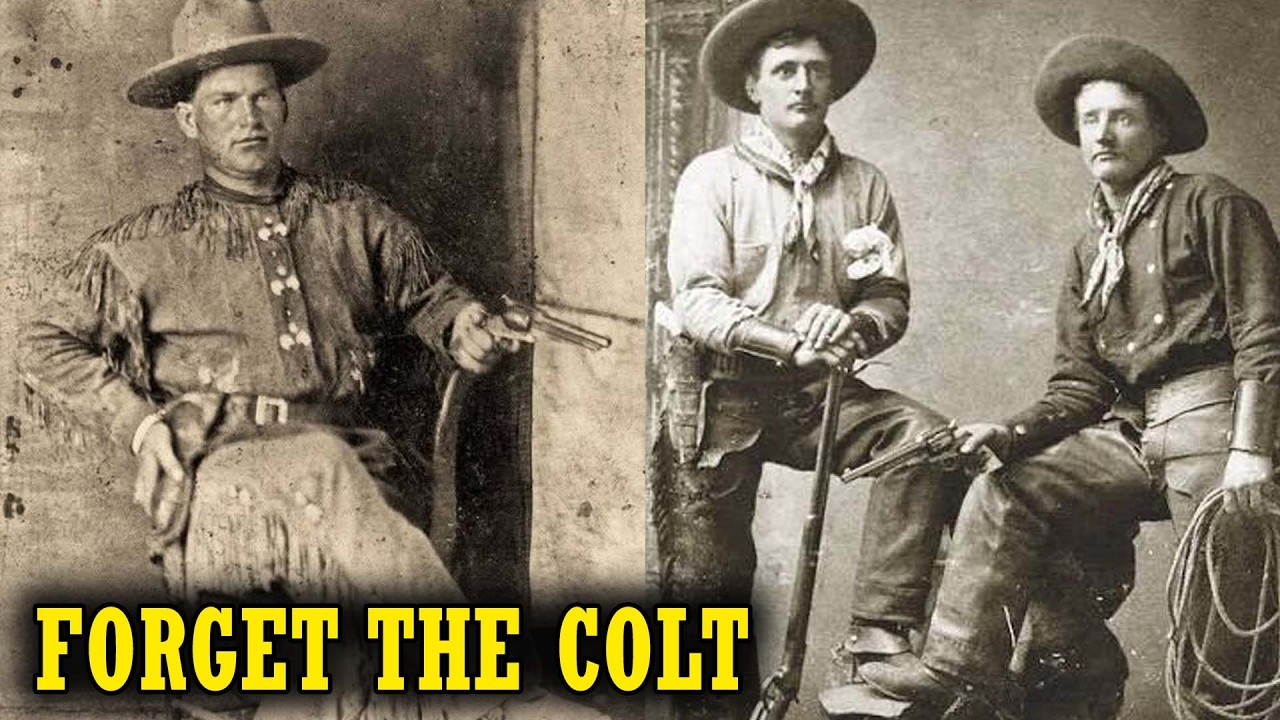
Because the tight cylinder cutouts held unfired cartridges in place while allowing expanded spent cases to drop free, a shooter could empty and reload far faster than with a standard Colt. Chambered mainly in its proprietary . 44 Merwin and Hulbert round or the well-regarded . 44 Russian, it earned a reputation for accuracy and stopping power.
Period documents and shipping records show the revolver sold at premium prices, and frontier figures including Pat Garrett, John Wesley Hardin, Bob Dalton, Sam Bass, and Texas Ranger Frank H. Hamer were reported to have used it. Hollywood largely ignored it because its precision mechanism jams easily when firing blank cartridges, and surviving originals are rare collector pieces too valuable to risk on a film set. Another forgotten design was the LeMat revolver, a heavy Civil War-era weapon nicknamed the Grapeshot Revolver.
Patented in 1856 by Dr. Jean Alexandre LeMat of New Orleans, the gun featured a nine-round cylinder wrapped around a central axis pin that was actually a second smoothbore barrel loaded with buckshot. A pivoting nose on the hammer let the shooter switch between firing pistol rounds and a shotgun blast with a flick of the thumb. Confederate cavalry commander J.
E. B. Stuart carried one for much of the war, including at the battle where he was fatally wounded, and General Braxton Bragg favored the weapon as well. Rough estimates of total production range from about 1,500 to nearly 3,000.
The gun’s bulk, unfamiliar appearance, and the difficulty of safely firing blanks from both barrels have kept it off screen. The Starr double-action Model 1858 offered genuinely rapid fire years before such mechanisms became common. Designed by Eban T. Starr of New York, the .
44 caliber revolver used a large forward blade inside an oversized trigger guard as a cocking lever, with a smaller trigger tucked behind it. A shooter could cycle through all six chambers by simply pulling the trigger, with no need to thumb the hammer. Government records show the Union Army purchased roughly 20,000 to 23,000 of these revolvers, making Starr the third largest supplier of revolvers to Union forces after Colt and Remington. Filmmakers have avoided it partly because its speed looks anachronistic to modern audiences, and its delicate lock work is difficult to maintain with blank ammunition.
A later model, the 1863, actually dropped the double-action feature in favor of a simpler single-action design. The Colt Cloverleaf House pistol, introduced in 1871, was designed for close-quarter self-defense rather than combat. Built by Charles Brinkerhoff Richards and William Mason, the same engineers who later designed the Single Action Army, the compact revolver had a four-round cylinder with recessed chamber walls that gave it a cloverleaf appearance from the front. It was chambered in .
41 rimfire, a larger and more powerful round than the small calibers typical of pocket pistols. The gun is best remembered for a notorious incident: financier James “Jubilee Jim” Fisk was shot and killed with one in 1872 by Edward Stokes. Only a few thousand were produced between 1871 and 1876, making originals scarce and impractical for film use. The Savage Navy Model 1861 took an entirely different approach to operation.
Built by the Savage Revolving Firearms Company of Middletown, Connecticut, the . 36 caliber revolver had two triggers stacked vertically inside a large heart-shaped guard. The lower ring-shaped lever was pulled with the middle finger to cock the hammer and rotate the cylinder, while the index finger pressed the upper trigger to fire. The cylinder also moved forward when the lever was pulled, seating tightly against the barrel to improve gas pressure and reduce the risk of chain fires.
Federal records show the government contracted for roughly 12,000 of these revolvers, with total production reaching about 20,000 including civilian sales. Several Union cavalry regiments from states including Wisconsin and Kansas saw service with the weapon, and some ended up in Confederate hands. Its unfamiliar silhouette and complex mechanism have kept it out of Western films. By the mid-1870s, shooters who needed speed relied on the Smith and Wesson Model 3 Schofield.
Originally introduced as the Model 3, the revolver was modified by Major George W. Schofield of the 10th U. S. Cavalry to be easier to operate on horseback.
Its top-break design used a spring-loaded star extractor that ejected all six spent casings at once when the action opened, allowing a complete reload in well under 30 seconds, roughly half the time needed for a Colt Peacemaker. The army purchased around 8,000 to 8,300 of them by 1879, issuing them to cavalry regiments including the 9th and 10th, which comprised the Buffalo Soldiers. Jesse and Frank James, Wyatt and Virgil Earp, John Wesley Hardin, Pat Garrett, Bill Tilghman, and Theodore Roosevelt were all reported to have carried one. Filmmakers have favored the slower Colt because its visibly lengthy reload process builds cinematic suspense, while the Schofield’s speed undercuts dramatic tension.
The Remington Model 1875, also called the Improved Army, was built to compete directly with Colt for civilian and government sales. Its distinctive solid steel web running along the underside of the barrel reinforced the front end of the revolver, giving it more structural integrity than the Colt’s separately attached ejector rod housing. Chambered in . 44 Remington, .
44-40 Winchester, and later . 45 Colt, the . 44-40 version offered a practical advantage: it used the same ammunition as the Winchester Model 1873 rifle, so a traveler could carry one cartridge type for both weapons. The U.
S. Department of the Interior purchased 639 nickel-plated units in 1883 for Indian police on western reservations, and the Mexican government bought about 1,000 more. Frank James reportedly called his Model 1875 “the hardest and surest shooting pistol made” when he surrendered to Missouri’s governor in 1882. The gun rarely appears in Westerns largely because studio-era prop houses stocked surplus Colts in far greater numbers, and the two guns look broadly similar from a distance.
One of the most unusual designs was the Walch 10-shot pocket revolver, patented in 1859 by John Walch of New York. The . 31 or . 36 caliber percussion revolver used a system called superimposed loading, with two complete powder and ball charges stacked in each chamber.
Two hammers and two triggers fired the charges separately, letting a small pocket revolver deliver 10 or 12 shots total. Roughly 200 of the larger . 36 caliber Navy 12-shot models and around 3,000 of the smaller . 31 caliber 10-shot pocket models were produced by the New Haven Arms Company, the same firm that later manufactured the Henry rifle.
The order caused financial strain for the company when the contracting party failed to pay. The design was more of an engineering novelty than a widely proven combat weapon, and the complexity of safely firing a double-loaded blank system has kept it off screen. British imports also played a real role on the frontier. The Tranter revolver, designed by William Tranter of Birmingham, England, was a heavy, sturdy handgun available in genuinely large calibers including .
442 and even . 577 bore, far exceeding the . 36 or . 44 rounds typical of American sidearms.
Early models used a dual-trigger system, with a lower trigger worked by the middle finger to rotate the cylinder and cock the hammer, and an upper trigger for firing. The Confederacy, which had almost no domestic arms manufacturing, relied heavily on imported weapons, and thousands of Tranters were shipped from Birmingham to the South through commercial contracts with New Orleans firms. The gun earned a following among Confederate officers including J. E.
B. Stuart. It was not an official Confederate government sidearm but arrived through private and commercial channels. Its British caliber standards and the cost of converting originals for blank fire have kept it out of Western films.
The Forehand and Wadsworth British Bulldog represented the other end of frontier self-defense: compact, concealable power for crowded boom towns. Originally designed by Philip Webley and Son of Birmingham, England, in 1872, the Bulldog was widely copied by American makers including Forehand and Wadsworth of Worcester, Massachusetts. Despite its small size, the solid-frame revolver was chambered in . 44 Bulldog, a wide, slow-moving lead round backed by a solid black powder charge.
Period hardware catalogs including Montgomery Ward listings from the 1880s show these revolvers sold in large numbers, often outselling the pricier Colt Peacemaker among shopkeepers, miners, and travelers. The design is tied to a sobering historical event: in 1881, Charles Guiteau used a . 442 caliber Bulldog-style revolver, a Belgian-made copy according to historical accounts, to shoot President James A. Garfield, who died several months later from complications related to his injuries.
The Colt Peacemaker may own the myth, but the real Old West was armed with a strange and inventive arsenal: revolvers that packed ten shots into a five-round cylinder, guns with a shotgun hidden in the barrel pin, and pocket pistols powerful enough to have a role in ending a presidential term. Hollywood chose one silhouette and ran with it for a century, but the frontier itself was a working laboratory of clever, sometimes bizarre firearm engineering that never made it to the big screen.