The story of Butch Cassidy’s alleged attempt to surrender is one of the most debated “what-if” moments in Old West history. According to multiple historical accounts, the legendary outlaw may have sought a pardon in 1899, hoping to trade his life on the run for legitimate work — including a surprising proposal that he guard the very trains he once robbed. Two versions of the supposed surrender attempt exist, both placing Cassidy in the Salt Lake City office of attorney Orlando W. Powers.
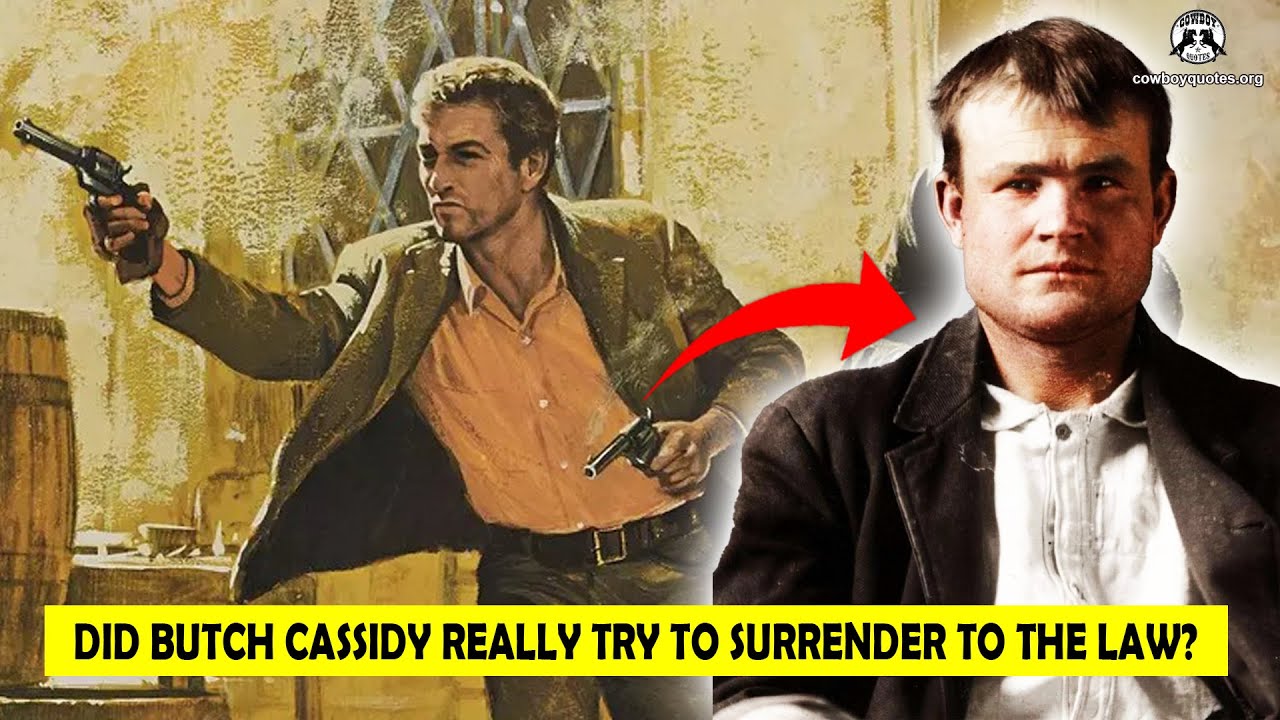
In the account recorded by historian Charles Kelly in “The Outlaw Trail,” first published in 1938, a well-dressed man entered Powers’ office in the autumn of 1899 and asked if their conversation would remain confidential. After being reassured, he identified himself: “My name is George Loy Parker, better known as Butch Cassidy. ”
Cassidy reportedly told Powers he was tired of running and pointed to the fate of Wild Bunch members who had been killed or captured. “Sooner or later, it’ll be my turn,” he supposedly said.
He asked whether Powers could arrange a pardon through Utah Governor Heber M. Wells so he could settle down peacefully. Powers was not optimistic. He explained that the governor could only pardon crimes committed within Utah, and Cassidy had never been convicted there.
Powers reportedly advised him to leave the country and start over somewhere new. A second version of the meeting appears in A. F. C.
Greene’s “Butch Cassidy in Fremont County,” written around 1940. Greene described Cassidy differently, portraying him in overalls and a blue denim jumper rather than city attire. In this account, Cassidy argued that no living witness could identify him for any crime, making a trial possible. Powers remained skeptical, warning that powerful corporations would find someone willing to testify.
Historians have noted a significant discrepancy in Kelly’s account. He claimed Cassidy introduced himself as George Loy Parker, but family and church records confirm his real name was Robert Leroy Parker. While Cassidy used “George Cassidy” as an alias during his outlaw years, the inconsistency has raised questions about the accuracy of Kelly’s word-for-word account. Further investigation has traced Greene’s version to an earlier source: Frederick R.
Bechdolt’s 1924 book, “Tales of the Old-Timers. ” Bechdolt was primarily a novelist, which initially led some historians to discount his work, but he did produce credible accounts of frontier history and worked as a journalist in Salt Lake City, potentially placing him near sources familiar with Cassidy’s story. Charles Kelly may have drawn from Bechdolt as well. In a 1939 letter, Kelly admitted that Bechdolt was one of his primary sources.
Yet Kelly’s version differs from Bechdolt’s in notable ways, suggesting he may have offered his own interpretation of the events. After leaving Powers’ office, Cassidy reportedly approached another influential figure: Parley P. Christensen, a well-connected Salt Lake City attorney with closer ties to Governor Wells. Kelly described Christensen as a former sheriff of Juab County, but county records do not support that claim.
Instead, records show a Parley P. Christensen was appointed town marshal of Nephi in 1914, long after the supposed meeting. Christensen was reportedly more optimistic than Powers and secured an appointment for Cassidy with Governor Wells. According to Kelly, Wells initially seemed open to leniency if no murder warrants existed.
However, when the attorney general checked Cassidy’s record, a murder warrant surfaced. The governor told Cassidy the deal was off the table. Cassidy insisted he had never taken a life, but the warrant ended the negotiations. The most unusual proposal emerged when Powers suggested that Cassidy could work for the Union Pacific Railroad as an express guard.
The logic was that Cassidy’s movements would be accounted for, and other outlaws might think twice before targeting trains protected by the notorious bandit. This idea appears in “Butch Cassidy, My Brother,” written by Cassidy’s sister Lula Parker Bettinson, though Kelly was likely her primary source. Bechdolt also referenced a version of the story, claiming Cassidy met with a sheriff and assured him the railroads could stand down their guards. A piece of historical evidence lends some credibility to the theory.
A letter dated May 30, 1900, found in the Utah State Archives, was written by W. S. Cuddy, a general agent for the Thiel Detective Service. Cuddy informed Governor Wells that based on reliable information, Cassidy was willing to surrender and take a job as a railroad guard if authorities would leave him alone.
Cuddy’s background added weight to the claim — he had spent eight years leading the Omaha Police Department before joining the detective agency. According to Kelly, Union Pacific officials found the proposal interesting enough to pursue. Powers contacted Cassidy’s attorney, Douglas Preston, who arranged a meeting at Lost Soldier Pass in southwestern Wyoming. Cassidy was supposedly to meet railroad officials there, but the meeting never happened.
Kelly claimed Cassidy waited for hours and left when no one appeared. Preston later explained that a storm had delayed his group. Kelly’s account includes a dramatic detail: when Preston arrived and found Cassidy gone, he kicked a stone out of frustration and discovered a note under it. The note supposedly expressed Cassidy’s disappointment and signaled his loss of faith in the negotiation.
That note has since become a focal point of skepticism. Long believed lost, copies suddenly appeared among rare document collectors in the 1980s. Author Dan Buck investigated and found a possible link to Mark Hofmann, a convicted forger known for fabricating Mormon-related documents. Buck could not prove Hofmann created the note, but he expressed strong doubts about its authenticity in a 2002 article for the Journal of the Western Outlaw Lawman History Association.
Buck also noted several logical inconsistencies in the story. If a storm delayed Preston’s group, why did Cassidy not face the same weather? The note was written in careful, deliberate handwriting, as if at a desk, rather than hastily scrawled in frustration. Cassidy would also have needed to carry a pen and ink bottle through rugged terrain.
The note’s placement under a rock, discovered only after Preston kicked it in frustration, seemed oddly convenient. Despite these doubts, historians caution against dismissing Kelly’s account entirely. Kelly worked with the information available to him, and his book became a foundational reference for later research. He acknowledged the limitations of his sources in the first edition, inviting readers to share additional facts to correct errors.
Cassidy’s willingness to consider an honest life is supported by his work history. After committing his first bank robbery in 1889, there is little evidence linking him to major crimes for the next seven years. He spent the year before the alleged surrender attempt as an assistant foreman at an English-owned ranch in New Mexico, using the alias Jim Lowe. The ranch owner, William French, later spoke highly of him, recalling him as a responsible and capable employee.
From the railroad’s perspective, hiring Cassidy would have been a difficult decision. The Union Pacific had invested $110 million to acquire the railroad in 1893, and placing a known outlaw in charge of protecting valuable shipments would have been seen as a major risk. E. H.
Harriman, the railroad’s president, favored direct action over deals — he had already implemented “possy cars,” modified baggage cars carrying detectives and fast horses, to respond to robberies. Officials also did not consider Cassidy the Wild Bunch’s most dangerous member. W. H.
Banks, the railroad’s general superintendent, considered Harvey Logan, better known as Kid Curry, the greater threat. If Cassidy were hired as an express guard, officials would have questioned how effective he could be against his former associates. Whether Cassidy truly attempted to negotiate his surrender remains unresolved. The accounts conflict on key details, and the evidence supporting the story ranges from credible letters to potentially forged documents.
What is clear is that Cassidy understood survival and reinvention. Shortly after the alleged negotiations failed, he fled to Argentina with the Sundance Kid and Etta Place, starting a new life far from the West. Historians continue to debate whether the surrender offer was genuine or another Wild West legend. The story’s persistence, despite its inconsistencies, reflects how Cassidy’s legacy has grown beyond the facts of his life.
Both Kelly and Greene captured the same general exchange, and the existence of multiple accounts suggests some version of the events may have occurred — even if the details remain impossible to verify. CONTENT:
The story of Butch Cassidy’s alleged attempt to surrender is one of the most debated “what-if” moments in Old West history. According to multiple historical accounts, the legendary outlaw may have sought a pardon in 1899, hoping to trade his life on the run for legitimate work — including a surprising proposal that he guard the very trains he once robbed. Two versions of the supposed surrender attempt exist, both placing Cassidy in the Salt Lake City office of attorney Orlando W.
Powers. In the account recorded by historian Charles Kelly in “The Outlaw Trail,” first published in 1938, a well-dressed man entered Powers’ office in the autumn of 1899 and asked if their conversation would remain confidential. After being reassured, he identified himself: “My name is George Loy Parker, better known as Butch Cassidy. ”
Cassidy reportedly told Powers he was tired of running and pointed to the fate of Wild Bunch members who had been killed or captured.
“Sooner or later, it’ll be my turn,” he supposedly said. He asked whether Powers could arrange a pardon through Utah Governor Heber M. Wells so he could settle down peacefully. Powers was not optimistic.
He explained that the governor could only pardon crimes committed within Utah, and Cassidy had never been convicted there. Powers reportedly advised him to leave the country and start over somewhere new. A second version of the meeting appears in A. F.
C. Greene’s “Butch Cassidy in Fremont County,” written around 1940. Greene described Cassidy differently, portraying him in overalls and a blue denim jumper rather than city attire. In this account, Cassidy argued that no living witness could identify him for any crime, making a trial possible.
Powers remained skeptical, warning that powerful corporations would find someone willing to testify. Historians have noted a significant discrepancy in Kelly’s account. He claimed Cassidy introduced himself as George Loy Parker, but family and church records confirm his real name was Robert Leroy Parker. While Cassidy used “George Cassidy” as an alias during his outlaw years, the inconsistency has raised questions about the accuracy of Kelly’s word-for-word account.
Further investigation has traced Greene’s version to an earlier source: Frederick R. Bechdolt’s 1924 book, “Tales of the Old-Timers. ” Bechdolt was primarily a novelist, which initially led some historians to discount his work, but he did produce credible accounts of frontier history and worked as a journalist in Salt Lake City, potentially placing him near sources familiar with Cassidy’s story. Charles Kelly may have drawn from Bechdolt as well.
In a 1939 letter, Kelly admitted that Bechdolt was one of his primary sources. Yet Kelly’s version differs from Bechdolt’s in notable ways, suggesting he may have offered his own interpretation of the events. After leaving Powers’ office, Cassidy reportedly approached another influential figure: Parley P. Christensen, a well-connected Salt Lake City attorney with closer ties to Governor Wells.
Kelly described Christensen as a former sheriff of Juab County, but county records do not support that claim. Instead, records show a Parley P. Christensen was appointed town marshal of Nephi in 1914, long after the supposed meeting. Christensen was reportedly more optimistic than Powers and secured an appointment for Cassidy with Governor Wells.
According to Kelly, Wells initially seemed open to leniency if no murder warrants existed. However, when the attorney general checked Cassidy’s record, a murder warrant surfaced. The governor told Cassidy the deal was off the table. Cassidy insisted he had never taken a life, but the warrant ended the negotiations.
The most unusual proposal emerged when Powers suggested that Cassidy could work for the Union Pacific Railroad as an express guard. The logic was that Cassidy’s movements would be accounted for, and other outlaws might think twice before targeting trains protected by the notorious bandit. This idea appears in “Butch Cassidy, My Brother,” written by Cassidy’s sister Lula Parker Bettinson, though Kelly was likely her primary source. Bechdolt also referenced a version of the story, claiming Cassidy met with a sheriff and assured him the railroads could stand down their guards.
A piece of historical evidence lends some credibility to the theory. A letter dated May 30, 1900, found in the Utah State Archives, was written by W. S. Cuddy, a general agent for the Thiel Detective Service.
Cuddy informed Governor Wells that based on reliable information, Cassidy was willing to surrender and take a job as a railroad guard if authorities would leave him alone. Cuddy’s background added weight to the claim — he had spent eight years leading the Omaha Police Department before joining the detective agency. According to Kelly, Union Pacific officials found the proposal interesting enough to pursue. Powers contacted Cassidy’s attorney, Douglas Preston, who arranged a meeting at Lost Soldier Pass in southwestern Wyoming.
Cassidy was supposedly to meet railroad officials there, but the meeting never happened. Kelly claimed Cassidy waited for hours and left when no one appeared. Preston later explained that a storm had delayed his group. Kelly’s account includes a dramatic detail: when Preston arrived and found Cassidy gone, he kicked a stone out of frustration and discovered a note under it.
The note supposedly expressed Cassidy’s disappointment and signaled his loss of faith in the negotiation. That note has since become a focal point of skepticism. Long believed lost, copies suddenly appeared among rare document collectors in the 1980s. Author Dan Buck investigated and found a possible link to Mark Hofmann, a convicted forger known for fabricating Mormon-related documents.
Buck could not prove Hofmann created the note, but he expressed strong doubts about its authenticity in a 2002 article for the Journal of the Western Outlaw Lawman History Association. Buck also noted several logical inconsistencies in the story. If a storm delayed Preston’s group, why did Cassidy not face the same weather? The note was written in careful, deliberate handwriting, as if at a desk, rather than hastily scrawled in frustration.
Cassidy would also have needed to carry a pen and ink bottle through rugged terrain. The note’s placement under a rock, discovered only after Preston kicked it in frustration, seemed oddly convenient. Despite these doubts, historians caution against dismissing Kelly’s account entirely. Kelly worked with the information available to him, and his book became a foundational reference for later research.
He acknowledged the limitations of his sources in the first edition, inviting readers to share additional facts to correct errors. Cassidy’s willingness to consider an honest life is supported by his work history. After committing his first bank robbery in 1889, there is little evidence linking him to major crimes for the next seven years. He spent the year before the alleged surrender attempt as an assistant foreman at an English-owned ranch in New Mexico, using the alias Jim Lowe.
The ranch owner, William French, later spoke highly of him, recalling him as a responsible and capable employee. From the railroad’s perspective, hiring Cassidy would have been a difficult decision. The Union Pacific had invested $110 million to acquire the railroad in 1893, and placing a known outlaw in charge of protecting valuable shipments would have been seen as a major risk. E.
H. Harriman, the railroad’s president, favored direct action over deals — he had already implemented “possy cars,” modified baggage cars carrying detectives and fast horses, to respond to robberies. Officials also did not consider Cassidy the Wild Bunch’s most dangerous member. W.
H. Banks, the railroad’s general superintendent, considered Harvey Logan, better known as Kid Curry, the greater threat. If Cassidy were hired as an express guard, officials would have questioned how effective he could be against his former associates. Whether Cassidy truly attempted to negotiate his surrender remains unresolved.
The accounts conflict on key details, and the evidence supporting the story ranges from credible letters to potentially forged documents. What is clear is that Cassidy understood survival and reinvention. Shortly after the alleged negotiations failed, he fled to Argentina with the Sundance Kid and Etta Place, starting a new life far from the West. Historians continue to debate whether the surrender offer was genuine or another Wild West legend.
The story’s persistence, despite its inconsistencies, reflects how Cassidy’s legacy has grown beyond the facts of his life. Both Kelly and Greene captured the same general exchange, and the existence of multiple accounts suggests some version of the events may have occurred — even if the details remain impossible to verify.