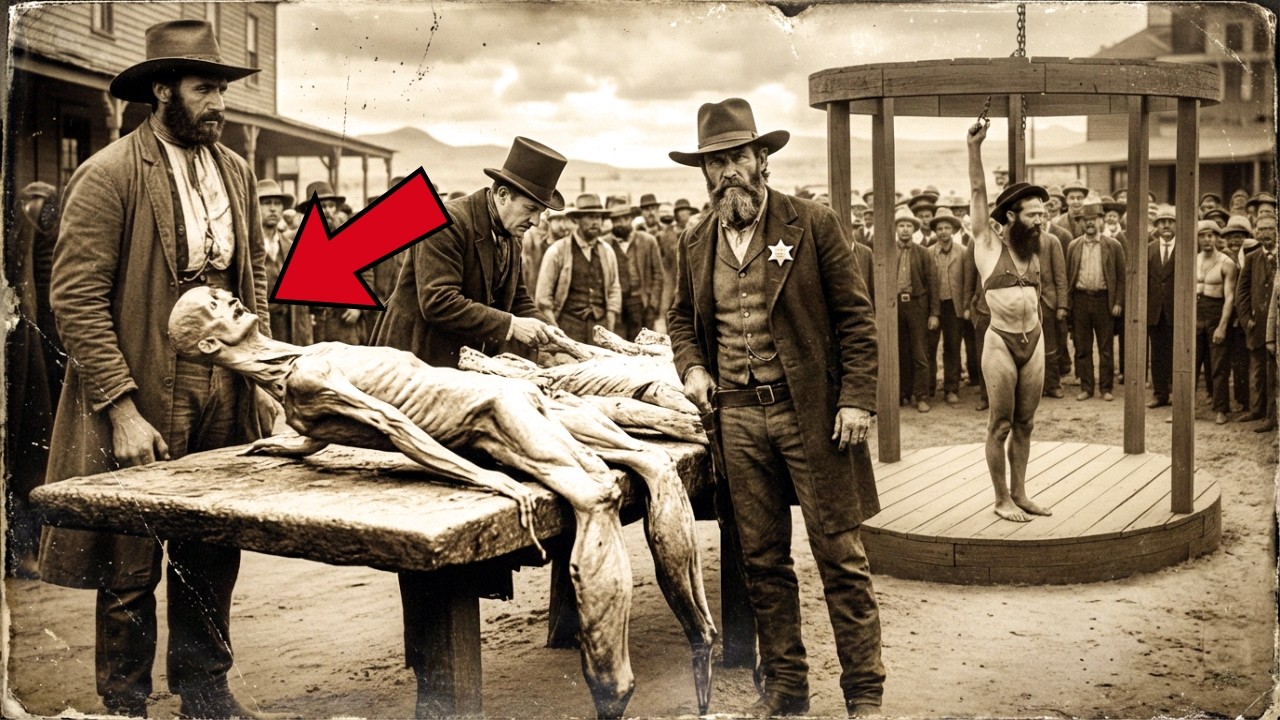
A 1976 television production crew filming an episode of The Six Million Dollar Man rented an old amusement park fun house as a location and made a shocking discovery. While moving what they believed to be a mannequin, part of the prop detached, revealing that it was actually a preserved human body. Examination later confirmed the remains belonged to Elmer McCurdy, an outlaw whose life had been so unremarkable that he barely registered in the history of the American West. Unlike famous contemporaries such as Jesse James or Billy the Kid, McCurdy’s criminal career was limited in scope and poorly executed.

He reportedly said he never wanted to surrender, but he died quietly, without the notoriety that defined the era’s more legendary figures. His unusual afterlife began after his death when a man falsely claiming to be a relative retrieved the body from a funeral home. That man was actually a carnival operator, and in the early 20th century, traveling shows frequently displayed outlaw remains as attractions. Over the decades, McCurdy’s body was used as collateral for unpaid debts, exhibited in sideshows, stored in a wax museum, and eventually forgotten in the amusement park fun house.
In 1977, McCurdy was finally given a proper burial in Boot Hill Cemetery in Guthrie, Oklahoma, 66 years after his death. His accidental rediscovery remains a strange footnote to the closing chapter of the American frontier. Strange stories from the Old West were not limited to human remains. In April 1890, the Tombstone Epitaph newspaper published an account of two ranchers who claimed to have encountered an enormous winged creature in the desert near Tombstone, Arizona.
The article described the animal as a gigantic reptile with wings, an unusually long tail, and a massive head. Its reported dimensions far exceeded those of any known living or extinct animal, and the account even mentioned a photograph said to document the discovery. Historically, the story does not hold up. No photograph accompanied the original article, and the first references to such an image did not appear until 1963.
No other newspapers repeated the account, which would have been highly unusual if the incident had been taken seriously. The 1890s marked the height of yellow journalism, when sensational stories were commonly used to boost circulation. The alleged creature fits neatly into a broader tradition of Southwestern folklore involving thunderbirds and winged serpents found in indigenous myths and settler legends. The search for mineral wealth also produced its share of strange tales.
During the 19th century, vast deposits of gold, silver, and copper drew prospectors across the West, and alongside real discoveries, rumors of hidden riches spread just as quickly. Among the best known is the legend of the Lost Dutchman mine, supposedly discovered by a German-born prospector named Jacob Waltz somewhere in Arizona’s Superstition Mountains. He reportedly hinted to acquaintances that the mine was extraordinarily productive but never revealed its exact location. Generations of treasure hunters have searched for it since, and numerous claims of discovery have surfaced, though none have ever been confirmed.
Reports of strange beings in the sky also predate the modern UFO era by decades. In 1896, Colonel H. G. Shaw and Camille Spooner claimed to have encountered three tall, thin, unusual figures while traveling to the Fresno Citrus Fair, with Shaw speculating that the visitors might have come from Mars.
The following year, residents across Texas described seeing cigar-shaped airships in the sky. One of the most enduring stories emerged near Aurora, where locals later claimed that one such craft came down nearby, with accounts suggesting that townspeople treated what they believed to be the pilot’s remains with respect. None of these stories have ever been verified, and no physical proof has confirmed the presence of extraterrestrial visitors. What the tales reflect is the imaginative spirit of the frontier era, when rapid technological change and expanding scientific ideas encouraged people to look upward for answers.
Some of the strangest legends involved human-like figures. In the oral traditions of the Northern Paiute people, there is a story about a hostile group that lived in what is now Nevada long before European settlement, sometimes described as having red hair and engaging in taboo practices. The best-known written version appears in an 1883 book by Sarah Winnemucca, who recounted the story as a traditional folk tale about danger and survival. As non-native settlers moved into Nevada, the story changed, with new details added over time.
After guano miners excavated Lovelock Cave in 1911 and uncovered human remains and artifacts, exaggerated claims circulated that unusually large skeletons, sometimes described as giants, had been discovered. No verified remains supporting those claims have ever surfaced, but the story spread widely through popular media. Souvenir collecting also created its own brand of frontier legend. For decades, visitors have removed objects from public lands across the American West, and places like Petrified Forest National Park have struggled with the steady loss of natural and historical material.
One of the most unusual examples comes from Bodie State Historic Park in California, a preserved mining town founded during the 1870s gold rush and largely abandoned by the 1940s. Despite protections, items have been taken from Bodie almost since it became a park, but many of those objects eventually find their way back. Park staff regularly receive mailed artifacts accompanied by letters from former visitors who admit to taking items and then experiencing a run of misfortune, from mechanical trouble to persistent health issues, which they attribute to what has become known as the Bodie curse. In one case, a visitor reportedly returned a nail after it punctured a tire while driving through town.
Historians and psychologists suggest these stories likely reflect guilt, coincidence, and the human tendency to find meaning in misfortune rather than any supernatural force. Perhaps the strangest true story involves animals that were never native to the American West. In the 1850s, a veteran of frontier service named Edward Fitzgerald Beale observed how poorly horses and mules performed in the arid Southwest and proposed using camels instead. The plan received official support in 1855, and by 1857, the US Army had brought in roughly 75 camels, creating what became known as the US Army Camel Corps.
Despite early success, the project faced resistance as funding became uncertain and mule breeders lobbied against it. When the Civil War began, the Texas camels fell into Confederate hands and were later released or dispersed, while the California herd was sold off. As some camels escaped or were abandoned, small numbers wandered through parts of Arizona and New Mexico well into the late 19th century. Many settlers had never seen camels before, and sightings of these unfamiliar animals fueled rumors and frontier legends.
One of the most famous was the Red Ghost, described in local lore as a strange desert creature with something attached to its back. When the mystery was eventually resolved, the creature turned out to be a feral camel. The last known feral camel, named Topsy, died at a zoo in Los Angeles in 1934.
These tales, whether rooted in truth, exaggeration, or pure folklore, reveal a frontier shaped not just by history, but by imagination, fear, and wonder.