A woman is beheaded on camera.
The film survives.
Devils dance across the screen.
Those films survive.
Trains crash.
People fight.
Bodies fall.
Those films survive too.
But in 1896, audiences in America and Europe paid money to watch something much stranger.
Babies appearing among flowers.
Infants seemingly rising from the soil.
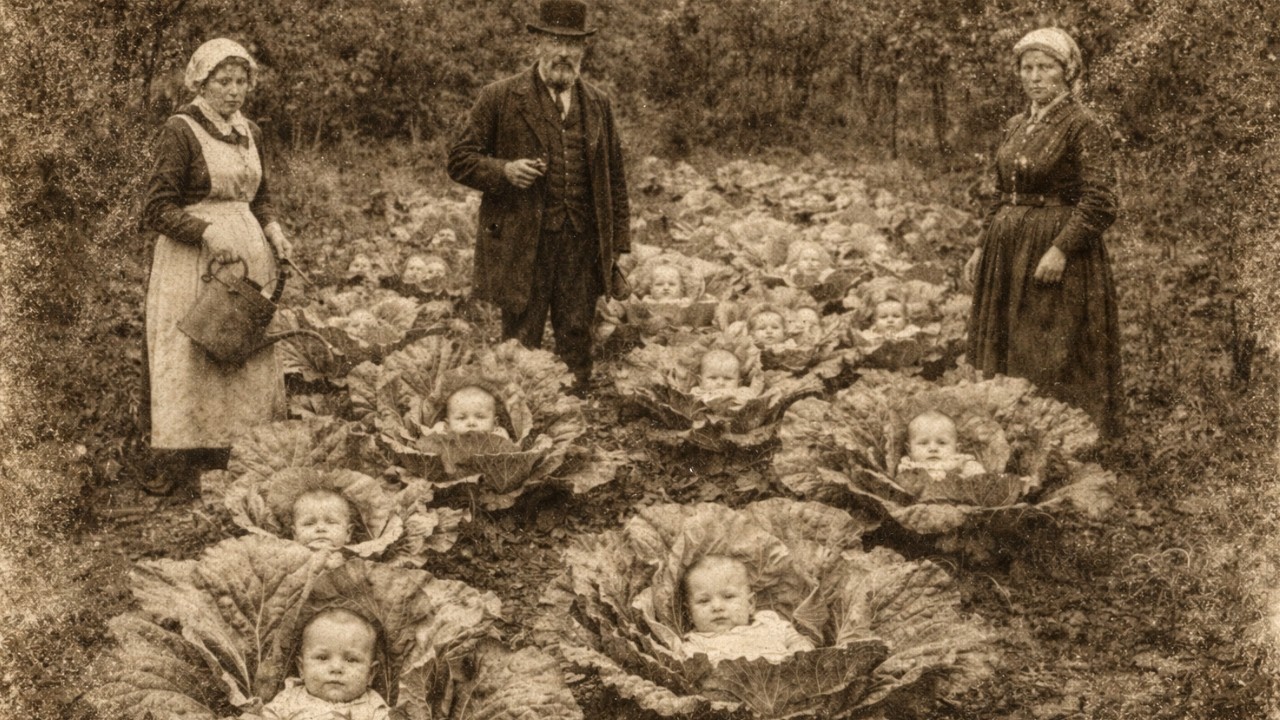
Children emerging from gardens as if they had grown there.
And almost every early film built around that same idea—
is gone.
Not one.
Not two.
A cluster of films.
Different studios.
Different countries.
Different filmmakers.
Same theme.
Same narrow period.
Same ending.
Missing.
Lost.
Unavailable.
Deteriorated.
And the more I followed the paper trail—
the less random it began to feel.
Because one of these films was not an urban legend.
It had a catalog number.
Edison Manufacturing Company.
A short film sometimes identified in surviving documentation as Babies in the Garden.
Approximately forty-five seconds.
A trick film.
A novelty.
Nothing obviously dangerous.
Nothing obscene.
Nothing revolutionary.
Yet by the end of the century—
the film appears to vanish from later records.
The descriptions survive.
The advertisements survive.
The programs survive.
The film does not.
And once you notice that—
you begin noticing other gaps.
A French film about babies emerging from a garden.
Gone.
A Biograph production built around the idea of generation.
Gone.
An early Méliès experiment involving miraculous human appearance.
Gone.
British titles.
German titles.
French titles.
Different companies.
Different archives.
Same disappearance.
Maybe this is simply what nitrate film does.
Early cinema was extraordinarily fragile.
Thousands upon thousands of films vanished through fire, chemical decomposition, neglect and deliberate disposal.
That explanation is real.
Necessary.
And statistically powerful.
But it leaves one uncomfortable question.
Why does the same subject seem to keep appearing in the missing column?
And why, only a few years later, do censorship boards begin writing rules specifically about depictions of birth, generation and the origins of human life?
That is where this story stops being about lost film.
And becomes a story about who decides what the future is allowed to remember.
I did not begin looking for suppressed knowledge.
I was looking at preservation.
Early cinema is filled with ghosts.
Titles in trade catalogs with no surviving prints.
Actors whose faces disappeared when nitrate stock decomposed.
Production companies whose entire output burned in vault fires.
You become accustomed to absence.
Then one catalog entry stood out.
Edison.
1897 inventory.
Item 247.
A film described as a strange horticultural display involving babies and garden imagery.
A short novelty exploiting the new possibilities of trick photography.
The camera could lie.
Bodies could vanish.
Heads could appear.
People could transform.
The audience knew they were watching an illusion.
That was the attraction.
The technology itself was magical.
And filmmakers immediately began experimenting with subjects impossible in ordinary life.
One surviving Edison film from the same era famously showed the execution of Mary, Queen of Scots.
An actress kneels.
A substitution effect occurs.
The axe falls.
A head appears to separate from the body.
The film survives because it became famous as an early example of cinematic special effects.
Violence—
preserved.
Another strange fantasy—
apparently not.
According to the source material behind this story, trade publications and exhibition notices referred to The Baby Garden during the late 1890s.
Audiences supposedly watched infants appear among vegetation through double-exposure effects.
A novelty.
A technical demonstration.
Something whimsical enough to sit beside comedy, music and other vaudeville attractions.
Then the film disappeared.
The easy explanation is nitrate.
And normally—
that would be enough.
Except nitrate decomposition does not explain a catalog number.
It does not explain why documentation remains while the object vanishes.
It does not explain why comparable films made on similar stock survive.
Again—
none of that proves suppression.
Archives are full of precisely this kind of uneven survival.
One reel burns.
Another survives.
One company copies a film.
Another discards it.
An obscure title disappears while an equally obscure one survives by chance.
History is messy.
But mysteries begin when the mess appears to form a pattern.
And this one seems to repeat.
France.
1890s.
The Lumière brothers had helped turn projected motion pictures into a phenomenon.
Their films documented workers leaving factories.
Babies eating breakfast.
Trains arriving.
Everyday life transformed into spectacle simply because the images moved.
According to the material behind this investigation, a French title involving babies and garden imagery was also exhibited during this period.
Again—
the description is fantastical.
Children emerging from the earth like flowers.
Again—
no known surviving print is identified in the source.
Then another company.
Biograph.
Another title associated with “life” or “generation.”
Production records allegedly survive.
The finished film does not.
Then Méliès.
No filmmaker of the period embraced impossible imagery more aggressively.
Heads multiplied.
Bodies disappeared.
Devils appeared.
The moon developed a face.
Reality was something Méliès bent for entertainment.
So a trick film involving miraculous generation would fit perfectly inside his world.
Yet the source claims an especially early example linked to such a theme is missing while many later fantasies survive.
Then British material.
Another “seed of life.”
Another “generation.”
Another absence.
Taken one at a time—
ordinary film loss.
Taken together—
a question.
And the strongest version of that question is not:
“Were these films destroyed because somebody knew a secret about human reproduction?”
There is no evidence for anything remotely that literal.
These were trick films.
Fantasy.
Stage magic transferred to photography.
The babies were not actually growing from plants.
The audiences knew that.
The more serious question is narrower:
Did later moral, medical or educational standards make this kind of imagery less likely to remain in circulation—
and therefore less likely to be preserved?
That possibility is much more plausible.
Because cinema was about to encounter censorship.
The earliest filmmakers operated in an almost lawless medium.
No established grammar.
No standard morality code.
No mature regulatory system.
A producer could photograph something strange—
print copies—
sell them—
and exhibitors decided whether audiences wanted it.
Then cinema grew.
Audiences grew.
Children watched.
Immigrants watched.
Working-class audiences watched.
Women watched.
Mass cinema frightened cultural authorities precisely because nobody completely controlled what millions of people were seeing.
Cities reacted.
Chicago established an early municipal film censorship system in the first decade of the twentieth century.
Other cities followed.
Boards reviewed films before public exhibition.
Sexual material.
Crime.
Violence.
Moral behavior.
Political content.
And, in some systems—
human reproduction.
Birth.
Childbirth.
Anatomical subjects.
Material considered unsuitable for general audiences.
The logic wasn’t difficult to understand.
Early twentieth-century America drew extremely strict boundaries around what respectable audiences were allowed to see.
Pregnancy itself could be socially hidden.
Childbirth was private.
Sex education was controversial.
A film dealing seriously with reproduction could become medical material.
Educational material.
Restricted material.
A trick film treating birth as comic or magical spectacle could fall awkwardly between categories.
Not serious enough for medicine.
Too suggestive for general entertainment.
Too inaccurate for education.
Suddenly—
a forty-five-second fantasy that seemed harmless in 1896 could look inappropriate twenty years later.
That doesn’t require a secret committee.
It requires bureaucracy.
And bureaucracy can erase culture almost accidentally.
Imagine an archive in 1920.
Shelf space is limited.
Money is limited.
Nitrate is dangerous.
Every reel is a fire risk.
You cannot preserve everything.
So someone must choose.
This title is historically important.
Keep it.
This title is technically innovative.
Keep it.
This title features a famous actor.
Keep it.
This one is a duplicate.
Discard.
This one is damaged.
Discard.
This one is obsolete.
Discard.
This one cannot be exhibited because of new moral standards.
Why spend scarce resources preserving it?
Discard.
Nothing dramatic happens.
No men in black coats arrive.
No government order says:
“Destroy all films showing babies growing from flowers.”
The film simply moves lower on the priority list.
Then lower.
Then lower.
One print deteriorates.
Another is thrown away.
Another remains forgotten in an attic until the nitrate turns to powder.
Then forty years later—
nothing survives.
That is what passive erasure looks like.
And in some ways, it is more powerful than censorship.
Explicit censorship leaves evidence.
Banned.
Seized.
Destroyed by order.
Passive disappearance leaves ambiguity.
Nobody knows exactly when the object vanished.
Nobody knows who made the final decision.
Maybe nobody made one.
The film simply stopped mattering to the institutions deciding what deserved to survive.
And this is where the reproduction theme becomes important.
Because the early twentieth century was changing who had authority over birth.
In 1900, most American births still happened at home.
Midwives.
Family.
Local physicians.
Childbirth belonged physically inside the household.
Then medicine professionalized rapidly.
Hospitals expanded.
Obstetrics became increasingly institutional.
By the middle of the twentieth century, hospital birth had become normal.
This transition had major benefits.
Medical intervention saved lives in many circumstances.
Sanitation improved.
Surgery improved.
Professional standards improved.
But institutionalization also changed the cultural meaning of birth.
What had been primarily a domestic event increasingly became a medical event.
Doctors.
Hospitals.
Clinical language.
Professional authority.
At the same time, debates over reproduction were intensifying.
Evolution.
Eugenics.
Birth control.
Sex education.
Public morality.
Religious teaching.
Scientific authority.
Who gets to explain where life comes from?
The church?
The physician?
The teacher?
The family?
The state?
Now insert cinema.
A completely new mass medium capable of showing impossible images to thousands of people who needed no education to understand them.
A baby rises from a flower.
Another appears from the soil.
The image isn’t scientific.
It isn’t theological.
It isn’t medical.
It’s folklore translated into technology.
And perhaps that is precisely why later institutions had no comfortable place for it.
The image belonged to no approved category.
Too childish for science.
Too biologically absurd for education.
Too suggestive for strict moral guardians.
Too obsolete for commercial exhibitors.
That combination alone could explain why such films might vanish at higher rates.
But the source proposes a darker interpretation.
That the disappearance represented control of the narrative of generation itself.
Here we need to slow down.
Because that claim goes much further than the evidence.
There is a difference between institutions restricting representations of reproduction—
which absolutely occurred—
and institutions coordinating internationally to erase symbolic alternatives to medical or religious authority.
The first can be documented historically.
The second requires direct evidence we do not currently have.
Still—
the coincidence remains worth examining.
Especially because violent imagery from the same era survived.
Why does the execution survive?
Because historians value it.
It demonstrates one of cinema’s first famous editing tricks.
Why do Méliès’ devils survive?
Because Méliès became canonical.
Why do trains survive?
Because the Lumières became foundational to film history.
Preservation is never neutral.
We save what later generations decide is important.
And importance changes.
A bizarre forty-five-second garden fantasy may look trivial beside a film scholars identify as a landmark.
That alone can create a survival bias.
But now imagine nine obscure films with similar imagery.
None considered canonical.
None valuable enough to copy repeatedly.
All eventually lost.
Suddenly the apparent pattern may come from something less sinister.
Not:
“They were destroyed because of what they revealed.”
But:
“They were never considered important enough to survive.”
That’s less dramatic.
It may also be closer to how archives actually lose culture.
Which raises a different and perhaps more unsettling question.
How many ideas have disappeared not because anyone feared them—
but because nobody powerful thought they mattered?
The early film world was extraordinarily wasteful.
Films were products.
Once audiences had seen them—
new films replaced them.
Companies did not initially imagine that scholars 120 years later would study every forty-second novelty as cultural evidence.
Prints wore out.
Films were cut apart.
Nitrate stock could be recycled for chemical material.
Storage cost money.
Copyright law was inconsistent.
Companies failed.
Libraries and museums arrived late to systematic film preservation.
By the time archivists understood what had already been lost—
huge portions of silent cinema had vanished.
That’s the normal tragedy.
But the documents often survive longer than the films.
Catalogs.
Advertisements.
Accounting ledgers.
Newspaper reviews.
Patent records.
Programs.
Letters.
Diaries.
So we end up with ghosts.
A title.
A date.
Maybe an image.
A description.
And no moving picture.
That is precisely what makes a film like Babies in the Garden fascinating.
Because if the descriptions cited in the source are accurate—
we know what audiences thought they saw.
A whimsical illusion.
Children appearing among flowers.
People applauded.
Nobody apparently ran screaming from the theater.
Nobody treated it as forbidden knowledge.
It was entertainment.
Then later generations lost the ability to watch it.
The cultural experience survives only as text.
Imagine someone in 1897 writing:
“I saw the most curious picture tonight…”
For them—
the sentence referred to something visible.
For us—
it refers to a hole.
And holes attract stories.
Human beings hate missing information.
If catalog item 246 survives—
247 is gone—
248 survives—
our attention locks onto 247.
Why?
Because absence feels intentional even when it isn’t.
This is the same psychological force that makes missing pages, sealed archives and redacted documents so powerful.
We imagine the content of the gap must be more important than the material surrounding it.
Sometimes we’re right.
Sometimes the gap exists because a clerk spilled coffee.
Or a fire destroyed one box.
Or one reel was loaned and never returned.
Or someone in 1913 needed shelf space.
The challenge is separating pattern from selection bias.
If we begin with the belief that generation-themed films were suppressed—
we will notice every missing generation film.
But how many early trick films about other subjects are also gone?
Transformation?
Fairies?
Ghosts?
Flowers?
Magic?
Religious miracles?
Dreams?
Animals?
If hundreds of those disappeared too, then nine missing generation films may not be statistically remarkable at all.
That comparison matters.
Without it—
a cluster is not yet proof of targeting.
But the censorship history remains relevant.
Because eventually institutions really did care about what movies showed.
And once they cared—
distribution changed.
Classification changed.
Preservation priorities could change too.
That’s enough to warrant investigation.
Not certainty.
Investigation.
Imagine a censorship office in 1915.
A reel arrives.
The official reads the title.
A fantasy involving childbirth or generation.
He watches.
Maybe nothing graphic occurs.
But it crosses a category.
Not suitable for general exhibition.
Educational only.
Medical context required.
Restriction.
Now the distributor has fewer places to show it.
Less commercial value.
Fewer new prints are struck.
Existing copies wear out.
The studio stops listing the title.
An archive later receives hundreds of reels.
Which does it preserve first?
The popular comedy shown everywhere—
or the obscure restricted novelty nobody requests?
That’s how a censor can affect preservation without ever ordering destruction.
Reduce circulation—
and survival probability drops.
This is an important distinction.
Censorship may not kill the film.
It can starve it.
And starvation leaves fewer fingerprints.
That mechanism is historically plausible.
But the larger claim—
that medical, religious and educational institutions deliberately aligned to suppress an alternative philosophy of human generation—
remains speculative unless correspondence, directives or coordinated policy can be demonstrated.
The files cited in the source would need to be examined directly.
Catalogs.
Board minutes.
Medical editorials.
Archive logs.
Film titles.
Exact wording.
Dates.
Provenance.
Only then could we distinguish a genuine historical pattern from a story constructed retrospectively out of unrelated losses.
And strangely—
that does not make the mystery weaker.
It makes it better.
Because now there is something we can actually test.
Start with the films.
Did they exist under these exact titles?
Can each be confirmed through contemporary documentation?
Then establish preservation history.
When is each film last documented?
Which archive held it?
Was the print physically cataloged—
or was only a distributor’s listing preserved?
Was it marked missing?
Discarded?
Decomposed?
Never acquired?
Then establish the comparison set.
How many other trick films produced by those companies during the same years are lost?
If 90 percent of comparable films are gone—
the disappearance is normal.
If only 10 percent are gone—
and almost every generation-themed film belongs to that 10 percent—
now we have something much more significant.
Then examine censorship.
Do the board records name specific films?
Or only broad categories?
Were those rules enforced against fantastical trick films—
or primarily against medical footage and explicit childbirth scenes?
Then preservation.
Did archives actually use censorship classifications to determine which films deserved preservation?
Can that connection be documented?
Those questions can transform the story.
Either the suppression theory collapses—
which is historically valuable—
or the pattern becomes stronger.
Either way, the answer is better than speculation.
And yet one part of the story remains true no matter what the investigation finds.
Something was lost.
Not necessarily forbidden knowledge.
But access.
Thousands of people reportedly watched these kinds of films.
They sat in darkened halls during the birth of cinema itself.
The projector rattled.
The screen flickered.
Then something impossible happened.
Flowers.
Soil.
A child appeared where no child had been.
The trick might look primitive today.
To an audience barely accustomed to moving photographs—
it could have felt miraculous.
They laughed.
Applauded.
Talked about it afterward.
Then the film disappeared.
The audience died.
The theater disappeared.
The projector was scrapped.
And eventually all that remained was the description.
That’s what lost media really means.
Not merely missing entertainment.
Missing experience.
A piece of human perception becomes unrecoverable.
We can reconstruct the theater.
Read the review.
Find the ticket price.
Study the camera.
Understand the special effect.
But we cannot sit inside the consciousness of the person seeing moving photographic illusion for the first time.
The reel carried that experience.
Once the reel disappears—
something goes with it.
That is why preservation matters.
And it is why patterns in preservation deserve scrutiny.
Because archives do not simply store the past.
They manufacture the version of the past the future is able to see.
Every preserved film says:
This mattered enough to save.
Every missing film leaves us guessing.
Sometimes chemistry made the decision.
Sometimes fire.
Sometimes money.
Sometimes morality.
Sometimes fashion.
Sometimes institutional judgment.
And perhaps, occasionally—
someone deliberately decided an image should disappear.
But if that happened here—
the surviving documents still have to prove it.
Until then, the strongest ending is not:
“They erased the truth.”
It is:
“We know the films existed.
We know some institutions later restricted representations of reproduction.
We know preservation was selective.
And we know the reels are gone.
What we do not yet know—
is whether those facts belong to the same story.”
That uncertainty is where the real mystery lives.
Because somewhere in an uncataloged collection—
a mislabeled can—
a forgotten projection booth—
a private archive—
or a box nobody has opened in eighty years—
there could still be a few hundred feet of nitrate film.
A handwritten label.
Item 247.
And if that reel ever appears—
forty-five seconds could settle a mystery that has survived for more than a century.
Not because the film would reveal where babies really come from.
Everyone already knew it was a trick.
But because it could finally tell us whether the thing that disappeared—
was simply a fragile piece of early cinema…
or a piece of culture someone once decided the future did not need to see.