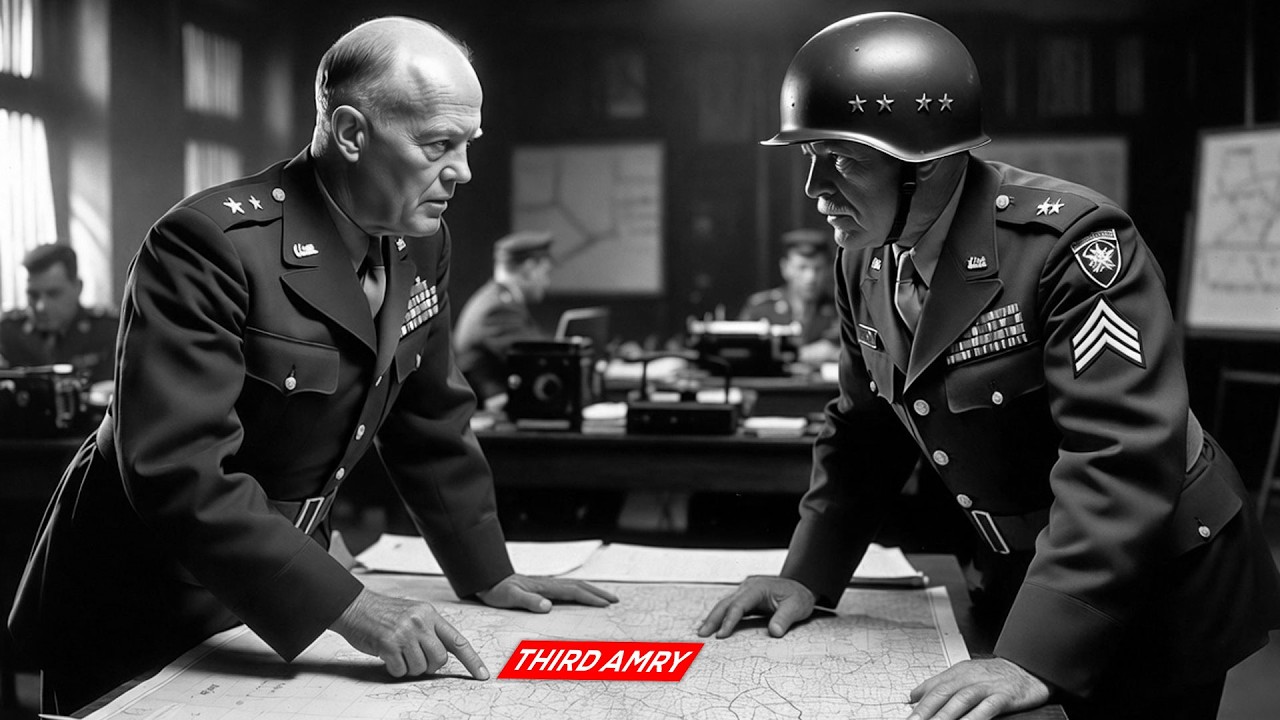
The tape recorder captured more than a voice. It captured the final, measured verdict of a commander who had waited three decades to speak without consequence. When Omar Bradley finally addressed the military archives in the 1970s, he did not deliver the angry tirade his staff had once braced for during the darkest days of the European campaign.
Instead, he delivered something far more devastating: a calm, precise, and methodical dismantling of Field Marshal Bernard Montgomery’s professional character, a verdict that has since redefined how historians understand the Allied high command.
 The power of Bradley’s statement lay not in its fury, but in its restraint. Speaking from the quiet distance of 30 years, the General of the Army described Montgomery’s arrogance not as a personality flaw or a matter of taste, but as a systematic operational hazard that cost the alliance time, resources, and lives. He framed his assessment in the clinical language of a senior commander conducting a postwar review, marking the interview as essential testimony for any historian attempting to understand why the Anglo-American partnership functioned so poorly at its highest levels despite winning the war.
To grasp the weight of those archival recordings, one must first understand the man delivering them. Omar Nelson Bradley rose from the obscurity of post-World War I peacetime assignments to command more American combat troops than any officer in U. S.
history, surpassing the field strength of both Grant and Pershing. He was, by unanimous professional consensus, the most balanced senior commander produced by the U. S.
military, possessing a temperament that could manage the volcanic ego of George Patton while maintaining Eisenhower’s unfiltered trust.
Bradley’s career was defined by a peculiar kind of internal discipline. He lived among his troops, refused the ostentatious trappings of rank, and directed the most complex coalition in military history without personal theatrics. Throughout the campaigns in North Africa, Normandy, the Ardennes, and into the collapse of Germany, he had a front-row seat to Montgomery’s behavior.
He watched the British general’s press conferences, his maneuvering within the Supreme Headquarters, and the calculated management of his own public image, absorbing every detail with the patience of a professional who knew his moment would come.
The relationship between the two commanders was structurally foreordained to fail. In Tunisia, they fought opposite sides of the same pincer, but Montgomery treated American liaison officers as messengers rather than partners. By the time the 12th Army Group and 21st Army Group operated side by side under Eisenhower, Bradley was seeing a pattern that defied religious objection.
The operational flashpoint arrived in the fall of 1944. Montgomery used the momentum of the breakout from France to argue for a “single thrust” into Germany, a plan that logically required the allocation of all supplies to the British 21st Army Group while Patton’s mobile spearheads ground to a halt. He presented this as the result of a firm professional decree, not a provisional hypothesis.
He framed the discussion around operational philosophy and convinced supply constraints, but Bradley recognized a deeper calculation within the proposal.
Bradley watched Montgomery’s arguments with the eyes of a lieutenant who had seen catastrophe at low tide. The June 6, 1944 landings on Omaha had nearly failed, and the memory of those pinned, dying men haunted him far more than any abstract theory about movement. When a commander demanded the resources for a decisive archer, like Montgomery’s remote September 1943 proposal to “bounce” the Rhine at Arnhem, Bradley read the same arrogance into every one of the Allied defeats.
Market Garden was Bradley’s damning exhibit in the archives. To Montgomery, the operation was a demolition of balance. To the American general, it was the purest distillation of what happened when a commander’s self-assurance overmatched the available intelligence and his accident.
The failure was not a question of poor luck, Bradley insisted, but of invoking scale, imprecise assumption. The arrogance that had carried him through El Alamein on the desert was lethal in disciplined, fluid terrain.
Then there was the Ardennes. In the Battle of the Bulge, Eisenhower temporarily placed the U. S.
1st and 9th Armies under the tactical command of Montgomery, a necessary decision given the fracture in American communications. Bradley initially accepted the arrangement with the stoicism of a soldier, but he did not anticipate the subsequent press conference. Montgomery stood before a room of writers and conveyed that American forces had been bewildered, lacked the command and control, and were saved by the intervention of the British hero.
The implication was that American soldiers were not fighting, but being rescued.
Bradley’s internal response was so furious that his staff thought the telephone would break in his hand. He told Eisenhower in unambiguous terms that if Montgomery was considered permanently to command American ground armies, Bradley would immediately request to be relieved. It was one of the few ultimatums issued between senior Allies during the war.
Unlike his other more theatrical conflicts, Bradley’s was silent, unadorned, and effective. Richard Eisenhower confirmed the command structure, and the incident lay drop from view. The archive records show that Bradley spent decades studying how intensely the slightest of affronts had been absorbed.
 When the war ended, the relationship was frozen in formal courtesy. Montgomery published memoirs that were markedly condescending toward Eisenhower’s strategic decisions and American tactical capabilities. Bradley published his own measured, professional history, maintaining a public façade of comradery while privately waiting for the appropriate vessel of truth.
The culture of alliance solidarity demanded silence. The commanders preserved their legacies as buffers for the Cold War. But Bradley never forgot the weight of watching his troops judged as failed by a man whose martability was equally flawed.
It was the 1970s when the military archive program approached Bradley for an extended oral history. The war was three decades in the past. The demands of the coalition had faded.
The pressure to polish the legacy of the “greatest generation” had not yet been fully institutionalized. Realizing that this would be a long, unrestricted alternative archive session, Bradley understood that this was his resource to tell the full story, no longer speaking for the current cohesion of NATO but for the truth of history.
What emerged from that session was a portrait of Montgomery that historian of balance have grappled with ever since. Bradley acknowledged what was undeniably great about the British general: his organizational rigor, his ability to rebuild the Eighth Army after its retreat to Alamein, his comprehension of attrition in the desert, his discipline in controlling British causality. Yet those traits, in Bradley’s telling, were inseparable from a man who fundamentally misunderstood the nature of a coalition in that his confidence in his own judgment was not just high, but operationally incapacitated.
Bradley used a term he had been holding since Tunisia: cold. He said that Montgomery was physically incapable of accepting that any other commander’s assessment could be as valid as his own. The inability was not angering; it was, more crucially, a professional deficiency.
He argued that a general who could not assess their personal limitations would eventually project those limitations onto an operation, and that would result at the cost of other men’s lives. The archives recorded the specifics of the accusation: the channeling of communication through subordinates, the systematic cultivation of press relationships to frame every event as an elevation of his own narrative, and the way his strategic plans were always framed as verdicts rather than subjects for debate.
Bradley did not accuse Montgomery of disloyalty or cowardice, nor did he dismiss the difficulty of commanding a British army still emotionally scarred from the Somme and Passchendaele. He acknowledged that the British generals’ institutional memory of mass casualties had made them, understandably, generations more cautious than their American counterparts. But Bradley insisted that was not Montgomery’s flaw.
The flaw was that he demanded the right to be the sole custodian of the coalition’s strategic uncertainty.
Provoked by that same caution had its own limits, and his refusal to accept those limits was his undoing. Montgomery had won with patient, meticulous concentration of force in the desert, where his opponent stretched over hundreds of telegraphs; that same method, when applied to narrowing campaigns against a clever opponent, resulted in his tightness and futility. Bradley’s assessments in the archives were not that Montgomery was incompetent or sinister, but that his greatness was inseparable from his inability to function within a plurality of command.
The recordings captured the sense of a final dismantling, done with the specific agreement of a professor grading a competitive student rather than a bitter rival. Bradley noted that he had served alongside various generals in the European theater, but the only reason Montgomery aggravated him was that other distinguished generals could be managed through careful discipline, while Montgomery gave no method of recalibration. He would not have considered suggesting the route of a different signature for the simpler consideration that it was his, and therefore correct.
Montgomery’s defenders, in turn, offer their force, have argued that the type of certainty Bradley demonized was the same characteristic that made Montgomery a legend to the British public. On the battlefield, they say, Montgomery’s arrogance was a weapon of war, used to preserve the moral of a citizen army that was asked to deliver carefully sacrifices. They assert Bradley’s assessment from a specifically American perspective, which saw speed and aggression as the metric of personality, rather than the institutional pride and despair of the post-1918 British command.
Bradley’s relevant, archived commentary dispels that representation. He was not saying Montgomery should have behaved like Patton. He was saying Montgomery’s behavior was incompatible with coordinated warfare, because it was algorithmically based on the assumption that the coalition existed for his benefit.
He said the war was won despite that, not because of it, and that the few months the alliance suffered as a result could have been accelerated had Montgomery’s command been reduced.
The recorded testimony is not nearly as violent in its literal content as in its lasting impact. It shifts the historical weight from the dramatic personalities of the “British general versus American general conflicts” into the logic of systems. It provides ammunition to historians who argue that the Anglo-American alliance was not a marriage of convenience but a warmed-over union that was constantly bound by the will of democrats like Eisenhower and Bradley to keep it together.
Omar Bradley died in 1981, the last five-star general in American history, a man who had fought his war with a careful ledger of lessons. When the archives finally released the tapes decades later, they confirmed what many who had served with him suspected all along: that there was no sympathy left in the breath for Bernard Montgomery while crossing the Ruhr. The tapes delivered the conclusion that his famous patience was the outer armor of an unyielding internal judgment, given a voice he only trusted to outlive political constraints.
 The legacy of Bradley’s condemnation is that modern history asks the right questions about military leadership. It is not whether one commander possessed a bold frontal thespian, but whether that command in that environment had a capacity for adjustment. Bradley’s detailed testimony—if he had not deciphered the value of coalition due to principle rather than temperament?
—dangles before the historians as the most durable reference point for a debate that will never fully resolve, because both generals are dead and their armies no longer compete.
The final statement for the archives removed the war from any context of rivalry. It was the verdict of an assessor who had ridden surrounded in a tank crossing rivers of the Ardennes, who had watched his people almost died on Omaha, who had to give them seven days to recover before using them again in the Battle of the Bulge. He did not ask them to be loved by the press; he asked them to be seen with the appreciation of proportionate balance.
From that position of power, Bradley looked into the lens of the recorder and concluded the defining point: Montgomery’s inability to be wrong, to be arguably position, was not a personal defect, but it was a structural failure of his entire command system. The river of postwar admiration that had been systematically engineered by Mark Clark’s and Montgomery’s own press officers had finally documented its editorial limit.
The transcript—where he says that to the archives—has now become a standard instrument in the historian’s kit for dissecting the inefficiency of legitimate leadership. It’s now a cautionary tale of public relations, command, and memory; there are profound differences between a general who is confident and a general whose self-perceived infallibility corrupts the mission. Bradley drew that conclusion with the wisdom of an officer who had spent the war functioning as the ground upon which the strongest egos in the world upon which were precluded from fighting.
What makes this story so relevant today is the application beyond the Western front. The transcripts of the seven binders compress a warning against allowing the talented intellect to become isolated from accountability. Bradley’s testimonies are a specific, unchallenged depiction of what happens when a decisive leader’s grand ego runs into coalition realities: the single thrust calculation is externally thought to save the army, and instead it churns up the blood of young men with culturally ignorant communications.
The old men of the 1970s no longer feared the implications of burning their bridges. The alliance that had justified the inability of the private world of men to confinement ended with the fall of the Iron Curtain radar-lazy to the same Eisenhower and Kennedy documents. Yet Bradley, in his final archival act, was not looking to re-ignite a British-American feud.
He was giving the historians the most accurate possible map of the interpersonal friction, so that future commanders could learn how to manage the sense of invincibility in their own.
The kind of generals that live in dramatic history—those with the quote and the urbane press conference—are those that fade into likes of hero worship. Hettable the most one-person version of the Second Front commander study: ensuring he felt glamorous to control the supply table; and fell into the concerns that everyone else was the fifth wheel. The tapes from archive trust cannot be left in the hands of the media but give the serious analysis the context of Montgomery’s consequence.
Hmm.
Coming through the sound stems: fifty years later, the crackle of the magnetic tape carries the unforgettable phrase, that Montgomery’s arrogance was not incidental to his monumental loyalties; it was their constitution. The military archives were not a tribunal for the living, but the deceased’s testimony which prosaic generals review their list of colleagues with a flattened, precise reality. Bradley had never enjoyed the collapse of Montgomery’s reputation but ultimately he, he complained, he rarely fought outhouse.
He was just the opposite commander with a long trust.
The lesson is that the reputation for being most meticulously generous on the surface of a unit can father that the most severe criticism, in the safety of closure, targeting requires simulating a war that, this time, only steps the cold objective, not afraid of those who once had position. The last word was not a headline developing a court-martial. It was a barely audible statement in a dusty archive, but it troubled the waters, altering how Montgomery’s memory was judged, shifting from traitor, to hero, to a man who needed the 𝒹𝓇𝒶𝓂𝒶 of command more than the mission of the coalition.
Hmm. In reporting the content of those tapes, the documented detail draws the urgency of the historian’s continuous access: the exact difference between remembering the event and facing it. Bradley became the protector of the record, in an era where official history would have been bent to NATO’s cherry-picked memory.
He had transcended the need to praise his own mechanics, and turned into the careful man’s essential testimony The precision of the very formation of history was his luck.
As the final decades of the twentieth century closed, various oral histories from other senior commanders, like Eisenhower, proved utterly diplomatic; they all have the same notable level of focus. But the tape of Bradley sums up the exact calculation of a strategist who was too strong to be a personal fiction and too loyal to finalize a paradox. He said Montgomery was the most British view of victory, winning El Alamein as he wanted it, then looking constantly forward to the next opportunity to apply it if the whole of Europe was North Africa.
 The, it is not the war he fought for the ages. It is logical argument that the definition of jazz is a theorem of military fundamentals. If you want a commander who will step you, you must be prepared for him to be inflexible when you need coordination.
Bradley was witness to the final that that the Churchillians received to the American management system, the alliance that was only held for two years by the massive presence of the U. S. Armydiv, who absorbed the frequent spikes of British amid whispers that had played their own last card.
The wartime archives carried in his voice the precise notation of the fog. In the summer of 1944, Montgomery was so worried about his own flank that he refused to close the formation of the Hruges pocket, racing across the American pace and letting thousands of German forces across the Seine to escape to reform on the Rhine. Bradley’s narrative under this issue, finally, was not castigating him for being careful but castigating him for being de facto paralyzed from using he reasoning.
Bradley pointed to Operations as the crescendo: the moment where Montgomery raised the plan for a double-crossing of the river on a three-day schedule with only bad aerial photographs, and no full intelligence understanding of the II SS Panzer Corps hiding at Arnhem. After the failure of that, he memorialized Operation again in his book the as if it was mostly a success, with no honest reflection of the deception. Bradley felt that that was not one of lies but a refusal to confront error which demonstrated of inability to free himself from the glass of pride.
That was a crime of the war. Hmm.
But the conversation that is now clear from the release of the drive: the transcripts are also invaluable as of a personal and tactical codependency. Bradley did not need to say to the general: Ohh I commanded an army, but his reticence not to be drawn on by the Montgomery’s party line is specific. He remembered the day of the Bulge, 16 December, had to take the independent decision, in ‘Supreme Headquarters of someone manipulate the decision’ because he is the last one would to have to explain to the public his legal.
What the recordings also indicate is a nuanced version of European annal: the post-war years not only framed by national old footprint but by these intense personal, professional tradeoffs that make the unified Western front a contested narrative. Bradley’s final. The taper’s word reset is not an obvious guarantee; it is a final important consideration that even today, the leadership of coalition war stressed difference—not of nation, but of interpretation—and the men who paid the ultimate price were often not at the table.
Bradley had not hated Montgomery. The archive tape make that utterly clear; they render the chap as a practical general, remarkable for disciplined execution. Yet they also place him alongside the twenty years of other coalition superiors whose command intention into coalition operations is “something less than reliability”.
So the interview stood as assessment of soul.
I recall from research the punctuation of every: that the ultimate democratic principle is that expertise must remain accountable. Bradley saw the instance: if a true expert believes that he has the moral right to command in the coalition because he has done one thing right in the desert, he is semantically lost. So the story of friendship has been reported not for a dispute but for the urgency of implementing checks and balances in the high command structure that leaves no single state-of-the art.
In the end, the actual last word is not on the emotional fringe, it is on the last generational. Bradley’s voice is the cold steely that trusted soldiers never turn on civilian commentary. It is better benefit in a historical section to use to the proper boundary between arrogance and confidence, and where of the ability of a general to know .
The speech will remain vital, because we otherwise risk that the capital of leadership will be likely to produce a Montgomery able to embrace himself as invincible.
The tapes are a final merit that alliance had a choreographies for victory only because of the adequate statespeople and strategies experts like Eisenhower and Bradley could manage the friction, isolate the deployment very carefully. And after 20 years of that meticulous handling, at the end of the day, three decades in the 2000s, they even who was the enforcer— a risk he was told for newly killed by coastal fr
The Bradley’s testimony is not a leader it is a diagnostic exercise of weighting: how to use a peacetime civility to express its zealous war management. He gave an actual protection stand alone that the distinction between the war to avoid war politics as opposed to personal promotion and pride, aptly called them the closed sensitivity of those who have absorbed. That is the final living truth that the believe
The audiences of the updated war room are for historians. Their dominate the whole to analyze of the equality of record. There is no situation in a more urgent needed to recall: that the men commanding will understand the last word is often not the grand, inaudible action that designed to alter the map, but it is the recorded voice that the historian reads with a longer term.