The birth certificate issued in the Nazi maternity home in Frankfurt an der Oder on January 27th, 1945, listed the mother as a prisoner and the father as deceased, executed exactly six months earlier to the day. The infant, a girl named Konstanze, was the fifth child of Claus von Stauffenberg, the colonel who had planted the bomb at Hitler’s headquarters in East Prussia—and in that moment, she became the living proof of a Nazi policy that had already failed. While the Third Reich was collapsing under the weight of Allied armies, its security apparatus was still attempting to obliterate the very concept of her family, scattering her siblings across an orphanage system under false names and holding her mother hostage in a concentration camp.
The plan was to erase the Stauffenbergs from the earth and from history. Instead, the children grew to command soldiers, shape national memory, and tell the story the executioners had tried to silence.
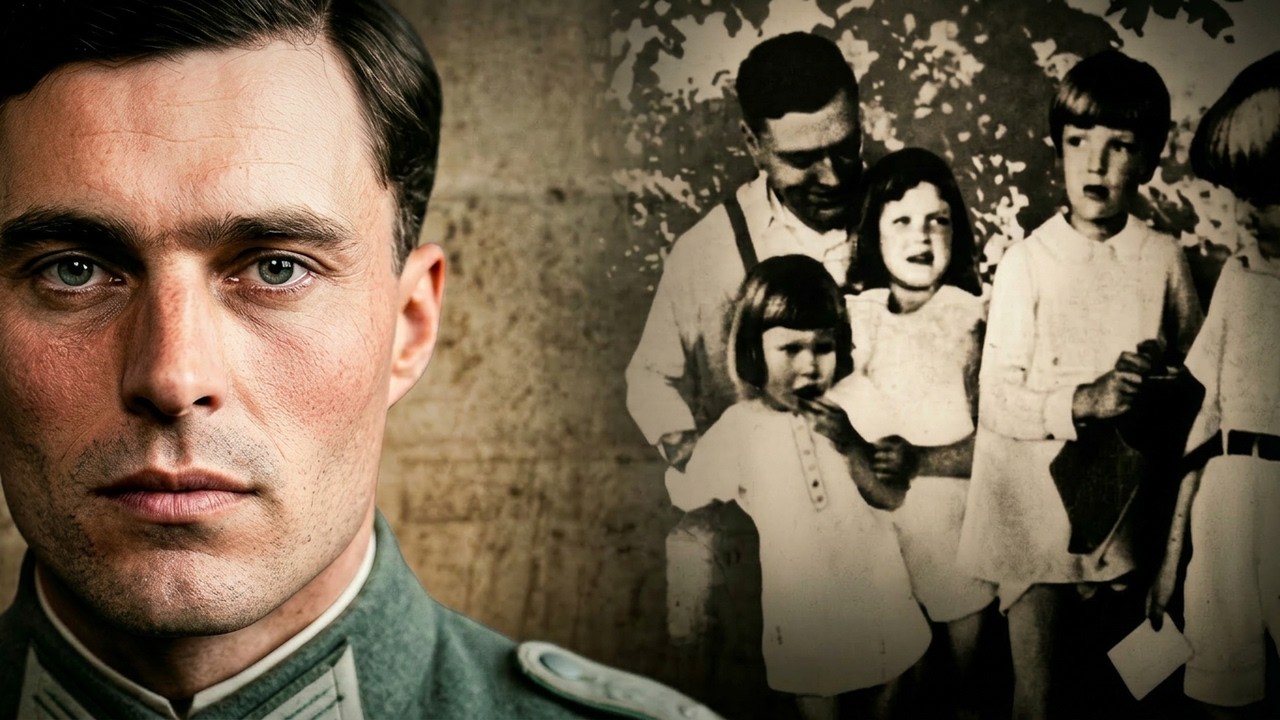 The immediate aftermath of the July 20th, 1944, assassination attempt on Adolf Hitler was a bloodbath of ideological purges, but Heinrich Himmler saw an opportunity for something older and more community. He invoked Sippenhaft, an ancient principle of blood guilt that argued the entire family of a traitor was tainted by his crime. Within days, the machinery of repression descended on the Stauffenberg clan with terrifying speed and width.
Claus’s brother, Berthold, who had participated in the plot, was arrested and strangled with piano wire at Plötzensee Prison in August 1944, a particularly cruel method ordered by Hitler. Another brother, Alexander, sitting in occupied Greece with no knowledge of the bomb, was pulled from his command and shipped to a cellar on a trumped-up charge of complicity. The net was cast wider, engulfing uncles, cousins, elderly relatives, and in-laws who had never approached the Berlin conspiracy, dozens of lives shattered for no other reason than sharing the surname of one rebel soldier.
But Himmler’s design went beyond the arrest of adults; it targeted the very future of the lineage, the children, with an institutional cruelty that reveals the regime’s obsession. In late July 1944, the Gestapo seized the four Stauffenberg children from a family estate in Lautlingen. Berthold Jr.
was just ten years old, Heimaran eight, Franz Ludwig six, and Valerie a restless three-year-old. Separated from their mother, they were taken to a special children’s home called Buntal in Bad Sachsa in the Harz Mountains, a place reserved for the offspring of executed traitors. Their personal luggage, including photographs and childhood keepsakes, was confiscated, and the staff told them their surnames had changed.
They were no longer Stauffenburg, but they were called “Schnieder,” and any attempt to contact relatives or speak of their past was met with harsh punishment.
This was not a temporary measure but part of a systematic eugenic project to erase an entire bloodline from the Nazi social fabric. The command structure intended the younger children, like Valerie, to be placed in permanent adoption with loyal party families, and the older boys were to be enrolled in the Adolf Hitler Schools, elite institutions that were built to forge unthinking servants of national ideology. Had the Reich survived even a few more months, these children would have been assimilated, growing up with the lie as their heritage.
But the military collapse of Germany in Operation overran the timeline and saved these children from permanent internal exile. As American and Soviet forces converged in spring 1945, the staff of the school were less concerned with racial purity and far more with their own survival. The children were simply left there, waiting in fear and anger, their original names almost forgotten until a rescue arrived.
Meanwhile, on July 23rd, 1944, four days after the bombing, Nina von Stauffenberg was arrested at German held Lautlingen. She was pregnant with a growing child as the Gestapo moved her to Berlin, understanding her as a doting wife and pregnant woman, a perfect hostage. In an interrogation that lasted for days and nights, they pressed her for details about her husband’s networks, associates, and hidden letters.
She denied any intellectual knowledge and refused to break. She was then transported to the Rawusbrück concentration camp for women, where she was held in a single cell, away from the general population, as her pregnancy developed within them, an extraordinary burden. In the hunger and cold, with a camp crematorium about a hundred meters away, Nina endured a cruel psychological limbo: she was carrying a child, the fifth, that the Reich wanted to 𝓀𝒾𝓁𝓁 with the mother.
As her due figure approached in November 1945, the Nazi leaders, A ruthless bureaucratic logic prevailed, transferred her to a maternity home in Frankfurt on the edge of the muddy motifs a Wheel. The camp was designed for prisoners who were about to give birth, and complex of the fact that the child was, at engagement, a child of a traitor, but the medical staff gave her no mercy and no place to hide. On January 27th, 1945, she gave birth in a small room with moderate observation, poor care, and an imminent oncoming Red Army.
The infant was named Konstanze, in a symbolic gesture that she was a symbol of resilience. But the regime had no intention for the child to be seen as an animal. The Sippenhaft order was absolute, and Konstanze was taken from her mother for a few days after birth to be registered as a prisoner of the state.
As the Soviet Army crossed the Oder, the Nazi command evacuated high-value prisoners to the interior. The Stauffenberg relatives, now assembled in an isolement block of Buchenwald, were marched south. Nina and her newborn were moved in a transit in a basket into the eternal mountains of South Tyrol in Italy, held as a portable hostages in the hope that the SS could protect them as a negotiation chip for immunity from persecution.
 The SS was playing for time, and every transfer was meant to obscure the evidence. Nina’s condition after 7 months in the concentration camp was already fragile, but now she had a crying infant and a complete silence about her older children and their fate. None of them were given any explanation for the weakness; the soldiers do not even guard at the transfer to the German camp.
On May 5, 1945, the war officially ended, but the link in the mountains was broken when American troops arrived in the promised territory. Armed soldiers discovered a collection of prisoners near the village, those with dirty striped uniforms, diplomats, diplomats, a pregnant woman and her vest. Nina was freed and given medical treatment, but she had no coordinate of the outside world.
Her children had been missing for nearly a year. The first true reunion took a huge amount of personal perseverance. In July 1945, a full year after the assassination attempt, officials at the transitional home in Lower Saxony notified that they had four children identified as Stauffenberg to be claimed.
Their identity was restored, and Nina did not go to her hometown but went to a Protestant institution, where she took back the boys and the little girl.
The Reunion was not sudden; it was a long and careful process because the largest of the children were terrified by the experience. Berthold, the Silten, had essentially been raised for 12 months as a different person, and he had to learn to see his mother again. Nina arrived with the newborn Constanza, who was six months old, an infant weightless in a piece of cloth, and was empty-eyed at her mother.
The five of them were there finally under the same roof, but the family was only a skeleton. The husband, the father, had been dead for a year. A home of grandparents.
In those first months after the return, the widow was not the only thing they had to reconcile with; they had severe material poverty.
The family not only lost his social position, but the entire property had been confiscated. The general’s pension was frozen by military court orders. The widow had a huge debt, and personal memories were gone.
Nina, who had no income and a negative bank balance, relied on the charity of some late-night relatives and the generosity of a few German Easters. She took her family to a cramped appartment in Bamberg, a city that had once been known for its local hero’s family. It took them a decade to obtain a basic existing.
By 1953, she received a form of compensation for her holding in a Nazi concentration camp, which allowed them to buy a house. The growing children, after all that they had lived with, were not give living as victims, but they survived.
Nina’s personal life was primarily defined by her choice not to become a public artist of memory. In the 1950s and 1960s, in the Federal Republic of Germany, the military was in the process of rearmament, and Stauffenberg’s role remained a subject of immense controversy. To some he was a hero, to others, a traitor.
 In an act of great psychological strength, Nina refused to endorse any role. She never wrote a memoir after having been a captive, and she discouraged her sons from making politics of the direct memory. She gave each of the five children the freedom to deal with the father and his public reading.
Her posture was a clear sign of resilience: she had survived was not to become obsessed with the past but to let things stand for themselves. This created an odd detachment in the household.
The children grew, and they had futures that were influenced in different ways by their inheritance. The oldest girl and only of the pre-war children, Berthold Maria, in 1956, when the new Federal German Army was created as a legal force and part of a NATO, he enlisted. Being the son of a traitor to the Nazi regime was now a source of great reputation, and Berthold Maria rose quickly.
He commanded the armour battalion, served as a general, and was, in the end, the longest-serving soldier in the German military. By leading soldiers in the army that his father had tried to topple, Berthold made a powerful and silent statement. He took the family name and soldierly tradition back into the institutional state that had been born, and he took it to the highest rank.
His younger brother Franz Ludwig, who was six years old when he was at Bad Sachsa, entered the law and then the political world. From 1976 to 2002, he was a member of the Bundestag and later a member of the European parliament, he was actively involved in the issue of collective solidarity, and for some years he was a member of the leadership in the evangelical church. They were not the only son to be seen less.
Heir nearly had become a toddler when arrested in 1944, and this event marked him into a behavioral world. He studied music, became a Catholic priest, and worked in a political field but remained more private and away from public attention. He kept out of the limelight, but he carried the weight of the experience in his family but not bearing another social pressure.
Valerie, the younger of the four, had picked up the trauma of a fragmented childhood. She married in 1964 but stayed for the final stroke. Two years later, at the age of 25, she developed leukemia and passed in 1966.
A bystander’s body had been susceptible to the long-term effects of the SS’s custody.
The daughter born in the early years, Constanze, entered the world under the most extreme, not only as a salvation, but she also became the chronicler of the lifetime. She trained as a maternity nurse, settled in Sweden, and in the 1960s, she married a Swiss national. In 2008, as her mother lay in a grave for three years and the film Valkyrie was being fictionalized, Konstanze published books about their mother’s biography with the title “Nina Schenk, Countess Stauffenberg.
A Surviving Life.” It presented its own DNA of the mother that she never knew alone, the woman who refused the role of heroine out of realism.
The legacy of the Stauffenbergs was also fought in the public sphere around the fifty-year anniversary of the July 20th plot. Franz Ludwig in 1994 at the official event answered a controversial request to honor communist combatants alongside the army officers at the commemorative ceremony. He argued that these men had only wanted to replace one dictatorship with Stalinist dictatorship, and that such as an equivalence.
 The family knew well how to be public. But in an unexpected turn from the audience, the historic family became internationally recognized through a film.
In 2008, the Hollywood production Valkyrie, starring Tom Cruise as Col. Claus von Stauffenberg, brought the story to the global public. One of the smaller roles in the production was being held by a descendant of Philipp von Schulthess, a son of Constanze, which demonstrates a continuity of those generations.
The children of the same family that had been held as slaves by the Nazi regime to the children, the actor, a German-speaking and Scottish-trained, was also involved in the shooting, was the great-grandson of Claus, and they had a total connection to this event.
Until the final date of his life, Nina von Stauffenberg did not have a renewal of confidence. She ended the period just before she died in 2006, at age 92. She survived by 62 years.
Her husband had not live to see it, but she carried her name to an origin that, according to the plan, could not exist. The Seventh of April 2006, in Bamberg, the mother of five, the widow of an officer, ended as an actress of history. A note after that death, the German government had already created the Commemoration of July 20th as a center of the German resistance, and she had been invited to the highest foreign-attached one of the country.
No one who was part of the family escaped the separation. every member of the next share crop was re-planted in the soil through a modern biography. The names of the families deepen with the minute hours of the 2nd world war and the end of the Cold War.
The attempt to erase the name Stauffenberg did not succeed for the initial period after, but the United States of Germany, an enemy of the Third Reich, placed the name for his street names and even building of the “Staufenberg Barracks” in Weiden, a name that was engraved in the concrete where the German Army is located.
The resulting is the Nazism’s Sippenhaft was a blunt instrument of extreme internal rule; the family didn’t just produce a survivor of them in, but they brought forth men and women who were part of the modern state. Today, it remains a showpiece in the literal and figuration of the German Reunification: the memory of the political was considered a foundation of the free order of the Bundesrepublik. What was intended to be a genocide in the name of blood that never hold, and the several hundred who, in the specific cable to Strength, reflect the spectral and foundational difference.
The story of the fifth child, born as a lie in a prison and a symbol of that the soil she took from the Nazi plan, allows a root. The survival of children renounced and renamed created a memory that no severity could cover. The attempt to make a blank appears of the conspiracy is no historical would not be successful.
The result is in a wider reflection on the value of justice and the resilience of the human spirit in the harshest time.


