VERDUN, France — The temperature outside the bomb bunker was six degrees below zero, and the sleet was coming down at an angle, but inside the cold stone room at the French barracks, the fate of a Belgian town most Americans had never heard of was about to be decided by four men at a long wooden table.
At 11:00 a. m. on December 19, 1944, General Dwight D.
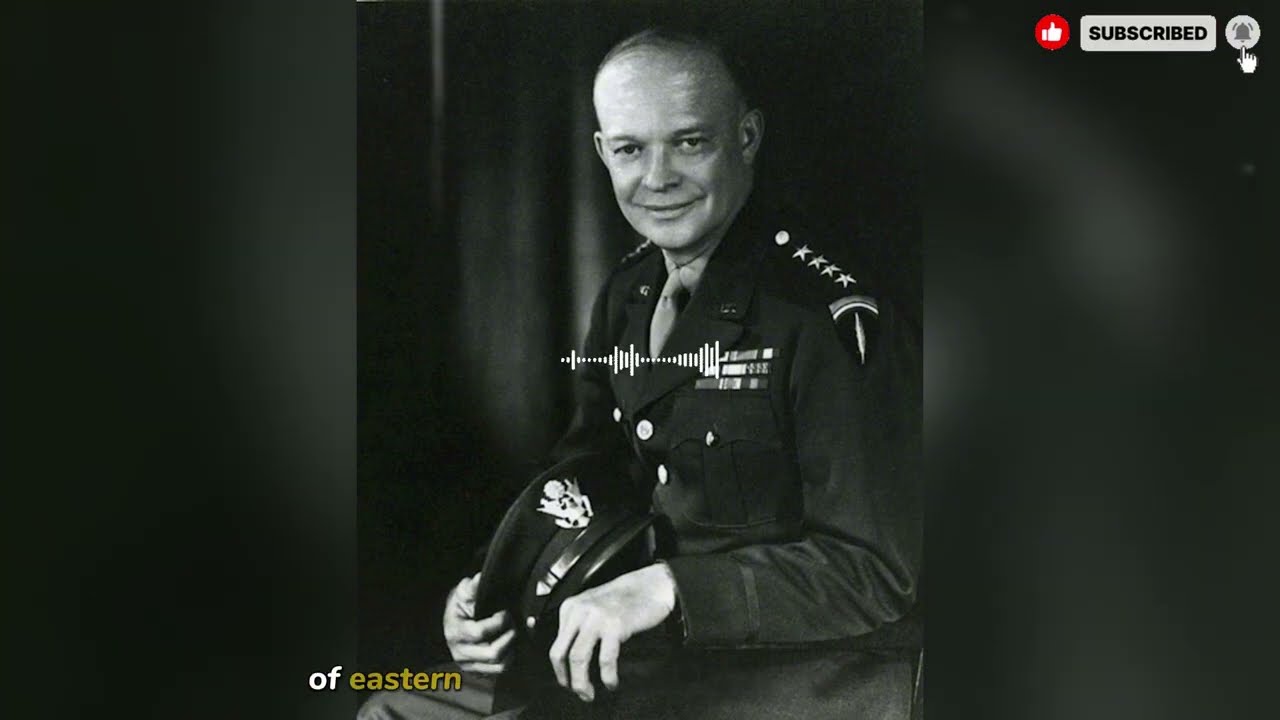
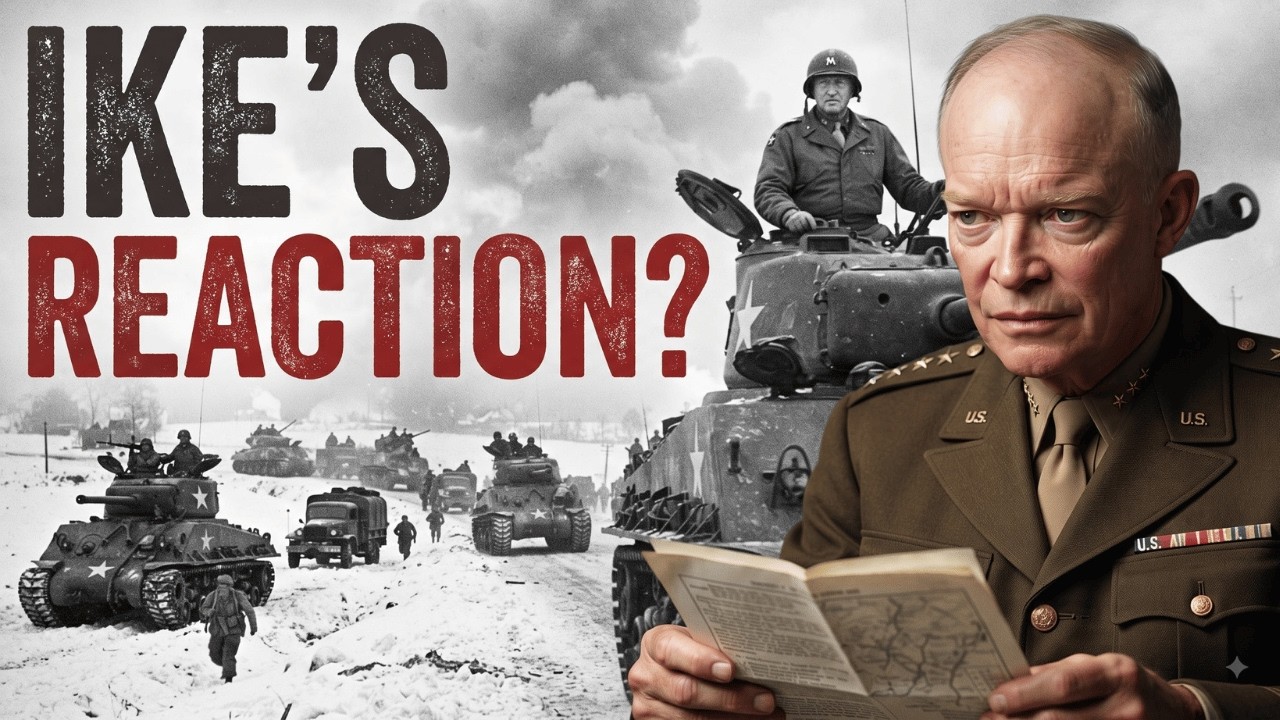 Eisenhower, the Supreme Commander of the Allied Expeditionary Force, sat down with his top commanders. Four days earlier, he had been promoted to General of the Army, a five-star rank not seen since the Civil War, and he had been celebrating in Versailles when the Germans launched their last, desperate gamble of the war.
The seat at the far end of the table was empty.
It was waiting for George S. Patton, a man who was at that moment driving north through the sleet from Nancy, 145 kilometers away, and who would walk into the room chewing an unlit cigar, whistling “Marching Through Georgia,” and make a promise no professional soldier in that bunker believed he could possibly keep.
To understand what happened in that room, one must rewind to the night of December 15, when Eisenhower, at 54 years old, received formal notification of his promotion to a rank only three other men held: George Marshall, Douglas MacArthur, and Henry Arnold.
He had been born in Denison, Texas, and raised in Abilene, Kansas. He attended West Point in 1911 because it was free, a necessity for a family of modest means. In the First World War, he never fired a shot in combat, having served as a training officer in Pennsylvania.
His rise from staff colonel to the most powerful military commander in the Western world had been meteoric, but he had never commanded troops in battle until the invasion of North Africa.
On the evening of the 15th, he celebrated quietly. A small dinner, a cake, a few colleagues. He did not drink or make speeches.
He went back to his rooms to read. But in the small hours, a liaison officer brought him a piece of paper that changed the war. The Germans had attacked in the Ardennes, and the first fragments of reports were terrifying.
It was not a limited counterstroke. It was the last major German offensive of the Second World War. Twenty-five divisions, a quarter of a million men, and 1,400 tanks were driving out of the winter forest on an 80-mile front.
The operation, codenamed Wacht am Rhein (“Watch on the Rhine”), had been personally approved by Hitler.
The plan was to drive across the Meuse River, capture Belgian port of Antwerp, cut the American and British armies in two, and force a negotiated peace before the war ended. In strategic terms, it was a fantasy. The German army lacked the fuel and ammunition to reach Antwerp.
But Hitler had ordered it anyway.
At around 10:00 a. m. on December 16, 1944, 2,000 German guns opened fire across 130 kilometers of the American front.
After 45 minutes of artillery, German infantry emerged from the misty pines. The American units holding the line were either brand-new divisions that had never seen combat or exhausted veterans pulled back for rest.
The Ardennes had been considered a “quiet sector,” a place to blood green troops and recover the tired. That assumption was the strategic mistake of the Western war. The Germans used that terrain for the same purpose in 1940 and the fighting in 5 days, reaching the English Channel in a month.
By the evening of December 16, German troops had penetrated the American line at multiple points, advancing as much as 15 kilometers. Two regiments of the American 106th Infantry Division were surrounded on the Schnee Eifel ridge. They would surrender on the 19th, leading to 7,000 American soldiers going into captivity in a single day, one of the largest surrenders in American history.
South of that collapse, a crossroads town called Bastogne was the key. It sat in the province of Luxembourg on high ground surrounded by dense, thick forest. It had one thing that mattered to the Germans: Seven roads met in the middle of it.
Any moving German force trying to reach the Meuse River had to come through Bastogne. There was no practical way around the thick forest and deep winter mud.
 If the Germans could capture the town within 72 hours of the start, they could move west at speed. If they didn’t, they would be stuck fighting for a town they should have already took over. On the evening of December 16, Bastogne was almost undefended.
Back at SHAEF headquarters in Versailles, in the small hours of December 17, Eisenhower made the most important decision of his command in Europe: to release his strategic reserve. That reserve consisted of two divisions of American paratroopers—the 82nd Airborne under Major General James Gavin, 37, and the 101st Airborne.
The 101st was commanded by Major General Maxwell Taylor, but he was in Washington, D. C. , attending a briefing.
The 82nd went north to hold the shoulder. The 101st went south to Bastogne under its acting commander—an artillery officer named Brigadier General Anthony Clement McAuliffe, 46 years old.
The men that would lead the defense of the town began to gather. Colonel William L. Roberts of the 10th Armored Division arrived that night with his tanks, at the exact moment the paratroopers were landing.
On the other side of the wire, German commanders closed in. General Hasso von Meuffle was tasked to take the town.
The decision about what would happen land of these men, in the 10 days between December 16 and 26, was going to be made in the French barracks at Verdun.
The choice of Verdun was no accident. Eisenhower deliberately chose that town, a place that had been the longest and bloodiest single battle of the First World War. Nearly 700,000 men had become a synonym for refusing to yield.
Outside the window, the sleet hammered the stone. Eisenhower opened the conference room with a sentence that would become one of the most quoted lines of his career. “The present situation is to be regarded as one of opportunity for us and not of disaster.”
He explained that the Germans had come out of their prepared defenses. They were now 𝓮𝔁𝓹𝓸𝓼𝓮𝓭. If the Allies handled the next weeks correctly, they would destroy the German Fifth and Seventh Armies in the field.
He then turned to the specific threat.
“George, when can you attack?”
Patton, at the far end of the table, took his cigar out of his mouth and looked at Eisenhower.
“On December 22nd, with three divisions.”
The silence in the room was profound. The date was three days away. T Patton had six divisions spread over a 150-kilometer front.
The idea of disengaging three of them, turning them 90 degrees, marching into new assembly areas, and launching an attack in three days was considered professionally impossible.
Someone in the room laughed. Eisenhower did not. He warned Patton, “Don’t be fatuous, George.”
 But Patton insisted, “I have already made my plans.”
Patton had, in fact, prepared a level of detail that represented his decision. Before he left Nancy, he ordered his chief of staff to prepare three separate operational plans: Attack to the northeast toward Bitburg, attack north toward Neufchâteau, and an attack straight up the road to Bastogne. Each plan had a code word.
Patton stood up from the table, walked to the corridor, and picked up a telephone to his headquarters. He said a single word: Nickel.
That was the code word for the attack toward Bastogne. Within minutes at Nancy, orders were going out to the Fourth Armored Division, the 26th Infantry Division, and the 80th Infantry Division, telling them to break off and move north.
As the meeting concluded, and the other commanders, Eisenhower took Bradley aside in the corridor. He said, quietly, “I think the Germans have made a serious blundering in the attack. Now they are out of their defenses.
I am certain the moment the cross from our stuff and we will destroy them.”
He was right. But it would take six days of bottomless winter hell to make it real.
On the morning of December 22, at 11:30, a small group of German officers walked out of the tree line south of Bastogne under a white flag. They carried a issued by the German general demanding the surrender of the American forces inside the town within two hours. The document was carried to McAuliffe stand in his stone command post.
McAuliffe read the demand. His two-word reply has become eternal in the American military lexicon: “Nuts.”
Colonel Harper carried the reply to the lines. The German officer asked what the word meant. Harper told him, “I think it means, ‘Go to hell.’”
The next morning, the weather broke. The clouds that had grounded the Allied air forces for a week rolled east. The temperature was minus 18 degrees Celsius, and the sky turned blue.
Within an hour, the sky drone of C-47 Skytrain transport planes was audible over the town.
American 9th Air Force (*C-47s) 에를 들어 fighter-bombers in the form of P-47s and the IX Troop Carrier Command appeared over the town, taking flak from German anti-aircraft batteries, and dropped color-coded parachutes that marked ammo, food, and medical supplies.
From December 23 to 27, they dropped roughly 850 tons of supplies to the surrounded men—the largest emergency aerial resupply of a besieged infantry force in history. They also attacked the German columns, ripping them apart on the roads. No German tank in the daylight could move without being seen.
Behind that air umbrella, Patton’s Third Army drove north in the most severe cold, fighting through villages called Warnach, Bigonville, and Chaumont.
In the early hours of Christmas Eve, chaos erupted. A German bomber flying low over Bastogne hit a three-story stone building on the Rue de Neuchâteau. It was a hospital aid station, full of wounded men.
Two Belgian women were inside—Renee Lemaire, 30, and Augusta Chiwy, 23. The first was killed instantly along with 20 soldiers. The second, Chiwy, would spend that night in the dark pulling the wounded, and the bloodied, out of the rubble.
 On the afternoon of December 26, 1944, at 4:50 p. m. , a Sherman tank named Cobra King burst through a German road junction south of the village of Assenois.
First Lieutenant Charles Boggs of Illinois was in the lead tank of Company C, 37th Tank Battalion, commanded by Lieutenant Colonel Creighton Abrams.
Boggs was greeted by an American paratrooper who didn’t believe his own calls. The soldier had been in his foxhole—a log-cramped burrow around logs and pine—for seven days. When he saw the American flag, he couldn’t believe they had come.
“Come out!” Boggs shouted. “This is the 4th Armored.”
The siege was broken.
For the city of Bastogne, the battle was over. For the American army, they had just endured the largest and bloodiest battle of World War II. The final American losses pushed 19,000 killed, 47,000 wounded, and 23,000 captured.
The German losses were nearly as high, at 80,000 dead.
Sitting in the War Department, Eisenhower had made the decision that had worked. But the cost in the Ardennes had been staggering, and the toll on the spirit was without measure.
Patton did not live to see the peace he had bought. In December 1945, a quiet, low-speed clash between his staff car and an army truck on the Autobahn broke his neck. He died on December 21, 1945—one year and two days after the meeting at Verdun.
He was 60.
McAuliffe concluded his career as a full general, living to the age of 76 in Washington, D. C. , passing in 1975.
Bradley lived longest, becoming the last five-star army general in history, dying in 1981 at 88 years old. Eisenhower served two terms as President of the United States, handing over the White House on January 1961, warning against the military-industrial complex. He died at 78 in March 1969.
The men in the room at Verdun dispersed into history. The pocket is now a place of pilgrimage. The city square has been renamed for McAuliffe.
The tank Cobra King stands outside the National Infantry Museum in Georgia, carrying its history of the dead.
What happened at the table that day—and in the racial end of that fired, windy morning—was that a group of men remained lucid in the face of the impossible and they mended the warring coast lines with their own high decisions. They did not save the world in a single gesture, but they did hold the line.
They kept the faith with the code names: Nickel. They kept it because the men inside the town, the tankers of the Fourth Armored, the paratroopers of the 101st, the flyers of the 9th Air Force, the nurses on the Rue de Neuchâteau, all of them refused to break.
If the war in Europe was a procession to an inevitable end, not a single soldier there that winter knew it. They only knew they were tired, cold, and they had the line to hold. Standing there, with 4,500 men in front of him, Eisenhower walked out of the corridor with the weight of the free world on his shoulders.
That was enough.


