Paris was only twenty miles away.
Patton’s tanks had broken through.
The road ahead was open.
He believed he could reach the French capital by morning.
Then the order arrived:
“Stop.”
Patton stared at the map.
“Stop for what?”
“The French.”
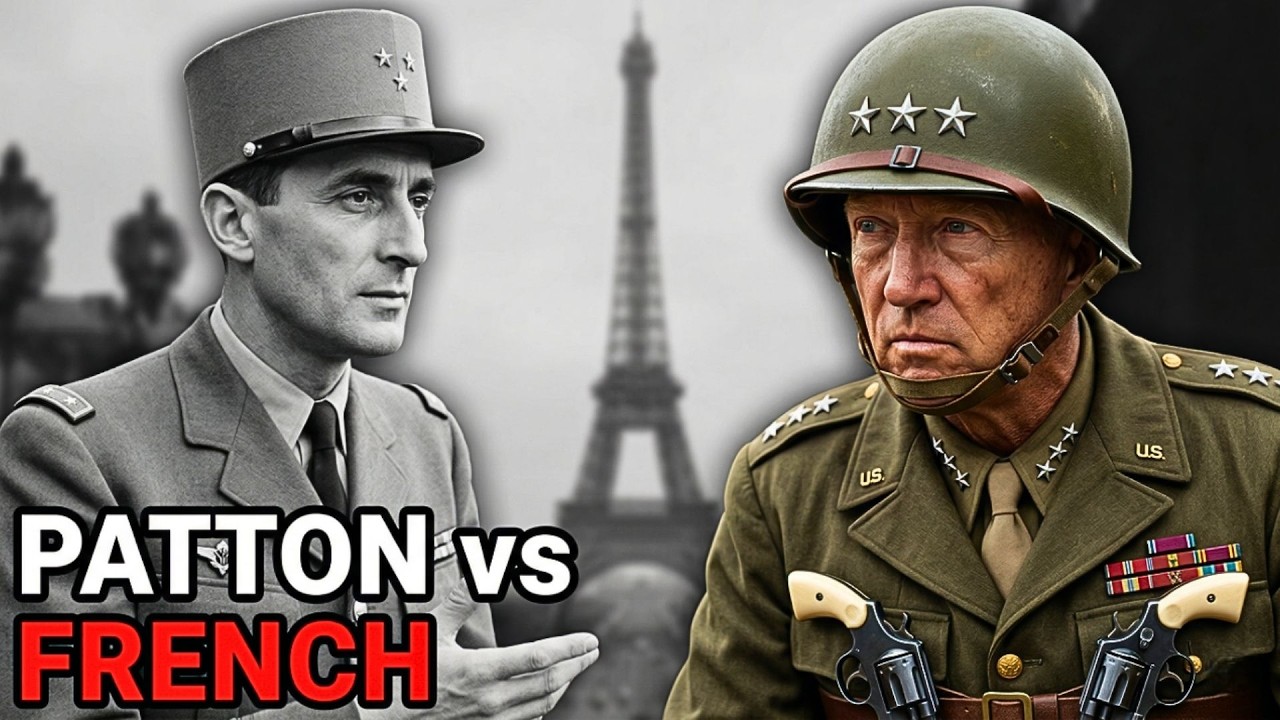
According to the story, General Philippe Leclerc carried the message personally.
His 2nd French Armored Division would enter Paris first.
Patton’s Third Army would wait.
“How far away are you?”
“Fifty miles.”
Patton looked back at Paris.
Twenty miles.
Then at Leclerc.
Fifty.
Every hour mattered.

The Resistance was already fighting inside the city.
Hitler had demanded Paris not fall intact.
Bridges could be destroyed.
Monuments could be lost.
More than two million civilians were trapped inside.
And the American tanks closest to Paris were being told not to move.
Patton leaned over the map.
“You want me to sit twenty miles from Paris while the Germans have orders to destroy it?”
Leclerc’s answer, in the source, is simple.
“Paris must be liberated by French soldiers.”
For once—
Patton’s greatest enemy wasn’t a German army.
It was politics.
And this time—
speed might not be the most important victory.
August 1944.
France was collapsing around the German occupation.
The Allied armies had broken out from Normandy.
German forces were retreating.
Roads east were filling with destroyed vehicles, abandoned equipment and shattered formations.
After years of occupation—
liberation was moving toward Paris.
But Allied commanders faced a strange problem.
Militarily, Paris was not necessarily the prize they needed immediately.
Politically—
Paris was everything.
The city had been under German occupation since June 1940.
German troops had marched through its streets.
Nazi flags had appeared on famous buildings.
French national humiliation had been made visible in the heart of France.
Now the occupation was cracking.
But taking Paris would create enormous logistical demands.
Millions of civilians needed food.
Fuel.
Security.
Administration.
Transportation.
The Allied armies were trying to pursue retreating German forces toward the east.
Every truck diverted toward Paris was a truck not carrying ammunition or fuel forward.
So Eisenhower initially favored bypassing the capital.
Keep moving.
Defeat the German army.
Deal with Paris when the military situation made sense.
Charles de Gaulle saw the situation very differently.
Paris was not merely another point on a military map.
It was legitimacy.
Whoever entered Paris as liberator would help define who governed France after the Germans left.
And de Gaulle wanted the answer unmistakable.
France.
That made General Philippe Leclerc and his French 2nd Armored Division enormously important.
The unit had fought alongside the Allies.
Its tanks and vehicles included American equipment.
Its soldiers were French.
And that distinction mattered.
France had endured four years of occupation.
Its political future was uncertain.
The legacy of Vichy remained toxic.
Resistance groups with different political loyalties were active throughout the country.
De Gaulle needed something the French population could see.
French soldiers returning.
French flags.
French armor entering the capital.
A French government asserting authority.
Liberation could not look simply like France changing from German occupation to American administration.
France needed to appear—
and become—
a sovereign Allied nation again.
That was the political reality surrounding Paris.
Patton represented another reality.
Momentum.
If a road is open—
use it.
If the enemy is retreating—
pursue him.
If the objective can be reached—
take it before the enemy recovers.
Those two ideas were now colliding.
The source places the confrontation on August 23.
Leclerc arrives at Patton’s headquarters.
A map opens.
Paris.
Patton’s forces—
twenty miles.
French forces—
farther away.
Patton points at the distances.
“I can be there tomorrow.”
Leclerc does not dispute it.
But this is not about who owns the faster tanks.
“This is a French matter.”
That sentence changes everything.
Patton sees civilians.
Bridges.
German demolition orders.
Military opportunity.
Leclerc sees four years of humiliation.
A capital city.
National sovereignty.
The future French government.
Neither perspective is trivial.
Patton presses him.
If the Germans destroy Paris while the Americans wait—
what then?
Leclerc’s answer remains political.
France must liberate France.
Patton hates the logic.
But he understands it.
And that may be more important.
Because generals do not fight wars merely to occupy terrain.
Military force exists to achieve political outcomes.
Sometimes taking the city faster can produce a worse political result.
Inside Paris—
time was already accelerating.
The French Resistance had risen.
Barricades appeared.
Police joined the revolt.
Government buildings were seized.
Gunfire erupted through streets that civilians had known for years under occupation.
French flags returned.
But liberation had not yet arrived.
The German commander was General Dietrich von Choltitz.
And hanging over him was one of the most infamous questions of the liberation:
Would Paris be destroyed?
Hitler wanted the city denied to the enemy.
Orders called for destruction of militarily important infrastructure, and later accounts helped create the famous image of Hitler demanding to know whether Paris was burning.
The popular version became almost cinematic.
Explosives beneath bridges.
Monuments wired for destruction.
A German general with his hand over the switch.
Reality was more complicated than the legend.
But the danger was not imaginary.
The Germans could still fight.
Bridges and infrastructure could be destroyed.
The uprising could be crushed violently.
Paris could suffer enormously in the final hours of occupation.
And Allied commanders knew time mattered.
That is why the source’s version of Patton becomes so dramatic.
Twenty miles.
He looks at the road.
Then at the order.
Wait.
For a commander whose entire personality was built around movement—
the word must have felt poisonous.
Patton had built his reputation on exploiting openings before they disappeared.
Drive.
Attack.
Keep the enemy off balance.
Do not give him time.
Now an enormous opening allegedly sits in front of him—
and politics says no.
According to the narrative, Patton asks Leclerc:
“So you want me to sit here while Paris burns because you’re worried about appearances?”
Leclerc’s response cuts deeper.
Not appearances.
“The future of France.”
That is the point Patton cannot dismiss.
Because the war will end.
Then what?
Someone has to govern France.
Someone has to rebuild authority.
Someone has to convince millions of French citizens that their country has returned.
A victorious Allied army can defeat Germany.
It cannot manufacture French legitimacy.
French soldiers entering Paris can.
The source gives Patton a compromise.
Forty-eight hours.
“You want Paris?”
“Take it.”
“But if you’re not there in forty-eight hours—
I’m going.”
Then another condition.
American liaison officers will move with the French.
Patton wants direct information.
If Germans begin systematically destroying the city—
his armor moves.
Whether this exact ultimatum occurred is another matter.
But as narrative, it perfectly captures the strategic dilemma.
Patton is willing to sacrifice glory.
He is not willing to sacrifice Paris.
Leclerc accepts.
The two men shake hands.
Not friends.
Not enemies.
Two Allied commanders trying to solve two different problems with the same city.
Leclerc leaves.
Patton remains over the map.
His chief of staff supposedly asks:
“Are we really letting them go first?”
Patton answers:
“For now.”
“And if they don’t make it?”
Patton looks toward Paris.
“Then we finish it.”
Now the race begins.
Leclerc’s 2nd Armored Division drives toward Paris.
The irony is almost painful.
Patton’s fear is delay.
And liberation itself creates delay.
French civilians flood roads.
Flowers.
Wine.
Flags.
People desperate to touch the soldiers returning after four years.
Vehicles stop.
Men embrace.
Crowds surround tanks.
Every liberated village wants its own moment.
But Paris is still ahead.
Mechanical problems occur.
Roads clog.

German resistance has not completely disappeared.
Inside the capital—
the Resistance continues fighting.
The clock keeps moving.
Patton receives reports.
Closer.
But not there.
Closer.
Still not there.
The temptation must have been enormous.
Send the order.
Start engines.
Twenty miles.
Perhaps hours.
But the Americans remain outside.
Because this is no longer simply a question of whether Paris will be liberated.
It is a question of who Paris will see arriving.
Then comes August 24.
French forces approach the capital.
That evening, elements of Leclerc’s division finally begin reaching Paris.
Among the first were men of La Nueve—
a company containing many Spanish Republican veterans who had fought fascism long before arriving in France.
Their armored vehicles moved into a city already erupting.
Then, on August 25—
the liberation becomes unmistakable.
More French armor enters.
Crowds flood the streets.
Flags appear from windows.
People climb onto vehicles.
Church bells ring.
German positions surrender or are overcome.
Von Choltitz is taken into French custody.
The German occupation of Paris is ending.
And the city is still standing.
The Seine bridges remain.
Notre-Dame remains.
The Eiffel Tower remains.
Paris has survived.
Now imagine the message reaching the American headquarters.
“Paris liberated.”
Patton looks up.
“French forces in control.”
Then the sentence that matters most:
“City intact.”
If the source wanted an easy version of Patton—
this would be the moment for anger.
The French received the photographs.
The French received the crowds.
Leclerc entered Paris.
De Gaulle would soon walk through it.
History would remember the French liberation of the French capital.
Patton’s tanks had been closer.
He could have tried to claim it.
Instead—
the source gives him a smile.
“Good.”
His staff is surprised.
Patton supposedly explains:
“That’s how it should be.”
That line represents a very different Patton from the caricature.
Not the general obsessed only with speed.
Not the glory hunter.
A commander recognizing that sometimes the strategically correct outcome does not put your own name in the headline.
Paris needed liberation.
But France needed something too.
Ownership of that liberation.
August 26.
Charles de Gaulle walks through Paris.
The Champs-Élysées becomes a river of people.
French flags everywhere.
Crowds stretching beyond sight.
After occupation—
a French leader walks openly through the French capital.
That image has political power no American armored column could reproduce.
France is not simply liberated territory.
France is returning as a state.
That mattered enormously for what came next.
The restoration of government.
The struggle over collaboration.
The relationship with the Allies.
France’s position in postwar Europe.
National pride may sound sentimental when viewed only through military maps.
It is not.
Nations run partly on legitimacy.
Symbols matter because people act on them.
Paris mattered because millions of French citizens understood what Paris represented.
De Gaulle understood that.
Eisenhower eventually accepted it.
And the Allied command made room for it.
But we should not turn this into an overly simple story about Americans graciously stepping aside.
The liberation of Paris resulted from many forces converging.
French Resistance activity inside the city.
Political pressure from de Gaulle.
Leclerc’s determination.
Changing Allied calculations.
German military weakness.
Von Choltitz’s decisions.
The broader Allied advance.
And the collapse of German power across France.
Nor should the preservation of Paris be credited to one man’s humanity alone.
The famous story of von Choltitz “saving Paris” has been heavily romanticized.
He had served Hitler’s war elsewhere.
His record was not that of a humanitarian suddenly placed in uniform.
The German ability to destroy every monument in Paris has also been exaggerated in later storytelling.
History becomes cleaner when reduced to one villain refusing one order.
Reality rarely cooperates.
But the fundamental fact remains extraordinary.
Paris escaped the catastrophic destruction suffered by many other European cities.
And French troops were among those who entered as liberators.
That brings us back to Patton.
Because the most interesting decision in this story is not:
Could Patton’s tanks physically reach Paris?
The more interesting question is:
Should they?
Military commanders are trained to exploit opportunity.
Yet military success exists inside political strategy.
Capture a capital—
but undermine the government you need afterward?
Win the photograph—
but weaken an ally?
Arrive six hours earlier—
but create resentment lasting years?
Suddenly speed becomes harder to measure.
Patton understood logistics.
Miles.
Fuel.
Hours.
He could calculate how quickly armor could travel twenty miles.
But there was another calculation.
What was it worth for French citizens to see French uniforms?
No equation could answer that cleanly.
Sometimes command requires recognizing values that cannot be placed on a map.
And there is a delicious irony here.
Patton built his legend around refusing to wait.
His instinct was almost always forward.
He hated hesitation.
He believed speed created opportunities that caution destroyed.
But Paris presented the opposite possibility.
Moving too fast could steal something from the victory.
Not territory.
Meaning.
That is why the source’s final Patton line works so well:
“Faster isn’t always better.”
For Patton—
that almost sounds like heresy.
But it captures a mature strategic truth.
The fastest army does not automatically produce the best political outcome.
Sometimes another unit must lead.
Sometimes another flag must appear first.
Sometimes the general who could take the glory—
wins more by allowing somebody else to take it.
Return to August 23.
The map on the table.
Paris.
Twenty miles.
Patton’s finger nearly touching it.
Leclerc standing opposite.
The French are farther away.
Patton knows what his tanks can do.
He has spent the campaign proving it.
Move.
Break through.
Exploit.
Do not stop.
Now he is being asked to violate his own instinct.
Wait.
Outside Paris—
American engines remain ready.
Inside Paris—
gunfire.
Resistance fighters.
German soldiers.
Civilians listening for the sound of approaching armor.
Somewhere above all of it hangs Hitler’s demand that the city not simply be handed over intact.
Patton has the simpler solution.
Drive twenty miles.
Take Paris.
Become one of the most famous liberators in modern history.
But war is not always about the simplest solution.
Paris is not just an objective.
It is France.
So Patton waits.
Hours pass.
Then the radio finally comes alive.
French armor has entered the capital.
German resistance is collapsing.
Paris is intact.
The Americans will not need to race in.
Patton has lost the photograph.
Leclerc gets it.
De Gaulle gets it.
France gets it.
And perhaps—
that was the point.
Because sometimes a general proves his strength by attacking when everyone tells him to stop.
But sometimes—
the harder decision is having an open road,
twenty miles between your tanks and one of the greatest prizes in Europe,
and realizing that the most important victory might be the one you allow your ally to claim.