The final radio transmission from the encircled German 6th Army had been one of desperation and fading hope. In the frozen ruins of Stalingrad, what was once Hitler’s prized force had been reduced to starving, frostbitten shadows of the men who had marched into the Soviet Union in the summer of 1942. By the opening days of February 1943, the pocket had collapsed inward, and the Red Army was conducting the final, brutal sweep of the city’s cellars and factories.
The surrender was not a single event but a series of ragged, violent surrenders, culminating in the capture of the highest-ranking German officers ever taken by the Red Army. The fate of those 24 generals, men who walked out of the Stalingrad pocket with their lives, would become one of the most complex and politically charged stories of the Second World War.
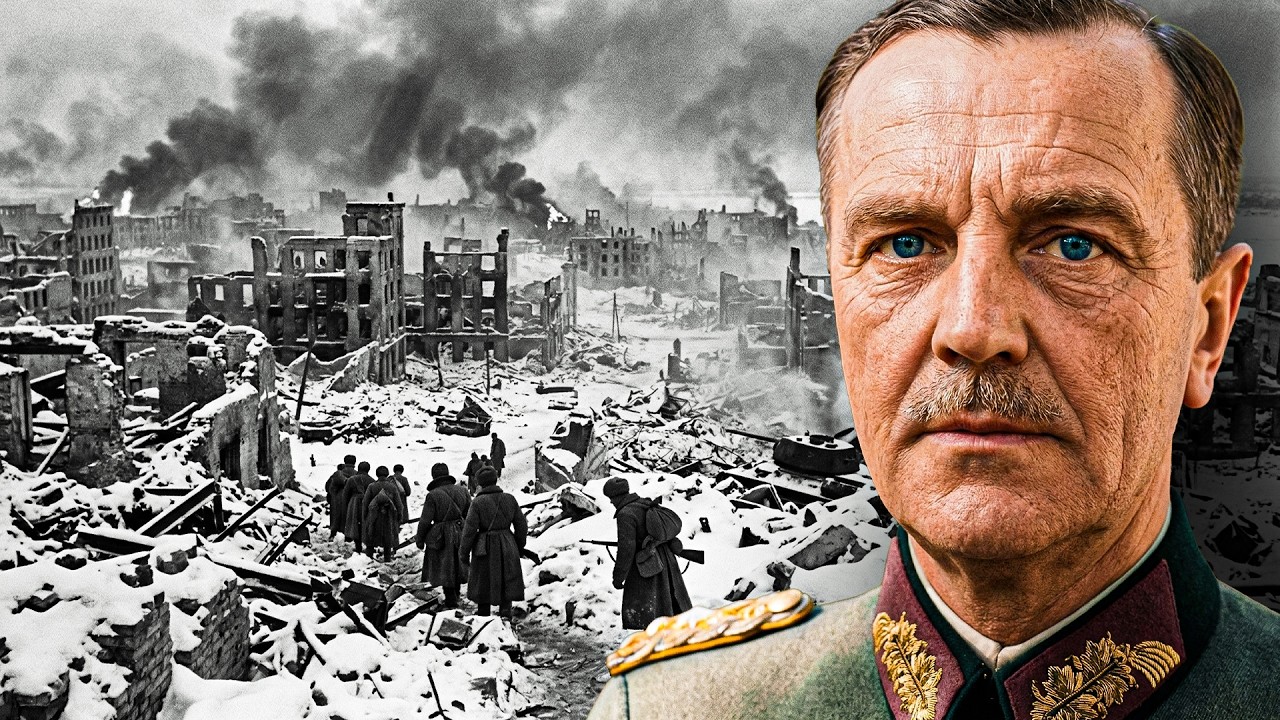 The first and most significant capture occurred on a cold morning on January 31st, 1943. The new Field Marshal Friedrich Paulus, his uniform filthy and his face haggard with exhaustion and defeat, had taken refuge in the basement of a shattered department store. The message from Hitler had been clear, a promotion to field marshal was the ultimate command.
No German field marshal had ever been captured alive; the implication was that Paulus was to end his own life in a blaze of glory. But the man in the basement refused the order. When Soviet medical officer Major Anatoly Soldatov descended into the dark, filthy command post, he found Paulus gaunt, unshaven, and surrounded by the hollow-eyed remnants of his staff.
Paulus offered his hand in surrender. Within two days, the northern pocket of the city, commanded by General Karl Strecker, also capitulated. With that, the Battle of Stalingrad was over, and the fate of 22 German generals was sealed.
The immediate aftermath was a logistics nightmare for the Soviet authorities. The city was a lunar landscape of craters and frozen corpses, and the immense number of prisoners was overwhelming. The generals, however, were a separate and distinct asset.
They were quickly separated from the ranks, placed under armed guard, and driven away from the destruction. Paulus, his chief of staff Arthur Schmidt, and his adjutant Colonel Wilhelm Adam were the first to be spirited away from the hell of the battlefield. They could see the condition of the ordinary soldiers around them, men who had eaten rats and shoe leather, marching listlessly into a captivity that many would not survive.
The generals were destined for comfort and political integration, while the rest, approximately 91,000 men, were marched off to the hellish camps of the Gulag system, a march that killed thousands instantly due to weakness and disease.
The conditions for the ordinary prisoners were so severe that they border on genocide through neglect. Of the 91,000 captured, nearly 80,000 would perish within the first few months and years. They were shipped by rail in open cattle cars to transit camps where they slept on frozen ground, and typhus ravaged their already weakened bodies.
The Soviet State was simply unprepared for this volume of prisoners, and the losses were catastrophic. For the generals, however, the survival strategy was the Moscow line. By mid-1943, Paulus and the other generals had been moved from the prisoner of war region to a special facility known as Camp No.
48 at Voykovo, a former sanatorium approximately 300 kilometers northeast of Moscow. Nicknamed the Castle, this facility was luxurious compared to the camps in which their men were dying, with beds, heating and adequate food. The generals were under the close watch of eager NKVD officers, and the facility was bugged.
 Every conversation was monitored. The unspoken deal was stark, cooperate with the Soviet agenda, become a key asset in the war of ideas, or face the return to the lower circles of the Gulag.
Soviet intelligence immediately targeted these generals for a propaganda campaign designed to break the morale of the Wehrmacht on the Eastern Front. In July 1943, the National Committee for a Free Germany was established, a body of German exiles and prisoners. Then, in September of that same year, a more dangerous creation was forged, the League of German Officers (BDO).
The chairman chosen for this puppet body was General Walther von Seydlitz-Kurzbach, a man who had commanded the 51st Army Corps at Stalingrad from the headquarters of the BDO, Generals were producing radio broadcasts and leaflets urging the German soldiers to desert, to turn their weapons on Hitler. Seydlitz went a step further, proposing the formation of a 40,000 strong army of German prisoners to fight alongside de Red Army. Though Moscow never approved the plan, the notion alarmed the Nazi leadership.
Hitler’s government sentenced Seydlitz to death in absentia and placed his entire family under Sippenhave, a terrifying collective punitive, and any real loyalties within the German military were obliterated.
Field Marshal Paulus, however, proved to be an impossible prize to convert immediately. For over a year, he refused all cooperation with the Soviet propaganda, even as the other generals in the camp began to soften. He initially insisted he remained loyal to Germany.
The breakthrough came not from torture, but from the assassination attempt on Hitler on July 20th, 1944. The execution of Field Marshal Erich von Witzleben, an officer he respected, shattered Paulus’s comprehension of the hop. On August 8th, 1944, Paulus addressed the German officers’ Trust on Free Germany radio, delivering an undeniable personal flip: “For Germany, the war is lost.
Germany must renounce Hitler.” The capture of this kind of statement was a huge propaganda victory for the Soviets and a massive hit to the morale of the German army, as they were already retreating all over the Eastern Front. The Nazi government retaliated by placing his wife Elena and daughter under Sippenhaft.
The next stage of the generals’ role was to be exported onto the international stage. The location was Nuremberg, the scene of the war crimes trials for the top Nazi leadership. As 1946 dawned, the defense attorneys had been publicly discrediting the witness testimony of the generals as fabricated.
 They demanded that the witness, Field Marshal Paulus, be brought before them in person, believing the Soviets would never produce a man they held so tightly. On February 11th, 1946, when presiding judge Geoffrey Lawrence asked the Soviet chief prosecutor Roman Rudenko how long it would take to bring the witness, Rudenko replied calmly “Thirty minutes.” The generals had been smuggled across occupied Germany in a complex decoy operation, and Paulus was waiting just outside the courthouse.
He was then announced into the packed courtroom. His testimony was devastating. He the fall Soviet invasion had been planned since September 1940, confirmed that senior commanders like Keitel and Jodl had directly involved in preparation.
His testimony on the spot, face to face, contributed to the conviction of both of those field marshals. The defense was shattered.
After the trial, the ultimate path of these men diverged sharply. Paulus returned with the Soviets to a life of confinement but relative docility, living in a guard Villa at any time, a high-value asset. But his counterparts had different fates.
Most refused to serve him. Arthur Schmidt, his chief of staff, dug in his heels and spent 12 hard years in prison and refused the cooperation. He only came home as a political bargaining chip in 1955.
Others, who were more willing to integrate, would be recycled. General Otto Korfes be released in 1948 to join the newly forming East German state, taking on a charge of the military archives. By the 1950s he was a major general in the armed police.
For these men, the war ended, but the line between absolute collaborator and resister faded into an ugly gray. They were both the Soviets and the colonial powers nothing more than propaganda assets, but many had done so to survive.
The collapse of military fortune was not the end of the bad fates. General Gustav Harteneck, who had fought to the last, he died in captivity in 1944. The men who had been loyal to a void concept of honor often died.
 The ones who survived were the ones who became tools. The return of the last prisoners was a diplomatic cause that built the relationship between West Germany and the Soviet Union. In September 1955, Chancellor Konrad Adenauer traveled to Moscow and negotiated the release of the last 10,000 German prisoners of war, an event that Germany called the “Return of the Ten Thousand.”
Walther von Seydlitz was amongst those released in October of that year. At the Friedland transit camp near Göttingen, families who had waited for 12 years reached out for men they barely recognized. The West German state was still split.
Seydlitz returned to a hostile reception, a population of veterans who despised him for his betrayal. The Bundeswehr denied him honors, and he stayed silent in Bremen until his death in 1976, posthumously pardoned by the Russians in 1996. Paulus died in Dresden on February 1st, 1957, exactly 14 years after the surrender of the 6th Army.
His body was conveyed to Baden-Baden in West Germany, whence he was buried alongside his wife.
He never saw his wife alive again, and his son had been killed on the Italian front. The legacy of the 24 generals is one of survival at any cost, a survival that split the very families of Germany. Some, like Paulus and Seydlitz, were rejected by their own countrymen as Heroes and traitors to the West, while the East embraced them.
The men in the ranks who were privates and sergeants were truly the forgotten ones. Only five thousand of the ninety-one thousand captured returned. The rest died six at a time in the Gulag, frozen or starved to death under the time of their own command.
The generals, housed and fed, turned into infamous data points of the war. Their fates were not written in the trenches but in the back rooms of the Crooks, where the image of the post-war the future of Germany was being forged in the collapse of the military.


