Doc Holliday’s reputation as one of the most dangerous men in Tombstone rests on a handful of documented facts and a great deal of legend. Among the weapons tied to him, a nickel-plated revolver and a short double-barreled shotgun have become central to that legend, even though the historical record is far less precise than the popular image suggests. Born John Henry Holliday in Georgia in 1851, he trained as a dentist and earned his degree in Philadelphia in 1872. Tuberculosis pushed him west, where the drier climate was believed to slow the disease.
Though he never fully abandoned dentistry, gambling became his primary trade as he moved from one frontier town to another. His background made him unusual. He could sound educated and controlled, but he was also prone to violent arguments. He was not a full-time lawman, nor was he simply an outlaw.
In Tombstone, he was a gambler, a close friend of Wyatt Earp, and a man whose loyalty drew him into a conflict that had been brewing for months. Later stories credited Holliday with a long list of killings, but modern historians have found that many of these claims cannot be verified. Some appeared years after his death, while others changed with each retelling. His reputation mattered anyway, because people in the Old West often reacted to what they had heard, not only to what could be proven.
Gary Roberts, one of Holliday’s major biographers, has noted that Doc did not possess a frontier-wide reputation during much of his early western life. That reputation grew later, especially after Tombstone. This timing matters: the famous gunman image was built from a small number of heavily repeated events rather than a continuous career of public gunfights. The legal setting of the famous confrontation is often overlooked.
Tombstone was a silver boom town, but in April 1881 it adopted Ordinance Number Nine, which restricted the carrying of deadly weapons inside town. Visitors were expected to deposit certain weapons soon after arrival and collect them when they left. On October 26, 1881, reports reached Marshal Virgil Earp that several armed members of the cowboy faction were gathered near Fremont Street after making threats. The term “cowboy” did not describe every ranch hand in Cochise County.
It was also used for a loose network of men linked in the public mind with cattle theft, robbery, and trouble along the border. Virgil called on Morgan Earp, Wyatt Earp, and Doc Holliday to help with disarming the group. That placed Holliday on the law’s side for this particular action, even though he did not have the long official career of a professional lawman. The guns carried by the Earp party therefore cannot be separated from the legal purpose they claimed.
The handgun associated with Holliday is often described with great confidence, but the surviving testimony is much less exact. Several witnesses referred to a nickel-plated pistol, which says something about its visible finish but does not establish a manufacturer, model, caliber, or serial number. Sheriff John Behan said it was his impression that Holliday had the nickel-plated pistol, but he would not state it as a certainty. Billy Claiborne was more definite and said Holliday held a nickel-plated pistol.
The popular picture of Holliday carrying a perfectly matched pair of revolvers is even harder to support. The court record does not give a clear inventory showing he entered the confrontation with two matching handguns. Specific revolver names became attached to Holliday through later books, collectors, reenactments, and movies. A weapon being available in 1881 is not proof that Holliday carried it on October 26.
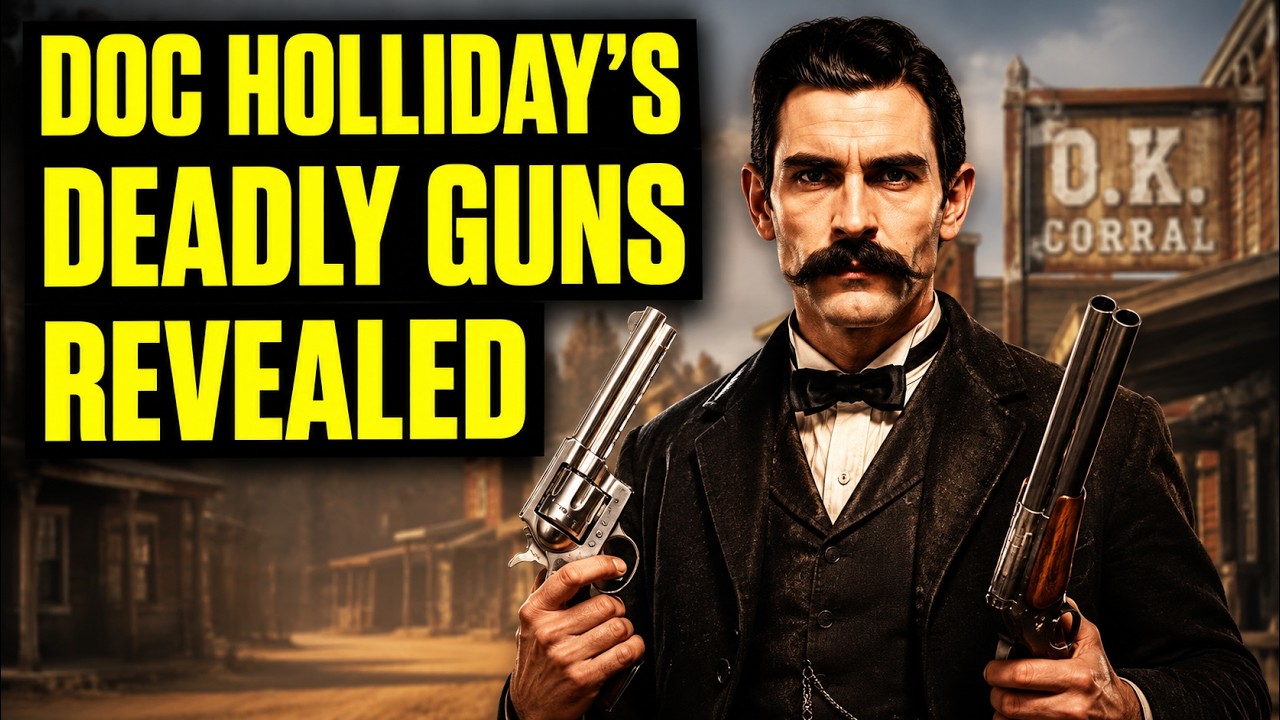
The short double-barreled shotgun is better documented, and there is an important detail that movies often blur. The shotgun was not necessarily Doc’s personal weapon. Virgil Earp obtained it from the Wells Fargo office as the group prepared to approach the armed cowboys. Virgil then passed it to Holliday and took Holliday’s walking stick.
Holliday carried the long gun under his coat while the four men moved down Fremont Street. Martha King, who saw them pass a butcher shop, testified that Holliday had a gun rather than a pistol. She could not tell whether it was a rifle or a shotgun, but she saw it beneath his coat when the coat moved. The exchange between Virgil and Doc formed part of the group’s preparation for the disarming effort.
The shotgun later became the weapon most firmly connected with Holliday’s actions during the confrontation. Wyatt Earp stated that Holliday had it, and the evidence generally links Holliday to the shot that struck Tom McLaury. The event remembered as the gunfight at the O. K.
Corral did not actually happen inside the corral. It took place on Fremont Street in or beside a narrow vacant lot near C. S. Fly’s photography gallery and boarding house.
Holliday had a room at Fly’s establishment, which made the gathering of armed men nearby feel especially threatening to the Earp side. Sheriff Behan met the Earp party and gave a message that was remembered in different ways. Wyatt said Behan told them the men had been disarmed. Behan later said he had only explained that he had gone there for the purpose of disarming them.
That difference mattered. According to Wyatt, he put his pistol into his coat pocket because he believed the immediate danger had been reduced. When the two groups faced each other, Virgil ordered the men to raise their hands and said he had come to take their guns. Within moments, shooting began.
No reliable record settles who fired the first shot beyond all doubt. The confrontation lasted roughly half a minute. Billy Clanton and the McLaury brothers were killed. Virgil and Morgan Earp were wounded.
Holliday received a minor graze, and Wyatt was not hit. The broadest reconstruction places the shotgun and a handgun in Holliday’s possession during the event, but witnesses disagreed about the order in which they appeared. The two weapon types served different roles in the historical record, but the fear surrounding Holliday came from his decision to walk into the confrontation at all. The strongest evidence about Holliday’s guns came from the preliminary hearing that followed the shooting.
Wyatt Earp and Doc Holliday faced murder charges, and Justice of the Peace Wells Spicer listened to weeks of testimony to decide whether there was enough evidence for a trial. The hearing did not produce one clean story. Witnesses connected to the cowboy side described the Earp party as aggressive and claimed Holliday appeared with a nickel-plated pistol. Other witnesses saw Holliday carrying a longer gun before the confrontation.
People disagreed about words spoken in the street, the positions of the men, the first shots, and whether Tom McLaury had been armed. A witness across the street later gave a description that historians still find useful because it was so honest: “All was confusion. ” The event was brief, loud, frightening, and viewed from different angles. Some witnesses were friends of one side.
Some had only a partial view. Some testified days later after newspapers and local arguments had already shaped public opinion. On November 30, Spicer ruled that the evidence did not justify holding the defendants for a murder trial. He did not declare that every decision made by the Earp party had been wise, and his ruling was not the same as a modern jury acquittal.
The hearing still preserved the most important descriptions of Holliday’s weapons. Those descriptions support a borrowed shotgun and an unidentified nickel-plated handgun while leaving the exact sequence unresolved. Holliday’s weapons carried meaning because tension had already reached a dangerous level before anyone walked down Fremont Street. On the night of October 25, Holliday argued with Ike Clanton over accusations connected to Wyatt Earp and information about suspected stage robbers.
Wyatt later said Holliday had been drinking and that he pulled Doc away from the argument. Ike continued making threats through the night and into the next morning. Barkeeper E. F.
Bole testified that he saw Ike armed and advised him to sleep. According to Bole, Ike replied that when the Earps and Holliday appeared on the street, the fight would begin. These statements were part of the defense case, so they must be read with care, but they show the atmosphere in which every visible weapon was interpreted. A nickel-plated pistol on Holliday was not frightening because of its finish.
It was frightening because people believed the man carrying it might act quickly and would not back away from a close confrontation. Holliday’s illness added another layer to the legend. Later writers often claimed that tuberculosis gave him a death wish, but historians have warned that this idea is overstated. Being seriously ill did not mean he wanted to die.
What observers may have seen was a man whose behavior could be difficult to predict, especially during arguments. The guns did not make Holliday unique in the way movies suggest. Handguns, rifles, and shotguns were familiar tools in the American West, used by lawmen, travelers, ranchers, guards, and criminals. Tombstone passed a weapon ordinance precisely because armed visitors were common enough to create a public problem.
What made Holliday stand out was the meaning people attached to him. He was educated, physically weakened by disease, financially dependent on gambling, and closely tied to Wyatt Earp. He had moved through Texas, Kansas, New Mexico, and Arizona, leaving behind a mixture of court records, newspaper reports, and stories that were difficult to verify. That uncertainty worked in his favor whenever someone considered challenging him.
It also worked against him in court and in the press because people were ready to believe the worst. Holliday did have genuine violent incidents in his past, but the best documented record is much smaller than the later legend. A few real events gave the rumors a foundation, and the rumors then made every later argument sound more dangerous. Film and television gave Holliday’s weapons a clarity that the historical evidence never had.
Westerns need recognizable props and a character that audiences can identify in seconds. A pair of polished revolvers fits the elegant, dangerous image created for Doc Holliday, especially when the actor is dressed differently from the rougher cowboys around him. The 1993 film “Tombstone” made that image especially powerful through Val Kilmer’s performance. Earlier movies, including “My Darling Clementine” and “Gunfight at the O.
K. Corral,” had already reshaped the men and the conflict for entertainment. Movie scenes compress months of tension into a few confrontations and turn disputed events into certain ones. Holiday’s connection with Johnny Ringo is made more direct, even though the real circumstances of Ringo’s death do not prove that Holliday killed him.
The problem begins when a prop choice is presented as a documented personal gun. The historical record does not confirm the matching two-revolver image. It points instead to a borrowed short shotgun and an unidentified nickel-plated handgun during the Fremont Street confrontation. Claims about a famous person’s weapon are only as strong as the chain of evidence behind them.
Historians use the word “provenance” for the documented path of an object from one owner to the next. A revolver said to have belonged to Doc Holliday needs more than an old appearance, an engraved name, or a family story. It needs records that connect it to Holliday and, for this topic specifically, to Tombstone in 1881. That level of proof is difficult because the hearing did not record a serial number or provide a detailed inventory of Doc’s handgun.
Holliday moved often, gambled heavily, faced money problems, and did not leave behind a complete personal archive. Weapons could be sold, pawned, borrowed, or replaced. A gun connected to him at one point in his life would not automatically be the gun he carried on Fremont Street. The most dependable evidence comes from documents created close to the event.
These include the city ordinance, contemporary newspaper coverage, witness testimony, Wyatt Earp’s statement, and Spicer’s decision. Even those sources disagree, which is why later certainty should raise questions rather than settle them. The shotgun has a clearer connection because witnesses saw a long gun and the Earp account explained where it came from. The handgun remains identified mainly by its nickel-plated appearance.
That gap is why books, reenactments, museum displays, and movies often show different guns in Doc Holliday’s hands. Each version fills the silence with its own choice. While the 1881 record stays limited to what frightened and confused witnesses believed they saw, the unanswered identity of the handgun remains one of the most revealing facts connected to Doc Holliday.