The olive-drab teletype machine in the Pentagon began to chatter at 9:47 a. m. on December 30, 1944.
The message that spooled out from the cipher room, marked for the eyes of the Chief of Staff of the United States Army, was not a field report. It was not a casualty list. It was a distress call from the Supreme Headquarters of the Allied Expeditionary Force, and it was encoded with a despair that George Catlett Marshall recognized instantly.
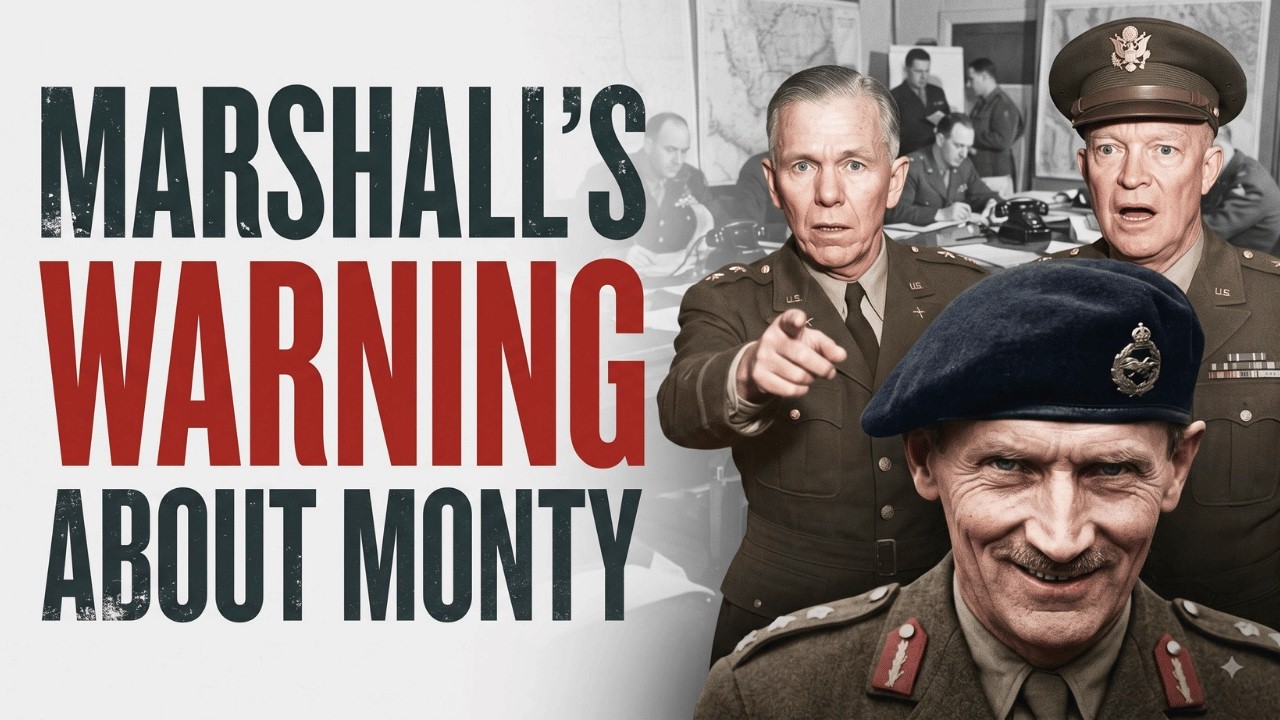 In that cold, unadorned office overlooking a concrete courtyard, Marshall read the summary from Versailles and understood that the coalition he had spent four years building, the intricate alliance of egos and armies that was the last, best hope against the Reich, was not being broken by German steel, but by British pride.
From his hotel room headquarters in Versailles, the supreme commander, General Dwight D. Eisenhower, was preparing to detonate the alliance himself. For over 48 hours, Eisenhower had been consumed by a single, corrosive crisis.
He had on his desk a letter from Field Marshal Sir Bernard Law Montgomery, a missive that arrived via courier from Zonhoven, Belgium, demanding operational command of all Allied ground forces on the northern front. Montgomery, emboldened by his temporary tactical control during the early, chaotic days of the Ardennes offensive, had effectively demanded a permanent reorganization of the Allied high command, insisting his leadership was the only reason the northern shoulder had not collapsed.
Montgomery’s letter was the culmination of a months-long feud. It was an ultimatum framed as a request—he asked Eisenhower to issue a directive that would permanently subordinate the American 1st and 9th Armies under his 21st Army Group, stripping command from Omar Bradley. Eisenhower, the man who held the coalition together through sheer force of will and diplomacy, was at his breaking point.
Attending to the reports of American soldiers dying in the frozen conditions of Bastogne, he was unwilling to concede another inch of command authority to his British subordinate. If Montgomery did not cease his intellectual insubordination, Eisenhower had resolved to settle the peace of the command structure or resign.
He had summoned his chief of staff, Walter Bedell Smith. The order was short and devastating: draft an ultimatum to the Combined Chiefs of Staff depicting that Bernard Montgomery was to be relieved of command immediately, or Eisenhower would ask to be relieved. The wording carried the weight of Mr.
Lincoln’s cabinet crisis of the 1860s; that Eisenhower was not a man to bluff. As the hot coal of this dispatch sat in the cable box, the strain of the entire European theater was visible in Eisenhower’s eyes. The counterattack in the Ardennes had sapped his physical strength and what remained of his patience.
Across the ocean, in the office that faced the interior courtyard of the Pentagon, George C. Marshall was reading the draft of that industry. He had not been informed directly by Eisenhower, but the tension in the aide-memoire was unmistakable.
 Marshall’s thoughts turned longer to his own summer of 1861, he had served endless years at the rank of Captain while others soared past him; he had learned that the worst thing about a coalition pressure is that if it breaks, you cannot simply pocket the pieces. The American public, in Marshall’s estimation, didn’t fully comprehend the ugliness of a coalition. But Marshall captured it, and knew that if Eisenhower resigned, it would tear the entire Western alliance apart in a single stroke.
Marshall was 63 years old; his birthday was the next day. He had a quiet, meditative way of choosing the moments that mattered most, and this was one. He had been the man to select Eisenhower for this moment; he had been the man who spent years cultivating him.
He was not about to let a British general bring him down. However, Marshall knew that sending a blunt message ordering Eisenhower to “fire him” would create the exact rupture they were trying to avoid. A pat on the head, a stiffness of tone, was needed.
In his steady, even-handed hand, he drafted a personal cable—not an official order, but a guiding frame.
He wrote that the American people and the American government would not accept the permanent placement of their sons under British operational command. Costs to the fiscal policy and the military was to be closed. It was a distinct line from Marshall to Eisenhower; the message was clear: the supreme commander held the authority; if Ike thought Montgomery had to be removed, then he had the backing of Washington.
But Marshall also gave him the capacity to strike a blow. He wrote that regardless of what the petition might be, he should trust himself. “You have our complete confidence,” the note read, “and if you think that his removal is the answer, then do it—do not surrender.”
The cable landed on Eisenhower’s desk at the Trianon Palace Hotel in the dim hours of December 30. His tired predictor read the words, and it unlocked the immediate circuit of defeat. Because for Eisenhower, Marshall’s cable was a potion of resolve.
 It let him breathe. He knew he would never have to resign because he would never let Montgomery dictate terms. Instead of sending his resignation, Eisenhower composed a reply to Montgomery—one specifically designed to break the “Monty firm” endlessly.
He intended to inform him in writing that he was to act as “my subordinate-in-chief” to demand his cooperation. The time for reality was now.
This crisis was destined to require a nighttime intervention. That evening—New Year’s Eve eve—a small British plane landed in the darkness near Versailles under a dangerously thick, foggy sky. It carried Major General Freddie de Guingand, Montgomery’s Chief of Staff.
He slept briefly and entered Eisenhower’s office, carrying a letter that Montgomery had now drawn up. De Guingand had flown over to defuse the bomb; he confirmed that Monty had realized the fatal gravity of his miscommunication. Montgomery’s letter was withdrawn; he extinguished his fanciful demand for command and offered his “complete devoted loyalty” instead.
Eisenhower saw the letter. He could see his enemy; he could either explode or extend a hand. He quietly took the peace offering.
He did not resign. He did not dismiss Montgomery. But something fundamental shifted in the room.
Eisenhower was no longer searching for reassurance; he was holding the stern facts. He knew he could do it. From now on, there would be no unrestricted independence for Montgomery.
 The News of this public settlement was shielded in official secrecy, yet the outcome was unalterable.
In the days that followed, Eisenhower drove a consolidation of the command, which officially returned the 1st and 9th Army to Bradley just as the German attack lost its momentum. Montgomery was left to nurse his bruised ego in Belgium, and the hope of any trans-partition was gone. The Anglo-American “broad front” strategy was intact and the command structure of the free world remained firmly in the hands of Americans, something that was never subject to negotiation again.
The answer is that the final installment of Montgomery’s series of line items was erased by Eisenhower’s ruthless acceptance of his ultimate power derived not just from Washington, but from the size and will of the US Army.
That single cable, unseen by the American public for decades, was as decisive as any tank division in the history of the western front. It was a stroke in a deep architectural battle, fought with shields slants instead of weapons: the architecture that the United States was no longer a participating “subordinate” in the collection, but the primary. A firm-voiced General with the face of the courthouse had told a successful American theater commander where his obligation lay.
But he had fundamentally confirmed the deepest truth of the war in Europe that America was the load-bearing wall in the coalition. If Eisenhower had folded, there might have been a fracture leading to a reduced outcome in the last 18 months of the war.
The circumstances will be chronicled in bytes of history as part of the 𝒹𝓇𝒶𝓂𝒶 of the command crisis. Yet, there is an enduring element to it. The relationship between state and field commander was fincalted.
In trials of war, a mantle was passed. Ike passed around his testament that he was the final arbiter. The Lasting image on the night of 1944 was that of a quiet, unarmed cable unit resting in a spacious cigar static and a final acknowledgment that the supreme commander, armed with the knowledge of the United States, had chosen to re-secure his own authority.
It was the first path. The coalition did not break that day. It shouldn’t have.
But for the reason that one man found the nature and one to signal it with an atomic.


