The Battle of San Jacinto lasted roughly 18 minutes, but the victory that secured Texas independence was built on weeks of calculated retreat, deliberate deception, and one critical bridge destroyed at exactly the right moment. In April 1836, the Texian army was small, exhausted, and burning with rage over the fall of the Alamo and the massacre at Goliad. Many men wanted an immediate, bloody confrontation. Sam Houston, nursing a bad ankle and moving with deliberate calm, did the opposite.
He ordered his forces to fall back repeatedly, marching toward the Colorado River and then the Brazos, drawing criticism from his own ranks. Houston’s strategy was to buy time. His men were brave but largely untrained, and supplies of food, ammunition, and horses were dangerously low. A single lost battle could have ended the rebellion entirely, leaving nothing between Santa Anna’s army and the Texas coast.
By retreating, Houston forced the Mexican forces to stretch their supply lines while giving his own men time to gather reinforcements, train in basic drill, and choose the ground where they would eventually fight. The terrain around Buffalo Bayou and the San Jacinto River suited the smaller Texian force. Marshes narrowed the approaches, tall grass concealed movement, and timber masked the Texian camp. Houston studied the ground like a surveyor and positioned his men where the larger Mexican army could not fully deploy its numbers.
Mexican commander Antonio López de Santa Anna made several critical errors before the battle even began. Confident that Houston was timid, he split his forces and pushed ahead with a select column, leaving other units miles behind. He established camp near open marshland without proper fortifications, posted thin and inattentive pickets, and allowed his men to rest through the heat of the afternoon. He believed the Texians were still retreating and would keep running.
Santa Anna also failed to clear the tall grass around his position, which blocked sightlines and later filled with smoke during the attack. His leadership style, based on personal will and sudden orders, left gaps in staff work that proved fatal when the surprise assault came. Before the first shot, a quieter war had already been fought. Scouts and spies, including the famed Deaf Smith, rode wide circles around both camps, counting watch fires and mapping hidden trails.
They provided Houston with constant intelligence on Mexican movements and weaknesses. The most decisive act of preparation was the destruction of Vince’s Bridge. On the morning of the battle, Deaf Smith and a small party cut down the only hard crossing over Vince’s Bayou, the main route for Mexican reinforcements. The move also eliminated any chance of Texian retreat, a signal that Houston intended to finish the fight.
Smith returned waving a plank and shouting, “Vince’s bridge is down. ”
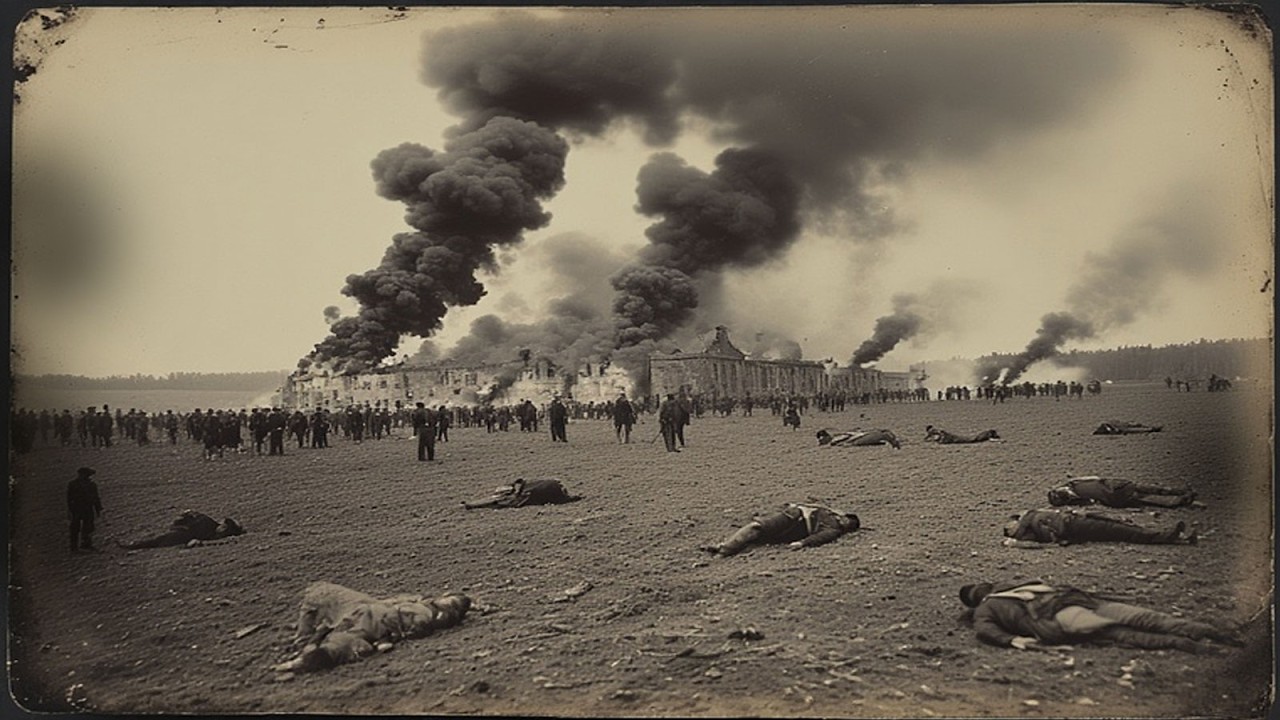
On the afternoon of April 21, 1836, Houston gave the order to attack. The Texian line advanced from behind a ridge, holding fire until close range. The twin sisters, two six-pounder cannons loaded with canister, fired into the Mexican camp at point-blank range.
The assault took the Mexican army mid-rest. Drums sounded late, orders clashed, and only a few companies managed any organized resistance. The charge lasted 18 minutes. Shouts of “Remember the Alamo” and “Remember Goliad” kept the Texian line together as they drove forward.
The Mexican center broke in chunks, and the camp itself became a trap of trip ropes, wagons, and canvas. Mexican cavalry was positioned too far east to play a meaningful role, and the destroyed bridge cut off any escape. Santa Anna fled the field but was captured the next day, found in a plain shirt and dusty pants. Many Texians demanded his execution, remembering the Alamo and Goliad.
Houston, wounded in the ankle, chose a different path. He spared the Mexican general, arguing that a living Santa Anna could end the war and sign documents that a dead one never could. Santa Anna, under guard, was taken to Velasco on the coast. On May 14, 1836, two treaties were signed.
The public treaty called for an end to fighting, the withdrawal of Mexican troops, and the exchange of prisoners. A secret treaty added that Mexico would recognize Texas independence, that the Rio Grande would be the border, and that Santa Anna would urge his government to honor the terms. Many Texian officers and soldiers were furious that Santa Anna was allowed to live. Houston responded that mercy was strategy, not weakness.
A dead general would only inflame the war. A living one could order his scattered troops to stand down. Mexico later rejected the treaties, claiming Santa Anna had no authority while captured. But on the ground the outcome was decisive.
Mexican units withdrew, and Texas functioned as an independent republic. The United States formally recognized the Republic of Texas in March 1837, which signaled that the new nation was being taken seriously by the international community. Santa Anna denied the treaty after returning to Mexico, but the facts on the ground had shifted permanently. Texas built its government, settled its land, and in 1845 joined the United States through annexation.
The Battle of San Jacinto is often remembered as a sudden stroke of luck. But the victory was the product of a patient plan: a retreat that trained the army and lured the enemy into overconfidence, scouts who blinded the opposition, a bridge cut at the right moment, and the decision to spare a captured general in exchange for peace.