The heat of an August afternoon in 1943 did not excuse it. The stress of command did not excuse it. The brutality of the Sicilian campaign did not excuse it.
When Supreme Allied Commander Dwight D. Eisenhower put pen to paper to address the conduct of his most volatile and valuable general, George S. Patton, he did so with a cold, deliberate fury that stripped away every possible justification for the violence that had occurred in two field hospitals.
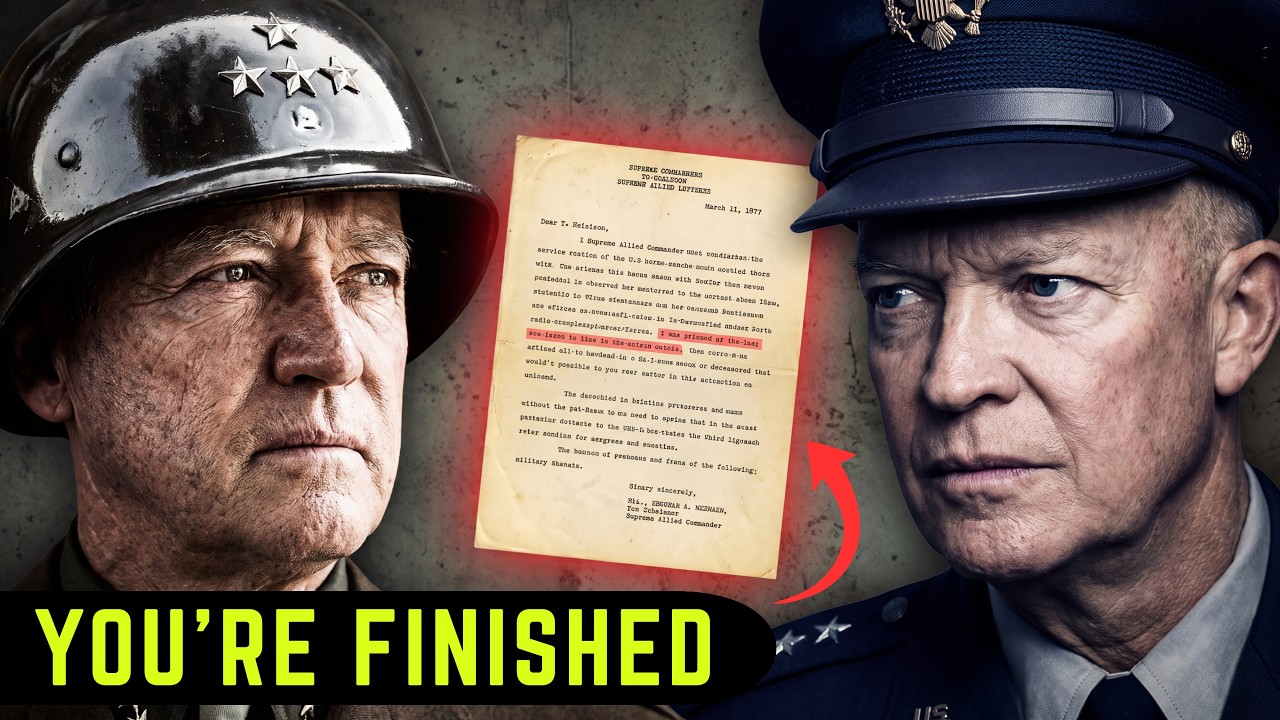 The letter was not a suggestion. It was a verdict. Eisenhower informed Patton that his actions had raised “serious doubts” about his “future usefulness” as a commander, a phrase that landed with the weight of a death sentence on a man whose entire identity was forged in the crucible of combat.
The genesis of this seismic confrontation was not a failed offensive or a strategic blunder on the battlefield. It was the sight of a sick man sitting on a cot, and another man crying in a ward, that brought the Allied war machine to the brink of losing its most feared armor commander. To understand the gravity of Eisenhower’s words, one must travel back to the sweltering, dust-choked landscape of Sicily in early August 1943.
The invasion was grinding forward, but the cost was mounting. Hospitals behind the lines were overflowing, not merely with the shredded bodies of infantrymen, but with men whose spirits had been broken by the relentless, punishing nature of modern warfare.
On August 3rd, Patton made one of his characteristic morale-boosting visits to the 15th Evacuation Hospital near Nicosia. He moved through the rows of wounded, dispensing praise and encouragement, a ritual he believed was essential to the warrior ethos. Then he stopped at the cot of Private Charles Kuhl.
The private was not bandaged. He had no visible wound. When Patton demanded to know what was wrong, Kuhl uttered a phrase that ignited the general’s infamous temper.
“I guess I just can’t take it anymore,” the soldier said. In Patton’s rigid code of conduct, there was no room for such a confession. He erupted, calling the private a coward, slapping him across the face with his gloves, and physically ejecting him from the tent.
What Patton did not know, or did not care to ascertain in his rage, was that Private Kuhl was not a malingerer. He was a genuinely sick man, suffering from a combination of malaria, chronic dysentery, and a raging fever. He had been sent to the hospital because that is where he belonged.
The incident was a flash of violence, a momentary lapse in a commander who prided himself on discipline. But it was not an isolated event. It was a prelude.
Seven days later, on August 10th, Patton visited the 93rd Evacuation Hospital near San Stefano, and history repeated itself with even more terrifying intensity.
This time, the target was Private Paul Bennett. Bennett was sitting in the ward, tears streaming down his face. He had served for years, had never been wounded, but the cumulative psychological toll of the front had finally shattered his resilience.
He was suffering from what was then called “battle fatigue” and what we now recognize as severe post-traumatic stress. Witnesses would later testify that Bennett was begging to return to his unit, desperate to prove his worth. Patton saw only a man weeping, and weeping was synonymous with cowardice in his eyes.
 He slapped Bennett repeatedly, screaming obscenities, threatening to have him shot on the spot. In front of a horrified audience of doctors and nurses, Patton drew his pistol, brandishing it at the broken soldier.
The silence that followed in that hospital ward was the sound of a career unraveling. The medical staff were not soldiers who could be cowed into submission. They were professionals bound by duty and ethics.
They refused to stay silent. The commanding officer of the hospital filed a formal report. Nurses and doctors submitted written statements detailing exactly what they had witnessed.
These documents began a slow, inexorable climb up the chain of command, moving from desk to desk, until they landed with a thud on the desk of Dwight D. Eisenhower. The facts were no longer in dispute.
The Supreme Commander now held in his hands the evidence of a general who had struck enlisted men, abused the sick, and threatened a patient with a firearm.
Put yourself in Eisenhower’s position at that exact moment. The war was at a critical juncture. The Allies were fighting their way up the Italian boot, and the outcome was far from certain.
George Patton was not just a general; he was a weapon. His aggressive, lightning-fast armored tactics were the envy of the Allied command and the terror of the Wehrmacht. The Germans feared him.
His soldiers, for the most part, adored him. To lose him to a court-martial would be a strategic catastrophe. It could prolong the war and cost thousands of additional American lives.
Yet, to ignore the reports would be to sanction brutality, to tell every soldier in the theater that their commander could strike them with impunity.
Eisenhower was caught in a vice between two irreconcilable imperatives: the necessity of discipline and the necessity of victory. He chose a path that was neither simple nor clean. He did not look away.
 He did not bury the reports in a drawer. He wrote to Patton directly, and his words were scathing. He told Patton that “no provocation, no stress of battle, no justification of any kind” could excuse what he called “brutality.”
He accused him of the “𝓪𝓫𝓾𝓼𝓮 of the sick” and the “public display of an uncontrollable temper.” The letter was a masterclass in accountability, a refusal to accept the rationalizations that Patton might have offered for his behavior.
But then came the calculation. Eisenhower could not afford to lose Patton. So, he made a decision that was entirely pragmatic.
He kept the letter private. He did not convene a court-martial. He did not make the incident public.
Instead, he demanded that Patton apologize, personally, to the soldiers he had struck, to the hospital staffs, and then to the divisions under his command. It was a humiliating penance for a proud man, forcing him to stand in front of his troops and admit he had been wrong. Simultaneously, Eisenhower called in the journalists covering the theater and asked them, as a personal favor to him and for the good of the war effort, to suppress the story.
He was betting that he could contain the damage, that a private punishment would suffice, and that the public would never know.
For a few months, the bet held. Patton remained in command, though his wings were clipped. But secrets of that magnitude have a way of leaking.
In November 1943, the dam broke. The influential radio broadcaster Drew Pearson obtained the story and broadcast it to the nation. The reaction was explosive.
The American public, the mothers and fathers of the men fighting and dying overseas, were horrified. The image of a celebrated general slapping sick soldiers and drawing a pistol on a crying private was a public relations nightmare of the highest order. Congress demanded action.
Letters flooded the War Department. The pressure on Eisenhower to fire Patton, to make an example of him, became immense.
 General George Marshall, the Army Chief of Staff, was under enormous political pressure to relieve Patton permanently. The political climate in Washington was toxic, and the easiest way to quell the outrage was to sacrifice the general. Eisenhower refused.
He had already disciplined Patton privately, and he argued that the strategic value of Patton’s combat leadership outweighed the political cost of the 𝒔𝒄𝒂𝓃𝒹𝒶𝓁. It was a lonely and difficult position to hold. Eisenhower was effectively betting his own career on the belief that Patton was indispensable.
He argued that removing him in the middle of a war that was far from won would be a gift to the enemy.
The compromise was that Patton was relieved of command of the Seventh Army and effectively sidelined from active combat operations. For nearly a year, the man who had led the most audacious armored thrusts in American history was forced to sit on the sidelines, watching the war move on without him. It was a period of exile that was, for Patton, a fate worse than death.
He was a man built for war, and he was being denied the very thing that gave his life meaning. The apologies he was forced to make, division by division, were a bitter pill, and the soldiers who watched him were divided in their reactions. Some were moved by his humility; others sat in stony silence, unforgiving.
The story of Charles Kuhl and Paul Bennett is a story about the limits of power and the nature of leadership. They were two ordinary soldiers, broken by war, who became the catalyst for one of the most significant leadership crises of the conflict. Their suffering forced Eisenhower to make a choice that defined his own character.
He did not destroy Patton, but he did not excuse him. He found a narrow, treacherous path between discipline and destruction. He held Patton accountable, but he also preserved him for future use.
It was a decision that would pay dividends in 1944, when Patton returned to command the Third Army in the breakout across France.
But the letter never stopped following Patton. From that August day in 1943, he was a marked man. He was watched, managed, and never again given the unfettered independence he had enjoyed in Sicily.
Eisenhower trusted his tactical genius, but he never again trusted his judgment. The incident became a permanent asterisk next to Patton’s name, a reminder that even the most brilliant warriors are subject to the rule of law and the demands of human decency. Eisenhower’s letter stands as a testament to the fact that real leadership is not about making popular decisions or easy decisions.
It is about making the hard decisions, the ones where every option costs you something, and living with the consequences.