The silence in that Heidelberg hospital room on December 21, 1945, was more than the absence of breath. It was the sound of history being rewritten. When General George S.
Patton succumbed to a pulmonary embolism at 17:50 hours, twelve days after a mundane fender-bender near Mannheim, the most aggressive combat commander of the European theater was silenced permanently. But the crash that killed him at just 15 miles per hour did more than end a life. It handed his three greatest rivals the keys to the narrative of World War II, allowing them to spend the next three decades systematically erasing the general from the strategic record.
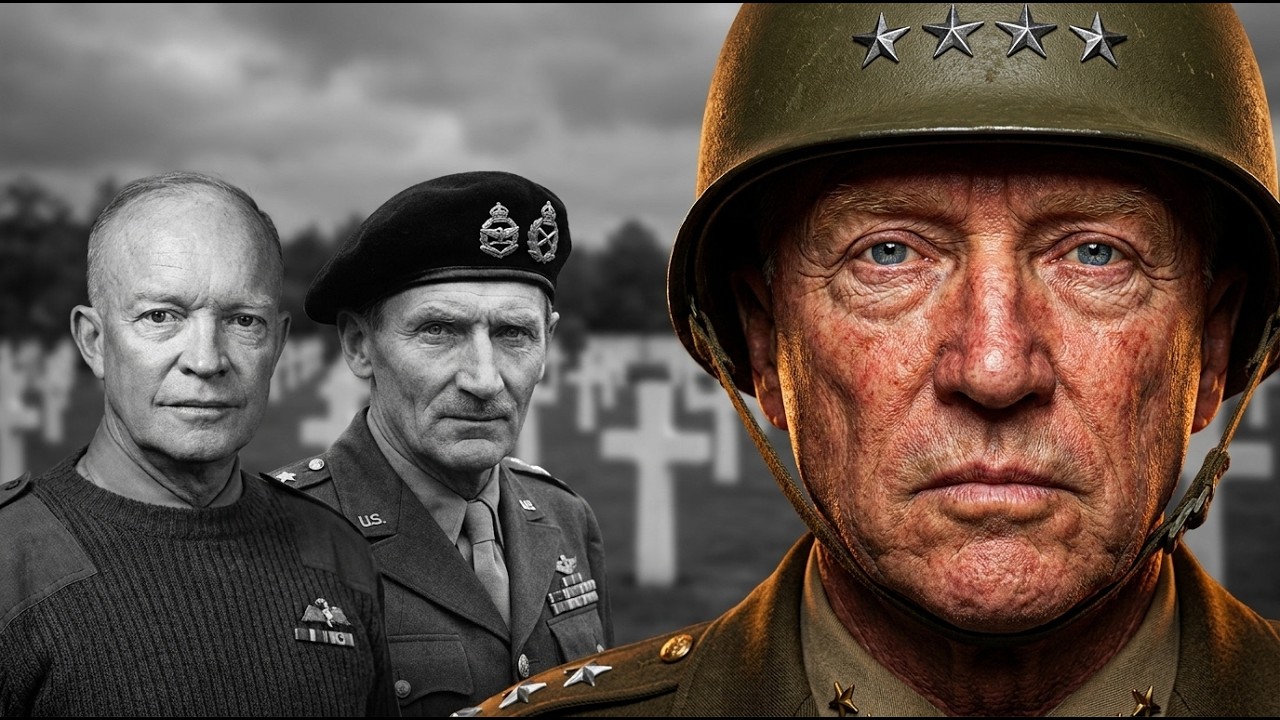 The vacuum was immediate and profound. Patton had been a problem for Allied command throughout the war, brilliant but insubordinate, effective but politically toxic. His superiors had spent three years trying to control him, managing his outbursts, his slapping incidents, his unauthorized raids.
With his death, that management became permanent. Three men had spent the war wrestling with Patton: Dwight Eisenhower, the Supreme Commander; Bernard Montgomery, the British Field Marshal and constant rival; and Omar Bradley, Patton’s former subordinate who had risen above him. All three clashed with Patton on tactics, personality, and the limits of command.
Now, they no longer had to manage him. They could define him.
Eisenhower recognized the opportunity within months. He had been the architect of D-Day, the coordinator of coalition strategy, but his military record was always secondary to his political positioning. Eisenhower understood that his next career was in politics, and Patton’s death helped that image immensely.
While Patton lived, Eisenhower was constantly defending him or threatening to fire him, forced to play the role of handler for a loose cannon. With Patton gone, Eisenhower could position himself as the calm, strategic leader who had won the war through planning and coalition management rather than aggressive combat operations. The political rise accelerated rapidly, from Army Chief of Staff to president of Columbia University to Supreme Commander of NATO.
In 1952, Eisenhower ran for president of the United States and won by a landslide, becoming one of the most popular presidents of the 20th century. His presidency shaped the Cold War in ways Patton would have violently opposed. Eisenhower built the military-industrial complex that the pure warrior Patton likely would have fought against.
Eisenhower emphasized nuclear deterrence and massive retaliation, while Patton believed in conventional forces and aggressive forward operations. Eisenhower pursued diplomatic solutions and containment, while Patton had advocated immediate confrontation with the Soviet Union while American forces were still mobilized. Patton’s death removed the most prominent voice for aggressive anti-Soviet military action, and Eisenhower’s cautious approach became American policy by default.
Montgomery spent the post-war years building his legend through memoir and public appearances. He became a viscount, a member of the House of Lords, and served as Deputy Supreme Commander of NATO from 1951 to 1958. When Montgomery published his memoirs in 1958, the book became a best-seller in Britain and established his version of the war as authoritative for British audiences.
The memoir portrayed Montgomery as the methodical, careful commander whose planning and caution had won the decisive battles. Patton appeared as a theatrical, reckless subordinate whose aggressive tactics required constant supervision from more balanced commanders, like Montgomery. The memoir war was entirely one-sided because Patton could not respond.
His diaries and letters existed but were controlled by his family, and the published Patton papers would not appear until 1963. By then, Montgomery’s version had been circulating for five years, shaping public understanding of the North Africa, Sicily, and Northwest Europe campaigns. Montgomery’s characterization of Patton as brilliant but unstable became the accepted narrative.
The careful editing of Montgomery’s memoir ensured that his own failures, particularly the disastrous Market Garden operation, were minimized while Patton’s successes were attributed to luck or to Montgomery’s strategic planning that had created the conditions for his advances.
Bradley’s trajectory was the most dramatic of all. He had been Patton’s subordinate in North Africa and Sicily, but by the end of the European campaign, Bradley commanded the 12th Army Group with Patton’s Third Army under his authority. After the war, Bradley rose to unprecedented heights, becoming a four-star general, administrator of Veterans Affairs, Army Chief of Staff, and the first Chairman of the Joint Chiefs of Staff from 1949 to 1953.
 Five-star rank was awarded in 1950, making him the senior military advisor to Presidents Truman and Eisenhower during the opening years of the Cold War. He shaped American military policy for Korea and the early nuclear era.
Bradley published his memoir, A Soldier’s Story, in 1951, portraying Patton as a talented but difficult subordinate who required constant management. Bradley described having to restrain Patton’s aggressive instincts multiple times, having to redirect his operations when they threatened to outrun logistics, and having to defend him to Eisenhower and Marshall when his public statements created political problems. The message was clear: Patton had been effective because commanders like Bradley managed him properly.
Without that management, Patton would have been dangerous to his own forces. The portrayal was calculated to elevate Bradley’s own reputation as the soldier’s general who had the competence to handle difficult subordinates while maintaining strategic focus.
The systematic dismantling of Patton’s tactical doctrine began in the late 1940s. The Third Army’s emphasis on speed, aggression, and exploitation operations was replaced by more methodical approaches. The new doctrine emphasized firepower, logistics, and coordination.
Patton’s style of command, characterized by forward command posts and personal leadership at the front, was discouraged in favor of more centralized control. The army that emerged in the 1950s was slower, more bureaucratic, and more cautious than the force Patton had led across France. The changes were presented as lessons learned from the war, but the effect was to eliminate Patton’s influence on American military culture entirely.
The rivals sat in oak-paneled rooms writing with gold pens, editing the passages that would define the war for generations, while Patton’s widow in Massachusetts fed letters into a fireplace to protect what remained of a contested legacy. The simple white cross stood in a field in Luxembourg among thousands of identical markers, the only general who chose to be buried with his men rather than in a place of honor. The publishing houses printed another thousand copies of memoirs that positioned Patton as subordinate, useful, dangerous, requiring supervision.
They were all engaged in the same project: controlling the narrative, defining the war, ensuring their version became history.
The silent witness problem was Patton’s inability to defend himself. Every memoir published by his rivals went unanswered. Every characterization of his decisions went unchallenged.
Every criticism of his tactics went unrefuted. The Patton papers would eventually provide primary source material that contradicted some of the rivals’ claims, but by the time they were published in 1963, the competing narratives had been established for over a decade. Historians who later studied the war had to contend with both the rivals’ memoirs and Patton’s papers.
The result was a more nuanced understanding, but the initial advantage belonged entirely to the men who survived to publish first.
The final ranking demonstrated the scale of the rivals’ success. Eisenhower served two terms as president and died in 1969 at age 78, having shaped American Cold War policy for two decades. Montgomery became a viscount, wrote multiple books, and gave countless interviews, dying in 1976 at age 88 having established himself as Britain’s most famous World War commander.
 Bradley became the first chairman of the Joint Chiefs and the last surviving five-star general, dying in 1981 at age 88 having influenced American military policy from World War through Vietnam. All three outlived Patton by decades. All three achieved positions of power and influence that Patton never experienced.
All three used those positions to shape how the war was remembered.
The contrast in burial locations was symbolic. Patton was buried at the American Cemetery in Luxembourg in a section designated for general officers but among the soldiers of Third Army with a simple white cross like every other marker. The location was Patton’s choice communicated before his death; he wanted to be with his men.
Eisenhower was buried at the Eisenhower Presidential Library in Abilene, Kansas, a massive memorial and presidential museum, a monument to his career and legacy. Montgomery was buried at Holy Cross Church in Binstead, England with military honors and national recognition. Bradley was buried at Arlington National Cemetery section one among presidents and Supreme Court justices.
The physical locations reflected the different paths their careers took after the war ended.
What happened to Patton’s enemies after he died? They accumulated power that changed the 20th century. Eisenhower became president and shaped the Cold War.
Montgomery became a British lord and military adviser to NATO. Bradley became the first chairman of the Joint Chiefs and remained influential through multiple presidential administrations. All three published memoirs that characterized Patton as brilliant but unstable, reckless but effective, requiring constant supervision from more balanced commanders.
The characterization went largely unchallenged for years because Patton was dead and could not respond. The rivals wrote the history of World War II and positioned themselves as the strategic minds who had won the war while managing difficult subordinates like Patton.
The legacy war was won by survival. The man who lived longest controlled the narrative. Patton died in 1945 before the full story of the European campaign could be documented from multiple perspectives.
His rivals survived for decades and used that time to establish their versions as authoritative. By the time historians had access to sufficient primary sources to evaluate competing claims, the public narrative had been set. Eisenhower, the strategic planner.
Montgomery, the methodical professional. Bradley, the soldiers’ general. Patton, the aggressive subordinate requiring management.
 The framework defined historical understanding for generations.
The irony was that Patton’s combat record remained stronger than any of his rivals. Third Army’s advance across France was the fastest sustained armored operation of the European campaign. The relief of Bastogne was executed with speed and precision that demonstrated exceptional operational capability.
The drive through Bavaria in the final weeks of the war showcased the aggressive exploitation operations that Patton had perfected. His rivals could characterize him as reckless, but they could not erase his results. The tension between Patton’s combat effectiveness and his rivals’ administrative success defined the historical debate about his legacy.
Patton won the battles, but his enemies won the history. They survived to write the books. He died too soon to stop them.
The three men who had spent the war trying to contain him spent the peace defining him. They positioned themselves as the architects of victory and Patton as a useful but dangerous tool that required careful handling. The characterization served their interests, elevated their reputations, justified their authority, but it was incomplete.
Patton’s own words, eventually published, told a different story. A story of strategic disagreements about how to fight the war, of professional jealousy and institutional politics, of commanders who valued caution over aggression and control over initiative. The full story required both perspectives, the rivals’ memoirs and Patton’s papers, the authorized histories and the dissenting voices, the winners who wrote first and the voices that emerged later to complicate the narrative.
The ultimate accounting showed three men who outlived their rival by decades, Eisenhower by 24 years, Montgomery by 31 years, Bradley by 36 years. They used that time to build legacies that extended far beyond their wartime service. They became presidents, lords, and chairmen.
They shaped the Cold War, NATO, and American military doctrine. They wrote books, gave speeches, and influenced generations of officers and politicians. Patton remained frozen in 1945, a combat commander who died before the peace.
His legacy was confined to the battlefield. Theirs extended to the political and strategic domains that defined the post-war world. The difference was survival.
They lived. He died. That single fact determined who controlled the narrative and who was reduced to a character in someone else’s story.


