The war room at 12th Army Group Headquarters in Luxembourg City was never silent, even in the dead of winter. At 6:41 on the morning of January 3rd, 1945, the hum of signals traffic and the low murmur of overnight staff updating situation maps filled the air. Major Chester Hansen sat at his desk, reviewing the overnight reports from six different corps, when the courier arrived with a sealed message.
He signed for it, noted the routing and classification, and felt a cold knot form in his stomach. The message was marked personal for General Omar Bradley, and it came from a SHAEF liaison at 21st Army Group Headquarters. Hansen did not open it.
 He set it down, picked up the phone, and called Bradley’s quarters. Bradley answered on the second ring, his voice clear and alert despite the early hour. He was always already awake.
Hansen said only, “Sir, you need to come to the war room.” There was a pause. Bradley asked, “How bad?”
Hansen replied, “I don’t know yet. The message is from a SHAEF liaison at 21st Army Group marked personal for you.” Bradley said, “Give me 5 minutes.”
He was there in four.
Bradley walked into the war room with a specific weight in his stride, a gravity that the overnight staff recognized instantly. This was not the weight of a front-line crisis or a German breakthrough. This was different, heavier, the kind that came from inside the alliance rather than from the enemy.
The room went quiet as he sat down. Hansen placed the message in front of him. Bradley read it once, set it down, and looked up.
His face was unreadable, but his voice was measured. He said, “Get me Hansen’s source. I want to know where this came from and I want to know it was accurate before I do anything with it.”
Hansen was already ahead of him. He said, “I already called, sir. The source is a British captain at 21st Army Group Headquarters.
He was in the room. He filed his report within the hour.” Bradley asked, “He was in the room?”
Hansen confirmed. Bradley asked, “What room?” Hansen told him.
Bradley picked up the message again and read it a second time. Then he stood, walked to the window, and looked out at Luxembourg in the January dark. He said nothing for a long time.
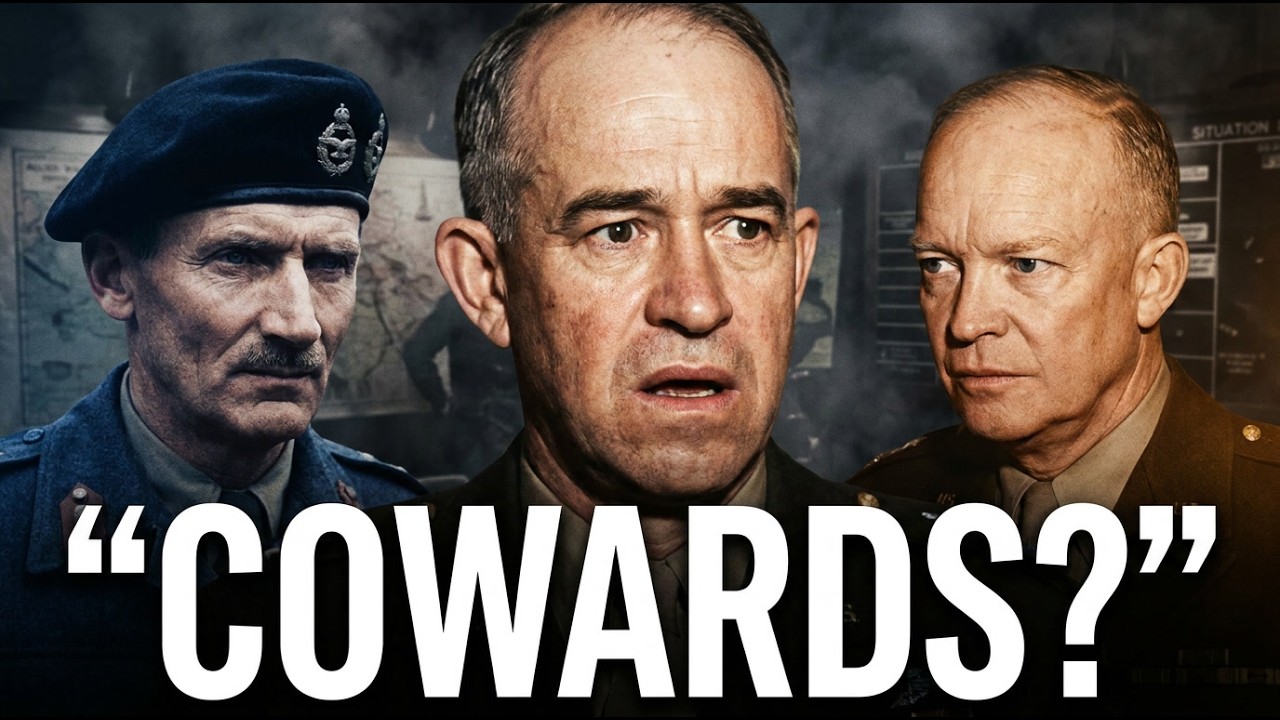
What Bradley had just read was not a battlefield report or a supply crisis. It was an account of what Field Marshal Bernard Montgomery had said in a staff meeting the previous evening about the performance of American soldiers during the first week of the Battle of the Bulge. The word in the message was specific.
The word was cowards. The British captain’s report was two pages long, and Hansen read it aloud while Bradley stood at the window, his back to the room. The meeting had been held at 21st Army Group Headquarters.
Present were Montgomery, his chief of staff de Guingand, three British corps commanders, and two liaison officers. The agenda had been operational, focused on counteroffensive planning for the northern shoulder of the bulge. The operational portion had concluded, but Montgomery had continued speaking.
He had spoken about the American performance during the initial German assault on December 16th. He had spoken about the divisions that had broken, the positions that had been abandoned, and the command failures that had allowed the German penetration to reach its maximum extent. He had used the word cowards, not as a general characterization of American soldiers.
The captain’s report was precise about this. Montgomery had been specific, referring to particular formations in the initial days of the offensive, formations that had been overrun or had retreated without orders. But the word had been used in a room with nine people in it by a British field marshal discussing American soldiers who had been fighting in his sector.
Hansen finished reading. The war room was quiet in the way rooms go quiet when something has been said that cannot be unsaid. Bradley turned from the window.
His face was calm, but his eyes were hard. He asked, “Who else has this?” Hansen said, “The captain filed with SHAEF liaison.
Bedell Smith has it. Eisenhower has it or will have it within the hour.” Bradley asked, “Montgomery doesn’t know the report was filed?”
Hansen said, “Not as of last night.” Bradley asked, “And the room? Were there other American officers present?”
Hansen said, “Just the captain.” Bradley sat down at the head of the war room table and gave a series of orders that were quiet and precise. He said, “Bring me the performance records.
Every division that was in contact on December 16th. I want the specific units Montgomery could have been referring to. I want the after-action reports.
 I want the casualty figures.” Hansen acknowledged and moved to comply. Bradley added, “And get me Eisenhower.”
While Hansen made the call, Bradley read. He started with the 106th Infantry Division. Two regiments surrounded and forced to surrender on the first day, the worst American unit disaster of the Western Campaign.
Bradley had been carrying that number since December. Seven thousand men. He read the after-action assessment.
The 106th had been hit by three German divisions simultaneously in the dark without adequate artillery support because the offensive had not been predicted in positions that had been designed for a sector considered quiet. He moved to the 28th Infantry Division, struck on its flank while already in contact, retreated under pressure that the division’s strength could not have absorbed. He read the 99th Infantry Division, green, three months in theater, hit on its first day of serious contact by the full weight of the German 6th Panzer Army’s initial assault.
Bradley read all of it the way he always read casualty reports, precisely, without commentary, with the specific attention of a man who understood that numbers were people and people deserved accurate accounting. Then he put the reports down and said, to no one in particular, “Three German divisions hit the 106th simultaneously in the dark, and Montgomery called them cowards.”
Hansen returned from the communications room and said, “Eisenhower will be on the line in 10 minutes, sir.” Bradley said, “Good.” Then he said, “Find me Collins.”
Collins was the commander of the 7th Corps. His corps had been in contact since the first day. His soldiers had held the northern shoulder of the Bulge under conditions that should have broken them.
Bradley wanted Collins in the room before he spoke to Eisenhower. He wanted a witness who had been in the Ardennes. He wanted the truth of the ground in the room before he said what he was going to say.
Collins arrived at 7:15, having driven from his corps headquarters in the dark. He came in still wearing his field coat, cold from the drive, reading the situation in the room with the instinct of a man who had commanded in contact for six months and had learned to read rooms the way he read terrain. He looked at Bradley and asked, “What happened?”
Bradley handed him the captain’s report. Collins read it standing up. His face did not change while he read it.
When he finished, he set it down and looked at Bradley. He said, “He said it in front of a room.” Bradley said, “Nine people.”
Collins asked, “Does he know the report exists?” Bradley said, “Not yet.” Collins asked, “What are you going to do?”
Bradley said, “I’m going to talk to Eisenhower. I want you here when I do.” Collins asked why.
Bradley said, “Because you were in the Ardennes from the first day. Because your corps held the northern shoulder. Because when Eisenhower asks me what the ground looked like on December 16th, I want him to hear it from someone who was there.”
Collins sat down and spoke with the weight of direct experience. He said, “The 99th held, Brad. People don’t know that.
The 99th was green, and they were hit in their first serious contact, and they held long enough for the second division to come up. That’s why the northern shoulder didn’t collapse.” Bradley said, “Tell Eisenhower that.”
The call connected at 7:30. Bradley had told his communications officer to keep the line clear of staff at both ends. Eisenhower understood the request and had complied.
Bradley said, “You have the report?” Eisenhower said, “Smith brought it to me at 6:00. I’ve read it.”
Bradley said, “Collins is in the room with me.” Eisenhower said, “Put him on.” Collins spoke for four minutes.
He described December 16th from the ground, not from maps, from the specific ground that his corps had been standing on when the German guns opened. He described the 99th Division. He described what it meant to be a green division in your first serious contact when the attack came at division strength in the dark.
He said, “Those soldiers held, Ike. They held longer than any assessment of their training and experience would have predicted. The reason the northern shoulder didn’t collapse in the first 72 hours is because green soldiers in the dark held ground they should not have been able to hold.”
 He said, “The word cowards is not in the same universe as what those men did.” He passed the telephone back to Bradley.
Bradley said, “You heard that.” Eisenhower said, “I heard it.” Bradley asked, “What are you going to do?”
Eisenhower said, “I’m going north.” Bradley asked, “Today?” Eisenhower said, “This morning.”
Bradley asked, “Do you want me there?” Eisenhower said, “No, this is between me and Montgomery.” Then he added, “But Brad, I need you to know something before I go.”
Bradley said, “Tell me.” Eisenhower said, “Whatever happens this morning, whatever Montgomery says or doesn’t say, the record is what Collins just described. That record exists and it is the record I will defend publicly if this becomes public.”
He said, “The soldiers who held on December 16th are not going to carry that word, not while I’m Supreme Commander.” Bradley said, “Good.” He said it quietly, the way he said things when they were right and did not require elaboration.
Eisenhower hung up. Collins looked at Bradley and said, “He’s going this morning?” Bradley said, “Yes.”
Collins said, “That’s the right call.” Bradley said, “Yes.” Collins asked, “What do we do?”
Bradley said, “We go back to the front.”
Eisenhower arrived at Montgomery’s headquarters at 11:00. He had the captain’s report. He had the after-action files that Smith had prepared during the drive north.
He had Collins’ four minutes on the telephone. What he found when he arrived was a Montgomery who had already been informed through internal 21st Army Group channels that a liaison report had been filed with SHAEF. De Guingand had told him at 9:30.
Montgomery had spent 90 minutes preparing. What he had prepared was a defense built on context. He told Eisenhower that the meeting had been an operational assessment, that he had been analyzing specific unit performance to understand the vulnerability that had allowed the German penetration to achieve its initial depth, that the language had been stronger than intended in the context of a closed staff meeting.
He said the word had been applied to specific formations in specific circumstances and had not been intended as a general characterization. Eisenhower listened to all of it. Then he placed the after-action files on the table.
He went through them one at a time, the 106th, the three German divisions, the dark, the positions, the absence of warning. He placed the 99th Division’s file on top and said, “Read the first page.” Montgomery read it.
The 99th Division’s after-action report described green soldiers in their first serious contact hit at full division strength in the first hours of the offensive. They held the northern flank for 72 hours at a casualty rate that the report described in numbers that were not abstract. Eisenhower said, “These are the soldiers you called cowards.”
Montgomery started to say, “The context.” Eisenhower cut him off. He said, “The context is in the file.
I’ve read it.” He said, “I’ve also spoken to the corps commander who was there.” He said, “Monty, I need to say something that I need you to hear completely.”
Eisenhower said, “The word you used in that meeting traveled from your headquarters to mine within 12 hours, not through official channels, through a liaison officer who was doing his job.” He said, “I want you to understand what that means. It means that anything said in that room, in any room at your headquarters, can reach SHAEF within 12 hours.
It means there is no closed staff meeting when American liaison officers are present.” He said, “I am not saying that to restrict what you discuss with your staff. I am saying it so you understand the environment.”
Then he placed his hand flat on the 99th Division’s file and said, “The second thing I want you to understand is this. The soldiers who fought in the Ardennes on December 16th were not cowards. Some of them were green.
Some of them were in positions that the intelligence assessment had marked as quiet. Some of them were hit by forces that the intelligence assessment had failed to identify.” He said, “They were not cowards.
 They were soldiers in the wrong place at the wrong time with inadequate warning, and some of them held ground they should not have been able to hold, and some of them died doing it.” He said, “That is the record, and it is the record that I will defend.”
Eisenhower continued with a gravity that left no room for ambiguity. He said, “If that word reaches the American press, if it reaches the families of the men who fought on December 16th, if it reaches the soldiers who are fighting right now in the same sector, the damage to this alliance will not be manageable.” He said, “Not by me, not by you, not by Churchill.
It will simply be damage.” Montgomery said, “I did not intend…” Eisenhower said, “I know.” He said it simply, without anger, not as absolution but as acknowledgment.
He said, “The intention is not the issue. The word is the issue. The word will not be used again about any American formation in any context, in any room where a liaison officer might be present, or where the word might travel.”
He said, “That is not a request.” Montgomery said, “Understood.” One word, the word that ended conversations.
Eisenhower looked at him for a moment and said, “The soldiers who held Bastogne, the soldiers who drove north in December to relieve it, the soldiers on the shoulders of this battle who held when they should not have been able to hold.” He said, “Those soldiers are going to win this war. I would like them to do it without carrying a word they did not earn.”
He picked up the files and drove south.
Bradley received Eisenhower’s call at 3:00 in the afternoon. Eisenhower told him the meeting had happened. He told him what he had said.
He told him the word would not be used again. Bradley asked, “Did he understand it?” Eisenhower said he understood the meeting.
Bradley said, “That’s not what I asked.” Eisenhower said, “I know.” He said, “Brad, some things you cannot make a man understand.
You can make him stop. That is what I did.” Bradley asked, “Is that enough?”
Eisenhower said, “For the soldiers, yes.” He said it with a finality that closed the question. Bradley held the telephone for a moment after Eisenhower hung up.
Collins was still in the war room. He had stayed through the morning working, running his corps remotely, doing the job that needed to be done while the conversation he had contributed to happened somewhere else. Bradley walked back in.
Collins looked up. Bradley said, “It’s handled.” Collins asked, “How?”
Bradley said, “The word won’t be used again.” Collins said, “That’s it?” Bradley said, “The soldiers who held on December 16th don’t know the word was used.
They were in the field. They were fighting. They don’t read liaison reports.”
He said, “What they know is what they did, and what they did is what the after-action reports say it was.” He said, “Green soldiers in the dark holding ground they should not have been able to hold. No one’s word changes that.”
Collins said nothing.
Bradley sat down at the head of the table and pulled the overnight reports toward him. The Bulge was still active. The German offensive was being reduced, but it was not finished.
The front needed managing. The corps commanders needed their army commander. The war needed the next decision and the decision after that.
He picked up the first report and read it the way he read everything, precisely, without commentary, with the full weight of his attention. The word from Montgomery’s staff meeting traveled no further than Eisenhower’s office and Bradley’s war room and the captain’s liaison report that had started it. The soldiers who had held on December 16th never heard it.
They were still in the line when Bradley sat down to his overnight reports, still holding the way they had held from the beginning because that was what they did. Not because anyone had called them anything, but because they were soldiers and soldiers held until they were told they could stop. The accusation had been contained, the alliance preserved, and the record set straight by the only authority that mattered, the ground itself and the men who had stood on it.


