On July 14, 1881, Sheriff Pat Garrett shot and killed Billy the Kid inside a dark bedroom in Fort Sumner, New Mexico Territory. The coroner’s jury ruled the death justified, and the outlaw was buried the next day. For more than a century, that was the accepted story. Decades later, a man named John Miller claimed he was actually the famous outlaw.
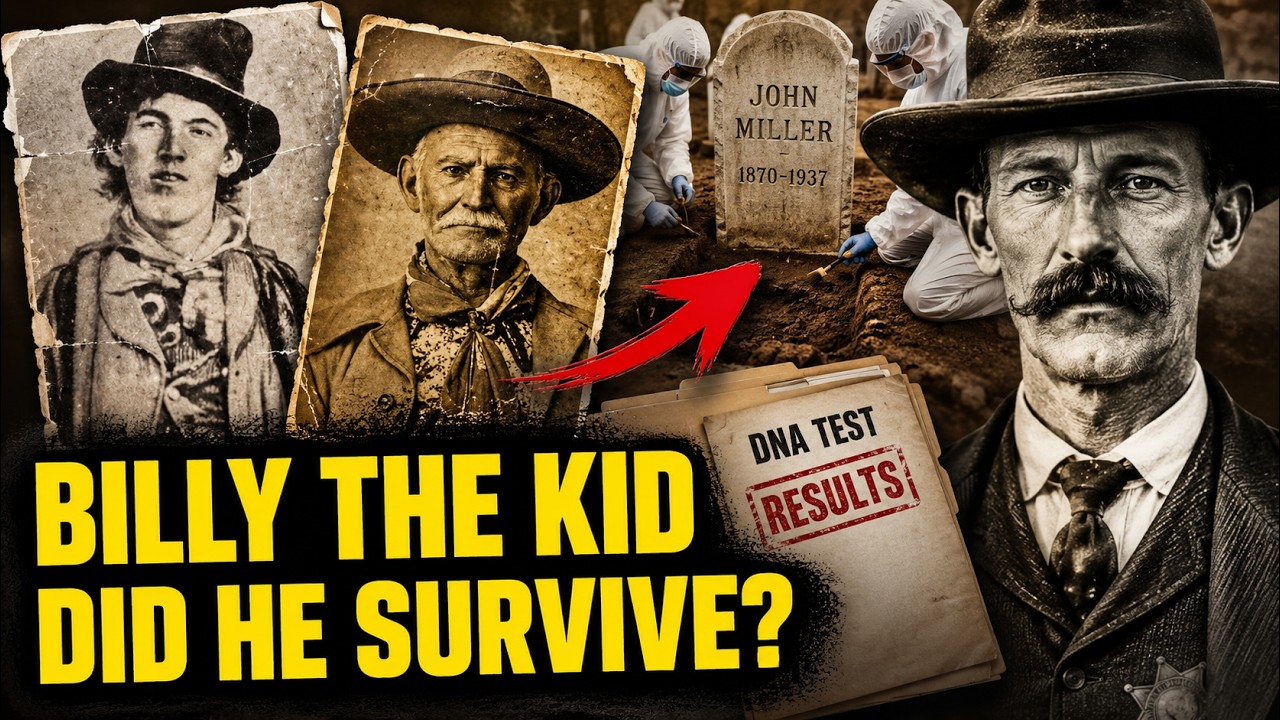
In 2005, investigators exhumed Miller’s remains in Prescott, Arizona, and turned an Old West legend into a genuine DNA case. The evidence, however, did not produce the conclusive answer many expected. Billy the Kid was a convicted killer who had escaped from the Lincoln County Jail while awaiting execution. His violent reputation grew out of the Lincoln County War, a bloody struggle over business and power in New Mexico Territory.
He had used several names, including Henry McCarty and William H. Bonney, and his early life was poorly documented. On April 28, 1881, Billy escaped from jail, killing two deputies during the breakout. Garrett had captured him months earlier and was under intense pressure to bring him back.
By July, Garrett, along with John W. Poe and Thomas McKini, had tracked Billy to the Fort Sumner area. Garrett went to speak with Pete Maxwell inside his home. According to Garrett’s account, Billy entered the dark bedroom, sensed something wrong, and asked in Spanish who was there.
Garrett recognized his voice and fired twice. One bullet struck Billy in the chest and killed him. The following morning, a coroner’s jury examined the body and identified the dead man as William H. Bonney, the outlaw known as Billy the Kid.
People in Fort Sumner who knew Billy personally viewed the body, prepared it for burial, and attended the funeral. Newspapers reported the killing immediately. Survival stories grew slowly as the Old West turned into legend. Several men eventually claimed to be the surviving Billy.
The two best-known were Brushy Bill Roberts and John Miller. Most claims went nowhere, but Miller’s case became the focus of forensic investigation because his burial place was known: the Arizona Pioneers Home Cemetery in Prescott. Miller lived for decades as a rancher in New Mexico and Arizona. Supporters pointed to his inconsistencies in census records, his reported knowledge of livestock and firearms, and statements from acquaintances who said he privately admitted he was Billy.
One friend, Frank Creezy, claimed Miller told him while drinking that he was William Bonney. Skeptics noted that much of this testimony was recorded decades after the events. Some came from people who had heard stories from parents or grandparents. There is no known 19th-century document in which Miller signs as Billy or provides verifiable information only the real Billy could have known.
Photographs also became part of the argument. Supporters compared images of Miller as an older man with the authenticated tintype of Billy, pointing to facial similarities and especially the prominent front teeth. When Miller was exhumed, examiners noted unusual positioning of his front teeth and healed trauma on his right shoulder blade, which supporters suggested could be an old gunshot wound. The strongest challenge to the Miller theory remains the timeline of July 1881.
Billy was known in Fort Sumner. Garrett knew him, Pete Maxwell knew him, and local residents recognized the body. A conspiracy would have required many people to be fooled or to participate in a deception, and no contemporary document describing such a plan has ever been found. In 2003, Lincoln County Sheriff Tom Sullivan reopened the case as a modern cold case investigation.
Investigators wanted physical evidence. They considered exhuming Billy’s mother, Catherine Antrum, from Silver City, New Mexico, but a judge ruled that investigators first needed to establish they could recover Billy’s remains. The Fort Sumner grave had its own location problems, as flooding in 1904 and lost markers created uncertainty about the exact burial spot. Investigators also examined an old carpenter’s bench believed to have been connected with Billy’s body after the shooting.
They said it had blood traces that could potentially belong to the outlaw. Forensic scientist Dr. Henry Lee examined the material, and samples were sent for laboratory analysis. But the chain of custody was a major problem.
Without reliable historical evidence connecting that exact blood to Billy’s body, DNA from the bench could not settle the question. On May 19, 2005, Miller’s grave was opened. Investigators recovered bones and teeth for DNA analysis. The excavation also unintentionally uncovered remains associated with another man, William Hudsmith, complicating the forensic work.
Samples from Miller were sent to Orchid Cellmark, a DNA laboratory in the Dallas area, for testing. Miller’s bones were later returned and reinterred. The exhumation also raised legal questions about whether all necessary state authorization had been obtained. Arizona prosecutors declined to pursue criminal charges, saying those involved appeared to believe they had permission.
The DNA results never produced a public, verifiable conclusion. Court filings show that DNA extraction and comparison work involving Miller, Hudsmith, and the carpenter’s bench were sought. In 2012, a group of records connected with the investigation was released, but the material did not provide conclusive evidence overturning the traditional account of Billy’s death. The PBS series American Experience notes that Miller’s bones were disinterred in 2005 and compared with samples believed to contain Billy’s blood, but also states that no test result proving the claim was made public.
Later reporting described the comparison as effectively useless for establishing identity. Two separate historical records now exist. John Miller was a real cowboy and rancher who died in Prescott in 1937 and was genuinely exhumed for DNA sampling in 2005. Billy the Kid was identified as the man killed by Pat Garrett at Fort Sumner on July 14, 1881, by contemporary officials and people who knew him.
The published forensic record still contains no validated DNA match identifying John Miller as William H. Bonney.