On August 2, 1876, Wild Bill Hickok walked into a Deadwood saloon and sat down for a game of poker. Hours later, one of the Old West’s most famous lawmen was dead, shot from behind by Jack McCall. The cards connected to that moment became known as the dead man’s hand, but the real story is darker, more complicated, and far less certain than the legend. Hickok was 39 years old, had been in the Black Hills for only a few weeks, and was not serving as a marshal, sheriff, or deputy.
In Deadwood, the famous lawman was mainly living as a gambler and trying to improve his finances. He joined a card game already in progress and accepted a seat that left his back exposed to part of the room. That detail would soon become the center of the story. No reliable document proves that Hickok knew he would die that afternoon.
Later writers added warnings, premonitions, and final speeches because those details made the event feel complete. The actual record is simpler and less dramatic. A nationally famous figure walked into an ordinary frontier business, sat down with several other men, and began playing cards. Jack McCall was also in Deadwood that day.
He was not a celebrated outlaw, an important gunman, or a known enemy from Hickok’s lawman years. He was an obscure drifter whose earlier life is poorly documented. Within a short time, the unknown man would become permanently connected to one of the best-known names in the American Old West. Deadwood had grown inside the Black Hills during one of the fastest gold rushes in the history of the American frontier.
Under the Fort Laramie Treaty of 1868, the Black Hills were included in territory reserved for the Lakota people. In 1874, an army expedition led by George Armstrong Custer entered the region and confirmed reports of gold. News traveled quickly, and miners began moving into the hills even though the land had not been legally open to them. By 1876, camps appeared along streams and gulches where miners believed gold could be found.
Deadwood developed beside Whitewood Creek in a narrow valley filled with dead timber that gave the settlement its name. It was less a finished town than a fast-moving construction site. The camp had no fully recognized municipal government, no established local court with clear authority, and no normal law enforcement system. That lack of legal authority would matter twice after Hickok’s death.
By the time Hickok reached Deadwood, his name was stronger than his position. He was still recognized as Wild Bill, the long-haired scout, marksman, gambler, and lawman from Kansas. In practical terms, however, his best years as a working lawman were behind him. He had not held a major town office since 1871.
There is strong evidence that his eyesight had become a serious problem. People who knew him described eye trouble, and later accounts said bright stage lights bothered him. The exact medical cause is unknown, but what can be said is that a man famous for accuracy was worried about his vision. A younger Hickok could depend on his sight, speed, and experience.
The older Hickok increasingly depended on other people believing the old stories. Fame also created a different danger. Any reckless stranger who challenged Hickok could become known overnight. Deadwood was full of people trying to rebuild their fortunes or identities, and a famous target offered a quick path to attention.
James Butler Hickok was born on May 27, 1837, near the community now known as Troy Grove, Illinois. He grew up in a farming family before moving west into Kansas Territory in 1855. The region was then caught in violent conflict over whether Kansas would enter the Union as a free state or a slave state. Hickok became associated with free state forces led by James Lane.
In 1858, he was elected constable of Monticello Township in Johnson County, Kansas. Hickok also worked for Russell, Majors, and Waddell, a large transportation company connected to freight and stage operations across the plains. This employment gave him practical knowledge of roads, horses, supply systems, and isolated frontier posts. The first event that built Hickok’s gunfighter reputation took place at Rock Creek Station on July 12, 1861.
A dispute developed over money still owed for the station. David McCanles came to the property, an argument followed, and three men were killed. Hickok shot McCanles. Hickok and others were charged, but the court accepted the claim of self-defense and acquitted them.
A widely read article published in Harper’s New Monthly Magazine in 1867 transformed the Rock Creek fight into a heroic battle against a dangerous gang. The article helped establish Wild Bill as a national character, but it was not a careful court history. His best-known biographer, Joseph Rosa, concluded that the documented number of men fatally shot by Hickok was around seven, not the dozens or hundreds claimed in popular stories. When the Civil War began, Hickok worked for the Union side in several roles, including teamster, wagon master, courier, scout, and employee of military police authorities.
After the war, he received an appointment as a Deputy United States Marshal at Fort Riley and served as a scout on the plains. His friendship and professional connection with William Cody, later known as Buffalo Bill, also developed through this frontier network. On July 21, 1865, Hickok faced Davis Tutt in the public square of Springfield, Missouri. Both men were gamblers, and their dispute involved money, pride, and a pocket watch connected to an unpaid or disputed debt.
Tutt displayed the watch in public after Hickok had warned him not to do so. The two men confronted each other across the square and exchanged fire. Tutt was killed, while Hickok was not hit. The event is often described as the first recorded one-on-one quick-draw showdown of the Old West.
Hickok was arrested and tried for manslaughter. The jury acquitted him. From that point, he was no longer just a frontier worker known in a few towns. He was becoming a national symbol of the armed West.
Hickok’s reputation helped him obtain law enforcement work in Kansas, but his actual time in office was shorter and less orderly than later legends suggested. In 1869, he served about six months as marshal of Hays City. He lost his bid for re-election in November 1869. In 1870, after leaving office, Hickok became involved in a saloon fight with soldiers and left the area after the encounter.
Hickok received his most famous law enforcement position in Abilene, Kansas. The city council approved his appointment on April 15, 1871, and he served until December 13 of that year. Abilene was a major cattle shipping point. The town had rules restricting weapons inside the settled area, and Hickok was expected to disarm violators, arrest troublemakers, and maintain enough calm for the cattle trade to continue.
On October 5, 1871, Hickok became involved in a confrontation with saloon owner Phil Coe in Abilene. Coe had fired a weapon within town, and Hickok moved to enforce the local rule. Accounts differ on the exact sequence, but Coe turned toward Hickok during the encounter, and Hickok shot him. A second figure then moved through the darkness toward the scene.
Hickok fired again and struck Mike Williams, a special deputy who was coming to help him. Williams died from the mistake. The accidental killing became one of the most important events in Hickok’s life. Later writers claim the death haunted him, although private emotions are difficult to prove from the surviving record.
What is clear is that he never took part in another documented gunfight after the Abilene shooting. The city council ended his employment in December. After Abilene, Hickok faced a problem shared by several famous frontier figures. His reputation was valuable, but it did not provide a dependable job.
In 1872, Hickok took part in an outdoor frontier exhibition near Niagara Falls. In late 1873, he joined William Cody and John Omohundro, known as Texas Jack, in a stage production called Scouts of the Plains. Hickok had little interest in acting and disliked the routine of performance. He left the company in March 1874 and returned West.
During the winter of 1876, Hickok renewed his acquaintance with Agnes Lake, a well-known circus owner and performer. Hickok and Lake married in Cheyenne, Wyoming Territory on March 5, 1876. He was 38, and she was older and more financially established. Less than five months after the wedding, Agnes received news that he had been killed.
Hickok traveled toward the Black Hills with Charles Utter, usually called Colorado Charlie, and a group organized around a wagon train. A contemporary diary places Hickok and Utter at a road ranch on June 30, 1876. They reached the Deadwood area around July 12. Martha Canary, better known as Calamity Jane, reached Deadwood at about the same time.
The evidence for a close personal relationship between her and Hickok is weak. The surviving record of Hickok’s time in Deadwood is much thinner than the legend built around it. He was there for roughly three weeks. He spent time with Charlie Utter and other acquaintances, looked at mining possibilities, and returned to card playing.
There’s no strong evidence that he spent those weeks cleaning up Deadwood, arresting criminals, or acting as an unofficial marshal. Very little can be stated with confidence about Jack McCall’s life before Deadwood. Even his name creates uncertainty. He had no documented career as a major outlaw, gunfighter, or enemy of Hickok.
At his first trial, McCall claimed that Hickok had killed his brother in Kansas, and that he had acted in revenge. Investigators and later historians could not identify a brother who clearly matched the story. After leaving Deadwood, McCall reportedly gave different explanations, including versions connected to a card game. The most accurate answer is that his motive remains uncertain.
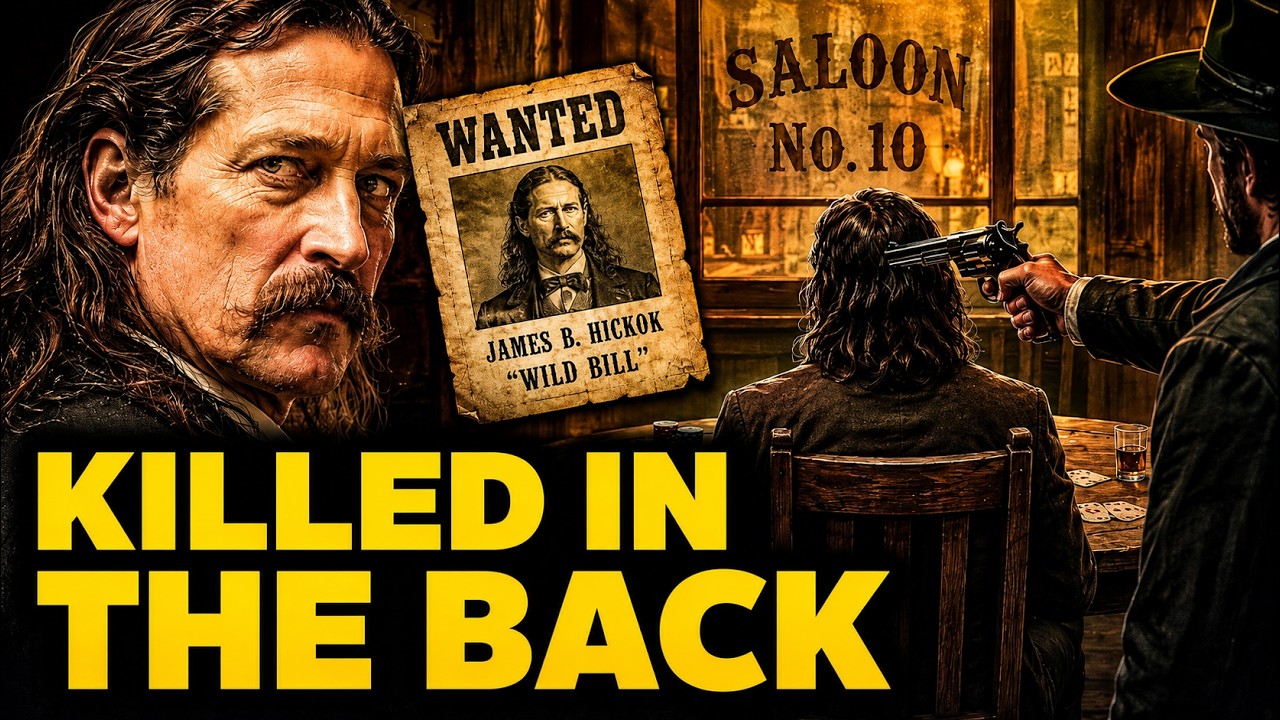
What is established is that he approached Hickok from behind in a public saloon and fired once. On August 2, Hickok entered Nuttall and Mann Saloon and joined a poker game. The business later became widely known as Saloon Number 10. Several men were at the table, including Captain William R.
Massie. Harry Young, sometimes called Sam Young, was working behind the bar and later gave an account of the shooting. Hickok’s chair left his back open to the room. Some versions say he asked another player to exchange seats and was refused.
What can be said without doubt is that he remained in the exposed position. The game continued and McCall entered the saloon. There was no formal challenge and no face-to-face exchange like the Springfield duel. McCall moved behind Hickok and fired a single shot.
Hickok died immediately at the age of 39. After the shooting, McCall ran from the building and tried to escape. He was captured nearby by men from the camp. McCall did not defeat Hickok in a Western duel.
He attacked from behind while Hickok was seated. That simple fact explains why the killing was described as an assassination. The best-known detail of Hickok’s death is also one of the least secure. Modern accounts say he was holding two black aces and two black eights when McCall shot him.
Those four cards are now called the dead man’s hand. The problem is that no surviving contemporary record from August 1876 clearly identifies them. Harry Young, the bartender who witnessed the final moments and testified during McCall’s first trial, did not describe black aces and eights. In an account published decades later, Young discussed the completed hand immediately before the shooting.
He said Hickok had held a strong combination but had lost to Captain Massie, then asked for more playing checks. The specific aces and eights story appeared in a major Hickok biography published by Frank Wilstach in 1926, almost 50 years after the killing. The careful historical wording is that black aces and black eights were traditionally said to be Hickok’s final cards, not that the surviving record proves they were. Deadwood residents placed McCall on trial the day after the killing.
Because the camp had no legally established local court, the proceeding was created by the community itself. It included a judge, attorneys, witnesses, and a jury, and it was held in McDaniel’s Theater. The jury accepted McCall’s revenge claim and found him not guilty. Contemporary criticism was sharp because the evidence showed a planned attack on a seated man, while the claimed brother could not be produced or clearly identified.
After the acquittal, McCall was free to leave. The important event was not a dramatic chase. It was the failure of the first legal response. McCall left the Black Hills and traveled into Wyoming Territory.
He reportedly talked openly about killing Hickok and gave versions that made the act sound more like a fair fight than an attack from behind. His boasting helped federal authorities locate and arrest him near Laramie. He was transferred to Yankton, the capital of Dakota Territory, where a legally recognized court could hear the case. A grand jury indicted him in October 1876.
His federal trial began on December 4 and ended on December 6. The jury found McCall guilty of murder. The second trial did not violate the constitutional protection against double jeopardy because the first group in Deadwood had no lawful jurisdiction to enter a binding judgment. Judge Peter C.
Shannon sentenced McCall on January 3, 1877. Appeals and requests for another trial failed. McCall was executed near Yankton on March 1, 1877. He was in his early 20s.
Less than seven months passed between Hickok’s death and McCall’s execution. Charlie Utter took responsibility for Hickok’s burial arrangements. Hickok was first buried in the South Deadwood Cemetery, also known as Ingleside, and Utter paid for the plot. A wooden headboard identified James Butler Hickok, named Jack McCall as his killer, and included a personal farewell from Utter.
In 1879, growth in the narrow valley forced the town to move graves from the original cemetery to a new location on the hillside. Hickok’s remains were transferred to Mount Moriah Cemetery with help from Utter and local residents. New monuments were later placed over the grave, but visitors repeatedly damaged them by taking pieces as souvenirs. Agnes, his widow, visited the grave in September 1877, more than a year after his death.
Martha Canary, known as Calamity Jane, was buried near Hickok in 1903. Their neighboring graves strengthened the claim that they had shared a close relationship. Historical research has found little evidence for that story. Hickok’s current grave remains at Mount Moriah, while the original saloon building where he was killed did not survive the major Deadwood fire of 1879.
The historic location and the later tourist saloon are not the same building.