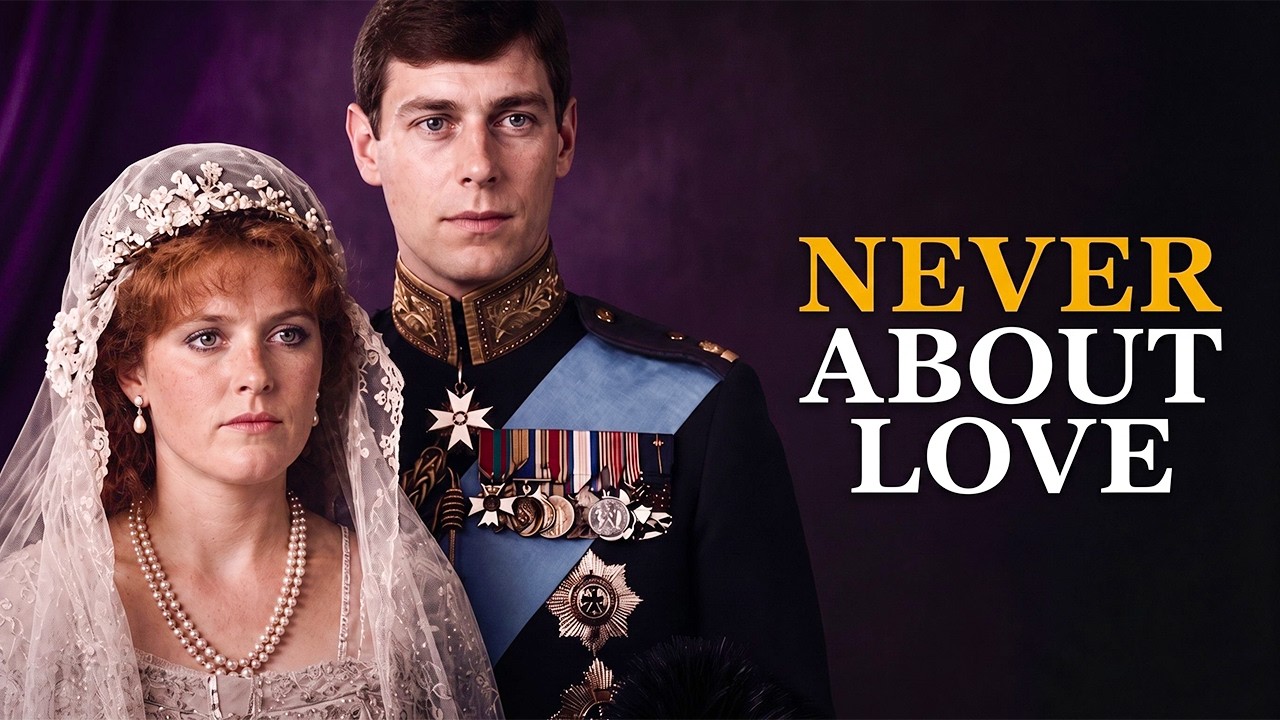
In July 1986, Sarah Ferguson married Prince Andrew in Westminster Abbey before an audience estimated at 500 million people. Hours before the ceremony, the Queen granted Andrew the title Duke of York, a wedding present that made Sarah a duchess. Nearly four decades later, in February 2026, both of them packed up and left Royal Lodge in Windsor Great Park, marking the final collapse of an arrangement that had outlasted their divorce by 30 years. Sarah Ferguson was born in 1959 and grew up in Hampshire.
Her father, Ronald Ferguson, was a polo manager whose proximity to the royal family gave the family access to rooms that money alone could not buy. Her mother left the family in the early 1970s for an Argentine polo player. After school, Sarah trained at the Queen’s Secretarial College and worked in public relations and publishing, learning how to handle clients and place stories in the press. By 1985, she was in her mid-20s, unmarried, and watching her close friend Diana navigate life as the most famous woman in Britain.
At Ascot in June 1985, Diana seated Sarah next to Prince Andrew at lunch. Andrew was 25, a Royal Navy helicopter pilot and the Queen’s second son. Within months, the couple was engaged. The announcement came on March 17, 1986.
The wedding took place on July 23, 1986. The Queen created Andrew Duke of York that same morning, hours before the ceremony. Roughly 2,000 guests attended, including Elton John and Nancy Reagan. Sarah wore an ivory silk dress embroidered with bees, thistles, and anchors.
She was 26 years old. She had acquired enormous status and, as it would later become clear, no independent financial means. The couple moved into Sunninghill Park, a new house built on Crown land near Ascot as the Queen’s wedding present. Sarah later wrote in her 1996 memoir that royal funding did not cover the pool and tennis court, and she used more than half a million dollars of her own money to finish a home she did not own.
Meanwhile, Andrew was frequently at sea. Sarah later told Canadian television that in the first five years of marriage, Andrew was away with the Navy for all but about 40 days a year. For a period, she was one of the most popular figures in the monarchy. In 1987, she took part in the Grand Knockout Tournament, a televised charity event featuring young royals in fancy dress.
The press treated it as evidence that the royals were not royal enough, and the criticism attached itself most strongly to Sarah. Coverage turned personal. She was called the Duchess of Pork and accused of being a freeloader. Every holiday was itemized, and her weight became a national talking point.
She has since spoken in detail about the eating disorder she lived with during this period. In November 1988, the News of the World reported that her father, Ronald Ferguson, had visited a West End massage parlor. He admitted he had been a fool and said he used the establishment for massage only. Buckingham Palace responded with a single line: he would have to deal with it himself.
He lost his positions as polo manager to the Prince of Wales and as a board member at the Guards Polo Club. His access, the family’s only real asset, was gone. In 1989, Sarah met Steve Wyatt in Houston, where she was guest of honor at the British Opera Festival. Wyatt was the stepson of the oilman Oscar Wyatt.
The claim that she and Wyatt had a love affair comes primarily from a 2001 book co-written by a woman who had worked closely with Sarah. Sarah has never publicly confirmed the affair. What is not in dispute is what happened next. In January 1992, a cleaner in a London flat vacated by Wyatt found an envelope containing around 120 photographs of Sarah with Wyatt.
One showed Princess Beatrice sitting on Wyatt’s knee. The photographs were sold and published widely. Nothing in them proved an affair, but they proved Sarah had a private life the palace had not vetted. The separation from Andrew was announced on March 19, 1992.
That same day, the Queen’s press secretary, Charles Anson, gave an off-the-record briefing to the BBC suggesting that Sarah was unsuitable. The briefing leaked. Anson later apologized to the Queen and to Sarah in writing. Sarah wrote that being labeled unsuitable froze her out permanently.
The record supports her. She never received a working royal role again. At the time of the separation, she had two daughters, two princesses, no house of her own, no income, and a reputation under sustained attack for four years. In August 1992, Sarah was photographed by a long-lens photographer while on holiday in the south of France with John Bryan, an American financial adviser.
The pictures, published in the Daily Mirror, showed her topless by a pool with Bryan holding her foot to his mouth. Her daughter Eugenie, then two, was in the frame. The Mirror sold three and a half million copies by nine in the morning. Sarah was at Balmoral with the Queen’s family at the time the photographs were published.
She left. Prince Philip, according to insiders speaking later, wanted her barred from royal residences entirely. Her exclusion from the family’s inner life was not in question afterward. The divorce came through on May 30, 1996.
Reported figures vary, but the lump sum to Sarah was in the low hundreds of thousands, with a trust set up for the daughters. Weeks later, Diana’s divorce settlement was reported at around 17 million pounds, and she kept apartments at Kensington Palace. Two women, the same family, the same year. One left with a fortune and a fortress.
The other left with a title, no house, no income, and a nickname the tabloids had spent a decade sharpening. Sarah was 36. She had two children in the line of succession, which meant she could never fully leave. She had one marketable asset: an understanding of the press from both ends.
She went and sold herself openly, on the record, for money. Weight Watchers came first, followed by a memoir, children’s books, American television work, and speaking engagements. She became the most commercially fluent person the House of Windsor had produced, and the only one who had to be. She also built a public narrative.
The happiest divorced couple in the world. Divorced to each other, not from each other, she told the Telegraph. She repeated variations of that line for two decades. The affection between them appeared genuine, and the line was also a product.
It kept her royal-adjacent, which kept her bookable, which kept her solvent. In 2008, she moved into Royal Lodge, the 30-room house on the Windsor estate where Andrew had settled. She called it a show of unity for the girls. By then, she had no property of her own she could sustain.
He had a large house on a lease from the Crown Estate at what Parliament later described as a peppercorn rent. Sunninghill Park, the house she had finished with her own money, sat empty on the market for more than five years after the divorce. In 2007, Andrew sold it for 15 million pounds to Timur Kulibayev, the son-in-law of the president of Kazakhstan. Buckingham Palace called it a straightforward commercial transaction.
A later BBC investigation traced the buyer’s funds to a loan connected to a bribery scheme. Kulibayev has denied any wrongdoing. By 2010, Sarah was in serious financial trouble. Her American company had collapsed, and her debts were reported at anywhere from one to several million pounds.
In May 2010, the News of the World published undercover footage of her meeting with a reporter posing as a wealthy businessman. In a hotel room, she accepted 40,000 pounds in cash and discussed a further 500,000 in exchange for an introduction to her ex-husband, who was then the United Kingdom’s unpaid special representative for trade and investment. On the tape, she says he would look after those who looked after her. Andrew denied any knowledge of the meeting, and the newspaper itself said he was not involved.
Sarah apologized the next day, called it a serious lapse in judgment, returned the cash, and said financial stress was no excuse. The following year came the development that eventually ended everything. In March 2011, the Evening Standard published an interview in which Sarah addressed the fact that Jeffrey Epstein, by then a convicted sex offender, had paid 15,000 pounds to one of her creditors. She called it a gigantic error of judgment, said she abhorred pedophilia and any sexual abuse of children, and said she would repay the money and have nothing to do with him again.
Weeks later, on April 26, 2011, she emailed Epstein. She told him she had never called him the p-word. She said she had been instructed to act fast to hold on to her career as a children’s book author and children’s philanthropist. She apologized to him and wrote that he had always been a steadfast, generous, and supreme friend to her and her family.
Her spokesperson said the email was sent on legal advice because Epstein had threatened to sue her for defamation, and that she stands by her public condemnation. The email was published by the Mail on Sunday and the Sun in September 2025. Within days, seven charities dropped her, including the Teenage Cancer Trust, which had been associated with her for 35 years, and the British Heart Foundation, which ended her ambassadorship. In October 2025, Andrew announced, after discussions with the King, that he would stop using the title Duke of York.
Charles went further and formally removed his princely style. The lease on Royal Lodge was surrendered. In January 2026, the Epstein files were released, containing further material on both of them. Andrew left Royal Lodge on February 4, 2026, first for Wood Farm and then an eight-room house on the Sandringham estate.
CNN reported that he was arrested in February on suspicion of misconduct in public office. He denies the allegations. Sarah left too. For months, her location was unclear.
Reports placed her in Portugal. For 30 years, she had controlled the public version of this marriage almost completely, writing the memoirs, giving the interviews, choosing which humiliations to confess. The palace never put out a counternarrative. What ended her was not a rival account.
It was her own writing, in her own words, in an archive she had no idea would ever be opened. The title arrived on the morning of the wedding, and it was the last thing taken away 39 years later, long after the marriage it was meant to dignify had ended. The dukedom outlasted the love, the divorce, the cohabitation, and both of their careers. It did not outlast the paperwork.
She was raised in a house where the only inheritance was knowing the right people. She married the rightest person in Britain. In the end, she was evicted from a home that was never hers, stripped of a name she was handed as a wedding present, with no door left to open for anybody.