The final, frantic radio message crackled out of the Führerbunker on the evening of April 28, 1945, a stark, three-word epitaph for a collapsing empire: “Reich Chancellery a heap of rubble.” The sender was not a frontline commander reporting a tactical setback, but Martin Bormann, the man who had spent the previous twelve years as Adolf Hitler’s most indispensable and sinister confidant. As Soviet artillery pounded the government district of Berlin into dust, Bormann, the gatekeeper who controlled all access to the Führer, was facing the ultimate test of his survival instincts.
The man who had orchestrated the downfall of Hermann Göring and Heinrich Himmler within the span of a single week now found himself trapped in a concrete tomb, his power evaporating with every Soviet shell that landed overhead.
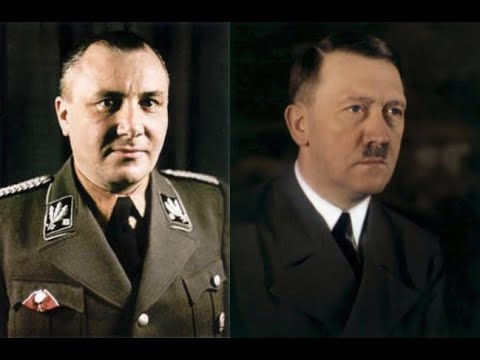 Bormann’s rise to this precipice of power was a masterclass in bureaucratic ruthlessness and unyielding loyalty. Born in 1900, he was a product of the post-World War I chaos, a disgruntled veteran who joined a Freikorps unit and participated in the violent political ferment of the Weimar Republic. His involvement in the 1924 political murder of Walther Kadow, a man who had betrayed the Nazi martyr Albert Leo Schlageter, earned him a year in prison, a credential that burnished his extremist credentials.
Upon his release, he joined the Nazi Party and quickly demonstrated a prodigious talent for organization and finance, rising through the ranks of the SA’s insurance office in Munich to become a powerful figure in the party’s financial machinery.
When Hitler seized power in 1933, Bormann’s trajectory became meteoric. Appointed chief of staff to Deputy Führer Rudolf Hess and granted the rank of Reichsleiter, the highest political rank in the NSDAP, he embedded himself within Hitler’s inner circle by 1934. He was not a charismatic speaker or a military strategist; his genius lay in his ability to manage the mundane details of Hitler’s life, from renovating the Berghof to acquiring adjacent properties to create a private Nazi enclave atop the Obersalzberg.
He even orchestrated the construction of the Eagle’s Nest as a birthday gift for the Führer in 1939, cementing his role as the indispensable administrator of Hitler’s personal and political existence.
His position as Hess’s chief of staff provided a crucial vantage point, granting him access to personnel files and enabling him to influence Hitler’s decisions on key appointments. Hitler, who deliberately fostered rivalries among his subordinates to prevent any single challenge to his authority, found Bormann’s loyalty and administrative competence invaluable. Bormann became the gatekeeper, the man who controlled the flow of information and people to the Führer, a position of immense power that he wielded with cold precision.
The flight of Hess to Scotland in 1941 was a gift that Bormann exploited to the fullest, as Hitler promoted him to Minister without Portfolio, consolidating his control over the party’s civilian bureaucracy.
Behind his back, his peers referred to him as the “Brown Eminence,” a nod to the color of his Nazi uniform and his shadowy, manipulative nature. During the war, while Hitler focused on military strategy at his headquarters, Bormann effectively ran the nation’s civilian administration, deeply involving himself in the extension of anti-Semitic measures to the conquered Eastern territories alongside SS chief Heinrich Himmler. Together, they were also responsible for the creation of the Volkssturm, a last-ditch militia of old men and boys, a desperate measure that underscored the regime’s final, fanatical throes.
As the war situation deteriorated, Bormann’s power only grew, his proximity to Hitler becoming an unassailable fortress against his many enemies.
 By early 1945, Bormann was the undisputed gatekeeper, the man through whom everyone had to pass to see the Führer. When Hitler transferred his headquarters to Berlin on January 16, 1945, Bormann and his staff moved with him aboard the Führersonderzug, Hitler’s personal train. The relentless Allied air raids forced Hitler to retreat into the Führerbunker beneath the Reich Chancellery garden in mid-February, and by mid-March, he had given up his office entirely, living full-time in the subterranean complex.
Bormann, maintaining his own party chancery apparatus nearby, took over a small office in the lower bunker, directly opposite Hitler’s suite, while continuing to sleep in his own nearby accommodation.
Albert Speer, Hitler’s armaments minister, later described the profound hold Bormann had over Hitler since 1942. After any conference, Bormann would enter, carrying his files, and speak with monotonous objectivity, advancing his own solutions based on a single word of agreement or a vague comment from Hitler. From these crumbs, Bormann would draft lengthy instructions, effectively making some of the most important decisions of the Reich.
This ability to convert whispers into death sentences made him a figure of immense fear; he could destroy anyone with a tale told to Hitler, who signed blank sheets of paper onto which Bormann had typed orders and directives. Even Himmler, the feared head of the SS, handled Bormann with kid gloves, maintaining his own close relationship with Hitler while carefully avoiding a direct confrontation with the gatekeeper.
The final weeks of the war saw Bormann at his most powerful and most desperate. He kept Hitler busy with paperwork and administration, limiting his contacts with the outside world, ably assisted by Labour Front leader Robert Ley and the one-eyed Dr. Hans Lammers, head of the Reich Chancellery.
As the Soviets encircled Berlin and fought towards the city’s center, Bormann had prepared an evacuation scheme, codenamed Operation Serailo, to move Hitler and his government to the Obersalzberg in the Bavarian Alps. Hitler resisted deserting Berlin, but many personnel and records were flown south from April 20, 1945. Ten aircraft loads of people and papers got away successfully on Hitler’s last birthday, while a final plane carrying his personal papers was shot down in eastern Germany on April 21, a loss that greatly upset the Führer.
The problem for Bormann was that his entire power rested on being beside Hitler. Without Hitler’s protection, he would have been eliminated by Himmler or another top leader. Though a plane was kept standing by to fly Hitler and his staff out of Berlin, Hitler dithered for days about leaving, until by the time he announced he would die in the capital, most airfields had been captured.
 The only remaining escape route by air was a risky flight from a temporary airstrip on the East-West Axis in the Tiergarten. Bormann could not desert Hitler while there was still a possibility the Führer would leave, so he remained stuck at his post, his fate inextricably linked to the man he served.
In his final days of power, Bormann orchestrated the dismissals of both Göring and Himmler. Göring, who had fled to Bavaria on April 20, unwisely attempted to assume leadership on April 23, believing Hitler had suffered a nervous collapse. Bormann spun Göring’s move into treason, and Hitler ordered the Reichsmarschall arrested and stripped of all his offices.
On April 28, Bormann received reports that Himmler had been secretly negotiating with the Western Allies. Hitler, enraged, ordered Himmler’s arrest, and Bormann gleefully transmitted the orders to Grand Admiral Karl Dönitz, who ignored them. Although Bormann took evident pleasure in eradicating his competitors, evidence shows he was drinking heavily and increasingly stressed by the proximity of the Red Army.
On the evening of April 28, the same day Himmler was ousted, Bormann sent his “heap of rubble” message to Dönitz. That night, test pilot Hanna Reitsch flew the new Luftwaffe commander, Field Marshal Robert Ritter von Greim, out of Berlin in an Arado 96 trainer from the Tiergarten airstrip. No evidence has emerged that any other aircraft left the city center after that date, discrediting conspiracy theories of a last-minute escape by plane for Hitler or Bormann.
The only way out now was on foot, attempting to infiltrate through the Soviet lines, a daunting prospect for the middle-aged, out-of-shape leaders in the bunker.
The final two days of Hitler’s life are well-documented. In the early hours of April 29, he married Eva Braun in a simple ceremony, with Bormann and Goebbels as witnesses. Hitler then dictated his political and private wills to his secretary, Traudl Junge, documents witnessed by Goebbels, Bormann, and Generals Wilhelm Burgdorf and Hans Krebs.
On the morning of April 30, Hitler was informed that the units holding the government quarter would be out of ammunition in two days. General Weidling, Berlin’s battle commandant, asked for permission for the remaining defense forces to break out. At 1 PM, Hitler gave his permission, making it clear he would shortly commit suicide.
 Bormann remained loyally at his master’s side, but he had no intention of killing himself. He was a natural survivor, a cunning and careful man who would use his remaining authority to somehow survive. Evidence of his intent is clear: on April 5, he had written to his wife, confirming arrangements for her safe passage with their ten children to a refuge in Bavaria.
On April 24, he sent an order finalizing preparations for two huts on the Hoher Göll mountain to be stocked with provisions for a group of people on the run. On April 29, he telephoned his wife to confirm his arrangements, promising to be in contact as soon as possible. These are not the actions of a man about to commit suicide.
At approximately 3:30 PM on April 30, Hitler and Eva Braun committed suicide in Hitler’s sitting room. Their bodies were carried to the Reich Chancellery garden, placed in a shell hole, doused in petrol, and set alight. The death of Hitler was confirmed beyond doubt by the fact that the escape groups organized for the night of May 1 were all too small to have successfully protected and escorted a man who had difficulty walking and was suffering from an undiagnosed shaking syndrome.
Hitler could never have walked out of Berlin unassisted. The approximately 780 SS troops guarding the Reich Chancellery were too few to fight through the Soviet rings en masse; they would instead attempt to break out in small groups to avoid attracting attention.
Brigadeführer Wilhelm Mohnke, who commanded the bunker breakout operation, had little idea of the current dispositions of Red Army units around the government quarter, as communications with German defenders had broken down. On the evening of May 1, Mohnke and his second-in-command worked out the group compositions and routes. Ten groups were organized, and Bormann would be a member of group number three.
They would depart between 10:30 and 11 PM, using darkness as cover. The question that has haunted historians for decades is whether Martin Bormann, the Brown Eminence, the gatekeeper of the Third Reich, managed to slip through the Soviet net and escape Berlin alive. The stage is set for one of the most enduring mysteries of the Second World War.