In the spring of 1914, a letter arrived at Buckingham Palace that made King George V go pale. A woman was threatening to sell his dead father’s love letters to the American press. She was not a stranger or an enemy of the crown, but a countess and former intimate of the royal family who had danced at the heart of England’s most exclusive circle for nearly a decade. Her name was Frances Evelyn Greville, Countess of Warwick.
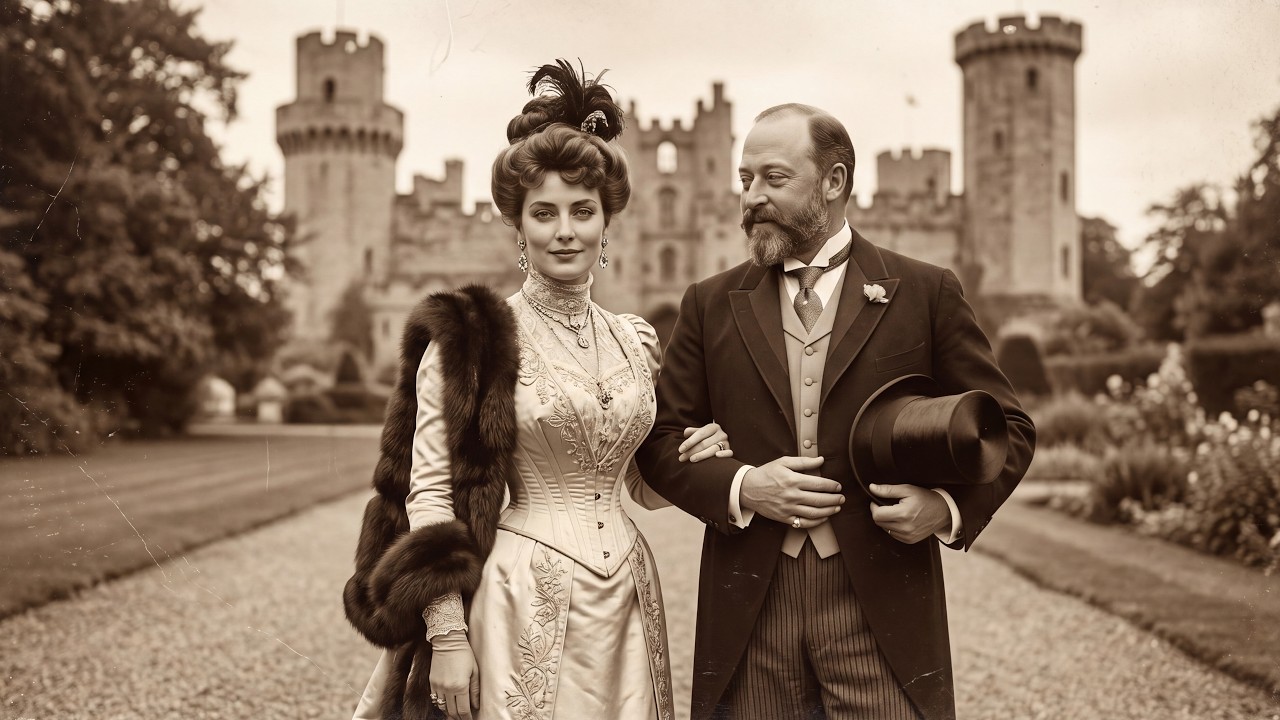
The world knew her as Daisy. She had once been considered the most beautiful woman in England and the favorite mistress of the Prince of Wales. Now she was nearly bankrupt and wanted 64,000 pounds to keep quiet. In 1865, two deaths in five months turned a three-year-old girl into one of the richest people in England.
In March, Colonel the Honorable Charles Maynard, Daisy’s father, died at his London home. Five months later, his own father, Henry Maynard, the third Viscount Maynard, died without a surviving male heir. The Viscountcy ceased to exist, but the land did not. Daisy inherited 14,000 acres of Essex countryside, Easton Lodge, farms, cottages, woodlands, and an income of 30,000 pounds a year.
To understand what that meant in 1865, a skilled factory worker earned perhaps 50 pounds a year. A country doctor might manage 300. Daisy’s income at the age of three was equivalent to 600 working men laboring for an entire year. The Maynard fortune was old money in the purest sense, with family connections to Easton Lodge tracing back to a grant from Elizabeth I.
But the bloodline running through Daisy’s veins told a different story. Her mother carried lineage that included three of Charles II’s most celebrated mistresses: Barbara Villiers, Louise de Kérouaille, and Nell Gwyn. Daisy’s blood was aristocratic, royal, and streaked with scandal going back 200 years. Nobody taught the child that the rents from 14,000 acres were not infinite.
Nobody told her that the world she was inheriting was already beginning to crack at the foundations. By the time Daisy was 18, Prime Minister Benjamin Disraeli was trying to marry her off to Queen Victoria’s youngest son, Prince Leopold, the Duke of Albany. Disraeli saw the match as politically tidy, a vast fortune married to a minor royal. Everyone would benefit except Daisy.
She liked Leopold well enough but did not love him and did not want to be a minor royal wife bound by the protocols of the Queen’s court. In the late 1870s, Daisy emerged into London society as one of the celebrated professional beauties, a Victorian phenomenon in which certain women became famous simply for being looked at. Their photographs sold in shops. Their names appeared in the social columns.
In 1881, she married Francis Greville, Lord Brooke, heir to the Earl of Warwick. The match was considered brilliant. Lord Brooke was handsome, titled, and the future master of Warwick Castle. Together the couple would command two great estates and a social position at the very center of the English aristocracy.
Queen Victoria sent a personal gift. The guest list included half the peerage. But it was the world she married into rather than the man that would define Daisy’s life. Lord Brooke was a member of the Marlborough House Set, the informal court surrounding Albert Edward, Prince of Wales, the future King Edward VII.
This was the most exclusive social circle in England, operating by a single unwritten rule: you could do anything as long as nobody talked about it. The whole system functioned like a beautiful, intricate clock. The great country houses were designed for this game. Bedrooms were arranged along long corridors.
Name cards were placed in brass holders on each door so nocturnal visitors could find their way in the dark. The word for this practice was corridor creeping. The one crime that could not be forgiven was indiscretion. You did not write letters that could be intercepted.
You did not confide in people who could not be trusted. Daisy entered this world at 21 with everything she needed to play the game except one thing: she could not keep a secret to save her life. Between 1889 and 1898, Daisy was the Prince of Wales’s acknowledged favorite, his principal mistress. She did not merely attend the most important parties; she gave them.
Easton Lodge became the stage for this performance. A private railway halt was built at Little Canfield so guests could arrive without being seen at the public station. A special siding was constructed for the Prince of Wales’s private train. A single weekend shooting party at Easton Lodge could involve 40 guests and 100 servants.
The kitchens would prepare breakfast, lunch, afternoon tea, and a formal dinner of eight or nine courses. A single weekend could cost 2,000 pounds, and Daisy hosted dozens of such weekends every year. The apex came in January 1895 when Daisy organized a fancy dress ball at Warwick Castle. The theme was the court of Louis XVI and Marie Antoinette.
Four hundred guests arrived in silk and powdered wigs. Daisy herself came as Marie Antoinette, dripping with borrowed diamonds and real pearls, her costume alone costing what most families spent in a year. One journalist heard the details and wrote a scathing account. Robert Blatchford, editor of the socialist newspaper The Clarion, held the ball up as proof of everything wrong with England.
While Daisy’s guests drank champagne dressed as French aristocrats, he wrote, children in the East End of London were going to bed hungry. Daisy would not read that article for some time. When she did, it would change her life. Daisy’s downfall began not with the king’s letters but with one furious letter of her own sent to entirely the wrong person.
Before she became the Prince of Wales’s mistress, she was entangled with Lord Charles Beresford, a naval officer married to a woman who tolerated his wandering with customary aristocratic silence. The trouble began in 1891 when Lady Beresford became pregnant. Daisy saw the pregnancy as a betrayal. If Charles Beresford was sleeping with his own wife, then he could not be fully devoted to Daisy.
Daisy sat down and wrote a letter to Lord Charles Beresford, a howl of rage, jealousy, and wounded vanity that would have been devastating if it ever became public. The letter arrived at the Beresford household, but Lord Charles was at sea. Lady Beresford opened it. Lady Beresford, now in possession of written proof that her husband’s mistress was a jealous lunatic, refused to return the letter.
Daisy panicked. She enlisted the Prince of Wales himself, who agreed to intervene. The Prince visited Lord Charles Beresford in person and demanded the letter’s return. Beresford refused.
Accounts differ on details, but the most widely repeated version has the Prince physically pushing Beresford against the sofa during a heated confrontation. Lady Beresford placed the letter with her solicitor, George Lewis. Daisy went to the solicitor herself, arriving at his office late at night and demanding the letter be handed over. Lewis refused.
The affair escalated until it reached the desk of Prime Minister Lord Salisbury, who was forced to broker a truce. The letter was eventually sealed and deposited with Lewis, not to be opened. Lady Beresford exacted her price: Daisy was to be excluded from a forthcoming state reception at Marlborough House. The Prince of Wales, caught between his mistress and an outraged wife, was forced to comply.
In the aftermath, the Prince drew Daisy closer, not further away. She had been his friend. Now she became his lover. Their affair lasted the better part of a decade.
The Prince wrote to Daisy constantly, letters that were long, affectionate, gossipy, and staggeringly indiscreet. He wrote about politics, about other women, about his mother the Queen, about matters of state no one outside the Privy Council should have known. He signed them with pet names. He addressed her as “my darling Daisy.
”
Daisy kept every letter. She bundled them in ribbon and stored them at Easton Lodge. She did not destroy a single page. The Beresford affair earned Daisy a nickname that followed her for the rest of her life.
The press called her the Babbling Brook, a pun on her husband’s title. It was delivered as a joke. It was, in fact, a prophecy. By 1901, when the Prince became King Edward VII, a new favorite had emerged.
Alice Keppel was younger, calmer, and above all discreet. By then Daisy was yesterday’s favorite, 40 years old, still beautiful, still wealthy on paper, but the ground beneath her was already giving way. The fortune that sustained Daisy’s world rested on a single foundation: land. For centuries, the bargain had held.
Then ships arrived carrying cheap American grain produced on vast mechanized farms. The price of wheat halved, then halved again. English tenant farmers could not compete. Rents fell by a third, then by half.
In the worst years of the agricultural depression between 1879 and 1896, nearly a quarter of Essex farmland went out of cultivation entirely. But Daisy did not adjust. She could not adjust. In 1902, she commissioned Harold Peto to create an Italianate paradise at Easton Lodge: 23 acres of formal gardens with terraces, pergolas, fountains, and a Japanese water garden.
The cost was staggering at a time when her rental income was falling year by year. In 1904, Daisy formally joined the Social Democratic Federation, one of the most radical socialist organizations in Britain. The newspapers treated it as a joke, calling her the Red Countess. They were wrong.
Daisy did not tire of socialism. She threw herself into it with the same reckless, consuming intensity she had brought to everything else in her life. She funded free school meals. She opened a home for destitute women.
She appointed radical clergymen to the livings on her estates. She spoke at public meetings and wrote articles for the socialist press. The doors of the Marlborough House Set began to close. Former friends cut her in the street.
The problem was simple and devastating. Daisy was spending money in two directions at once, still maintaining the great houses while pouring money into schools, charities, and political campaigns. Her income, already savaged by the agricultural depression, was being pulled apart from both sides. By 1913, Daisy was desperate.
The debts had become unmanageable. She made a decision that would define her legacy more than anything else: she decided to sell the letters. She wrote to King George V and proposed an arrangement. She would return the letters in exchange for 64,000 pounds.
The palace reacted with horror. King George consulted his private secretary, Lord Stamfordham, who found an elegant solution. The letters, he argued, were the intellectual property of the writer. Edward had written them, so the copyright belonged to his estate, which was now the property of the Crown.
Publishing them without permission would be a violation of copyright law. The Crown solicitors obtained an injunction from the High Court preventing Daisy from publishing, reproducing, or selling the letters. The injunction was granted in secret without publicity. Daisy tried another angle.
If she could not sell the letters in England, she would sell them in America, where the copyright injunction might not apply. The threat was credible, and the palace knew it. Stamfordham found a solution. Arthur Du Cros, a wealthy industrialist and founder of the Dunlop Rubber Company, was approached quietly and asked to solve the problem.
Du Cros paid Daisy 64,000 pounds. The letters were surrendered. The payment was structured as a private financial arrangement with no official connection to the palace. In 1916, Du Cros was created a baronet, an honor presented as recognition of wartime services but widely understood as recognition of his services to the Crown’s reputation.
The letters themselves passed into obscurity. They have never been published. Their current location, if they still exist, is unknown. Some historians believe they were destroyed by the palace.
Others believe Du Cros kept them. Daisy received her 64,000 pounds, but the money did not save her. It vanished into decades of accumulated debt. The Great War then accelerated everything.
Young men who had worked the farms were sent to France and in terrible numbers never came home. Easton Lodge emptied. In 1918, a sick monkey wrapped in a blanket burned down half of Easton Lodge. A servant, in an act of misguided kindness, had wrapped the monkey in a blanket and placed it near a fire.
The monkey escaped, trailing the burning blanket through the corridors and setting fire to curtains, carpets, and furnishings. The fire destroyed much of the main house. Rooms where the Prince of Wales had slept were gutted. The library where Daisy had read the Fabian tracts that changed her life was consumed.
Daisy could not rebuild. The insurance was insufficient. In 1919, she began selling land. In 1923, she stood for Parliament as the Labour candidate for Warwick and Leamington.
Her opponent was a young Conservative named Anthony Eden, with excruciating irony the brother of Daisy’s own daughter-in-law. Daisy lost badly. She tried to give Easton Lodge to the causes she believed in. She offered it to the Labour Party as a headquarters.
They declined. She offered it to the Trades Union Congress as a conference center. They also declined. In 1928, a new crisis erupted.
Daisy had produced a memoir that the Crown found unacceptable. The palace moved to suppress it. There were threats of prosecution and talk of imprisonment. The memoir was published in censored form.
The most damaging passages were removed. Reviewers noted the book was curiously bland. They did not know the interesting parts had been cut with a legal scalpel. In the final years of her life, Daisy filled Easton Lodge with animals: dogs, cats, horses rescued from slaughterhouses, retired circus ponies.
She filled the house with people too, not politicians but writers, thinkers, and radicals. H. G. Wells lived on the estate for years.
George Bernard Shaw came to argue about socialism. Charlie Chaplin visited. A. A.
Milne was a guest. In 1937, Daisy made a formal declaration protecting the parkland at Easton Lodge, ensuring the ancient trees and wild gardens would be preserved as a nature reserve. She died on the 26th of July, 1938, at the age of 76. Her estate was valued at 37,000 pounds.
Her inheritance at the age of three had generated 30,000 pounds every year. At her death, her entire remaining wealth would not have covered a single year of the income she had been born into. A fortune built over three centuries was spent in a single lifetime. After Daisy died, the two properties diverged into unexpected fates.
Easton Lodge was requisitioned by the military during World War II. American bomber crews set up their base on Daisy’s former lawns. The gardens that Harold Peto had designed were bulldozed to make way for runways. In the 1950s, the decision was made.
Easton Lodge was demolished and its materials sold for salvage. Warwick Castle followed a different path. In 1978, David Greville, the eighth Earl of Warwick, announced the castle would be sold to the Tussauds Group for 1. 3 million pounds.
The Earl’s son publicly opposed the sale, calling it a betrayal. The sale went ahead. Tussauds transformed Warwick Castle into one of the most visited tourist attractions in England. In the private apartments, they created a tableau of a weekend house party in 1898, the height of Daisy’s reign.
Wax figures of Daisy’s actual guests now stand in the rooms where the real people once gossiped and flirted. The gardens at Easton Lodge, the ones Daisy declared a nature reserve in 1937, are being restored today by volunteers and are open to the public on selected days. The Italianate terraces that Harold Peto designed are emerging from decades of woodland growth. The Japanese water garden is being cleared.
The letters are gone, whether destroyed, hidden, or simply lost. The words that Edward wrote to his darling Daisy remain unread, their secrets buried with the people who fought over them. The woman who could not keep a secret has left behind the greatest secret of all: letters that were worth 64,000 pounds, that brought the Crown to the brink, that began with three words, “My darling Daisy,” and ended with a silence that has lasted more than a century.