The German emperor crossed into the Netherlands as a fugitive on November 10, 1918, and the first thing he asked for when he reached the safety of a Dutch nobleman’s castle was a cup of English tea. It was the 11th of November, the very day the war he had presided over came to an end. He had lost his throne, his empire, and his army in a matter of days, yet he could not bring himself to believe any of it was permanent. Wilhelm II was the eldest grandson of Queen Victoria, raised with English manners and expectations, and he was both kin and enemy to the British public.
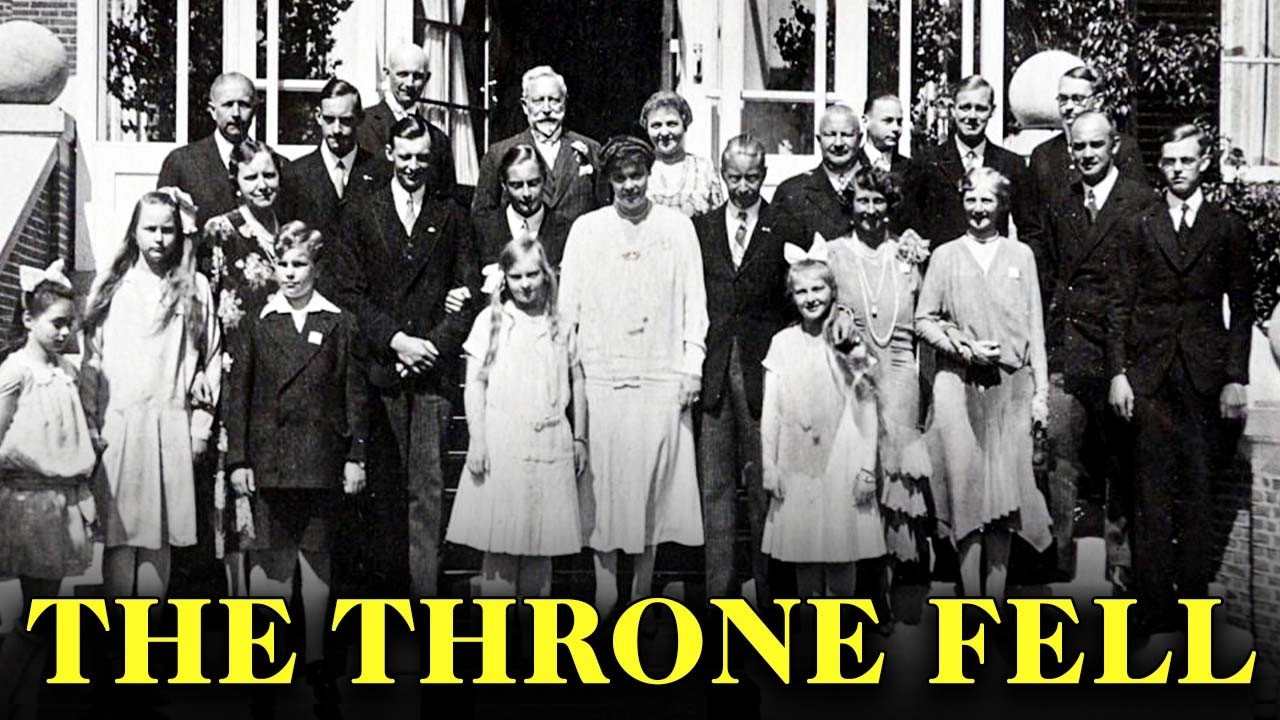
The dynasty he led had taken roughly 900 years to climb from a hilltop castle in Swabia to the imperial throne of a unified Germany. The fall of that empire took only a single autumn. Born in 1859 with a withered left arm that was damaged during a difficult birth, Wilhelm spent his life concealing the injury behind uniforms and military display. He came to the throne in 1888 at age 29, after his father died of throat cancer just 99 days into his reign, and he inherited an empire he was in no way ready to lead.
He dismissed Chancellor Otto von Bismarck in 1890 because he could not bear to share the stage, and he poured his restless energy into building a battle fleet that challenged Britain and helped turn the cousin into the enemy. The war he helped start destroyed him. In October 1918, German sailors mutinied rather than sail to their deaths in a futile final battle, and the revolution swept across Germany. By November 9, the chancellor in Berlin had announced the Kaiser’s abdication without his knowledge or consent.
At army headquarters in Spa, Wilhelm was told to his face by his own generals that the army would not march under his command. He had three choices: surrender, fight, or run. He ran. The Netherlands took him in, sheltering him from the victorious Allies who wanted him hanged.
He signed his formal abdication on November 28, 1918, in a borrowed room at Amerongen Castle. The signature changed nothing because the world had stopped treating him as emperor weeks before. He never accepted it. He spent the next 22 years waiting for a restoration that never came.
His wife, Empress August Victoria, followed him into exile already a sick woman. Their youngest son, Prince Joachim, could not absorb the loss of the only identity he had ever known and took his own life on July 18, 1920, at age 29. The empress died on April 11, 1921, at age 62, having outlived the throne by barely two and a half years. Her body was returned to Germany for burial, and tens of thousands of mourners lined the route, revealing how much monarchist feeling remained.
Wilhelm married again in 1922. His second wife, Princess Hermine, encouraged the fantasy that the monarchy might return. The sons of the dynasty scattered into wildly different fates. The crown prince, Wilhelm, spent the rest of his life chasing relevance and flirted with the Nazis in the hope of regaining a throne, gaining nothing but lasting disgrace.
His brother August Wilhelm went further, joining the Nazi party in 1930 and serving as a princely ornament for the regime. Other brothers, Eitel Friedrich and Oscar, rejected Hitler and kept their distance. Wilhelm remained at Huis Doorn, a modest manor in the Dutch countryside, where he had shipped 64 railway carriages of furniture, silver, paintings, and tapestries from his palaces. He arranged the rooms to recreate a scale model of his vanished empire and refused to let his body be returned to Germany unless the monarchy was restored.
He died on June 4, 1941, at age 82, living his final year under Nazi occupation. Hitler sent a wreath to the funeral. The family’s argument over what remained of its wealth stretched across the entire 20th century and into the 21st. The property dispute passed through the Weimar years, the Nazi seizure of eastern estates, and the chaos of postwar Germany.
Only in the summer of 2025 did the German federal authorities and the family reach a settlement, creating a foundation to keep contested objects in public hands. The headship of the house passed to Georg Friedrich, a direct descendant of the last Kaiser, who became the sole owner of Hohenzollern Castle, the ancestral seat, at the end of 2025. The dynasty survives not as a sovereign power but as a heritage house, a name attached to a castle and a memory.
Huis Doorn is now a museum, its rooms frozen exactly as the last Kaiser arranged them, a monument to refusal in a country that long ago moved on.


