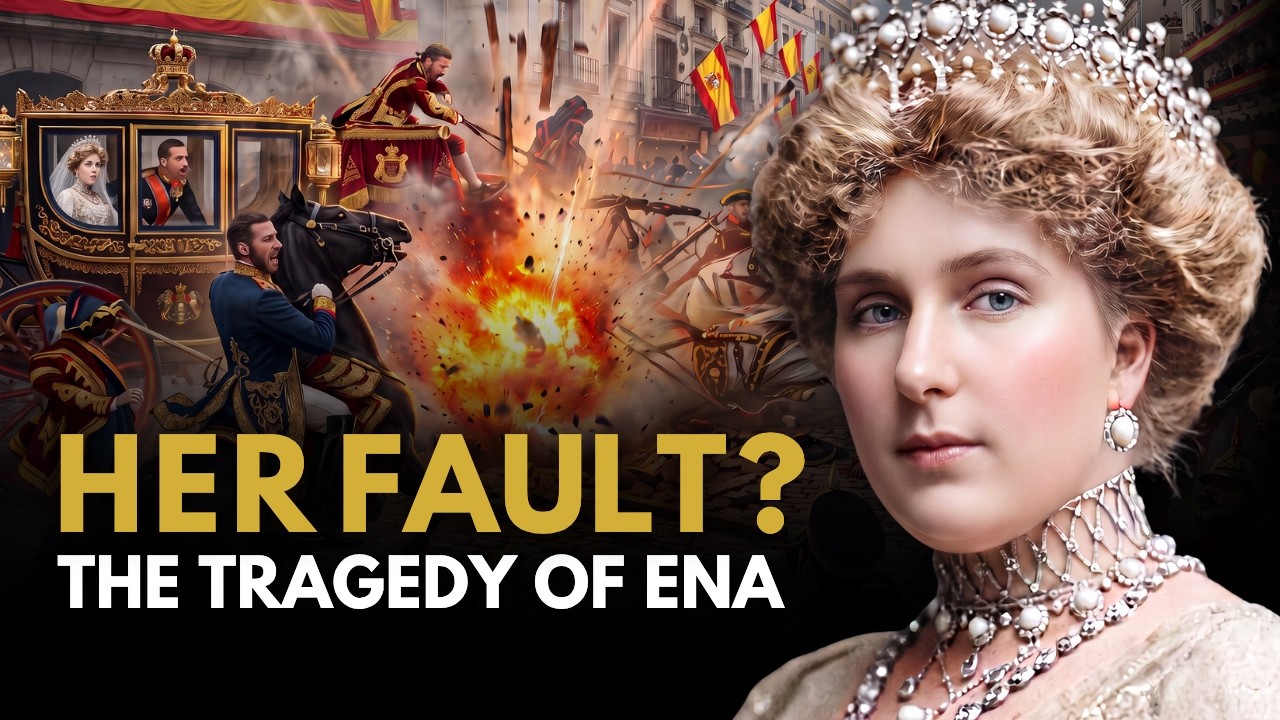
Her white wedding dress was soaked in the blood of strangers just moments after the ceremony ended. The carriage procession through the streets of Madrid on May 31, 1906, was supposed to be a triumphant start to a royal marriage, but an anarchist’s bomb turned it into a massacre. Twenty-four people were killed and more than a hundred were wounded. The bride, Princess Victoria Eugenie of Battenberg, refused to change out of her bloodstained gown, insisting the Spanish people see her as she truly was after sharing their horror.
The bombing was only the beginning of a long series of misfortunes for the young queen. Born on October 24, 1887, at Balmoral Castle in Scotland, Ena—as she was known within the family—was the daughter of Prince Henry of Battenberg and Princess Beatrice, the youngest daughter of Queen Victoria. Because the queen demanded that Beatrice remain at her side as a companion and secretary, Ena grew up in the heart of the British Empire rather than in the quiet of the German principality of Hesse. She was spirited, stubborn, and adored by her formidable grandmother, but she carried an invisible burden: the possibility of having inherited hemophilia, the so-called “royal disease” that prevented blood from clotting properly.
Her father died of malaria in 1896 while serving in the Anglo-Ashanti War, an early and painful loss that left the nine-year-old Ena and her mother dependent on Queen Victoria’s support. Ena grew up among crowned relatives, absorbing strict ideas of duty, honor, and royal dignity. She seemed destined for a quiet life within the British royal circle, but fate had other plans. In 1905, the young King Alfonso XIII of Spain arrived in Britain on an official visit.
He was actively searching for a bride who could strengthen Spain’s international position and rejuvenate the fading Bourbon dynasty. At a Buckingham Palace party, he spotted the nineteen-year-old Princess Ena and was immediately captivated by her fair skin, blue eyes, golden hair, and slender figure. The British press nicknamed her “the English rose. ”
But the path to the altar was obstructed by serious obstacles.
The Spanish court and the Catholic Church strongly opposed the king marrying a Protestant. Ena was required to publicly renounce Anglicanism and convert to Catholicism, a step regarded in Britain as close to national betrayal. Even more troubling were persistent rumors that Ena’s mother was a carrier of hemophilia. Spanish advisors begged the king to abandon the engagement, warning of the genetic danger to future heirs.
Alfonso, deeply in love, dismissed the warnings and resolved the diplomatic and religious conflicts himself. Ena, equally determined, diligently studied Spanish language and culture, preparing herself to rule her new country. The wedding in Madrid drew thousands of spectators lining the streets to celebrate the union of the young king and his British bride. After the ceremony at the Church of San Jerónimo, the royal couple rode in an open carriage pulled by eight white horses.
Among the crowd near number 88 Calle Mayor stood Mateo Morral, a committed anarchist who considered the assassination of monarchs the highest political achievement. As the carriage reached his position, he threw a bomb concealed in a bouquet of flowers. The device struck overhead electric lines, bounced, and landed among the crowd and guards. The explosion tore through the festive street, leaving chaos, smoke, and casualties.
The royal couple survived without physical harm, protected by the carriage’s armored upholstery and sheer luck. Ena’s dress was drenched in the blood and tissue of the dead and wounded. Rather than collapsing, she displayed remarkable composure, refusing to change clothes and completing the journey to the palace with her head held high. The Spanish admired her courage, but superstition began to whisper that a marriage that began in blood would bring a curse upon the country.
Within a year, in May 1907, Queen Ena gave birth to her first child, the long-awaited heir, Prince Alfonso. The joy at court was short-lived. By the time the infant was a few months old, doctors noticed alarming symptoms: minor bruises and scratches would not heal, and bleeding would not stop. The diagnosis was devastating: hemophilia.
King Alfonso XIII, accustomed to absolute authority and a perfect public image, could not forgive his wife for passing a fatal disease to their firstborn son. The situation worsened with the birth of more children. Their youngest son, Prince Gonzalo, was also found to have hemophilia. Of the couple’s three sons, only the middle one, Juan—later Count of Barcelona and father of King Juan Carlos I—was born healthy.
This was not enough to save a marriage already crumbling. Alfonso XIII publicly neglected his wife, took many mistresses, and blamed Ena for every misfortune in the family. His cruelty wounded the proud British princess deeply. Their personal life was destroyed, and a heavy silence settled over the palace.
Finding herself abandoned by her husband and regarded with suspicion by the court, Ena turned to what she did best: public service. She transformed royal charity work in Spain, spearheading reforms in healthcare, supporting the fight against tuberculosis, establishing sanatoriums, and reducing infant mortality. She worked actively with the Red Cross, visited hospitals personally, organized training courses for nurses, and paid close attention to medical care. Her genuine compassion earned her the admiration of ordinary Spaniards.
While the king’s authority declined, Queen Ena, despite her foreign origins and the stigma of being labeled a “disease carrier,” won the respect and love of the public. By the early 1930s, Spain’s political crisis reached its peak. Alfonso XIII’s authoritarian rule and support for the dictatorship of General Miguel Primo de Rivera had alienated the military, intellectuals, and working classes. In the municipal elections of April 1931, Republicans won a sweeping victory in the country’s major cities.
Massive demonstrations erupted across Spain demanding the immediate abolition of the monarchy and the expulsion of the Bourbons. On the night of April 13–14, 1931, panic gripped the palace. Alfonso XIII realized that the army would no longer protect the crown and that the only way to avoid civil war and bloodshed was to leave the country voluntarily. Queen Ena hastily packed their belongings while revolutionary crowds chanted anti-monarchist slogans outside the palace windows.
On the morning of April 14, the king left Madrid secretly by car. Hours later, the queen departed with her children, heading into the unknown and leaving behind a quarter-century of their lives. At the French border, the king and queen finally separated. Alfonso accused Ena of weakening the Spanish throne with her British blood and coldness, while Ena could no longer tolerate his infidelities, indifference, and vanity.
They parted amicably but coldly, remaining formally married for the sake of the Catholic Church even as they lived in different countries. Exile brought Ena not only the loss of her status but also a series of devastating personal losses. The lethal curse of hemophilia continued to haunt her sons in exile. In August 1934, the queen’s youngest son, Infante Gonzalo, died in a car accident.
A little over four years later, in September 1938, her eldest son, the former heir to the throne Alfonso—who had recently renounced his rights to make a non-royal marriage—died in a car accident in Florida under painfully similar circumstances. What seemed like minor accidents proved fatal: their inherited hemophilia turned internal injuries into fatal bleeding. The queen buried her sons one after another, carrying her grief with patience, silence, and deep sorrow. After the collapse of her family and the deaths of her sons, Queen Ena settled in Lausanne, on the shores of Lake Geneva in Switzerland.
Her villa, “Yolanda,” became a quiet refuge for an aging woman who had transformed into a living legend of a bygone era. Despite exile and loneliness, she retained her sharp intellect, refined taste, and influence within European royal circles. Young princes and princesses from across the continent came to her for advice, and her close circle of friends included rising global stars, among them the future Princess Grace of Monaco. Meanwhile, Spain underwent profound change.
After years of Franco’s rule and complex political maneuvering, it became clear that the monarchy could be revived in a new form. In 1968, an event Ena had waited for over nearly four decades finally took place. The Spanish Bourbons reconciled with history, and the elderly queen was invited back to Madrid for a solemn celebration: the baptism of her grandson, the newborn Prince Felipe—today’s King Felipe VI of Spain. When the eighty-year-old queen set foot on Spanish soil at Madrid airport, she was welcomed not as a disgraced exile but as a great mother of the nation.
Tears streamed down her cheeks as she saw crowds of Spaniards greeting her with the same warmth they had shown at the beginning of the century. She held her great-grandson in her arms, a boy carrying the same blood but born in a completely different Spain—peaceful and free. The circle of her earthly destiny was complete. Having regained the love of the people she so longed for, Ena felt her strength was spent.
Her health gradually declined under the weight of age and the emotional shocks she had endured. She spent her final days quietly, surrounded by the few loyal servants who remained and cherished memories of distant Spain: the glitter of festivities, the blood on her wedding dress, and the graves of her sons. On April 15, 1969, the heart of Queen Victoria Eugenie stopped beating. She was 81 years old.
According to her last wishes, she was initially buried in the Church of the Sacred Heart in Lausanne, having expressed her hope of returning to Spain only when the country had reconciled with its past and become free and democratic. Sixteen years later, in 1985, King Juan Carlos I fulfilled his grandmother’s cherished wish. Her remains were transferred to Spain in a solemn procession and placed in the Royal Monastery of San Lorenzo de El Escorial, the traditional burial place of Spanish monarchs. There, in the pantheon of kings and queens, beside her late husband Alfonso XIII, Queen Victoria Eugenie finally found eternal rest.
The British princess who became Queen of Spain through immense suffering carved her name into history as a woman of extraordinary resilience. Her personal tragedy faded into the grandeur of her historical destiny. After surviving a terrorist attack on her wedding day, enduring the incurable illness of her children, and tasting the bitterness of exile, her memory endures as a symbol of unyielding will. She was destined to be a stranger among her own people and one of her own among strangers, yet she earned the sincere love of the Spanish people through her compassion and tireless work.
Her legacy remains a reminder that the true strength of a monarch is measured not by power, but by the ability to remain human amid the storms of history.