Princess Elizabeth’s wedding to Philip Mountbatten at Westminster Abbey on November 20, 1947 was one of the most carefully staged royal spectacles of the century. Yet amid the 2,000 guests filling the pews, three women were deliberately missing. Philip’s surviving sisters—Margarita, Theodora, and Sophie—were not invited. Their absence was a palace decision, enforced by silence, and accepted by the groom without public complaint.
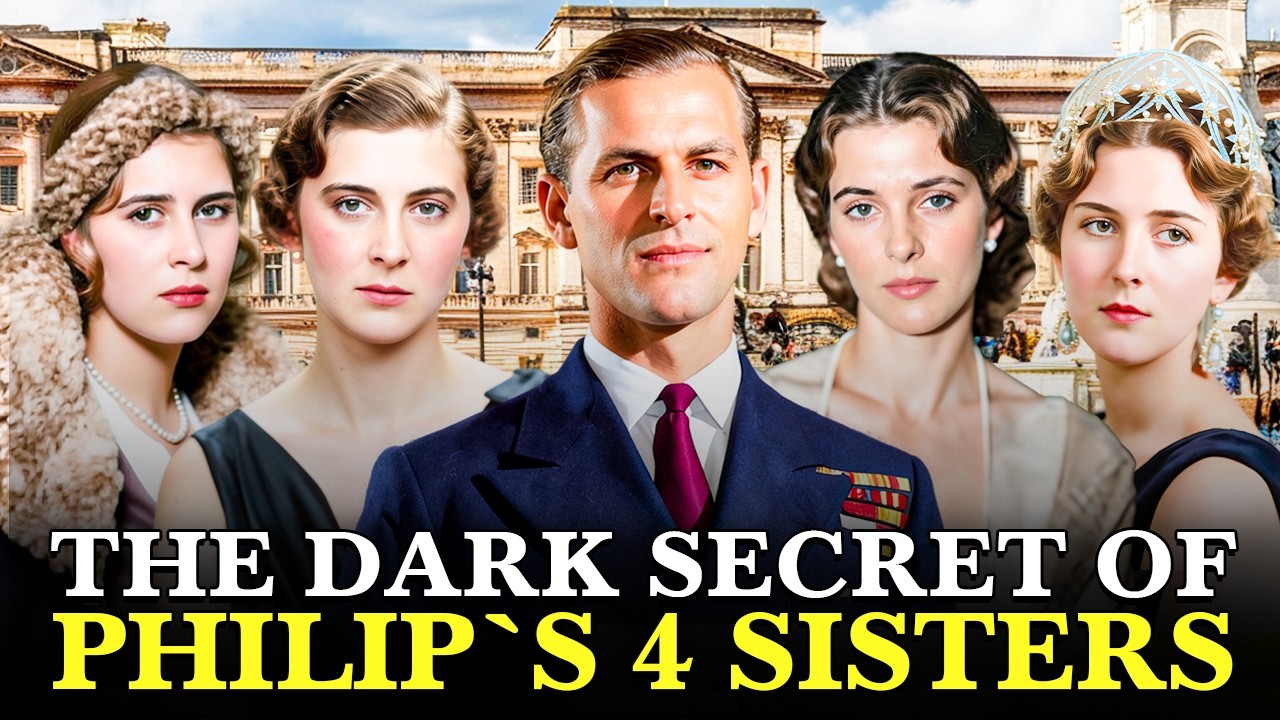
Philip had four sisters. They had raised him when his mother could not and his father would not. The eldest, Cecile, was killed in a plane crash in 1937 alongside her husband, their two young sons, and her unborn child. The other three had married German princes in the early 1930s.
By the time of the wedding, their German surnames and wartime addresses had made them unspeakable inside the institution Philip was joining. Philip was born on June 10, 1921, on the island of Corfu, the fifth child and only son of Prince Andrew of Greece and Denmark and Princess Alice of Battenberg. Greece was tearing itself apart. In 1922, following the catastrophic defeat in the Greco-Turkish War, a revolutionary committee seized power.
Prince Andrew was court-martialed, convicted of disobedience and abandoning his post, and sentenced to lifelong banishment. The family fled aboard HMS Calypso. The infant Philip was carried from the island in an improvised cot made from an orange box padded with blankets. He was 18 months old; his sisters ranged in age from 7 to 17.
The exile was their first inheritance. From infancy, they learned that status does not protect against sudden expulsion. The First World War had destroyed the network of intermarried royal houses that had governed Europe for generations. German princely families lost political power and social relevance almost overnight.
For many of these families, the appeal of Nazism was not inexplicable—it offered hierarchy, anti-communism, and the promise that rank would matter again. This broader pattern is essential to understanding what happened to Philip’s sisters. They were not four inexplicable women who stumbled into bad marriages; they were entering a world moving with gathering speed toward catastrophe. Alice, Philip’s mother, was born at Windsor Castle in 1885, profoundly deaf from early childhood.
She was intensely intelligent and possessed a moral severity that could appear as either great strength or frightening rigidity. She married Prince Andrew in 1903 and bore five children, but the century intervened. She would later be recognized by Yad Vashem as Righteous Among the Nations for sheltering a Jewish family in her Athens home during the German occupation—an act of extraordinary courage performed by a woman whose own daughters had married into circles entangled with the regime whose victims she protected. But she was also volatile, and in 1930, she was committed against her will to a sanatorium in Switzerland, diagnosed with schizophrenia.
She remained institutionalized for years, separated from her children. Prince Andrew was charming and socially graceful but fundamentally unreliable as a father and husband. After the exile, he drifted toward Paris and the life of a displaced prince, leaving his children to manage with the emotional infrastructure of a family that had already fallen apart. The four sisters married into German princely houses with striking speed: Sophie married Prince Christoph of Hesse in December 1930; Cecile married Georg Donatus, Hereditary Grand Duke of Hesse, in February 1931; Margarita married Prince Gottfried of Hohenlohe-Langenburg in April 1931; Theodora married Berthold, Margrave of Baden, in August 1931.
Four weddings in about twenty months. These were not leisurely courtships—they were rapid placements of a displaced family seeking to anchor itself before the ground shifted again. The tradition they relied on, that royalty could always find safety inside another branch of its vast cousinhood, was already obsolete. Cecile was the sister Philip loved most openly.
Her household in Hesse-Darmstadt had genuine warmth. She had two young sons, a devoted husband, and by autumn 1937, she was pregnant again. On November 16, 1937, she was traveling with her husband, their two sons, his mother, and attendants to a wedding in London. Their aircraft struck a chimney in heavy fog near Ostend, Belgium, and crashed.
There were no survivors. A newborn infant, delivered in the wreckage as Cecile had gone into premature labor, did not survive either. An entire branch of the family—parents, children, grandmother, unborn child—was obliterated in a single afternoon. Philip was 16, at Gordonstoun in Scotland, when the news reached him.
He was devastated. The funeral was held on November 23 in Darmstadt under full Nazi control. The procession moved through streets lined with spectators; swastikas were visible on banners and armbands. The apparatus of the regime was the ordinary backdrop of public life.
Among the mourners was a 16-year-old boy in a dark overcoat—he did not own formal mourning clothes—walking behind the coffins of his sister, her husband, their children, and their grandmother. That image would follow him for the rest of his life. The sisters stood together at Darmstadt. Sophie was heavily pregnant herself.
Alice reappeared after years of estrangement—she returned for the catastrophe, not for the living. One more detail belongs to this chapter: Cecile and Georg Donatus had left behind a two-year-old daughter, Johanna, who had been too young to travel. She was taken in by her uncle. She died of meningitis in 1939 at age four.
The branch of the family that had represented stability was entirely gone. The war completed the division. Philip entered the Royal Naval College at Dartmouth in 1939 and served as a British officer through the Atlantic, Mediterranean, and Pacific theaters. He was mentioned in dispatches for actions at the Battle of Cape Matapan in 1941, off the coast of Greece—the country that had expelled his family.
Meanwhile, his sisters lived inside Germany. The postal lines closed. They could not know whether their brother was alive; he could not know whether they survived the bombing raids on German cities. Christoph of Hesse, Sophie’s husband, was a documented Nazi insider.
He held party membership and a role in the Luftwaffe, and the Hesse household was deeply woven into the regime’s social fabric. In October 1943, he died in an air crash in the Apennines while serving with the Luftwaffe. Sophie was 29, a widow with five children, in a country losing the war. The regime her husband had served consumed him too.
Alice, meanwhile, was in occupied Athens, sheltering Rachel Cohen and her two children in her home—a daily, practical, dangerous act of courage. She would later be recognized for it. After the war, the palace saw Philip’s family as a liability. In 1947, he became a naturalized British subject, renounced his Greek and Danish titles, and took the surname Mountbatten—his mother’s family name, anglicized from Battenberg during the First World War because the original German name was unacceptable in a country at war with Germany.
The name change was not merely a formality; it was a narrative device designed to redirect attention from a messy truth to a cleaner fiction. British anti-German feeling was still acute two years after the war. The palace decided the sisters would not be invited. King George VI was a cautious man, not a cruel one, but the wedding was a state event governed by state logic.
Lord Mountbatten’s influence over Philip’s remaking was pervasive. The sisters were a risk. The risk was managed by exclusion. Philip accepted the decision the way he had absorbed every other loss—by adjusting, by continuing, by performing normality so convincingly that the performance became the reality.
The man who had lost his home at eighteen months, his mother to illness, his father to indifference, his favorite sister to a plane crash, was asked to stand at the altar without the women who had raised him, and to do so with a smile. The wedding itself was offered to a nation in the depths of postwar austerity as a moment of renewal. Elizabeth’s dress, designed by Norman Hartnell, was embroidered with crystals and 10,000 seed pearls. She had saved ration coupons for the fabric.
The ceremony was broadcast to an estimated 200 million listeners. Philip wore the uniform of a Royal Navy lieutenant and had just been created Duke of Edinburgh. In Germany, three women who were not there did whatever they did that morning. The historical record is silent.
They were trained to accept the decision and not make a scene. The sisters continued to live their German lives. Theodora died in 1969 in Constance. Margarita died in 1981 in Bavaria.
Sophie, the last, died in 2001 in Munich at 87. Philip’s father Andrew had died in 1944 in Monte Carlo, at a remove from all his children. Alice died on December 5, 1969, at Buckingham Palace, living there in her gray nun’s habit for the last two years of her life after founding a religious order. Her remains were later transferred to Jerusalem.
Philip did not speak publicly about his sisters for decades. The official story of his life was clean: born in Corfu, educated at Gordonstoun, served in the Navy, married Elizabeth. The sisters existed in the liminal territory between acknowledged fact and active memory. The Netflix series The Crown reintroduced them to a global audience, dramatizing Cecile’s death as the formative trauma of Philip’s youth, though royal historians noted it invented a causal link between Philip’s behavior and the crash that did not exist.
The crash was caused by fog. The most significant correction came at the end of Philip’s life. When he died on April 9, 2021, at age 99, his funeral was constrained by COVID-19 restrictions to 30 mourners. Among them, at Philip’s explicit wish, were three German relatives descended from his sisters: Bernhard, Hereditary Prince of Baden; Philipp, Prince of Hohenlohe-Langenburg; and Donatus, Landgrave of Hesse.
The palace acknowledged that German relatives had not attended the 1947 wedding because of anti-German feeling after the war. The wedding had been built around the sisters’ absence. The funeral was built in part around the presence of their descendants. The man who had stood in Westminster Abbey without his family arranged in his final instructions for the family to be brought back.
The exclusion that lasted 74 years was symbolically reversed—not by the institution, but by the man himself. Three men in dark suits sat in St. George’s Chapel representing branches of a family the monarchy had spent three-quarters of a century treating as though they did not quite exist.
They were simply there, included at last in the ceremonial life of a family that had excluded their mothers from the ceremony that should have included them most.