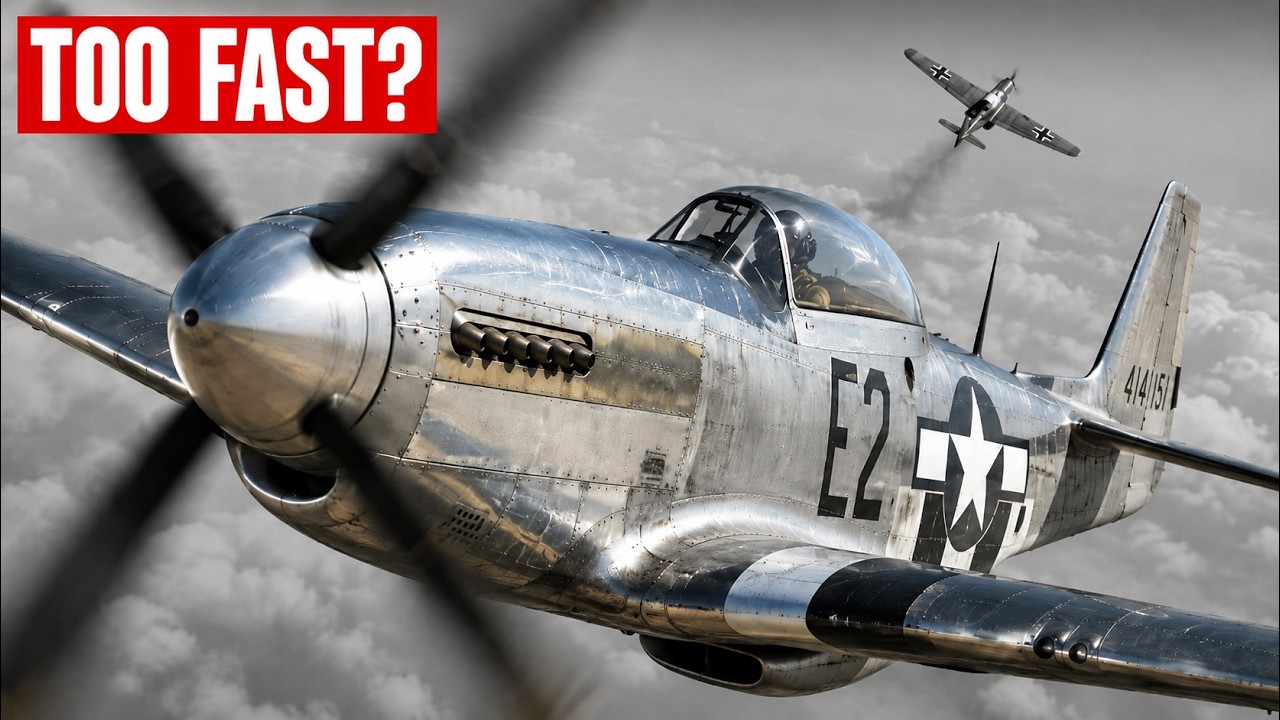
The morning of January 11, 1944, began with the familiar ritual of war for a young German fighter pilot climbing into his Messerschmitt above central Germany, but it would end with the shattering realization that the sky over the Reich would never belong to the Luftwaffe again. For two years, the formula had been brutally consistent: American bombers would come, their short-range escort fighters would turn back at the edge of their fuel limits, and the German squadrons would swoop in to slaughter the heavy bombers with impunity. On this day, however, the calculus of the air war changed forever when the American fighters did not turn back, and a single Mustang bearing two Chinese characters on its fuselage performed an act of valor that would redefine the meaning of aerial combat and signal the beginning of the end for Hitler’s air force.
The context of this pivotal moment was forged in the crucible of catastrophic loss just three months earlier. The sky over Schweinfurt had turned black on the afternoon of October 14, 1943, not from clouds but from the smoke of burning B-17 Flying Fortresses. Of the 291 bombers that crossed the German border that morning, 60 never returned, and another 142 limped home riddled with holes, their engines dead and crews wounded or missing.
 In a single afternoon, the United States Eighth Air Force had lost the equivalent of an entire combat wing, a disaster that would become known as Black Thursday. At his headquarters outside London, Lieutenant General Ira Eaker stared at the loss reports and understood that his entire theory of strategic bombing was collapsing. The belief that heavily armed bombers flying in tight formation could defend themselves against enemy fighters in broad daylight had been proven catastrophically wrong.
The math was unforgiving: at a ten percent loss rate per mission, the statistical probability of a bomber crew surviving the required 25 missions approached zero.
The aircrews knew the odds were stacked against them, yet they continued to fly into the teeth of German defenses because they had no other choice. The P-47 Thunderbolt, magnificent and brutal as it was, could barely reach the German border before its fuel gauges demanded a return to base. The P-38 Lightning possessed greater range, but there were too few of them, and most were fighting in the Mediterranean and Pacific theaters.
Beyond the fighters’ turn-back point, the bombers flew naked through the most dangerous airspace in the world, and that was precisely where the Luftwaffe hunted them with devastating efficiency. The strategic situation demanded a fighter that could fly all the way to Berlin and back, and that fighter was about to arrive in the form of a revolutionary aircraft that had nearly been relegated to the scrap heap of aviation history.
The story of the Mustang began four years earlier in a hangar in Inglewood, California, when a British Purchasing Commission approached North American Aviation with an impossible request. They wanted fighters immediately, hundreds of them, to prepare for the coming Battle of Britain. When the commission asked North American to build Curtiss P-40 Warhawks under license, company president James Kindleberger refused and instead offered to design something better from scratch in 120 days.
The British agreed out of desperation, and 102 days later, an unpainted airframe rolled out of the factory with a razor-thin fuselage, a revolutionary laminar-flow wing, and a radiator scoop mounted under the belly that engineers predicted would fail. It was designated the NA-73X, and when it first flew on October 26, 1940, the British christened it the Mustang.
For the first two years of its existence, almost nobody in America wanted the aircraft because of a fundamental flaw: the Allison V-1710 engine produced excellent power at low altitude but lost it catastrophically above 15,000 feet. The United States Army Air Forces examined the beautiful airframe married to the wrong powerplant and shrugged, ordering only a small batch for ground attack and reconnaissance before moving on to other priorities. The Mustang was on its way to becoming a footnote in aviation history when a Royal Air Force test pilot named Ronald Harker climbed into the cockpit of a Mustang Mark I at RAF Duxford on April 30, 1942.
Harker, who tested aircraft for Rolls-Royce, wrote a report after that single flight that would change the outcome of the air war over Europe. The airframe was superb, the visibility excellent, the handling among the finest he had ever encountered, but the engine was strangling everything the airframe could do. His recommendation was simple and profound: give this aircraft the Merlin, and you will have the finest fighter in the world.
The Merlin engine, the same two-stage supercharged powerplant that had won the Battle of Britain in the Spitfire, was mated to the Mustang airframe within months. The prototype flew in November 1942, and the performance numbers stopped conversations in rooms full of engineers. The aircraft could reach 20,000 feet in 5.
9 minutes, achieve 440 miles per hour at altitude, and with drop tanks, it possessed the range to reach anywhere in Germany and return home. The aircraft that had nearly been abandoned suddenly became the most important fighter in the American arsenal. Production of the new variant, the P-51B, began in June 1943, and by November, the first squadrons were forming in England.
They just needed pilots, and one of the most extraordinary pilots of the war was about to step into the cockpit.
James Harold Howard was born on April 8, 1913, in Canton on the southern coast of China, where his American father taught ophthalmology at Canton Christian College. Growing up between two worlds, Howard learned Mandarin as a child and watched Chinese soldiers march past his family home during the warlord conflicts of the 1920s. He came of age understanding what most American boys did not: that war had a face, that empires could crumble, and that distance from fighting did not mean safety.
He came to the United States for high school, attended Pomona College in California, and joined the United States Navy, earning his wings at Pensacola. By 1941, he was a Navy fighter pilot flying off the wooden deck of the aircraft carrier Enterprise when an offer arrived from a retired army captain named Claire Chennault, who was recruiting American pilots for a secret mission to fly for the Republic of China against the Japanese.
Howard resigned his Navy commission and boarded a ship for the Far East, where he joined the unit that would become legendary as the Flying Tigers. Two weeks after Pearl Harbor, he was flying combat over Burma, and in the sky above the country of his birth, he shot down six Japanese aircraft. He learned that a fighter pilot’s most important weapon was not his guns but his patience, the ability to see the enemy before the enemy saw him, to fire in short tight bursts, and to break away before the counterattack came.
When the Flying Tigers were disbanded on July 4, 1942, Howard accepted a commission as a captain in the Army Air Forces, was promoted to major, and in the summer of 1943, he was given command of the 356th Fighter Squadron, part of a brand new unit forming in the American Midwest called the 354th Fighter Group.
In November 1943, when the 354th arrived at their new base at Boxted in southeastern England, they were told they would be the first American unit in combat with the P-51B Mustang. What they did not know was that they belonged to the Ninth Air Force, a tactical organization designed for ground support of the coming invasion of Europe, not for escorting heavy bombers over central Germany. But the Ninth had the Mustangs and the Eighth Air Force did not, so an agreement was quietly reached: the 354th would remain under Ninth Air Force on paper, but operationally they would answer to Eighth Fighter Command for the missions that mattered.
The first American unit to take the P-51B into combat over Europe was, in a sense, the wrong unit from the wrong air force, on loan for a mission it had never been designed for. That was the situation in the first week of January 1944, with Doolittle in command, Howard leading a squadron, and the Luftwaffe radar operators beginning to notice a new escort fighter reaching farther into occupied Europe than any American aircraft had ever reached before.
The alarm clocks went off in the dark across the flat farmland of East Anglia, in Nissen huts scattered around more than 40 airfields, at 4:00 in the morning on Tuesday, January 11, 1944. Mission briefings began at 5:00, and at Deenethorpe, home of the 401st Bombardment Group, the pilots and navigators and bombardiers filed in with tin cups of coffee and sat on wooden benches, staring at a curtain covering the map at the front of the room. Everyone knew what that curtain meant: when it came down, some of them would find out they were going to die that day.
The curtain came down, and the red yarn on the map ran east from England across the North Sea over the Dutch coast and deep into central Germany, deeper than most of them had ever flown. The tape ended at three cities: Oschersleben, Halberstadt, and Braunschweig, 100 miles southwest of Berlin. The intelligence officer explained that the AGO Flugzeugwerke at Oschersleben was the largest producer of Focke-Wulf 190 fighters remaining in the Reich, the Junkers factory at Halberstadt was making wings for Ju 88 bombers, and the Waggum works near Braunschweig were building Messerschmitt 110 heavy fighters, the twin-engine killers that carried rockets under their wings and fired them into bomber formations from beyond machine gun range.
 At Boxted, 40 miles to the east, the pilots of the 354th Fighter Group received the same briefing at the same hour, but their job was different: they were to keep the bombers alive. Major James Howard sat in the second row and listened, a 30-year-old man with a narrow face, dark hair cut short, and the quiet manner of someone who had already survived one war and did not feel the need to talk about it. Colonel Kenneth Martin, the 33-year-old group commander, explained the plan: 663 heavy bombers would take off in three divisions, with P-47 Thunderbolts escorting them across the North Sea and as far into Germany as their fuel allowed.
Then the Thunderbolts would turn back, and at the deepest point of the mission, 49 P-51B Mustangs of the 354th Fighter Group would meet the bombers over the target. They were the only long-range escort in the entire European theater: 49 fighters for 663 bombers, with the rest of the German sky belonging to the Luftwaffe.
Takeoff began at 7:30 in the morning, and the sight was something ancient and enormous being wakened against its will. The mist rolled low across the grass, the taxiways glistened with frost, and the engines of four-engine bombers spinning up in the cold filled the air with a sound that shook the ground. They rose from more than 40 fields across East Anglia, B-17 Flying Fortresses and B-24 Liberators, silver and olive drab, forming up in the pale winter sky wingtip to wingtip, climbing to 20,000 feet in slow patient spirals.
By 9:00 in the morning, the formation was crossing the Dutch coast, and that was when the weather began to fail. The forecast had promised broken cloud over Germany, but the reality was solid overcast climbing higher than the bombers could fly, streaming in from the northwest in unbroken layers. The lead navigators radioed back to command that the escort fighters were losing sight of their charges and the bomb groups were losing sight of each other.
At headquarters outside London, the operation staff of the Eighth Air Force made a decision: recall. The order went out over the wireless, and the Second Bombardment Division headed for Braunschweig turned around and began the long flight home. The Third Bombardment Division headed for Halberstadt did the same.
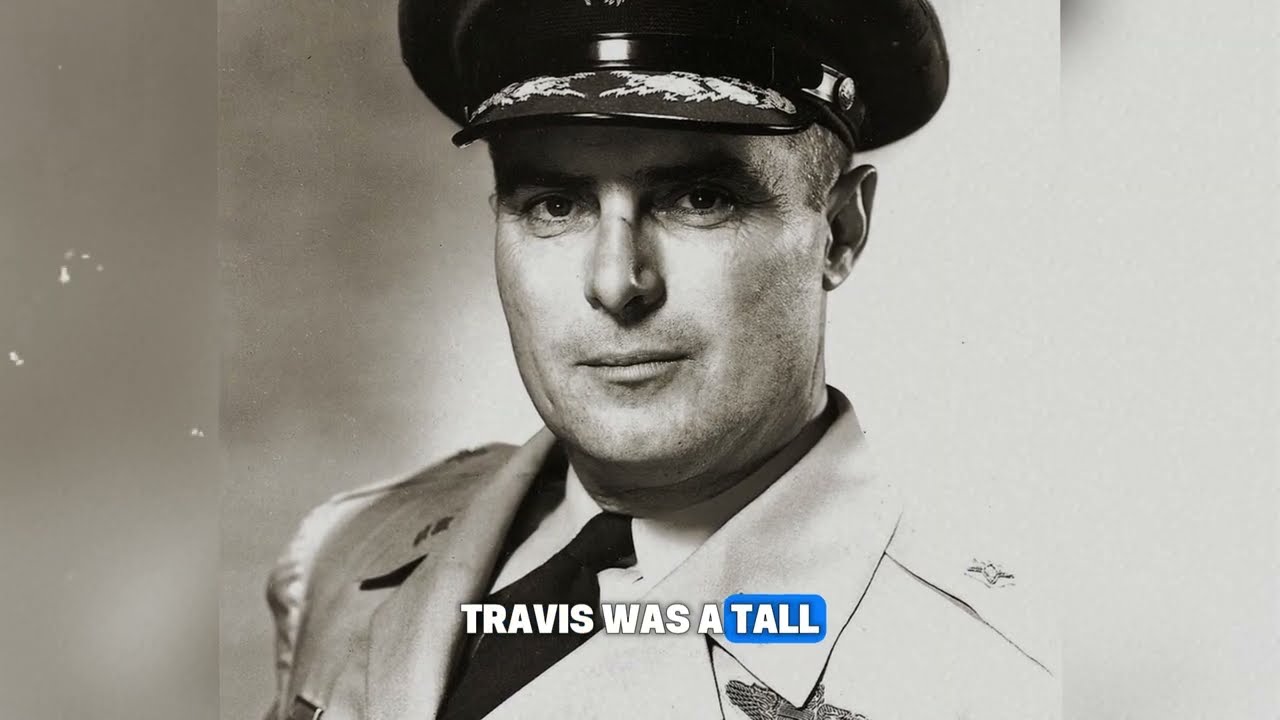
But the First Bombardment Division did not. At the head of the First flew a B-17 carrying a 39-year-old Brigadier General named Robert F. Travis, a tall, hard-jawed Georgian, a West Point graduate, and one of the youngest general officers in the American air arm.
Travis read the recall order, looked out through the cockpit windows at the 238 bombers strung out behind him in the winter sky, calculated the distance to the target and the distance back to England, weighed the risk of turning a massive formation around inside German airspace and exposing every bomber to the Luftwaffe individually, and made his decision: he would press on. Historians have argued about that decision for 80 years, some calling it courageous and others reckless, but what is certain is that when Robert Travis chose to continue toward Oschersleben, 238 American heavy bombers stayed with him, and 60 of them were not going to come home.
Below them, on the frozen airfields of northern Germany, the Luftwaffe was climbing to meet them. From bases at Deelen and Rheine and Wunstorf and Jever, the fighter groups of the German air defense scrambled: Jagdgeschwader 1, Jagdgeschwader 3, Jagdgeschwader 11, Zerstörergeschwader 26, flying Messerschmitt Bf 109Gs, Focke-Wulf 190As, and Bf 110 twin-engine heavy fighters armed with the Werfergranat 21, a 21-centimeter mortar shell mounted in a tube slung under each wing and fired from beyond the range of the bomber’s . 50 caliber machine guns.
One rocket, well placed, could break a B-17 in half. The German plan had not changed in months: wait for the escort fighters to turn back, then move in, fire the rockets from long range, watch the American formation disintegrate, and send the single-engine fighters in through the wreckage to finish the survivors. It had worked at Regensburg, it had worked at Schweinfurt, and it had worked again and again through the terrible autumn of 1943.
There was no reason to believe it would not work today.
At exactly the moment the German fighters expected, the American P-47 Thunderbolts began to turn for home, having reached the limit of their fuel. They banked one by one and dove away toward the west, leaving the bomber formation naked. The Bf 110s of Zerstörergeschwader 26 leveled off 10,000 feet above the bombers, opened their rocket tubes, and prepared to fire.
That was when the escort arrived: 49 Mustangs dropping down through the overcast, cutting straight through the German attack formation before the German pilots even understood what they were seeing. Colonel Kenneth Martin led the 354th into the fight, picked out a Bf 110, closed on it from behind, and opened fire. The German pilot broke hard, Martin followed, and the engagement took place over the town of Halberstadt at 25,000 feet.
What happened next has never been entirely resolved: American witnesses reported that Martin’s Mustang closed too fast, that he was unable to break off in time, and that his aircraft and the Bf 110 collided in midair, disintegrating together in a fireball that spread across a mile of sky. Some accounts have suggested it was deliberate, that Martin, seeing that his target would escape, chose to ram it rather than let it live to attack the bombers. Martin survived, bailed out at high altitude, drifted down through the freezing German air, and was captured within hours by local police, spending the next 16 months as a prisoner of war at Stalag Luft III.
The battle spread across a hundred miles of sky as individual Mustangs, separated from their leaders in the confusion, hunted individual German fighters. Some dove after Bf 109s trying to escape at low altitude and discovered for the first time in the war that an American fighter could catch them. Others climbed after Focke-Wulfs and out-turned them in the thin air above 30,000 feet.
For the German pilots, something was happening that had never happened before: they tried to disengage, they rolled, they broke away in the sharp sudden climbs that had let them escape from P-47s and P-38s for two years, and the Mustangs came with them. One Luftwaffe officer later wrote that his squadron had been briefed to expect the usual American escorts and that his flight had made its intercept run confident that the fighters overhead were the shorter-range Thunderbolts. When the first Mustang closed on his wingman and stayed with him through a full split-S at high speed, he understood immediately that everything the Luftwaffe had believed about the range of American fighters was wrong.
In the middle of all this chaos, a single Mustang lost its group. James Howard had made his first pass on a Bf 110 climbing toward the bombers, closed to 200 yards, fired a short burst, and watched the German aircraft roll onto its back and fall away trailing black smoke. His first victory of the day.
Then he pulled up hard looking for his wingman, and they were gone. In the swirling chaos of the dogfight, Howard had climbed above his squadron, and below him he could see contrails, tracer fire, and aircraft turning in tight circles, but he could no longer identify friend from enemy. The radio was a wall of overlapping voices, and his fuel gauge was already reading below half.
He looked down and saw 20,000 feet below him in a long gleaming line the B-17s of the First Bombardment Division still driving east toward Oschersleben. He looked closer and saw coming in from the north in loose finger-fours German fighters, not two or three, not five or six, but 30 or more. There were no other American fighters in the sky, and Howard understood in that moment what was about to happen to those bombers.
 He pushed his stick forward and dove.
The B-17 he came down on was flying with the 401st Bombardment Group, led that morning by a pilot named Allison Brooks. A tail gunner in one of the ships saw the Mustang appear out of the sun and screamed a warning over the intercom, then realized what he was looking at: a single P-51 Mustang dropping down into the cloud of German fighters, not turning away, not calling for help, but attacking. Howard picked out a Focke-Wulf 190 setting up a run on the lead bomber, closed to firing range, and squeezed the trigger.
Two of his four machine guns fired; the others did not. He had just encountered the great flaw of the early Mustang: the four . 50 caliber guns in the P-51B’s wings were mounted at an angle to fit the thin airfoil, and under the stress of high-G maneuvers, the ammunition belts twisted in their feed chutes, jamming the guns.
Two of Howard’s four guns were already out of the fight, but he kept firing anyway. The Focke-Wulf broke off, Howard turned inside another one and fired again, this time with three guns working. He hit the German fighter in the engine, smoke poured out, and the pilot bailed.
Two victories.
Howard pulled up and looked around: the bombers were still under attack, new German fighters were coming in from every direction, and his guns were failing one by one. For the next 30 minutes, James Howard did the only thing he could think of: he kept flying at them. He would climb, pick a target, dive on it, fire whatever guns still worked, and pull off.
When he had no guns, he still made the pass. The German pilots saw an American fighter coming at them, and they broke away. They did not know his guns were empty; they only knew that if they did not evade, they might die.
For 30 minutes on the morning of January 11, 1944, one man kept the Luftwaffe off a group of American bombers by making attack after attack after attack. Some of the passes had bullets in them; some did not. None of the German pilots knew which.
Inside the B-17s of the 401st Bombardment Group, gunners and bombardiers and navigators watched through their scarred Plexiglas as the single Mustang alone against everything turned tightly through the German formation, climbed, dove, fired, and climbed again. They did not know his name, they could not reach him on the radio, but they could see painted on the side of his aircraft two words in bright yellow: Ding Hao, a phrase Howard had picked up in China meaning roughly very good, written in the language of the country where he had been born.
Below them, the target was coming into view. The AGO Flugzeugwerk at Oschersleben, the factory that was building the very fighters attacking them, spread out under a thin layer of winter haze. The bombardiers hunched over their Norden bomb sights, the bomb bay doors ground open, the bombs fell, and the formation turned for home.
James Howard turned with them, his fuel gauge reading close to empty, his guns almost entirely jammed, his aircraft hit by cannon shells that had passed through the port wing without finding anything vital. He flew alongside the bombers on the north flank of the formation all the way to the Dutch coast, and by the time the last Bf 109 broke off pursuit, he had been in continuous combat for nearly 40 minutes, made at least six attack runs, and fired the last of his ammunition somewhere over the German border. On his own, he had protected a group of B-17s that had every reason to expect they would not survive the day.
Sixty American heavy bombers did not come home from the raid of January 11, 1944. The 401st Bombardment Group lost four, but without the man in the Mustang, they would have lost many more. None of them, as their damaged aircraft touched down on the runways of Deenethorpe that afternoon, knew his name, but their commander, Colonel Harold Bowman, wanted to, and by the following week, so would the entire United States of America.
The Mustang came in low over the Essex countryside just before 3:00 in the afternoon, its cowling blackened, its skin streaked with oil and cordite, and three neat holes in the port wing marking where the Focke-Wulf’s cannon shells had passed through. James Howard set the aircraft down on the runway at Boxted, climbed out, and walked toward the debriefing hut with the steady unhurried stride he had used every other day of the war. He told the intelligence officer he had gotten separated from his group, found a bomber formation under attack, and done what he could.
He thought he had shot down two German fighters, possibly three. He was not sure. He asked whether the bombers had made it home, nodded when told they had, signed the report, and went to find something to eat.
Forty miles to the north at Deenethorpe, the surviving B-17s of the 401st Bombardment Group were coming home one by one, and inside the operations building, the pilots were being debriefed. Again and again the same story came out: there had been a Mustang, one Mustang, that appeared out of the clouds when the German fighters came in, stayed with them all the way through the target run, fought off attack after attack alone for more than half an hour, and when it finally broke off and turned for home, the German fighters broke off with it. Nobody knew whose it was, but every man in that room remembered two things: a yellow marking on the side of the aircraft and two Chinese words painted below the cockpit.
Colonel Harold Bowman listened to the reports, picked up the telephone, and called every fighter group within escort range of Oschersleben, asking the same question at each base: do you have a pilot who was over Oschersleben this morning alone in a Mustang with Chinese writing on it? At Boxted, the answer came back: yes, Major James Howard, 356th Fighter Squadron, 354th Fighter Group.
The following Monday morning, a young reporter for the New York Times named Frederick Graham arrived at Boxted with a photograph. Graham had heard, filtered through the censors, the outline of what had happened on the mission of January 11, and he had come to see the man who did it. Howard did not want to be seen, but he agreed to the interview because his commanding officer told him to.
He sat on the edge of a folding chair in a Nissen hut and answered questions in short, even sentences. When Graham asked how many German aircraft he had shot down, Howard said he was not sure. When Graham asked what he had been thinking as he attacked 30 enemy fighters alone, Howard said he had seen a job that needed doing.
 When Graham asked whether he had been afraid, Howard said he had been busy. The story ran in the New York Times on January 19, 1944, under the headline One-Man Air Force Bullet Tells His Feat, and the next morning, James Howard was famous. Newspapers across America ran his photograph, radio broadcasts described the fight, and letters began to arrive at Boxted from parents of B-17 crewmen thanking him for their sons’ lives.
Five months later, in June 1944, on the eve of the invasion of Europe, General Carl Spaatz pinned the Medal of Honor onto the tunic of James Howell Howard on a windswept airfield in England. Howard was the only fighter pilot in the entire European theater of operations to receive the medal and live. The citation for his medal did not come from his own report, which he had barely written; it came from the crews of the 401st Bombardment Group, bomber pilots, bombardiers, radio operators, waist gunners, men who had watched from their windows and turrets as a single American fighter kept them alive.
By the time Howard received it, everything about the air war over Europe had changed. At the end of January 1944, Jimmy Doolittle had given an order that broke 60 years of military doctrine: American fighters would no longer be tied to the bombers but would be released ahead of the bomber stream to hunt. Bomber crews complained, wanting their little friends close where they could see them, but Doolittle did not care.
He had studied the mathematics of Schweinfurt and what had happened on January 11, and he understood that as long as American fighters were flying defense, the Luftwaffe would choose when and where to fight, and as long as the Luftwaffe could choose, the Luftwaffe could survive. He was going to take that choice away.
Between February 20 and February 25, 1944, the Eighth Air Force flew what history remembers as Big Week, six days of sustained assault on the German aircraft industry with every heavy bomber in England and every fighter that could fly. The Luftwaffe rose to defend the Reich as it had to, and the P-51s were waiting. On March 4, 1944, the first American fighters reached the sky over Berlin, and on March 6, the first major American raid on the capital of the Third Reich saw 69 bombers lost and 80 German fighters shot down.
The Luftwaffe kept fighting and kept dying. By the summer of 1944, 14 of the 15 fighter groups in the Eighth Air Force were flying Mustangs. The numbers tell the story more clearly than any narrator can: in 1943, the Luftwaffe lost roughly 2,400 aircraft on the Western Front; in 1944, that number rose to more than 6,000.
In 1943, a new German fighter pilot arriving at his squadron had received between 250 and 300 hours of flight training; by the end of 1944, that number had fallen below 100 hours, while an American replacement pilot arrived with more than 400 hours in his logbook.
Adolf Galland, the Luftwaffe’s General of the Fighter Arm, understood this equation better than anyone. In his memoirs, written after the war, he was blunt about what had happened: the appearance of long-range American escort fighters was the decisive factor in the defeat of the Luftwaffe, not the bombing itself. The bombing hurt, but the German aircraft industry, dispersed into forests and rail tunnels and small workshops, actually reached its highest monthly production figures in September 1944, building more than 3,300 fighters in a single month.
The Germans were not running out of aircraft; they were running out of men who could fly them, and the men who could fly them had been killed in the sky over their own country by escort fighters that did not turn back. James Howard did not stay in combat much longer. On January 30, 1944, less than three weeks after Oschersleben, he shot down another Bf 110 in a fight over Brunswick, and on April 8, 1944, he shot down a Focke-Wulf 190 over the same city, his sixth aerial victory of the European war and his 12th of the entire conflict, counting the six he had scored in China with the Flying Tigers.
Shortly afterward, he was rotated home to help train new fighter pilots.
The war went on without him. His squadron mates flew escort over Normandy on D-Day, over the Ardennes during the German counteroffensive in December, and over Berlin in the last weeks of the war. Colonel Kenneth Martin, who had rammed his Mustang into a Bf 110 over Halberstadt, spent 16 months as a prisoner of war and was liberated by Soviet forces in May 1945, eventually retiring as a colonel.
Brigadier General Robert Travis, the man who chose to continue the mission after the recall order, went on to command combat wings in the Pacific, was promoted to major general, and was killed on August 5, 1950, in the crash of a B-29 Superfortress at Fairfield-Suisun Air Force Base in California, which was renamed in his honor and is known today as Travis Air Force Base. Adolf Galland survived the war, wrote his memoirs, and died in Remagen, Germany in 1996. The men Howard fought that morning mostly did not survive, and the ones who did rarely spoke of it.
The ones who wrote memoirs described the arrival of the long-range American fighter in nearly identical terms: they had understood on that day that the war was going to be lost, not that day, not that week, not that month, but eventually, and that from that morning forward, there was no longer any patch of German sky where a Luftwaffe pilot could rest.
James Howard came home to the United States, married, had children, went into business in St. Louis and then in Florida, and served as the director of a small airport near St. Petersburg.
In 1991, he published a memoir called Roar of the Tiger, a quiet book written by a man who had never quite understood why so many people wanted to know his story. He died in Bay Pines, Florida on March 18, 1995, at the age of 81. His Mustang, the P-51B with serial number 43-631, the aircraft the world knew as Ding Hao, did not survive the war.
After Howard rotated home, the aircraft was flown by other pilots of the 354th Fighter Group and was eventually damaged beyond economic repair and scrapped for parts. Not one of Howard’s original combat aircraft is known to exist today, but the story survived. Eighty years have passed since the morning of January 11, 1944.
The airfields at Boxted and Deenethorpe have become farmland, and the town of Oschersleben, once the center of Focke-Wulf production for the Third Reich, is now a quiet market town in the German state of Saxony-Anhalt. Somewhere in the archives of the United States Air Force is a report written in the flat, careful language of a debriefing officer describing the actions of Major James Howell Howard on that morning. The document runs a few pages and does not use the word hero, but the men whose lives he saved that morning are the reason we remember him.
They were the ones who told the story, who described a single Mustang appearing out of the clouds when they had no reason to expect help, who wrote letters and gave interviews and stood at podiums and said quietly that they were alive because of a man they had never met. That is what the medal was made of, that is what the story is made of, and that is what the sky over central Germany on the morning of January 11, 1944 gave to the young men in the bombers and the young men in the fighters and the young men who came after them: a moment when the balance shifted, a moment when the range of an American fighter and the courage of a single American pilot and the desperate arithmetic of a war that had gone on too long all came together in the winter sky above a factory town no one had ever heard of. The Luftwaffe would keep fighting for 16 more months, but the men who flew that day understood what had happened.
The hunters had become the hunted, and the American bombers, for the first time in the long terrible history of the daylight air war, had a friend who could go all the way with them, all the way to the target, all the way home.