
The frost of a Chicago December morning in 1908 could not chill the fire that burned within Lester Joseph Gillis, the infant who would grow into a force of nature that the FBI would come to regard as its most dangerous adversary. Born into poverty in a cramped flat on the city’s west side, this was not a child destined for a quiet life. He was the youngest of six children born to Belgian Flemish immigrants, Joseph and Mary Gillis, who had crossed the Atlantic seeking opportunity only to find backbreaking toil in the stockyards and cramped tenements.
From the very beginning, there was something different about little Lester, a volatility that would define his entire existence. His angelic face, soft and almost feminine, concealed a darkness that would eventually terrorize a nation and force the fledgling Federal Bureau of Investigation to evolve into a modern, ruthless crime-fighting machine. The story of Babyface Nelson is not merely a tale of a criminal’s rise and fall.
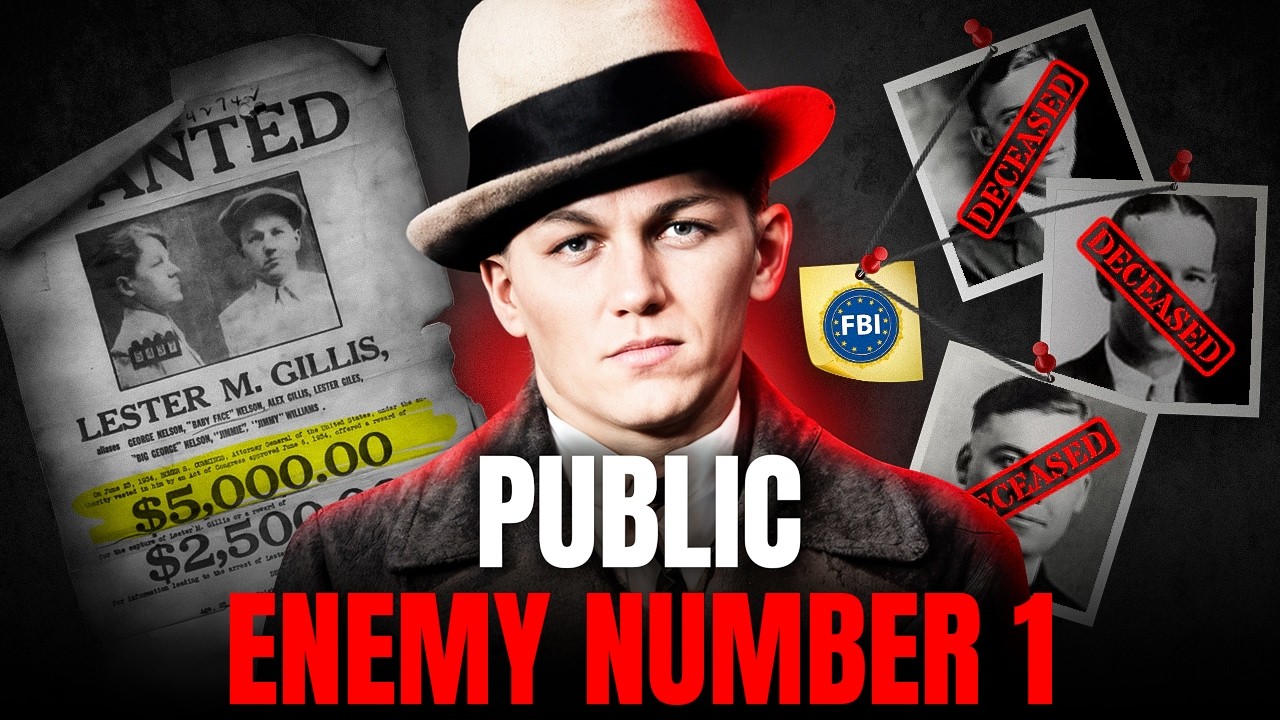 It is a stark, brutal examination of how a child shaped by violence and poverty can become the very embodiment of chaos, a man whose name would become synonymous with reckless bloodshed and whose final, desperate stand would etch itself into the annals of American law enforcement history. His was a life lived at breakneck speed, a violent arc from street urchin to public enemy number one, ending not in a blaze of glory but in a bloody, agonizing whimper on a cold November evening, a life cut short at just 26 years of age, but one that left an indelible mark on the nation’s consciousness. The environment that forged Lester Gillis was one of unrelenting hardship.
The Union Stockyards, with its constant stench of blood and offal, dominated the landscape of his youth. The air was thick with the smoke from factories and the grime from freight yards. It was a neighborhood where survival was the only law, and toughness was the only currency.
For a boy who stopped growing at just 5 feet 4 inches, this world was a brutal proving ground. His small stature and his soft, delicate features made him a natural target for the older, stronger boys who ruled the streets with their fists. He was beaten, kicked, and humiliated, a punching bag for anyone looking to assert dominance.
But there comes a moment in every such life when the victim either breaks or transforms. For Lester, that transformation was explosive. One day, after a beating too many, a switch flipped inside him.
He stopped being a victim and became a fighter, a one-man whirlwind of violence. He studied boxing, honing his skills in the back alleys, learning that his rage could be a weapon as sharp as any blade. He developed a reputation as a banttom rooster, a scrappy brawler with a chip on his shoulder and a thirst for revenge that was unquenchable.
His fists were always bloodied, never bruised, a testament to his ferocity and his willingness to inflict pain. By his early teens, Lester was already deeply entrenched in a life of crime. He ran with the Halstead Street Boys, a gang of tough kids who ruled their block with a mix of swagger and violence.
His first serious arrest came at age 13, when he shot a fellow gang member in the jaw during an argument. This landed him in the Illinois State Reformatory at Pontiac, a harsh, military-style institution designed to break young offenders. It was a cold, gray world of strict discipline and hard labor, a place where defiance was met with swift punishment.
But if Pontiac was meant to reform him, it failed spectacularly. He emerged not as a rehabilitated youth but as a more hardened, more resentful criminal. His subsequent years were a revolving door of arrests and incarcerations, from stealing cars to attempting burglaries.
He was shuttled between juvenile detention centers and reform schools, each stint only serving to further embitter him and deepen his hatred of authority. In 1926, while he was locked away, his father, Joseph Gillis, committed suicide. Lester, consumed by guilt, blamed himself, believing his criminal ways had driven his father to despair.
This tragedy, rather than reforming him, only added a layer of profound grief and rage to his already volatile personality. When he walked free at age 18, he was a hardened, angry young man with a widowed mother to support and a burning desire to escape the poverty that had defined his life. The 1920s presented him with the perfect opportunity.
Prohibition had turned the United States into a battleground between law and organized crime. The demand for alcohol was insatiable, and the underworld was more than happy to supply it. In Chicago, no one exploited this opportunity better than Al Capone, who had turned bootlegging into an empire built on violence, corruption, and intimidation.
Lester, always on the lookout for a way to make serious money, answered the call. He was hired by Capone’s outfit, working under the notorious enforcer Machine Gun Jack McGurn. His job was to shake down labor unions, using intimidation and violence to ensure that a slice of their dues found its way into gangster pockets.
He excelled at this work, reveling in the fear he could instill. Knives, revolvers, machine guns, even baseball bats, every tool had its place in his brutal repertoire. But Lester had a habit of taking things too far.
His violence was indiscriminate and excessive, causing complaints even from the powerful Union Siciliana, a precursor to the modern mafia. He was making the wrong people nervous, and Capone, who relied on unions to support his political allies, eventually marked him for death. It was only through the intervention of McGurn, who had taken a liking to the young psychopath, that Lester’s life was spared.
He was cut loose from the outfit, a dangerous, unemployable liability in the city’s criminal underworld. Forced to lay low, Lester took a mundane job at a Standard Oil station, where he met and married a young saleswoman named Helen Vziniac. Theirs was a whirlwind romance, a volatile union between a dangerous man and a woman drawn to the fire in his eyes.
They had two children, a son named Ronald and a daughter named Darlene, but the pressures of providing for a family only pushed Lester back toward crime. He was not cut out for honest labor, and the meager wages from the gas station were not enough to satisfy his ambitions or his ego. He put the word out that he was ready for work, and despite his reputation for recklessness, one man agreed to meet him.
Roger Tui, a powerful rival of Al Capone, saw potential in the young gunman. He introduced Lester to the members of his gang who specialized in armed robbery, and Lester found his true calling. He ditched the petty tactics of his youth, the creeping through windows and lurking in alleys.
Now it was simple, brutal, and direct. Walk in, gun drawn, demand cash, and walk out. By 1930, as the Great Depression tightened its grip on the country, Lester Gillis was no longer just a small-time hood.
He was the leader of a crew of robbers, dubbed the Tape Bandits by the press for their signature move of taping up their victims. They targeted wealthy homes and jewelry stores, pulling off a series of audacious heists that netted them tens of thousands of dollars. Their scores were impressive, but it was on October the 3rd, 1930, that Lester truly announced his arrival on the national stage.
He and his crew hit the Atasa State Bank, making off with $4,600. It was a relatively small sum, but it was a bank, and it marked a turning point in his criminal career. Three nights later, he proved his audacity by targeting one of the most powerful figures in Chicago, stealing $18,000 in jewelry from the wife of corrupt mayor Big Bill Thompson.
When later asked to describe her attacker, she recalled, He had a baby face. He was good-looking, hardly more than a boy, had dark hair, and was wearing a gray top coat and a brown felt hat turned down to the brim. This was the first time that Lester was publicly called Babyface, a nickname he would come to despise with every fiber of his being.
The robberies soon took a deadly turn. On November the 26th, 1930, during a heist at a tavern, Lester fatally shot a stock broker named Edwin R. Thompson.
It was his first known murder, and it would not be his last. He continued his crime spree, hitting jewelry stores and banks across the region, his violence escalating with each job. His luck finally ran out in January 1931, when he was arrested after a botched jewelry store heist in Chicago.
He was sentenced to one year to life in Joliet Penitentiary, a grim fortress of concrete and steel. But his troubles were far from over. Word reached him inside those cold walls that a witness had identified him as the sole gunman in a separate jewelry store heist in Wheaton, Illinois.
A separate trial was on the horizon, and if convicted, he could be staring down a 25 to 30 year sentence. At just 23 years old, his future looked bleak. But Lester was not the type to accept his fate passively.
With the help of his devoted wife, Helen, he devised a daring escape plan. On the morning of February the 17th, 1932, shackled to a detective and bound for a pre-trial hearing in Wheaton, Lester made his move. Faking sickness as the train slowed at Joliet station, he convinced a guard to unlock his handcuffs so he could go to the bathroom.
In a split second, he struck like a viper, landing a clean right hook across the guard’s jaw. Before the officer could recover, Lester was already bolting towards the exit doors of the train, jumping off onto the station and running down the embankment. Waiting for him at the curb was a getaway car, driven by his wife, Helen.
Tires screeched, the car lurched forward, and Lester Gillis was a free man once again. For months, Lester stayed ahead of the law, leaving behind only a trail of stolen cars and vague sightings. He and Helen moved across the country, eventually landing in Reno, Nevada, where he briefly took up bartending jobs under an assumed name.
It was there that he was drawn into a murder-for-hire plot, killing a key witness named Roy FR for two local crime bosses. The body was never found, and the murder only added to his growing reputation as a ruthless killer. Knowing it was only a matter of time before someone recognized him, Lester and Helen skipped town, disappearing into California, a haven for fugitives who knew the right people.
There, they settled in the picturesque coastal town of Sorcelito, where they found refuge under the protection of Sicilian crime boss Jeppe Joe Parente. Lester, now using the alias George Nelson, worked as a bartender, bodyguard, and parking valet for the mob boss, biding his time and waiting for the right opportunity. He was a loyal soldier, but he was also ambitious, and he chafed under Parente’s control.
The crime boss, amused by Lester’s youthful appearance, took to mocking him by calling him Babyface, a nickname that Lester absolutely despised. It was a constant reminder of the soft, angelic features that had made him a target in his youth, and it fueled his growing resentment. In their free time, Lester and his loyal accomplice, John Paul Chase, befriended two other criminals working for Parente.
Tommy Carol, a former boxer skilled with a machine gun, and Eddie Green, a clever bank scout known as a jug marker, someone who scouted out banks for robberies. Both had plenty of experience in the Midwest, and they shared tales of daring heists and narrow escapes. But what truly captivated Lester was the mention of one name, John Dillinger.
Dillinger was the outlaw king of his time, handsome, reckless, and charismatic. He robbed more banks than anyone else, and he did it with boldness and style. Lester was hooked.
He wanted part of that action. He craved his name in the headlines. He wanted to be more than just a hired thug in California’s underworld.
In 1933, Lester, Helen, and Chase packed up their car and pointed it east. Their destination, the Midwest. Their goal, bank robbery.
Lester could already picture the headlines, his name in bold, just like Dillinger’s. But ironically, in chasing his dream, he would never escape the one thing he despised most. The nickname Babyface Nelson would follow him for the rest of his life.
Lester Gillis understood that bank robbery was more than just a simple heist. It required skill and a reliable team. With that in mind, he and Chase made their way to Long Beach, Indiana, a known gathering spot for criminals looking for work.
They hoped to secure a place in the Dillinger gang, but their initial reception was hostile. Homer Van Meter, one of Dillinger’s top men, mocked Lester outright, dismissing him as a punk who had never robbed a bank in his life. The laughter stung, and the insult that always set him off, Babyface Nelson, only added to his fury.
Lester seethed, but he knew better than to pick a fight with one of Dillinger’s top men. He turned on his heels and stormed out, humiliated but determined. He would prove them all wrong.
Lester and Chase soon ran into their old friends from Sorcelito, Tommy Carol and Eddie Green. Low on cash and eager for action, the four men armed themselves and hit the road. On October the 23rd, 1933, Nelson and his crew raided the First National Bank in Brainard, Minnesota, escaping with $32,000.
But it wasn’t just the money that made the headlines. As they fled, Nelson fired his submachine gun wildly at bystanders, showing a casual disregard for human life that shocked the nation. After the job, he met up with his wife and children, then headed south to San Antonio, Texas to lay low.
In Texas, Nelson and his gang collected firepower, buying weapons from the underworld gunsmith Hyman Layman. Among them was a 38 Super Cult pistol modified into a fully automatic weapon, a weapon that would become his signature. Nelson and his crew continued their crime spree, each job bringing new lessons.
Lester studied Carol and Green closely, learning how they stormed into a bank, how they fired shots into the ceiling, making customers panic. They overpowered the guards before anyone could react. Then they forced employees to open the cash drawers and the vault.
They timed everything perfectly. They bagged the money, sprayed the walls with gunfire to scare bystanders, and made a clean getaway. If a bank guard wanted to be a hero or a teller was bagging the cash too slow, Lester had no problem ending them on the spot.
It served as a message to the next bank that they robbed. Cooperate or die. Chase, always loyal, usually waited outside in the driver’s seat of the getaway car with his foot over the gas pedal, ready to speed off at any moment.
Occasionally, Helen also rode shotgun. She gnored on her fingernails, feeling thrilled by the danger. She once told Lester that he never looked more dashing than when he came running out from a bank holding a Thompson submachine gun, and he embraced that image completely.
What Lester lacked in finesse, he made up for in sheer audacity. He was the first through the door, the loudest in the room, and the most aggressive. His voice rang through the banks, cursing, shouting, and barking orders.
He demanded customers emptied their pockets. He wanted tellers to move fast. He told guards to drop their weapons unless they intended to die.
It wasn’t long before law enforcement and the press started identifying the gang as his. Chase, Carol, and Green didn’t care so long as they got paid. But Lester was thrilled.
His name was in the papers. But there was just one problem. That damned nickname.
No matter how many times he introduced himself as George Nelson, no matter how many banks he robbed, the press always referred to him as Babyface Nelson. Despite his growing notoriety, Lester wasn’t satisfied. His name was out there, but it wasn’t big enough.
After nearly every robbery, the credits seemed to go elsewhere. Sometimes it was misattributed to Pretty Boy Floyd. Other times to the Dillinger gang.
He respected Dillinger’s skill, but he hated the attention the man got, the headlines, the legend, the massive bounty on his head. Babyface wanted that kind of fame for himself. Frustrated but determined, Lester set up a base in St.
 Paul, Minnesota, a known safe haven for outlaws. The city’s police were notoriously corrupt, and criminals on the run could count on the local authorities to turn a blind eye. While Chase took some time off to visit family, Lester and Helen moved into the luxurious St.
Francis Hotel, enjoying the glamour that came with being flush with stolen cash. It was in this very setting that Homer Van Meter reappeared. Only this time, he wasn’t laughing.
The man who had humiliated Lester in Long Beach was now extending an offer. By February 1934, Dillinger’s once mighty gang was in absolute shambles. Several key members had been captured, and Dillinger himself was sitting in Crown Point jail in Indiana.
That left only Van Meter and John Hamilton still at large. They needed reinforcements, and Van Meter begrudgingly had to admit that Nelson was making a name for himself. Van Meter made it clear Dillinger was looking to break out a prison soon, and Hamilton and Van Meter who was still on the outside were looking for action to help fund the jailbreak.
Lester saw his opening. This was his chance to be on equal footing. But he wasn’t just about to hand over jobs without setting his terms the way he saw it.
If Dillinger wanted in, he had to take orders. Van Meter bristled, barely restraining his temper. But Lester didn’t give him chance to argue.
He laid it down simply. Eddie Green had already scouted two banks that were high-paying targets. One in Sou Falls, South Dakota, and another in Mason City, Iowa.
This was his crew, his jobs. They could take it or leave it. After a tense pause, Van Meter clenched his jaw and gave a curt nod.
Van Meter was in. Next on the agenda was how they were going to break Dillinger out of jail. True to form, Babyface Nelson suggested a bold idea, blowing Dillinger out of the Crown Point jail with dynamite.
But Dillinger was not on board. Communicating with the gang through his lawyer, he shut the idea down. The jail was crawling with armed guards and police were already bracing themselves for a potential escape attempt.
Too risky, too many guns, too many chances for someone to get killed. Instead, Dillinger suggested a quieter method of breaking out. On March the 3rd, 1934, John Dillinger pulled off his infamous wooden pistol escape from the Crown Point jail.
In the prison workshop, Dillinger made a wooden gun. He shaped it carefully and added details to make it look real. He used two nails for sights aand a safety razor for the barrel.
To complete the illusion, he darkened it with shoe polish. Once ready, he sprang into action. Taking two guards hostage, he rounded up every officer in sight, forced them into his own cell, and locked the door behind them.
In a bold move, he walked out of Crown Point jail, got into the sheriff’s car, and drove straight through the front gates, leaving the press and police looking like fools. Dillinger laughed all the way to St. Paul, where he would soon meet his newest ally.
Lester had finally made it. The Dillinger gang wasn’t his competition anymore. Now he was part of it.
It didn’t take long for John Dillinger to realize that teaming up with Babyface Nelson was a mistake. Within the first 24 hours, he saw exactly what kind of man he had invited into his operation. Their initial formal meeting took place in Lester’s hotel room at the St.
Francis with members from both gangs in attendance. Dillinger, tall, broad-shouldered, and mustachioed, had a natural air of confidence. In contrast, Lester was small and wiry.
He seemed eager to prove himself, but his bravado hid a deep insecurity. He skipped the small talk and jumped right into sharing his philosophy. Before we go any further, he said, I want you all to know that I don’t take no orders.
I walk into a bank, open fire, 𝓀𝒾𝓁𝓁 anything that moves. I grab the money, and I’m out of there. If you don’t like it, find yourself another psy.
The room went silent. Homer Van Meter, still stung by his pride after bringing Nelson in, saw red. The insults flew, tempers flared, and within seconds, both men had reached for their guns.
They might have killed each other right there and then, if it not for Dillinger stepping in. He didn’t like unnecessary violence, and he wasn’t keen on babysitting hotheaded egos. Directing a sharp look at both men, he calmly ended the confrontation.
I’ve always found one thing works particularly well, Dillinger told them. Cooler heads will always prevail. His meaning was clear.
Settle down or get out of the Dillinger gang. The very next morning, Dillinger witnessed firsthand the kind of chaos that Lester could bring. The two were driving through Minneapolis on their way to pick up John Red Hamilton, Dillinger’s right-hand man.
Lester was behind the wheel, running his mouth as usual, barely paying any attention to the road. He ran a stop sign and scraped a bumper of an oncoming car. The other driver, Ted Kidd, unharmed but furious, stepped out and started shouting at him.
Before Dillinger could even attempt to calm him, Lester stepped out of the car, pulled out his gun, and shot Ted Kidd between the eyes in front of his wife. Dillinger recoiled and shouted, You didn’t have to do that. As Lester was getting back into the car, he turned to Dillinger and said, Hell, why not?
as if he had just swatted a fly. When really, he’d shot an innocent man dead in the middle of Minneapolis. Dillinger knew right then that Nelson was going to be a problem.
Lester’s recklessness failed to improve with time. On March the 6th, 1934, Dillinger, Nelson, Van Meter, Hamilton, Green, and Carol arrived in a stolen white packard at the Security National Bank and Trust Company in Sou Falls, South Dakota. Carol stayed at the wheel as the rest of the gang rushed through the bank’s Gothic doors.
Thompson submachine guns appeared from beneath coats. Customersand staff raised their hands. But before the gang could get control of the room, an alarm was triggered.
Lester exploded. Who did that? Which one of you sons of did that?
he screamed, shoving the barrel of his gun into the faces of the terrified bystanders. I’ll find out who did it if I have to 𝓀𝒾𝓁𝓁 every damned one of you. Dillinger just snapped at him and told him to forget about it.
You’re supposed to be the lookout, so shut up and just keep an eye out for the screws. Lester shot Dillinger a murderous look, but turned his attention to the street. His anger faded into something much more dangerous.
Excitement. A police sedan had just pulled up outside. You want screws, Dillinger?
Well, here they are. Balancing himself on a desk, Nelson leveled his Thompson submachine gun at the plate glass window and fired. Officer Hail Keith was struck and fell onto the pavement, badly hurt.
Lester cheered like a sportsman, landing a perfect shot. I got one of them. I got one of the bastards.
That’ll teach him to interfere. Dillinger, however, wasn’t celebrating. The gang grabbed their take, about $50,000, and made their escape.
But the damage was done. Dillinger worked hard to avoid unnecessary violence. He knew that killing policemen would only bring more trouble.
And here was babyfaced Nelson, acting like an unhinged lunatic, treating the whole thing as if it was a game. Dillinger wanted to cut him loose, but it wasn’t that simple. Nelson had brought valuable bank jobs to the table, not to mention the firepower of Tommy Carol and Eddie Green.
Against his better judgment, John Dillinger decided to stick it out. 8 days later, on March the 13th, 1934, the gang struck again, this time in Mason City, Iowa. Dillinger, wary of Nelson’s temper, convinced him to stay bythe getaway car.
But even with him outside, the job quickly turned complicated. First, National Bank President Willis Bagley, spotting the gang entering, didn’t hesitate. He spotted the shine of steel under their coats.
Then he ran and locked himself in his office with the vault keys. Van Meter, realizing what had happened, sprinted after him, but he wasn’t fast enough. The door slammed shut and Bagley refused to budge.
Frustrated, Van Meter fired several rounds into the door, but it held. No amount of threats or gunfire could force Bagley out. In the bank’s main hall, the gang soon saw that they weren’t in a typical small town place.
The bank, one of the richest in the state, invested a lot in vault security. A steel cage was set up over the bank’s lobby. It looked like a fortress and had enough room for a guard.
It even had scanning holes and a gunport. It was an uncommon security feature and today it was fully staffed. Guard Tom Walters launched a swift counterattack from inside the reinforced cage.
He threw a tear gas shell into the bank’s main lobby which struck Eddie Green in his back. Green staggered back before steadying himself and retaliated with a burst of submachine gun fire in the direction of the steel cage. The bullets, however, did nothing.
The steel barrier held firm. One round ricocheted, catching Walters with a minor wound, but it wasn’t enough to stop him. The gas thickened, burning the eyes and throats of everyone inside.
The gang did their best. They pulled handkerchiefs up over their faces and carried on scooping up cash. However, visibility was getting worse.
Seconds later, Dillinger emerged from the bank’s entrance, coughing violently, his face slick with sweat and tear gas. Lester eyed him wearily. What the hell happened to you?
But before Dillinger could respond, a shot cracked through the air and the bullet clipped him in the elbow. Dillinger twisted and kept his balance. Then he ducked behind the packard with Lester.
The two men scanned the buildings across the street, searching for the shooter. Lester fired off a few rounds, but there was no sign of movement. Dillinger cursed the interfering Publix and he shouted in the direction of the shooter.
This is a $100 tailor-made suit, you bastard. Three stories up, retired officer John Shipley crouched by his office window holding his shotgun. He had recognized the scene for what it was.
Almost immediately, Dillinger dashed from behind the packard to the bank’s entrance, urging Nelson to keep his head down, fully aware that they were sitting ducks under Shipley’s crosshairs. Lester kept crouched behind the packard, his eyes darted to the street corners. He knew sirens would arrive soon.
He could already picture them closing in, trapping them like rats. And then they arrived. A halfozen squad cars, lights flashing, tires screeching.
 Lester tensed, bracing for a shootout. But before he could grab his Thompson, he saw something remarkable. Dillinger had pulled off one of his signature moves.
More than two dozen hostages surrounded him and the gang. Employees and customers were packed tightly together as the crew pushed them towards the getaway car. It was genius.
The police couldn’t risk opening fire without hitting civilians. Dillinger ordered Lester to the wheel, but in the chaos, they had forgotten about the sniper. As Dillinger and Van Meter lined up hostages on the car’s running board, Officer Shipley took aim again.
The blast struck Dillinger in the same arm as before and Van Meter threw him in the backseat of the car to prevent any further injury. At the same moment, Lester’s hat was blown clean off his head. He spun around, his eyes narrowing as he spotted movement in an upstairs window.
This time, he fired back, but Officer Shipley had already ducked out of sight. Furious, Lester took out his frustration on the nearest hostage. It was the bank’s vice president, an elderly man who was struggling to keep up with the others.
Lester grabbed the vice president in front of him as cover. The old man groaned in pain and cursed under his breath. Lester fumed.
He pulled out his pistol and held it towards the man’s chest, ready to deliver a final fatal blow. Before he could complete his threat, Dillinger knocked the firearm out of his hand, and it discharged harmlessly against the car door. Startled, Lester turned to see that Dillinger, who was propped up in the back seat, had knocked his weapon out of his hand.
Dillinger quickly retrieved the weapon and said, No need to 𝓀𝒾𝓁𝓁 him, Nelson. Now do your job. Leave these people alone and get us the hell out of here.
Lester’s jaw clenched, but he said nothing. He slid into the driver’s seat, hands gripping the steering wheel so tightly that his knuckles turned white. The engine rumbled to life and the car eased forward, hostages still clinging to the sides.
Police stood frozen, powerless to act. 5 miles out of town, they released the hostages unharmed. Lester, however, was seething.
He pressed the gas pedal harder, his foot flattening against the floorboard. The car hurtled towards the horizon, the fury in Nelson’s chest burning hotter than ever. FBI Director J.
Edgar Hoover had had enough. The Midwest had become a playground for outlaws. Its rolling cornfields transformed into the new Wild West.
The only difference was that time had swapped the horse for a Ford and the Sikshooter for a Thompson submachine gun. The legendary gunslingers of the past, Jesse James, Billy the Kid, John Wesley Harden, Butch Cassidy. They hadn’t disappeared.
They had evolved. Their names now sounded like a list of modern bandits. John Dillinger, Babyface Nelson, Pretty Boy Floyd, and Bonnie and Clyde.
At a widely publicized press conference, Hoover revealed the bureau’s first public enemies list. This list named the country’s most wanted criminals. He made one thing clear.
They would hunt these men relentlessly. They would either be captured or they would die. There would be no in between.
At the very top of the list, John Dillinger. Right below him, Lester Gillis, aka Babyface Nelson. Hoover wasted no time.
Special Agent Sam Cowley was put in charge of the hunt for Dillinger. Setting up base in Chicago, he worked alongside Melvin Purvis, the head of the city’s field office. Under their leadership, a team of agents spread out.
They chased every lead and followed every whispered rumor. By late March 1934, they reached St. Paul, Minnesota.
Dillinger, Nelson, and the rest of the gang were hiding there after the Mason City bank job. On March the 30th, a tip sent federal agents to the Lincoln Court Apartments. They believed Dillinger was staying there with his girlfriend, Billy Frechette.
The agents moved in. Gunfire erupted. Bullets tore through the walls and windows, but when the smoke cleared, Dillinger was gone.
He had escaped once again. But Hoover’s list didn’t just have Dillinger’s name on it, and the other outlaws marked for elimination wouldn’t be so lucky. News of Dillinger’s near miss reached the rest of the gang in a matter of minutes.
Knowing the heat was on, they split up. Lester and Helen disappeared into the wilderness of Iron County, Wisconsin. They rented a remote cabin in the woods and waited for news from their scattered associates.
Homer Van Meter, Tommy Carol, and John Hamilton vanished into the west of Mississippi. Eddie Green, however, made a fatal mistake. Instead of hiding, the gang’s expert jug marker stayed in St.
Paul with his girlfriend, Bessie Skinner, and the FBI tracked him down. On April the 3, federal agents stormed Bessie’s apartment on Rondo Avenue. Green tried to fight his way out, but unlike Dillinger, he wasn’t fast enough.
He was shot multiple times. Days later, he succumbed to his wounds in the hospital. Holed up in the Wisconsin woods, Lester fumed, not over Eddie Green’s death, but over hearing that Dillinger was named public enemy number one, and it made him furious.
No matter how many banks he hit, no matter how many gunned down, he was still being overshadowed. And then came the final insult. The price on Dillinger’s head was $20,000.
The bounty on Lester’s, only 5,000, and he took it personally. Lester himself ranted to those around him. Don’t these law men know they are dealing with the most dangerous man in America?
They should want to pay top dollar to get the most dangerous man in the country. Don’t you think? But when back in Dillinger’s presence, Lester kept his bitterness to himself for now.
By mid-April, the gang regrouped with their wives and girlfriends at a hidden spot in northern Wisconsin and gathered to plan their next bank robberies. Their sanctuary was Little Bohemia Lodge. It was a rustic retreat nestled in the woods 50 mi north of Rhinelander.
It was the perfect hideout. The lodge was mostly visited by hunters and fishermen. Since the sporting season didn’t start until May, the area was nearly empty, or so they thought.
For the gang, Little Bohemia Lodge seemed like the ideal hideaway. in the remote Wisconsin wilderness. It really was the last place that anyone would think of to try and find some of America’s most wanted men.
But to the lodge’s owner, Emil Wanatka, something didn’t add up. Why would a group of smartly dressed men and women be so far off the beaten track at this time of the year? To him, something didn’t add up.
He decided to take no chances and called the local police, who in turn contacted the FBI. As soon as federal agents heard the descriptions, they knew they had a lead. The descriptions of two of the guests, match John Dillinger and Babyface Nelson.
Melvin Purvis, the bureau’s top man in the Midwest, wasted no time. He put together a strike team of about 30 agents from different cities in the region. He told them to meet in Rhinelander, Wisconsin.
Private planes flew in select operatives from St. Paul and Chicago. And on April the 22nd, 1934, they gathered for a final briefing led by Special Agent Sam Cowley.
Then, as night fell, they set out for the lodge. The operation started badly. Two Bureau cars broke down on the rough roads.
This forced agents to ride on the running boards of other vehicles in the biting cold. With just 2 mi left, they turned off their headlights and moved in slowly. They rolled onto the lodge’s property, listening to the soft sound of the engines idling.
Then, as they approached the lodge, the main door opened. Three men emerged, stepping off the porch and into a parked coupe. It was not Dillinger’s men, but in the confusion.
The FBI didn’t know that. Purvis, still at a distance, called for them to stop. The men in the car didn’t respond.
Their cranking engine drowned out the warning, and the agents opened fire. The driver slumped over the wheel, killed by seven bullets. The other two were badly wounded.
When the agents rushed forward to inspect the bodies, horror set in. They had just gunned down three innocent tourists. Back inside, gunfire at midnight only meant one thing.
It was time to run. Dillinger, Van Meter, and Hamilton were in the middle of a poker game when the shots rang out. Without hesitation, they ditched their cards, grabbed their weapons, and sprinted for the nearest exits.
Dillinger and his crew vanished into the trees before the FBI even knew that they were gone. Elsewhere in the lodge, Tommy Carol slipped through a window and disappeared into the darkness. But Lester, Lester was different.
He had been holed up in a nearby cabin and reacted exactly as expected, head-on and guns blazing. Spotting the FBI raiding party, he opened fire on Melvin Purvis, exchanging a volley of bullets before retreating into the main lodge under heavy return fire. But rather than sticking with the others, Nelson slipped out the back and bolted into the woods, taking off in the opposite direction.
He spent nearly 90 minutes moving through the thick forest. And finally, he emerged a mile from Little Bohemia and found the Lang family’s home. Wasting no time, he forced them at gunpoint into their car and ordered them to drive.
Before long, Nelson grew impatient with the car’s sluggish pace. Spotting a brightly lit house ahead, he commanded them to pull over. Inside, switchboard operator Alvin Kerner had already caught wind of the FBI raid and immediately called the authorities, reporting the suspicious vehicle now idling outside his home.
Nelson burst into the house and took Alvin Kerner hostage. At around the same time, the owner of Little Bohemia Lodge, Emil Wanatka, showed up at the house. Wanatka was forced behind the wheel of his own car at gunpoint.
And just before they were about to set off, another car pulled up. Inside were FBI agents W. Carter Baum, Jay Newman, and local constable Carl Christensen.
The moment they stepped out, Nelson ambushed them. Newman, still behind the wheel, barely had time to react before Nelson opened fire. His custom 38 Super Cult pistol fired into the group, seriously injuring Christensen and Newman.
Agent Carter Baum took three bullets to the neck and died instantly. Later, Nelson expressed confusion over why Baum never fired back. He told Chase, Baum had me cold.
Why didn’t the punk fire when authorities found his weapon? The safety was still on. With the agents down, Nelson threw them out onto the road and stole the FBI car and sped off.
 But less than 15 mi away, his luck ran out. A flat tire slowed him down, and as he tried to change it, the car became stuck in the mud. With no choice but to flee on foot, he disappeared into the forest once again.
He spent several days in a hidden cabin, resting andre gaining strength. Then he stole another car and escaped for good. Back at the lodge, the FBI took prisoners, but not the ones they wanted.
Three of the gang’s women, including Helen Gillis, Nelson’s wife, were captured inside. After intense FBI questioning, they were found guilty of harboring, but were later released on parole. The botched raid was an absolute public relations disaster for the FBI.
One agent was dead, as was an innocent bystander. Four others, including two civilians, were severely wounded, and the whole Dillinger gang got away. Criticism poured in.
Many called for J. Edgar Hoover’s resignation, and a widely circulated petition demanded the suspension of Melvin Purvis. The Little Bohemia raid was supposed to bring down Dillinger, Nelson, and the rest of the gang.
Instead, it only added to their legends. Lester Gillis was in California when he heard the news. The best news of his life.
John Herbert Dillinger, the untouchable outlaw, the living legend, the man law enforcement just couldn’t catch, was dead. On the humid Sunday evening of July the 22nd, 1934, Dillinger had walked straight into an FBI ambush outside the Biograph Theater in Chicago. Betrayed by a woman and gunned down in the street as he tried to run.
He had died just like any other fool who wasn’t quick enough. Now he, Babyface Nelson, was at the top of the list and officially public enemy number one. After the shootout at the Little Bohemia Lodge and his murder of special agent Carter Baum, Lester had vanished.
He spent a month hiding out on an Indian reservation near Lake Flambeau, Wisconsin, moving only when necessary. By the time he finally reemerged to Chicago, the heat had started to die down. Helen had been picked up by the police at Little Bohemia, but was paroled after just 3 weeks.
As soon as she was free, she tracked him down, and so did John Paul Chase. Lester had plans, big ones. But the old gang was gone.
Eddie Green dead. Tommy Carol cut down in a hail of bullets in Waterloo, Iowa after trying to evade arrest. With federal agents tightening their grip on the Midwest, Lester decided it was time to disappear for a while.
He, Helen, and Chase headed west to California, where they remained throughout the summer of 1934, waiting for the right moment to return. Even with Dillinger gone, Hoover’s war on crime was far from over. Lester followed the headlines as one by one the old names were erased.
John Red Hamilton killed the day after the Battle of Little Bohemia by police ata roadblock. Homer Van Meter gunned down in St. Paul.
Bonnie and Clyde ambushed and slaughtered outside Shreveport, Louisiana. Pretty Boy Floyd killed in an Ohio cornfield. The outlaw era was crumbling.
Yet somehow, Babyface Nelson was still standing. He kept slipping through the FBI’s grasp, avoiding the fate that claimed so many who had once held his position of public enemy number one. Yet, his survival came with a price, one that absolutely infuriated him.
No matter where he turned, the ghost of John Dillinger haunted him. The press wouldn’t stop comparing them and always in ways that insulted Lester. They spoke about Dillinger’s skill, his cunning, his ability to evade the law like a gentleman outlaw.
But Lester, Lester was no gentleman outlaw. They portrayed Babyface Nelson as a punk, a rabid dog, a trigger happy maniac. And Lester was furious.
I’ll show them. He ranted to Chase. I’ll show him who’s the better man.
Even if I have to rob a bank a day, they’ll see who’s the best. Lester, Helen, and Chase left Flambeau for Nevada, lingering in the town of Minden for a short spell before heading back to Chicago. Lester had one goal in mind, to build a new gang.
But the underworld wanted nothing to do with him. He was too hot, too unstable, too reckless. No one would want to work with him.
and whispers began circulating that he wouldn’t live to see Christmas. Lester and Chase weren’t as invisible as they thought. FBI inspector Sam Cowley had learned of their return to Illinois.
Cowley was one of Hoover’s most brilliant and relentless agents, a man known for his analytical mind and unwavering dedication. With Melvin Purvis at his side, he was determined that this time Nelson wouldn’t slip away. Through eyewitness reports and informants, the bureau tracked his movements.
Lester’s Ford V8 was seen frequently along the highways between Chicago and Lake Geneva. From time to time, he and Chase stayed at various roadside resorts, but they never lingered too long. Cowley wasn’t taking any chances.
He ordered a full-scale manhunt. Agents swept the highways, staked out diners and gas stations, and questioned farmers and motel clerks. They studied every car that passed, every face in a crowd.
It was only a matter of time. Lester Gillis had always promised to go down fighting. On November the 22nd, 1934, he made good on that promise.
Around 8:00 a. m. in the morning, Lester, Helen, and John Paul Chase drove south in a stolen Ford V8.
They took US Highway 12, now known as US14, heading towards Chicago. Nelson was always on the lookout for federal agents, and soon he saw a sedan. It was driven by agents Thomas McDade and William Ryan.
After a series of U-turns, eventually both cars locked eyes and now Nelson was pursuing them when his Ford V8 caught up with the agent’s slower sedan, John Paul Chase opened fire. The agents fired back. Then, thinking they were outgunned and needed backup, they sped away and drove into a field.
What they didn’t know is that one of their bullets had pierced one of Nelson’s water pumps, which was quickly draining power from his car. As Nelson’s damaged Ford drove south, a second FBI vehicle arrived. It was a blue Hudson driven by agents Herman Hollis and Samuel Cowley, and they joined the chase.
Nelson knew that his car was dying,,and if he didn’t act fast, the chase would be over, but not in his favor. He saw a chance and turned sharply into Barrington’s North Side Park, stopping by three gas stations. Hollis and Cowley sped past him by 100 ft.
They slammed on the brakes, skidded to an angle, and then stepped out as gunfire rained down. Nelson shouted for Helen to take shelter in a nearby ditch. Then he and Chase returned fire.
In the chaos, a bullet from Cowley’s machine gun struck Nelson in the lower abdomen. Leaning on the Ford’s running board, Nelson grabbed his 351 Winchester rifle from the back seat. Then he did the unthinkable.
He charged straight at the agents. What the hell are you doing, Les? Chase shouted.
I’m sick of this cat and mouse. I’m going to 𝓀𝒾𝓁𝓁 those bastards. Nelson advanced on the agents, firing so fast with his rifle that bystanders misstuck it for a machine gun or that he had it modified, which he didn’t.
Cowley took six bullets to the chest and stomach. Hollis, shotgun in hand, blasted Nelson’s legs, knocking him down. For a moment, the battle seemed over, but Lester wasn’t done yet.
As Nelson staggered back to his feet, Hollis, already wounded, took cover behind a utility pole andreached for his service pistol. In response, Nelson fired a fatal shot to Hollis’s head, who collapsed. Nelson staggered over to Hollis and stood over his body for a brief moment before moving towards the agent’s Hudson.
His own car was dying, but theirs wasn’t. Too wounded to drive, Nelson ordered chase behind the wheel. They moved guns and supplies from the fort to the Hudson.
Then they loaded Helen inside and fled. But Nelson had been hit 17 times. Seven bullets from Cowley’s submachine gun had ripped through his torso.
10 shotgun pellets from Hollis had torn into his legs, slumped in the back seat, his voice fading. He turned to Helen and whispered, I’m done for. Nelson then muttered final directions to Chase, guiding him to this safe house at 1627 Walnut Street in Wilmette.
Nelson was gravely wounded and was placed in a bed upstairs. Helen sat alone with her dying husband, watching as he seemed to gather one last flicker of strength. His voice, weak but steady, broke the silence.
Say goodbye to mother, he murmured. He went on naming each of his family members, his sisters, his brother, nieces, nephews, and in-laws. But when he spoke of their children, his voice cracked and tears welled in his eyes.
For a time, he fell silent. Then, in a final whisper, he said, It’s getting dark, Helen. I can’t see you anymore.
At 7:35 p. m. , with Helen by his side, Lester Joseph Gillis, aka Babyface Nelson, finally met his brutal end.
He was just 26 years of age. Doctors declared Herman Hollis dead shortly after he arrived at the hospital, aged just 31. His partner Sam Cowley spoke briefly with Melvin Purvis and had surgery, but sadly he later died from an abdominal wound just like Nelson’s, aged 35.
After a tip from a Chicago telephone company worker, Nelson’s body was found. It was wrapped in an Indian pattern blanket. Helen put the blanket there, later explaining to detectives he always hated being cold.
The body was found in a ditchat the northeast corner of St. Paul’s Lutheran Cemetery in Skokie, Illinois. His body was then taken to Sedovsky’s funeral home at 1845 North Hermitage Avenue, where it attracted this large crowd.
The feds had spent years hunting Babyface Nelson, but in the end, he had saved them the trouble. In the aftermath, Helen and Chase fled. After J.
Edgar Hoover’s harsh orders to find the woman and give her no quarter, the FBI issued a death order for Nelson’s widow. Helen roamed Chicago as a fugitive for days. Then she surrendered on Thanksgiving.
Chase made it to the West Coast, but his freedom didn’t last long. 2 months later, he was arrested. He was sentenced to life in prison and remained behind bars until his parolein 1966.
He died of cancer in his native California. Shortly after, Helen was sentenced to one year in a Michigan women’s prison. She had violated her parole from Little Bohemia Lodge.
Upon her release, she vanished into anonymity. Cowley and Hollis, killed in the line of duty, were mourned as heroes. Their deaths sealed the fact that no redemption existed for Babyface Nelson.
Any hope of his name carryingthe mystique of John Dillinger or perhaps the folk hero charm of Pretty Boy Floyd or maybe the Robin Hood myth of Bonnie and Clyde was completely gone. Dillinger had died walking into an FBI trap cut down in a Chicago street. Floyd had died out gunned in an Ohio cornfield, never even getting the chance to fire back.
Their deaths had evoked sympathy from the public. Nelson’s death didn’t evoke any sympathy at all. He had gone out like a rabid animal, bleeding out in the back of a car after another reckless, senseless, and meaningless rampage.
He had spent his lifetime trying to prove that he was the most dangerous criminal in America. And to be fair to Lester, I think in the end he did prove that