On the morning of Saturday, November 14th, 1936, two funerals were held less than 200 feet apart on West 137th Street in Harlem. The larger service, which began at 10:00 in a wide brownstone near Seventh Avenue, was for a wholesale coal and ice dealer who supplied much of the neighborhood. The procession that left for the cemetery ran to 22 cars. The smaller service began at 1:00 in a narrow storefront chapel four doors down.
The dead woman was Mrs. Cora Nash, 61 years old, a laundress who had worked for 30 years in a hand laundry on 135th Street. She had died of pneumonia at Harlem Hospital 11 days earlier. Fourteen people attended.
There was one car behind the hearse. The two hearses passed each other on the block a little after 1:00, and the drivers raised a hand in the ordinary way. Nothing about the day was unusual. Ellsworth “Bumpy” Johnson was 31 years old that November.
He had been expected at the 10:00 service, and his absence from the larger funeral was noticed and remarked on for weeks afterward. He came instead to the smaller one, and he came early. He had known Cora Nash in the ordinary way that people on a block know each other for years. She had pressed shirts for him in the laundry.
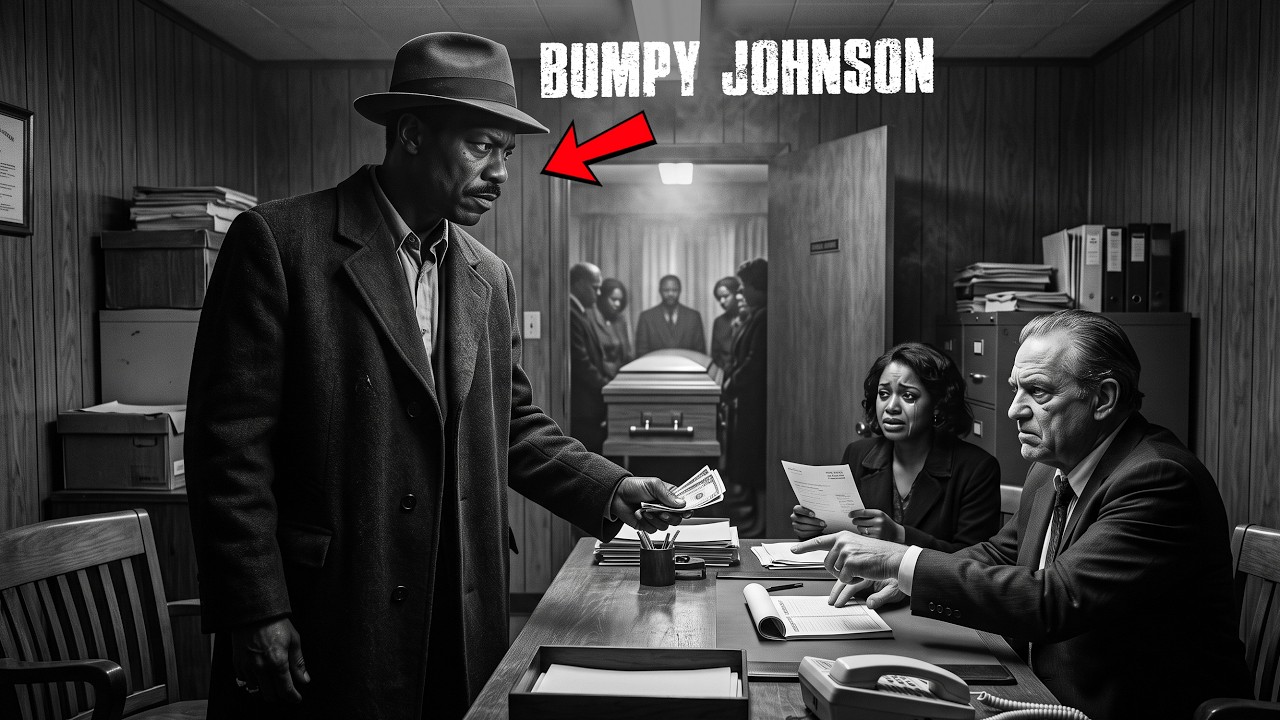
When her rent had run short one winter, a man who worked for him had paid it without saying who had sent the money. She had never learned the answer, though she may have guessed. The trouble came after the service in the small office at the back of the chapel. Cora Nash’s daughter, Vera, 26, had been asked to stay behind to settle the account.
Two men were waiting: the business manager of the parlor and a district manager for the industrial insurance company that had been collecting from the Nash household since 1922. The explanation took about four minutes. Her mother’s policy, the one paid on at 30 cents a week for 14 years, had lapsed. The premiums had been collected at the door every Thursday.
During the 19 days Cora Nash was in the hospital, and for two weeks before that, when she had been too sick to work, the collector had come and gone away empty-handed. The policy allowed a grace period of four weeks. The fifth week ended while she was still in a hospital bed. The contract lapsed by its own terms.
Reinstatement required a statement of health signed by the insured, and no company would accept a statement of health from a woman with pneumonia in both lungs. The face amount of the policy had been $186. The amount payable on her death was nothing. The parlor’s bill was $68, and the daughter had been given a plain grave in a public section on the promise of paying it out at $2 a week.
Johnson had come to the door of the office by then. He offered to settle the parlor’s bill in full and to pay whatever arrears would put the policy back in force. The district manager refused the money, loudly enough for the women still waiting in the chapel to hear him. He said the company did not accept payments from third parties, that it did not do business with men like him under any circumstances, and that a name like his appearing anywhere near a claim file would invite questions the family did not want.
Johnson did not raise his voice. He folded the money and put it back in his inside pocket. He looked at the desk, where there was a small cardboard receipt book about the size of a hand with a rubber band around it and the corners worn soft. He asked Vera Nash for the book.
He asked for nothing else. He put it in his coat, thanked the two men in the ordinary way a person thanks anyone, and left. He walked south on Lenox Avenue in the wet cold with his hat on and his hands in his pockets. Men who knew him said afterward that the thing they remembered about that afternoon was that he was not angry in any way they could see, and that this was worse than anger, because anger they understood.
This is the part of the story that is usually left out because it is the part with no action in it, and it lasted eight days. What he did during those eight days was sit at a kitchen table on 141st Street with the receipt book open in front of him, a pencil, a sheet of butcher paper, and an adding machine. The book was ordinary. It had begun in the spring of 1922.
Each week a collector had marked the date and initialed the line, 30 cents a week. There were gaps in 1930 and 1932, weeks skipped and made up later. There were two reinstatements, both in years when she was healthy enough to sign a statement. Adding it week by week and allowing for the gaps, the payments came to $214.
20. The policy promised $186. The insurance companies had been selling small weekly premium policies uptown since before the war. A dime or a quarter a week bought a promise that a burial in a public grave would not happen.
A funeral cost more cash than most households on those blocks had ever held at one time. The realization came slowly over those eight days. The district manager who had refused his money was not the reason Cora Nash had no funeral. The collector who had come and gone away empty-handed worked on commission and lost money on every lapse in his book.
Neither of them had designed the thing. The design was in four pieces. Collection was weekly and at the door, which meant a policy could be sold to a household with no bank account, but it also meant the policy depended on a household having money in the house on the same day every week for years without interruption. The grace period was four weeks, which sounded generous and was not, because illness and lost work do not resolve in four weeks.
Reinstatement required evidence of insurability, which meant the policy protected a person exactly as long as that person did not need it. Forfeiture on lapse meant that everything paid in stayed in. The fourth piece was the one he had watched happen in the office and had not understood at the time. When a policy did pay, the money frequently never touched the family’s hands.
The funeral parlor took an assignment of the policy signed by the survivor in the first hour of grief and then built the estate for the exact face amount of the policy, whatever the funeral had actually cost. A $150 policy purchased a $150 funeral. The insurance was not insurance for the family at all. It was a purchase order for the trade written years in advance.
Understanding that changed what he intended to do about it, because a system cannot be intimidated. It has to be met with the only things it is not built to withstand: documentation, a lawful complaint, and a working alternative that people can actually join. He also decided on a rule that governed everything afterward. His name would not appear on any of it, not on a letterhead, not on a bank signature card, not on a complaint, not in a newspaper.
He understood what he was to the people who would have to be persuaded. The moment his name was on the paper, the story would stop being about a woman who paid $214 for nothing and would become a story about him. Building the thing took most of December. He went to people one at a time, with the receipt book in his pocket and the butcher paper folded inside it, and he showed them the arithmetic before he asked for anything.
The lawyer came before anyone. Walter Ree kept two rooms above a shoe store on 135th Street and did evictions, wills, and small negligence cases. He had spent four years as a clerk in an insurance defense office downtown, which meant he knew what the insurance law required and how the department behaved. Reverend Amos Fenner mattered for a reason that had nothing to do with the pulpit.
His church on 137th Street had a burial committee, seven women who knew which families were behind on premiums, which had buried someone in the last year, and which kept the payment books in a drawer rather than a shoebox. Miss Adah Crouch was 71 and had been recording secretary of a benevolent association since 1908. She could say what a funeral had cost in 1911, in 1922, and in 1935, and she could show the entries. She agreed to help on the condition that whatever they built be chartered, audited, and printed.
Those three conditions turned out to be the reason it survived. Emett Hollis was 34 and had been a licensed funeral director for 6 years, working out of a small parlor on Eighth Avenue with one hearse he shared. Asking an undertaker to publish an itemized price list in 1936 was asking him to break with every other parlor on the avenue. What Hollis wanted in exchange was volume and steady payment, which was the one thing a coalition could actually deliver.
Lucius Grady kept books at night for a chain of hand laundries. His rule, imposed early and never relaxed, was that no figure went into any document unless it could be traced back to a specific card, and no card was written except from a book held in the writer’s hand. Dr. Arthur Boyce kept an office on 138th Street.
He was brought in for a narrow and decisive reason. The central claim of the entire campaign was that policies failed at the exact moment illness arrived. An admission date and a discharge date matched against the last initialed line in a payment book is evidence. Boyce could tell families how to request their hospital dates in writing over their own signatures.
The collection network was the part nobody outside the neighborhood would have thought of. In a great many buildings, one woman kept the payment books for several families, the janitor’s wife or an older tenant who was reliably home on Thursday afternoon when the collector came through. In one building on 139th Street, a single woman held the books for nine households. These women were the actual distribution system of industrial insurance in Harlem.
Eleven of them came in during December. A druggist on Lenox and a laundry owner on 138th Street agreed to be collection points. A man from one of the Harlem weeklies came in near the end of December and agreed to hold the story until the tabulation was finished and checked. The strategy agreed on in the last week of December was slow.
Everything rested on the survey. Grady had printed 3×5 cards, and each card recorded the same items: the company, the weekly premium, the date of the first payment, the face amount, whether the policy had ever lapsed and in what circumstances, whether it had been reinstated, whether anyone in the household had died while the policy was in force, and if so, what the parlor had charged and whether the parlor had taken an assignment. The books themselves never left the neighborhood and never stayed overnight. A family’s payment book was the only evidence that family had that it had paid anything for 14 years.
Books came in at 10:00 in the morning and went back the same afternoon with a signed permission slip attached to the card. Economic pressure came from building a place for the money to go. The association was chartered under the membership corporations law in January with three officers, none of them Bumpy Johnson, and a bank account requiring two signatures, one of them a clergyman’s. Members paid 25 cents a week.
The benefit was not cash but a funeral contracted in advance with Hollis’s parlor at a written itemized schedule. Casket $45, hearse $20, one limousine $15, preparation $25, chapel $10, permits and certified copies $6, opening of the grave $14. The total was $135, and every one of those figures was printed on a card that any member could carry into any other parlor on the avenue and hold up. Churches read the schedule from the announcements.
Barbershops kept a stack by the register. The women who held the books for their buildings carried them in their coat pockets. There were no pickets and no speeches, because a picket in front of a funeral parlor would have been indecent. Legal pressure ran on three tracks at once.
The petition to the superintendent of insurance concerned the lapse and forfeiture practice and asked for an examination of the district’s records. The complaint to the state authority that licensed funeral directors concerned assignments of insurance taken at face value without itemized statements of services actually rendered. The inquiry to the borough relief bureau concerned parlors that declined burials at the public allowance while accepting the same family’s insurance money for years. Johnson set two conditions on everything.
Nobody was to be visited at night, and nobody was to be threatened in any way by anyone for any reason. And no household was to be advised to stop paying its premiums until it had a replacement in force. 25 cents a week to the association was to be paid in addition to the existing premium for as long as the existing premium was still worth reinstating. Collection of the books began in the second week of December.
62 books came in before Christmas. People were reluctant, not because they distrusted the church women, but because a payment book represented a private embarrassment. The gaps in it were a record of every bad month a household had ever had. What changed it was the arithmetic.
When a woman brought a book in and Grady totaled it in front of her on the spot and handed her a slip showing what she had paid to date against what the policy would pay, she took that slip home and showed it to four other people. Nearly every book that came in during January came in because of a slip somebody else was carrying. 340 books came in during the first three weeks of January, then more. By the last week of the month, a second table was set up in the back of the laundry on 138th Street.
It was a hard winter, and the campaign had the peculiar experience of gathering evidence and watching the thing it was documenting happen in real time. Four households in the survey lost policies to lapse in January while the survey was going on. All four during illness. All four became exhibits.
Effects appeared before anything had been filed. A collector on one route began warning households when they were two weeks behind, which was not required of him. Two families that mentioned the survey when they went to the district office were quietly reinstated without a health statement and without argument. The wide parlor near the Seventh Avenue corner put a price card in its window in the third week of January, the first such card on that block in anyone’s memory.
It appeared about 10 days after the association’s schedule began circulating in the churches. Hollis conducted nine funerals in January at the published schedule and 17 in February. His books were kept open to Grady, and the comparison that came out of them closed the argument that the price list was charity or a stunt. It showed a licensed director’s actual costs and margins on 26 services, proving the schedule was profitable.
The association had 340 members by the middle of February and had paid its first two claims. Six people from one building joined in the following 10 days, and none of them had been persuaded by anything anyone said. A collector who had worked the same route for nine years came to Ree’s office in the middle of February and gave a signed statement, and with it the carbon copies of his own weekly reports going back three years. The reports showed his lapse counts week by week and the commission chargebacks assessed against him when a policy he had written lapsed inside its second year.
He had been losing money on the same practice that was costing the families their money. He asked for nothing and did not want his name used publicly. The opposition when it came was intelligent, and it did not come as violence. A rumor started in early February and moved fast, which meant it was placed rather than born.
The rumor was that the burial association was a policy bank, that the 25 cents a week was going into the numbers, that Bumpy Johnson was behind it, and that the money would be gone by summer. It was a good attack because it was almost true in the only sense that mattered to the people repeating it. He was behind it. Two churches suspended their announcements.
Collections fell for 11 days. The answer was entirely paper. The charter was posted in the church vestibules. The bank account was moved to require three signatures, two of them clergy.
A certified public accountant agreed to examine the books quarterly, and his first statement was printed on a single sheet and distributed the same week. Johnson put in writing over his own signature that he held no office, no signature authority, and no claim on any funds, then and in the future. Other pressure followed. A letter arrived at Ree’s office from counsel for the insurance company in the last week of February.
It asserted that soliciting policyholders to compare their contracts constituted interference with contractual relations, that the copying of company receipt books was improper and possibly unlawful, and it suggested that a funeral establishment cooperating in such a campaign might find its license reviewed. Every one of the three failed. The books were the property of the policyholders, and every card carried a signed permission slip from the person who owned the book. Comparing prices is not interference with a contract, and the association had never solicited a single policyholder to cancel anything.
Hollis’s license was clean, his prices were lawful and posted, and his margins were documented by an outside bookkeeper. The tabulation was finished in draft on Tuesday, January 19th, and refiled in final form in the last week of February after every disputed card was reverified. 1,140 books had been examined from 19 blocks. The average premium was 27 cents a week.
The books recorded just over $142,000 in premiums paid. 412 of the policies had lapsed at least once, and 96 of those lapses had occurred while the insured was hospitalized or receiving relief. 197 policies had been in force more than 12 years, and on 128 of those, the total premiums paid already exceeded the face amount of the policy. 63 deaths had occurred in the surveyed households within the previous three years.
In 41 of those, the funeral establishment had taken an assignment of the policy. In 29, the amount charged had equaled the face amount of the policy to the dollar, across five different parlors and casket qualities. In 11, the family had paid a balance beyond the policy amount as well. The superintendent’s office scheduled a conference for Thursday, March 11th, 1937, at the department’s New York office on Lower Broadway.
The district manager who had refused the money in the back office on 137th Street was present and he did not speak. The company was represented by a vice president from the home office, two attorneys, and an actuary who had brought the district’s own lapse experience with him. Johnson attended. He sat in the back row against the wall with his hat on his knee.
He was not introduced, and he said nothing for four hours. The character of the meeting changed in the second hour. The company’s position at 10:00 had been that every contract had been administered exactly according to its terms, which was correct, and which nobody had ever disputed. Its position by 1:00 was a question about what the department would consider an acceptable notice period before forfeiture.
Once a party begins negotiating the terms, it has conceded the thing it came in denying. The agreement was signed on Friday, April 9th, 1937, in the form of a stipulation between the company and the department, with a separate written undertaking from the Association of Funeral Directors covering four parlors. Policies that had lapsed while the insured was hospitalized or receiving public relief in the surveyed district within the preceding three years were to be reinstated on written application within 90 days without evidence of insurability, on payment of arrears without interest, with full credit for all premiums previously paid. The company undertook to mail a printed notice 14 days before any forfeiture and to print on the inside cover of every new receipt book a running space for the cumulative total paid.
A non-forfeiture value was to be applied to industrial policies in force five years or longer. No policy was to be assigned to a funeral establishment for an amount exceeding the itemized cost of services actually rendered, and any surplus was to be paid to the beneficiary. The four parlors undertook to furnish a written itemized statement before any contract for services was signed, and to post a schedule of prices where it could be read from the street. Refunds were made to 29 families over the following two months, totaling $1,827.
The largest single refund was $141 paid to a man in his 70s who had buried his wife in 1935 and had been charged $300 for a service that itemized at $159 when finally itemized. 268 policies were reinstated by the end of June. The behavior on the block changed in ways that were small and permanent. Collectors began carrying the 14-day notice as a matter of routine.
Two other industrial companies operating above 125th Street adopted the printed cumulative total in their receipt books before the end of the year without being asked to. Price cards appeared in parlor windows on Seventh and Eighth Avenues through the spring and summer. Women on those blocks began saying in parlor offices that they wanted to see the itemized bill before anything was signed. Cora Nash’s grave in the public section received a stone in May of 1937.
It was set by the association as its first act after the settlement. Johnson did not attend the setting. The association had 940 members by 1939 and had paid out on more than 60 funerals at the itemized schedule. It survived the war when many such funds did not, because it had been chartered, audited, and published from the beginning.
The larger consequence was not in Harlem at all. The practices documented on 19 blocks in the winter of 1936–1937 were the ordinary practices of industrial insurance across the country, and they came under examination by state departments and by federal committees at the end of the decade. The specific demand made on a Harlem block in the winter of 1936, that a family be handed a written itemized statement of what a funeral costs before signing anything, became a requirement of federal law for every funeral establishment in the United States in 1984, 47 years later. Johnson’s name is not on the stipulation of April 9th, 1937.
It is not on the charter of the association, not on the bank’s signature card, not on the petition, not in the newspaper table of percentages that ran that spring. The people who did the work were a lawyer above a shoe store, a clergyman, a 71-year-old recording secretary, a night bookkeeper, a young undertaker who broke ranks with his trade, 11 women who kept their neighbors’ payment books, a druggist, a laundry owner, and a daughter who answered questions about her mother in a downtown office. That distribution of credit was deliberate. It was decided in the eight days after the funeral, and it was the reason the thing worked.
He was buried himself on a Saturday in July 1968, having died at a restaurant table on Seventh Avenue on the 7th of that month. His funeral was the large kind: the canopy, the flower cars, the traffic held at the corner, the crowd standing on both sidewalks for the length of the block. Thousands came. The association he had never joined was still collecting 25 cents a week that summer in the same buildings, and it had a printed schedule of prices and an accountant’s statement posted where anyone could read it.
The difference between the two funerals on West 137th Street in November 1936 was never closed, and nobody involved had imagined that it could be. What was closed was something else: the distance between what a family paid and what a family was told it was paying. That was the whole of it. It was done with a receipt book, a pencil, a sheet of butcher paper, 11 women in 19 blocks, and four months of counting.
And it held.