The final hours of the Third Reich were measured not in days, but in the desperate, gasping breaths of a dying regime huddled beneath the chancellery in Berlin. As Soviet artillery reduced the city above to rubble and dust, a macabre ritual was unfolding in the concrete catacombs of the Führerbunker. It was there, in the suffocating gloom of May 1st, 1945, that the woman once hailed as the “First Lady of the Reich” committed an act so profound in its depravity that it continues to haunt the historical record.
Magda Goebbels, the matriarch of the family that Nazi propaganda had crafted into the ultimate symbol of Aryan purity, systematically murdered her six children. She did not do so in a moment of hysterical madness, nor was she ordered to by her fanatical husband, Joseph. The evidence, drawn from survivor testimonies and her own final correspondence, paints a chilling portrait of a woman who made a cold, calculated, and deeply ideological decision to extinguish the lives of her own flesh and blood.
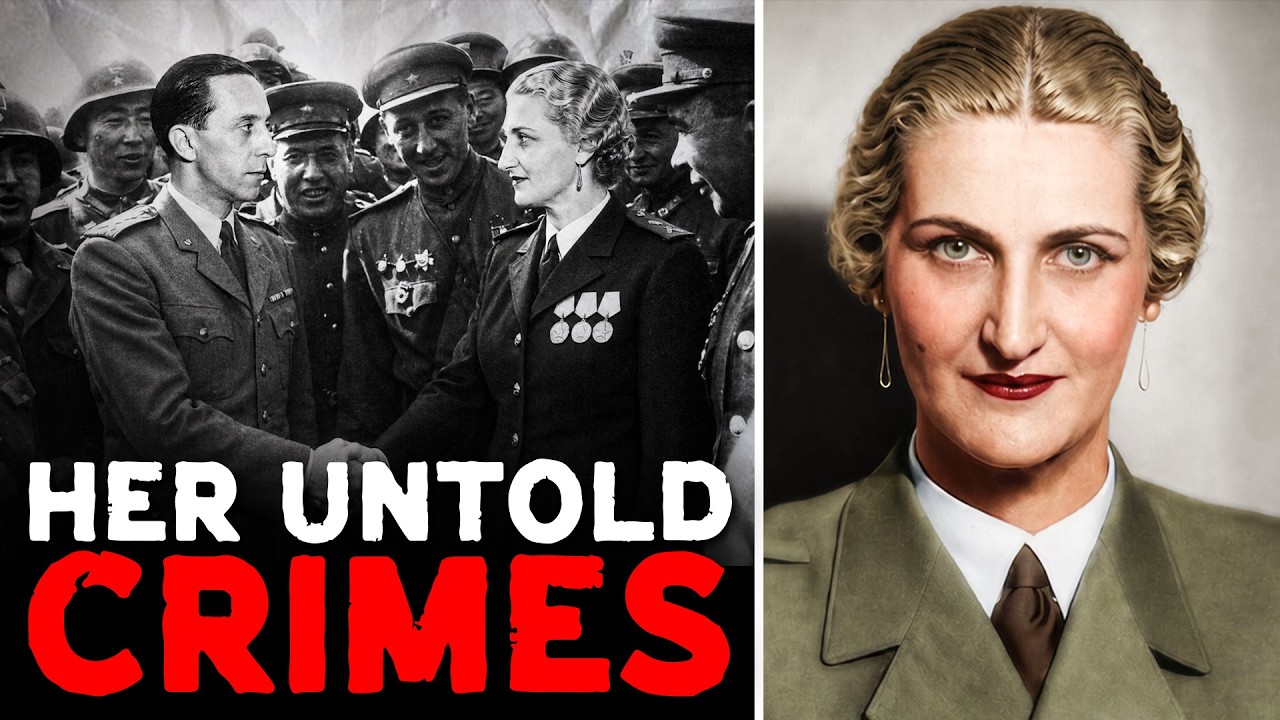 The prevailing narrative that Joseph Goebbels, the master of Nazi deception, forced his wife into this final act of annihilation is a historical convenience that the facts do not support. The testimony of those present in the bunker, including SS dentist Helmut Kunz, who administered the initial sedatives, reveals a different dynamic. It was Magda who initiated the plan.
It was Magda who, days before the end, approached Kunz and requested his assistance in killing her children. Her former sister-in-law, Ello Quandt, confirmed that Magda had been contemplating the act for at least a month prior to the fall of Berlin. Even more telling is Magda’s own farewell letter, smuggled out of the bunker, in which she explicitly states she is staying “against Daddy’s will.”
Joseph had wanted her to leave, to save the children. She refused. In the final, terrible calculus of their marriage, the zealot was not the husband, but the wife.
To understand how a woman could arrive at such a point, one must strip away the layers of propaganda and examine the life of Magda Friedländer, the woman who existed before she became Magda Goebbels. Born Johanna Maria Magdalena Behrend in Berlin in 1901, her early life was a testament to cosmopolitan tolerance, the very antithesis of the racial hatred she would later embrace. When she was seven, her mother remarried Richard Friedländer, a wealthy and respected Jewish businessman.
He adopted her, and for the next decade, she was known as Magda Friedländer. She was educated at a Catholic Ursuline convent school in Belgium, where she became fluent in French and moved in sophisticated, international circles. This upbringing was a world away from the narrow, xenophobic ideology of the Nazi party that would later consume her.
Then, in her teenage years, came a love 𝒶𝒻𝒻𝒶𝒾𝓇 that makes her subsequent transformation all the more incomprehensible. She fell deeply in love with Haim Arlosoroff, a brilliant Jewish student and the brother of a classmate. Arlosoroff would later become one of the most prominent Zionist leaders in the world.
At the time, their connection was intense and all-consuming. According to contemporaries, Magda wore a Star of David necklace and began learning Hebrew. She spoke of converting to Judaism and even considered following Arlosoroff to Palestine to help build a Jewish homeland.
This is a biographical detail that stands as a stark rebuke to the narrative of a woman who was always a Nazi. Of all the wives of the Nazi elite, none had a past that made their eventual ideological commitment more baffling, more contradictory, and more terrifying than Magda’s.
The path from the arms of a Zionist lover to the murder of her children in Hitler’s bunker is a journey of a decade-long moral decay, one that began not with hatred, but with a profound and dangerous restlessness. At nineteen, she married Günther Quandt, a wealthy industrialist more than twice her age. The marriage was one of convenience and comfort, but it was devoid of passion.
 One condition of the wedding was that she had to drop the Jewish-sounding surname Friedländer. She complied without hesitation, becoming Magda Quandt. The marriage produced a son, Harald, but by 1929, the relationship had soured into divorce.
Adrift and seeking purpose in the tumultuous political landscape of Weimar Germany, she attended a Nazi rally in 1930 out of sheer boredom. She heard Joseph Goebbels speak, and the encounter was immediate and electric.
The chemistry between them was instant, but her fixation quickly extended beyond the Propaganda Minister to the Führer himself. She married Goebbels in December 1931, with Adolf Hitler serving as a witness. The children arrived in rapid succession: Helga, Hildegard, Helmut, Holdine, Hedwig, and Heidrun.
They were not just a family; they were a propaganda tool. Hitler, a bachelor with no family of his own, needed a domestic ideal to present to the German public. The Goebbels family was engineered to fill that void.
From the moment of their birth, the children were political objects, their images meticulously crafted and disseminated to sell the regime’s vision of racial purity and domestic bliss. They were the Reich’s children, their value inseparable from the regime that had elevated them to iconic status.
This is the crucial context for understanding Magda’s final decision. If the Reich was to fall, then everything the children represented would fall with it. In her twisted worldview, their very existence was tied to the thousand-year empire that was now crumbling into dust.
By late April 1945, with the Red Army encircling Berlin, the offers to save the children came pouring in. Albert Speer, the Armaments Minister, offered to fly them to safety. Karl Gebhardt of the German Red Cross made the same offer.
Even Hitler himself, on the final Sunday of his life, urged her to leave the bunker with the children. She refused them all. When the famed test pilot Hanna Reitsch landed near the Brandenburg Gate and entered the bunker, she spent two days with the children, singing with them and begging Magda to let her fly them out.
 Magda refused, but with a chilling caveat. She asked Reitsch to stop her if she wavered in her resolve.
The farewell letter Magda wrote to her son Harald, who was a POW in North Africa, offers the clearest window into her state of mind. It is not the rambling of a woman on the brink of a nervous breakdown. It is a composed, doctrinal statement of faith.
She wrote that the world coming after the Führer was not worth living in. She declared that the children were too good for the life that would follow. She framed the impending murders as an act of “salvation” and a “grace of destiny.”
She was not breaking down; she was performing a final act of loyalty. The language is that of sacrament and purity, a grotesque perversion of maternal love twisted by a decade of immersion in Nazi ideology. She was ensuring that her children would never have to live in a world without their Führer.
The mechanics of the murder are as horrific as the intent. On the evening of May 1st, after Hitler had already taken his own life, Magda went to the children’s room. She dressed her daughters in long white nightgowns, combed their hair, and tied ribbons in it.
She told them that they were going to receive a vaccination to protect them from illness. Dr. Helmut Kunz, the SS dentist, administered morphine injections to render them unconscious.
Once they were asleep, Magda, accompanied by Hitler’s physician, Ludwig Stumpfegger, placed a cyanide capsule between each child’s teeth and crushed it. She did this six times. The eldest, twelve-year-old Helga, showed signs of having partially awakened.
The Soviet forensic report noted bruising on her face, evidence that she had fought back in her final moments, that she was old enough to understand the betrayal.
 After the act, witnesses described Magda as pale and silent, her face a frozen mask. She descended the stairs and sat at a table in the telephone exchange, mechanically sorting a deck of playing cards. She did not cry.
The woman who had built her public persona on the image of the perfect, nurturing mother had just systematically extinguished the lives of her children. The Soviet forensic team that entered the bunker on May 2nd opened autopsy file number 1477, documenting the deaths of the six children. The world was confronted with the physical evidence of the regime’s final, absolute depravity.
The aftermath of this atrocity reveals a deeply unsettling truth about accountability. Helmut Kunz, the dentist who administered the morphine, did not die in the bunker. He was captured by the Red Army and spent years in Soviet detention.
In 1952, he was sentenced to 25 years in a labor camp, but he was released in 1955 as part of a prisoner repatriation agreement. A new West German investigation into his role in the children’s deaths was opened in 1959, but the court declined to convict him. Kunz returned to his dental practice in the Black Forest town of Freudenstadt, where he was remembered as a gentle, well-liked man.
He died a free man in 1976 and was buried in a municipal cemetery. The man who helped put the children to sleep for their murder faced no meaningful consequence for his actions.
The story of Magda Goebbels is not a simple tale of a fanatic following her husband into oblivion. It is a far more complex and terrifying case study in the power of ideology to override the most primal of human instincts. Her personal history—the Catholic education, the Jewish adoptive father, the Zionist first love—offered no protection against the seductive, all-consuming nature of Nazi fanaticism.
She was not an anomaly; she was a product of a system that dehumanized entire populations and elevated a single leader to the status of a god. Her decision to 𝓀𝒾𝓁𝓁 her children was not a spontaneous act of despair but the logical, horrifying conclusion of a life that had become entirely subsumed by a murderous ideology.
The only one of Magda’s children to survive was Harald Quandt, the son from her first marriage, who was safely in an Allied POW camp. He received his mother’s farewell letter in captivity and, after the war, went on to inherit a portion of the Quandt industrial empire, becoming one of the wealthiest men in West Germany. He kept photographs of his half-siblings on display for the rest of his life.
He died in a plane crash in 1967 at the age of 45. He was the one who lived, the one who carried the weight of his mother’s monstrous legacy, a legacy that serves as a permanent, chilling reminder of the depths of human cruelty that can be reached when ideology is placed above humanity itself.