It had rained during the night, and by the morning of May 24, 1938, the sidewalks between Lennox Avenue and 7th Street still held water in the low places. Men who worked at the produce markets had been out before 5 a. m. , and the stoop where a small crowd gathered had long been worn into a shallow curve.
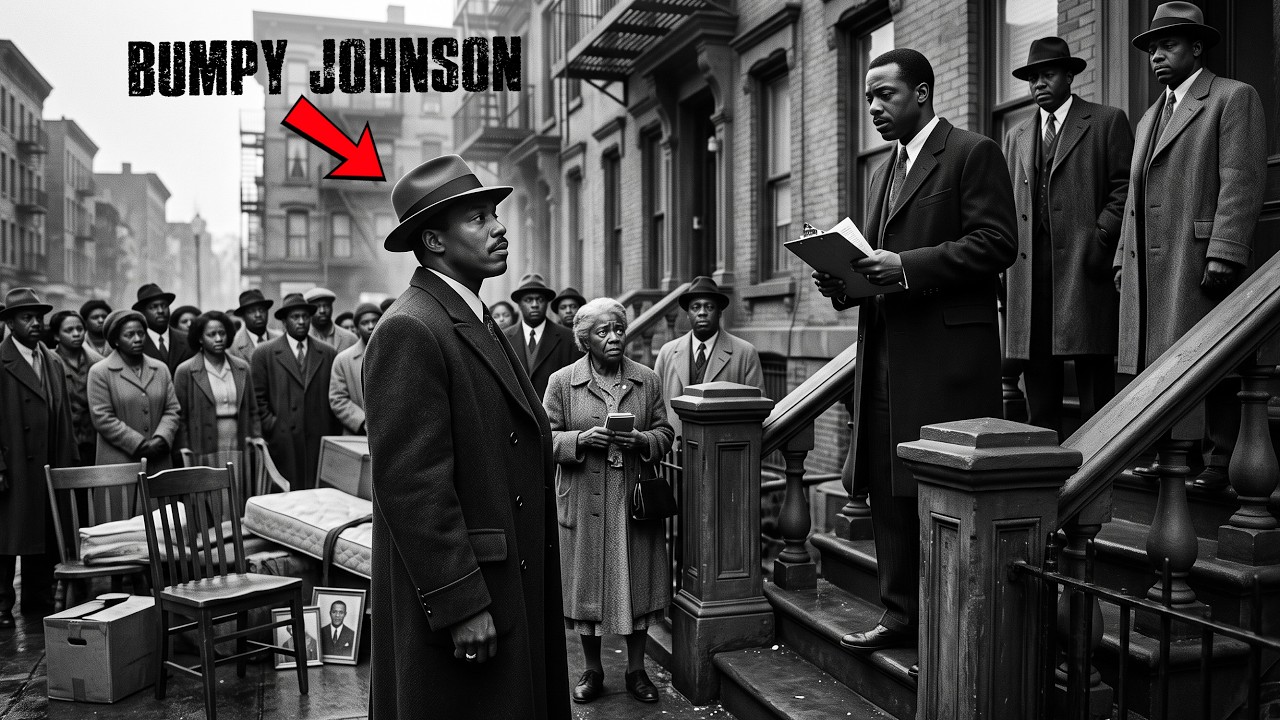
A city notice had been nailed to the door of a building, declaring the premises unsafe and dangerous to life, ordering all occupants to vacate. The notice was dated the previous afternoon, which meant the deadline had already passed. A truck from a moving concern was already backed up to the hydrant when a man known as Bumpy took off his hat and asked a clerk a question in a level voice. He asked who had requested the survey.
The clerk told him that if he was not a party in interest, it was none of his business. One of the other clerks laughed, a short sound that was turned into a cough. When Bumpy pressed again, the clerk repeated that it was a legal proceeding, and that he was not allowed to be involved. Bumpy did not argue.
He looked up the block at the other buildings, one after another, then got into a car that pulled away east. He walked eight blocks without speaking, which was not his habit, and stood at a newsstand on 145th Street without buying anything. He understood that the clerk had not been insulting him personally. The clerk was a small man who had been given a large sentence to say, and the sentence was the true opponent.
The rule had been applied correctly, and that was exactly the point. The buildings on that block had been inspected, condemned, and ordered vacated, and the record of why was locked away. Bumpy went to the Hall of Records and found the block and lot system, where every parcel was divided into numbered lots. He discovered that the file behind the vacate order was not secret by law.
There was no requirement that a person be an owner or a mortgagee to inspect it. It was written down, indexed, and open to the public. It had simply never occurred to anyone that it was theirs to read. He went to people individually, in their offices and kitchens and shops, and asked each for a single specific thing that only that person could give.
Was there a legal proceeding by which a person could compel a city department to produce the file behind an order? A lawyer explained it carefully, assuming he would not follow it, and then watched him follow it. The previous year the legislature had rewritten the old writs of certiorari and mandamus into a single simplified proceeding under article 78 of the civil practice act. Bumpy had to have an interest in the matter, and he did.
He offered the lawyer three months of steady wages to teach four people how to search a title and then check their work. The lawyer agreed, and the notebook that came out of those lessons was worth more than any lawyer in the city. Bumpy knew it the moment he saw the first page. He went to Holy Duval, the city editor of a Harlem weekly with a circulation of 19,000, and made a bargain that Duval repeated for the rest of his life as the best deal he ever made.
Duval would print the facts without adjectives, no editorials, no outrage, no description of anyone as a vulture or a thief, just columns of figures, dates, and corporate names, week after week, and let the reader do the arithmetic. For his own part, Bumpy kept his name off the papers. He told the lawyer the truth: that his name on a court paper was a gift to the other side, worth more than any lawyer they could hire, because it would let them argue about him instead of about the building. The whole art of the matter was to make the case about the building, not the man.
When the first case was prepared, a lawyer and a young researcher named Alton Sears, a 19-year-old hotel night clerk, found the three cards with the same Broadway address. Puit’s notebook was photographed twice, with the original placed in a church safe, not because anyone would steal it, but because a document that exists in one copy is a document that can be lost. The rent strike was the only weapon the tenants of the six standing buildings actually held, and it was a real one. Loretta van Pierce, a tenant, would file a proceeding under article 78 in Idella Rose’s name and the names of 39 other tenants, demanding that the Department of Housing and Buildings produce the record on which the vacate order was based: the inspector’s report, the engineers’ survey, the date of each inspection, and the identity of every person who had requested, ordered, or paid for any survey of the premises.
The difference between asking for the record and asking for the order was the whole opening of the case. If the city had made a mistake, it could be checked, and a man who is checking your figures has already stopped defending himself. The search produced nothing at first because the four searchers were slow and did not yet know the indexes, and the city sent back most of the early cards to be done again. But the pieces began to come together.
All three deeds gave the same address for the grantee, a room number in an office building on Lower Broadway. All three were recorded by the same attorney. Two had been executed by the same officer, a man signing as secretary of two different companies 11 months apart. Nine corporations, all formed between January 1936 and October 1937, all with capital of a few hundred dollars, all with an address in one of three rooms in the same building, all represented by the same firm of attorneys, held or had taken options on 11 lots along that block and the two blocks adjoining.
The options had a common form and a common expiration. Someone had taken a written option on a building three and a half weeks before the city discovered that the building was dangerous. The other side responded on July 11th with a letter that was courteous. They raised the offer for $236 by another $1,100 and mentioned that the building was closed and that a woman of her age should not carry such a worry.
But when the case came to court, the city produced two witnesses who stated where the complaining party had been standing and for how long, and the complaint was dismissed. Bumpy understood exactly what it was. It was not an attempt to jail him. It was an attempt to produce a newspaper line reading that the tenants’ campaign was connected to a man with a record.
The word carried, but it did not stick, because the tenants were not aggrieved by the process—they were the ones who had been put out. The owner had never appealed, and the mortgagee had been paid. In the end, a lawyer made the argument that decided the case, and she made it in two sentences. She asked the department to produce its file, and the record showed that no inspection of the premises had been made by any employee of the department between June 1931 and March 1938.
A title company declined to certify title on two of the optioned lots, citing the pending proceeding and an unrecorded assignment, which meant no bank would lend on them, which meant the assemblage could not be financed on schedule. The settlement was offered quickly. The city would keep its machinery and its reputation, and the tenants’ lawyers would get the victory. They offered Bumpy the whole victory in exchange for letting the machinery stay exactly as it was.
He asked for a piece of paper and wrote on it in front of two witnesses the terms as they had been stated. The lawyer asked why, with some real bewilderment, because he had come prepared to be argued down on the number of years and had instead been refused everything. Because if I take that, Bumpy said, then in three years it happens on 143rd Street, and those people will not have Mrs. Rose.
In the end, Idella Rose spoke for about 90 seconds and said that she had been put out of a room she had lived in for 31 years by a piece of paper she was not entitled to read, and that she was not going back into that room on the same terms. The department did not fight it after that. A reinspection was made on January 4, 1939, by two engineers, one from the department and one independent, both signing. Under the new rule, occupants of a building under consideration for such an order would receive written notice at their apartments not less than 10 days before the order issued, except in cases of imminent peril certified by the borough superintendent.
And the file supporting any such order would be open for examination during business hours to any occupant of the premises, to any owner or occupant of a building on the same block, and to any incorporated block or civic association in the district on request, without inquiry into the interest of the person making it. It was the answer to a sentence spoken on a wet stoop on the morning of May 24th, and the man it answered never referred to it in public in his life. What followed was quieter than what came before, which is the usual shape of these things. Alton Sears, the 19-year-old hotel night clerk who found the three cards with the same Broadway address, became a title searcher and then a title officer, and in 1962 he opened his own abstract company.
Loretta van Pierce spent the next 31 years in housing law, argued in the appellate division 11 times, and told her students that the most useful thing she ever learned she learned from a client’s friend who never appeared on a single paper. And the families in those years did not know any of this. When a notice went up on a door on that street, and for a long time on the streets around it, somebody would read it, and somebody else would go downtown to the Hall of Records with a block and lot number written on the back of an envelope, and before anyone raised his voice or wrote a letter or called a meeting, the first thing asked out loud was the plain and unanswerable question a man had asked on a wet sidewalk in May 1938, and had been told was none of his business.