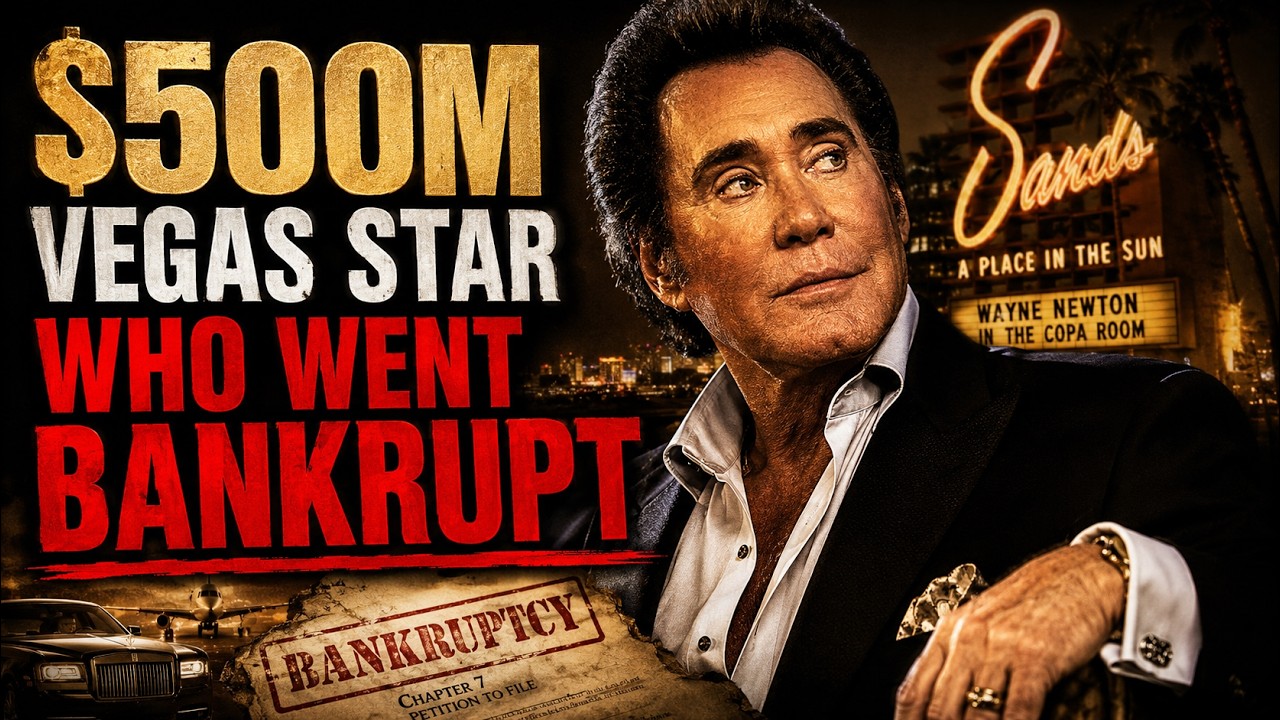
In 1992, Wayne Newton walked into a courthouse in Las Vegas and told a judge he had nothing left. The most famous entertainer in the history of the city, the man who had headlined for decades and earned millions, had reached the end of a financial road that had been crumbling under him for years. It wasn’t a sudden catastrophe that did it, but the accumulated weight of choices, obligations, and a lifestyle that had always cost more than it brought in. Newton’s story began long before the money and the fame.
As a boy with severely damaged lungs, he had struggled to breathe across a room. But he could sing with a warmth and reach that made adults stop mid-sentence to listen. The stage gave him the one thing his own body had always denied him: the ability to run, to perform, to exist fully in the open air. He and his older brother Jerry started playing county fairs and local events, anywhere there was a microphone and an audience could be gathered.
He found his destination almost by accident when he was 13 years old, standing on Fremont Street for the first time, staring up at the lights that turned the desert night into something that had no right to exist. Wayne Newton didn’t perform for rooms; he performed for individuals. While other entertainers treated Las Vegas as a lucrative detour between cities that mattered, Newton treated it as the city that mattered most. It was his home, his stage, the place where every instinct about performing was confirmed every single night.
By the mid-1970s, Newton was one of the highest-paid performers in Las Vegas. His contract at the Sands Hotel guaranteed him several hundred thousand dollars per week. He performed 330 shows in a single year at his peak. He remembered names.
He showed up to charity events and birthdays where no camera was waiting. That generosity wasn’t a performance; it was a way of being that was as natural to him as breathing. He was constitutionally, structurally generous. The same way some people are simply tall or left-handed.
The ranch was always the clearest example of this. It was more than 30 acres in the middle of Las Vegas, a place he built and maintained with dozens of staff at any given time. The feed costs, the veterinary bills, the maintenance required for more than 50 horses, all of it added up to a number each month that would have caused most people to sit quietly and reconsider several major life decisions. He paid his people well because loyalty mattered to him.
He simply could not do less. The gap between what he earned and what he spent was small at first. Newton, who had been performing since he was 16 and never knew a life without a stage, was not built for sitting with a spreadsheet and confronting arithmetic. Then in 1980, a story appeared in print that would follow him for the rest of his working life.
A published article alleged connections between Newton and organized crime figures. Newton was publicly, loudly, and genuinely furious. The mob label, once attached, doesn’t scrub off in Las Vegas or anywhere else. He didn’t issue a statement and wait for the news cycle to move on.
Instead, he sued NBC, which had broadcast the allegations nationally. While he performed hundreds of shows a year, the legal machine ground forward through courtrooms across Nevada and beyond. Years accumulated, legal fees compounded, and the emotional bandwidth required to sustain a major federal lawsuit while performing 330 shows annually and managing a ranch the size of a small municipality would have broken most people. Newton kept going because the stage was the one place in his life where none of the arithmetic applied.
For two hours every night, he was still the king of Las Vegas. In 1986, a federal jury handed Newton what looked like complete vindication in the NBC case. His legal team embraced. The coverage was exactly what he had spent years hoping for: a public declaration that the story had been wrong and Wayne Newton had been telling the truth.
Then NBC appealed. The network argued First Amendment protections and that as a public figure, Newton faced a higher evidentiary bar. In 1990, the Ninth Circuit Court of Appeals reversed the judgment entirely. The years of litigation, the millions in legal fees, the emotional investment in a case he had made deeply personal, all of it produced a net result of zero.
Newton wasn’t paying attention to any of that. He was fighting a network news division with everything he had, and by the time the fight ended, the ground beneath everything else had already shifted. The numbers, when they became public, carried the particular brutality of things that should have been caught earlier and were not. The tax debt was the most visible evidence of what had been happening quietly for a long time.
For a man whose identity was as thoroughly bound up in that place as Newton’s was, the threat carried a weight that had nothing to do with real estate values. The public nature of the bankruptcy added its own dimension of pain. Newton had spent decades projecting an image of abundance, of a man for whom the good life was not an aspiration but a permanent condition. Now the newspapers were running stories about his tax debts and his creditors.
Howard Hughes had built the land where the Frontier Hotel stood. Built in 1942, it was one of the original strip properties, and by the time Newton got involved, it had the tired quality of something that had survived long enough to become outdated. Newton bought the Frontier and poured money into it. The Culinary Workers Union walked off the job in September of 1989 and didn’t return for six years.
Newton put his fortune into the property, the way a man keeps bailing a boat he knows is sinking because the alternative is watching it go down. The tax obligations were renegotiated into payment schedules that stretched far into the future. Newton continued performing well into his 80s. The voice settled into something different with age, as all voices do.
But the specific gift of making contact with every individual in the room, of collapsing the distance between the stage and the seat, remained intact through the financial collapse and the legal battles and everything else the decades brought. He kept the thing the money had been trying to purchase all along: the right to stand in front of an audience every night and give them something they couldn’t find anywhere else at any price. Some people measure a life by what it accumulates.
Newton measured his by what he could give away and still have enough left to walk on stage and do it again the next night.