The cold December air hung heavy over the Aversa courtyard as a disgraced figure in a stripped Wehrmacht uniform was bound to a wooden stake, the final chapter of a brutal war closing with a single, decisive volley.
At precisely 8:00 a. m. on December 1st, 1945, General Anton Dostler, a man who once commanded tens of thousands of troops for the Third Reich, met his end.
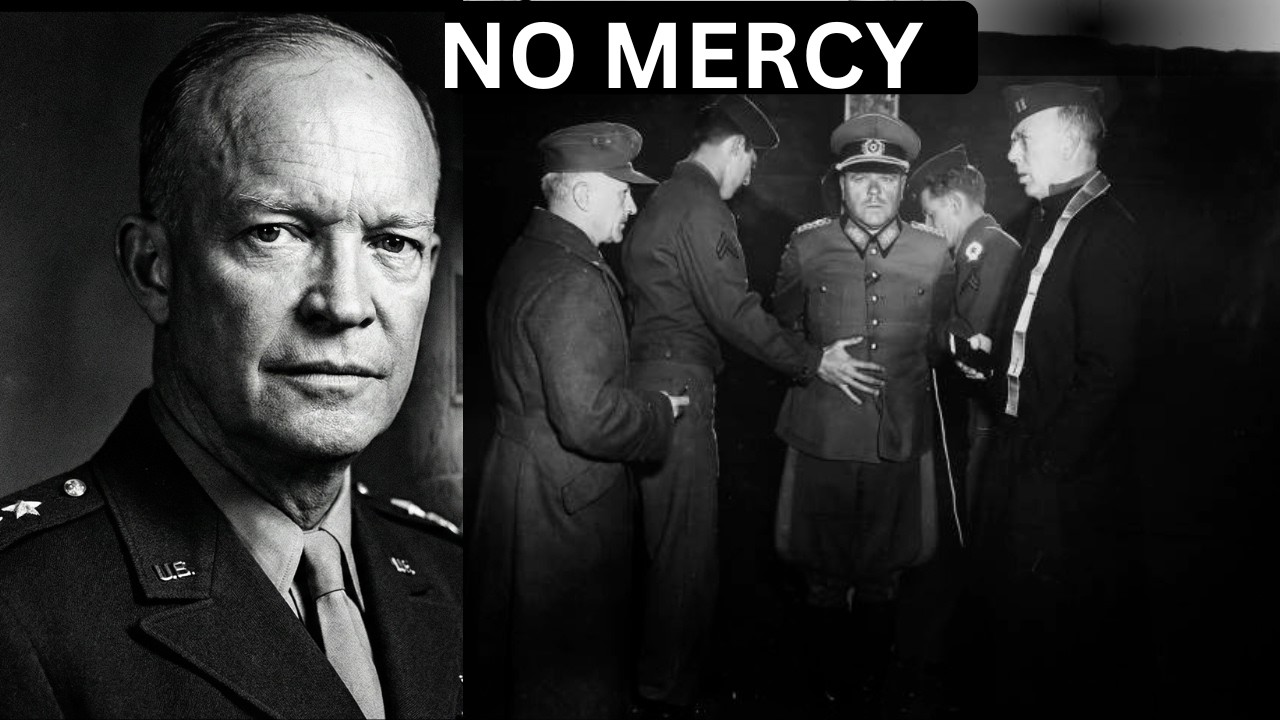 The 12 American M1 Garand rifles raised in unison, the officer’s command cut through the frosty silence, and a single volley of fire ended the life of the first German general to be executed for war crimes by the Western Allies. To the men who pulled the triggers, this was not revenge; it was the cold, hard enforcement of justice. To the world, it was a resounding declaration that the shield of rank and the excuse of obedience could no longer protect those who embraced atrocity.
Dostler’s path to that muddy stake was paved with the blood of American soldiers—a crime so heinous that it overrode any sense of diplomatic leniency from Supreme Allied Commander Dwight D. Eisenhower. Months earlier, in the spring of 1945, Eisenhower had witnessed the horrors of Ohrdruf concentration camp.
He walked through sheds filled with emaciated corpses and saw the ash of the crematoriums. That visceral confrontation with pure evil transformed the strategic general into a vessel of grim moral clarity. When Dostler’s plea for mercy landed on his desk, Eisenhower did not hesitate, scrawling a rejection that read like an epitaph for the Nazi excuse: the escape of a general from punishment when he ordered the shooting of prisoners would be a mockery of justice.
The saga that sealed Dostler’s fate began in March 1944, high in the treacherous mountains of Italy. A team of 15 uniformed American commandos, part of Operation Ginny II, was inserted deep behind enemy lines with a singular objective: destroy a critical railway tunnel to sever German supply lines. They were not spies; they wore the official insignia of the United States Army, which should have guaranteed their protection under the Geneva Convention.
But the mission went horribly wrong, and the men were captured by Italian fascist forces before being handed over to his command.
Dostler was presented with a clear-cut legal dilemma. A subordinate officer, a man with a conscience, pleaded with him, warning that executing uniformed soldiers was a flagrant war crime that could not be undone. But Dostler was a man consumed by ambition and a desire to prove his unyielding loyalty to Hitler.
He invoked the Führer’s notorious “Commando Order,” a directive that demanded the immediate slaughter of all Allied special forces, even those in uniform. With a slam of his fist on a desk, he dismissed the legal objections and approved the summary execution.
The 15 Americans were marched to a rocky cliff near the sea and shot without trial, without last rites, and without the comfort of writing to their families. Their bodies were hastily buried in a shallow pit, a cold and secret grave intended to erase them from the earth. Dostler returned to his dinner, believing the matter was closed and that history would never call him to account.
He was confident in the power of the Third Reich and his own untouchable rank, but he had failed to anticipate the unwavering resolve of the American justice system that would hunt him down.
When the war ended in May 1945, Dostler was captured and initially treated with the respect his rank demanded. He was fed American rations and placed in comfortable quarters, believing he would be debriefed and released like many of his peers. That illusion shattered when investigators for the US Army, having discovered the mass grave of the 15 commandos, walked into his cell and charged him with war crimes.
Dostler was reportedly offended, outraged that a general of the infantry would be degraded by the legal process. He stammered that he could not be tried like a common criminal, a sentiment that evaporated the moment the tribunal pronounced the death sentence.
 His trial was a masterclass in the defense of obedience. Dostler’s lawyers argued the “just following orders” defense, claiming he feared court-martial or execution if he had defied Hitler’s direct command. They argued that a soldier cannot be held responsible for executing an order from his supreme commander, even if that order is illegal.
The American tribunal rejected this premise with a clarity that would define the Nuremberg Trials that followed. They asserted that a soldier is only bound to obey lawful orders, and an order to murder unarmed prisoners of war is a crime against humanity. Dostler had a choice, and he chose murder; therefore, he would pay with his life.
The reaction to the sentencing was immediate shock and a frantic scramble for clemency. Dostler’s legal team appealed to the highest levels, arguing that executing a general would set a dangerous precedent and inflame German resistance. They begged for a life sentence, a prison cell, anything but death.
The case ultimately reached Eisenhower, a man known for his genial temperament and diplomatic approach. Many assumed the Supreme commander would commute the sentence to solidify peace and stability in post-war Germany. But Eisenhower’s decision to confirm the death penalty was a calculated act of moral leadership, not a diplomatic gesture.
He stared at the telegram from Dostler and saw the faces of those 15 boys.
On December 1st, 1945, the reality of his situation finally crushed Dostler. As the black hood was placed over his head, all traces of the arrogant Nazi commander vanished. He was blindfolded, bound, and waiting for an end he had long imagined he was immune to.
Witnesses reported that his body was trembling as the firing squad took aim. In those final seconds, the world did not see a general; it saw a murderer who had been caught, judged, and found wanting. The volley of shots did not just 𝓀𝒾𝓁𝓁 Dostler; it killed the notion that a uniform could absolve a man of his conscience.
The execution sent a shockwave through the remnants of the German military hierarchy. Generals who had once believed they would simply return to their estates and write their memoirs were suddenly terrified. They realized that the Americans, particularly Eisenhower, were not playing the old game of war.
The message was crystal clear: the past would not be forgotten, and those who violated the laws of war would be held accountable. It was a stark warning that the victors were not interested in reconciliation with the architects of the Holocaust and the slaughter of prisoners-of-war; they were interested in justice.
Eisenhower’s decision was not born of hatred for the German people but of a profound revulsion for the Nazi system. He had seen the ultimate expression of that system in the camps, and he had heard the testimony of Dostler’s own officers who had begged him to spare the prisoners. The Supreme Commander understood that to show mercy to a man like Dostler would be to insult the memories of the millions who had perished.
 By refusing the plea, Eisenhower ensured that the victims of Operation Ginny II did not die in vain, that their death was avenged by the rule of law rather than the rule of the mob.
The distinction between soldiering and murder was articulated with brutal precision in that courtyard. Dostler was an officer who had worn a uniform with pride, but he had tarnished it with the blood of innocent captives. He thought that generals would not execute other generals, viewing the conflict as a gentleman’s disagreement.
He failed to understand that he was not engaged in a gentleman’s war; he was engaged in a criminal conspiracy. The 12 American rifles that fired on that December morning were not firing at the man; they were firing at the principle of impunity that the Nazi state had cultivated.
For the men of the 75th Army Corps who had followed Dostler’s orders, the execution was a terrifying revelation. They realized that the wheel of justice could turn with terrifying speed. While thousands of lower-ranking soldiers were quickly processed and sent home, the officers who gave the orders were being held to a higher standard.
Dostler’s execution highlighted the American commitment to the principle of command responsibility—the legal doctrine that a commander is personally liable for the war crimes committed by his subordinates if he orders them or fails to prevent them.
The legacy of General Dostler’s execution endures because it stands as a bulwark against the temptation to justify the unjustifiable. In the decades since, the “Nuremberg Defense” has been cited in countless tribunals, from Vietnam to the War on Terror, and it has almost universally been rejected. The lesson of Aversa is that the chain of command does not sever the link to one’s own conscience.
When you cross the line of humanity, when you slaughter the defenseless, every excuse melts away in the face of the evidence. The execution was a painful but necessary act of closure for a world trying to rebuild from the ashes of the Second World War.
Eisenhower, who would later become President of the United States, rarely spoke publicly about the decision. But his private correspondence reveals a man who felt no guilt. He viewed the execution as a matter of fundamental principle.
He had seen the concentration camps, and he had seen the chained bodies of the American commandos. The request for clemency was an insult to his intelligence and to the sacrifices of his men. He understood that in the fight against totalitarian evil, one cannot afford to be lenient with the architects of our destruction.
His “Confirmed” stamp was a final battle cry against the darkness.
 The final moments of Anton Dostler were devoid of the pomp and circumstance of his former life. There was no marching band, no parade of troops, no adoring crowds. There was only the cold morning, the smell of gunpowder, and the sound of a body slumping against the ropes.
The medical officer stepped forward to pronounce the death. The shooting was so precise that it was over instantly, a mercy that Dostler had denied the 15 Americans he ordered executed without trial. The symmetry of that moment was not lost on the witnesses, a poetic end for a man who had eschewed all rules of engagement.
As the news of the execution spread, it drew a line in the sand for the future conduct of warfare. It declared to the world that the international community would hold individuals accountable for their actions, regardless of their position or the authority under which they acted. While some historians argue that Eisenhower was too harsh, that a prison sentence would have sufficed, the prevailing consensus is that the severity was a necessary corrective to a barbaric regime.
Dostler’s execution served as a ritualistic purification, a way for the Allied forces to close the book on a campaign of terror and reassert the primacy of law.
Seventy-eight years later, historians still debate the precise impact of the Dostler case. Some argue it served as a deterrent to other German generals, forcing them to cooperate with Allied investigators. Others suggest it was a political tool used to demonstrate the resolve of the occupying forces.
Regardless of interpretation, the image of the general tied to the post remains a powerful symbol. It is a direct challenge to the idea that any man can wash his hands of his deeds by pointing to a superior. The blood of the victims demands a reckoning, and Dostler’s death was that reckoning made manifest.
The story of December 1st, 1945 is a brutal reminder that while war is a hell of violence, the law exists even in the chaos. The 15 American soldiers of Operation Ginny II were silenced, but their sacrifice became the sword that fell upon their murderer. The decision by Eisenhower to deny mercy was a profound expression of moral absolutism, one that rejected the gray zones of political compromise.
It is a reminder that true peace is not forged by looking away from the past, but by confronting it, judging it, and when necessary, punishing it with the ultimate price.
The execution of General Dostler is not merely a historical footnote; it is a foundational moment for international criminal justice. Where Dostler was shot, the principles of the Nuremberg Charter were strengthened, ensuring that mankind could not easily slip back into the darkness of “just following orders.” Eisenhower’s steely resolve in the winter of 1945 demonstrated that the highest office of command carries the heaviest burden of responsibility, and that when that burden is betrayed by murder, the reckoning will be absolute.
The volley that killed Dostler echoed across the ages, a shot heard around the world that justice had truly arrived.