The man who commanded the mass murder of hundreds of thousands of civilians across the occupied Soviet Union, who crushed the Warsaw Uprising with a savagery that stunned even hardened SS commanders, and who then climbed into the witness box at Nuremberg to condemn the very men he had served beside, has died in a Munich prison clinic at the age of 73. Erich von dem Bach-Zelewski, the SS general who became the most infamous turncoat of the Third Reich, passed away on March 8, 1972, serving a life sentence not for the genocide he orchestrated, but for a handful of political murders committed in 1933. His death closes a chapter of such profound moral complexity that it continues to haunt the annals of post-war justice, leaving behind a legacy defined by the tens of thousands of unprosecuted crimes that he admitted to under oath, and the calculated betrayal that kept him out of the gallows for nearly three decades.
Bach-Zelewski, who was born in 1899 in the West Prussian town of Lowenburgg, was not an early fanatical adherent of the Nazi movement. He joined the party in 1930 and the SS in 1931, timing his entry to coincide with the organization’s meteoric rise to power, a move that historians now recognize as the first of many calculated career decisions. A decorated veteran of the First World War and a member of the brutal Freikorps paramilitary units that fought in the Baltic states, Bach-Zelewski possessed a combination of organizational competence and moral flexibility that made him invaluable to SS chief Heinrich Himmler.
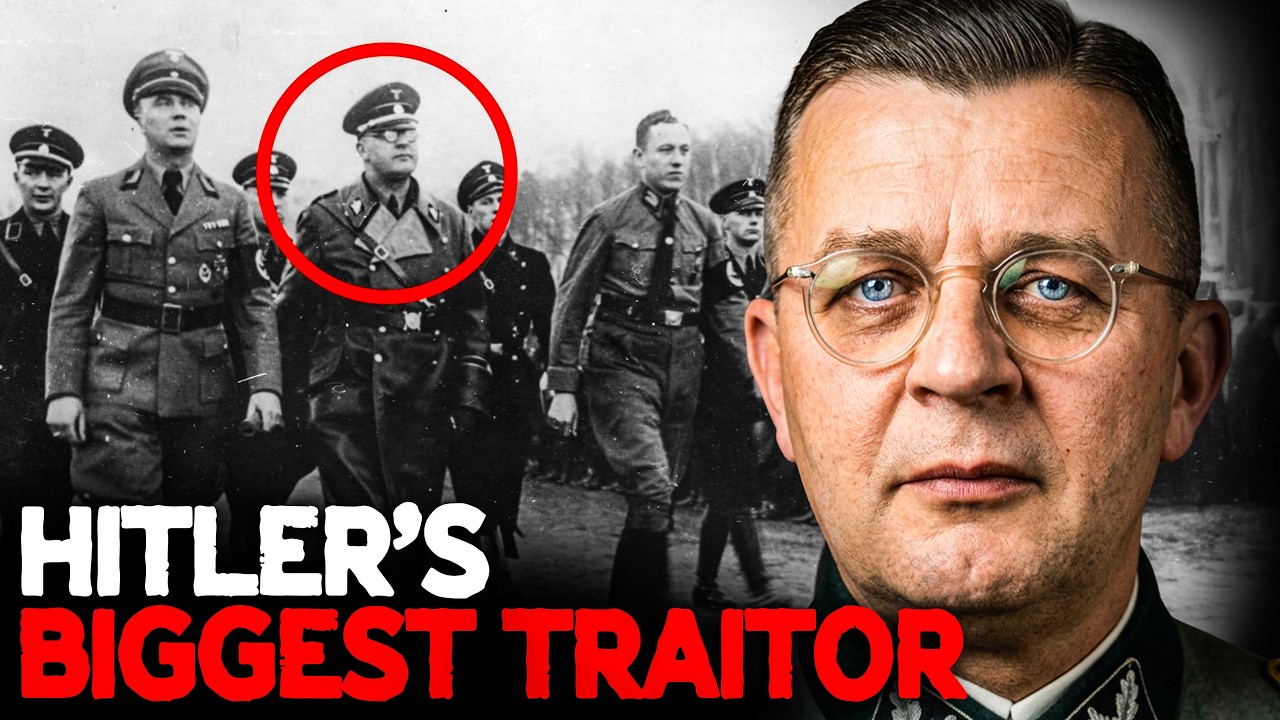 By 1934, he had risen to the rank of SS-Gruppenführer and participated in the Night of the Long Knives, the bloody purge that eliminated the SA leadership, a crime for which he would eventually be convicted, but only after the war had ended and the world had moved on.
His rise through the SS hierarchy was meteoric, driven by a willingness to execute any order without hesitation and an ability to manage the vast, complex administrative machinery of the security state. In June 1941, with the launch of Operation Barbarossa, Bach-Zelewski was appointed Higher SS and Police Leader for Russia-Center, a position that gave him jurisdiction over an enormous swath of occupied Soviet territory, including Belarus and parts of Western Russia. It was here, in the vast killing fields of the Eastern Front, that Bach-Zelewski oversaw some of the most savage mass murder operations in human history, coordinating the activities of the Einsatzgruppen mobile killing units and commanding antipartisan sweeps that systematically eradicated entire villages.
The scale of the crimes committed under his command defies comprehension. In the Pripet Marshes alone, during the summer and autumn of 1941, SS units under his command swept through villages in what was officially designated as an antipartisan operation, but was in practice a systematic massacre of Jewish civilians and anyone suspected of harboring resistance fighters. By his own admission at Nuremberg, Bach-Zelewski reported to Himmler that his units had killed approximately 200,000 people classified as “bandits” during these operations, a number he acknowledged was a significant undercount of the actual civilian casualties.
The victims were predominantly women, children, and the elderly, killed because they were Jewish or because they lived near where a partisan attack had taken place.
In August 1941, Bach-Zelewski reportedly suffered a complete nervous breakdown and was hospitalized, claiming later that the psychological weight of supervising mass executions had become unbearable. He told investigators that he had reported his distress to Himmler personally, and that this conversation had contributed to the development of gas vans and eventually the death camps, methods that would place greater distance between the killers and the killed. Historians remain deeply skeptical of this self-serving narrative, noting that every word Bach-Zelewski ever said about his own role was shaped by the imperative of self-preservation, but the timing of the shift towards more industrialized methods of killing does align with his account.
Despite his breakdown, Bach-Zelewski returned to active duty and was promoted to even greater power. In June 1943, Himmler appointed him Chief of Anti-Partisan Units for all of German-occupied Europe, a continent-spanning command that placed him at the center of some of the most brutal counterinsurgency campaigns in history. Under this rubric, his units killed hundreds of thousands of civilians across Yugoslavia, Greece, and the Soviet Union, operations in which the distinction between partisan fighters and the civilian populations that supposedly harbored them was routinely ignored or deliberately erased.
The Nazi leadership’s propaganda consistently identified Jews with partisans regardless of any actual evidence, making the antipartisan war inseparable from the Holocaust itself.
The most dramatic and historically significant episode of his wartime career came with the Warsaw Uprising of August 1944. When the Polish Home Army rose against the German occupation, Hitler ordered the city to be destroyed and its population annihilated. Bach-Zelewski was placed in command of the German forces tasked with crushing the rebellion, which included the Dirlewanger Brigade, composed largely of convicted criminals, and the RONA Brigade, made up of Russian collaborators.
In the first week of the uprising, these units committed massacres on a scale that even some German officers found 𝓈𝒽𝓸𝒸𝓀𝒾𝓃𝑔, with an estimated 40,000 to 60,000 Polish civilians systematically shot in the Wola district alone.
In a move that has bewildered historians ever since, Bach-Zelewski actually intervened to stop some of the massacres, removing Kaminsky from command of the RONA Brigade and having him shot, ostensibly for looting and indiscipline. He issued orders restricting the killing of civilians, though these orders came only after tens of thousands had already been murdered. Some historians have seen this as evidence of a residual capacity for moral restraint, but the more convincing interpretation is that Bach-Zelewski, reading the military situation clearly by 1944, was already calculating how he would appear to the Allied powers who would eventually sit in judgment over him.
He was building a narrative, a story he could tell later, and stopping the massacre of civilians gave him something to point to.
When the uprising finally capitulated on October 2, 1944, Bach-Zelewski negotiated surrender terms with General Tadeusz Komorowski that were extraordinarily civilized by the standards of Nazi treatment of resistance movements. The surrendering Polish fighters were granted prisoner of war status under the Geneva Convention, an astonishing concession, and the civilian population was not massacred upon the surrender. Bach-Zelewski conducted himself as if he were a European military officer operating under the rules of warfare, treating Komorowski with a degree of mutual military respect that seemed almost surreal given the context of 63 days of murderous fighting.
This was currency he intended to spend at the post-war tribunal, and he spent it successfully.
As the Third Reich collapsed in April and May of 1945, Bach-Zelewski made a choice that stunned his former comrades. While other SS men fled, hid, or committed suicide, he surrendered to American forces and immediately began talking. From the moment of his surrender, he provided Allied intelligence officials with detailed information about the SS command structure, about individual officers and their roles, about specific operations and orders.
He was, as one Allied intelligence officer reportedly described him, one of the most valuable sources they had about the inner workings of the SS. His cooperation became his shield, and it proved to be a remarkably effective one.
 When the International Military Tribunal at Nuremberg opened in November 1945, Bach-Zelewski was positioned as a star witness for the prosecution. He took the stand and told the truth, or at least a significant portion of it, confirming that Himmler had personally ordered the systematic extermination of the Jewish population of Europe, describing the Einsatzgruppen operations in detail, and corroborating the scale of civilian massacres in antipartisan operations. His most dramatic contribution was his testimony about Hermann Göring, the Luftwaffe chief who was attempting to dominate the proceedings through sheer force of personality.
Bach-Zelewski directly contradicted Göring’s claims of ignorance about SS operations, providing specific information about what senior Nazi leaders had known and when they had known it.
The reaction of the defendants in the dock was one of visceral contempt. Göring reportedly raged privately to his defense team, denouncing Bach-Zelewski in terms that left no doubt about how he viewed the betrayal. The other defendants reacted similarly, understanding that Bach-Zelewski’s testimony was dismantling the coordinated defense strategy they had constructed.
He was confirming knowledge, describing criminal orders, and doing so with the authority of a man who had been a participant. His betrayal was total and deliberate, and it helped seal the fates of men who might otherwise have been able to construct deniable defenses. Anst Kaltenbrunner, who headed the Reich Security Main Office, was convicted and hanged, with Bach-Zelewski’s testimony contributing to establishing the scope of the RSHA’s criminal activities.
But here lies the central and most troubling question that hangs over all of Bach-Zelewski’s testimony at Nuremberg. If he was describing SS killing operations on the Eastern Front with enough authority and specificity to condemn other men, was he not simultaneously describing his own role in those operations? And if so, why was he not in the dock alongside the men he was helping to condemn?
The answer reveals something deeply uncomfortable about the nature of post-war justice. The Allied prosecutors were focused primarily on the men in the dock, the most senior surviving Nazi figures whose conviction was a political as well as a legal imperative. To convict them, they needed evidence, and the evidence they needed most urgently was the kind that only insiders could provide.
Bach-Zelewski provided that evidence. In exchange, he was not prosecuted at Nuremberg. He was a witness, not a defendant.
The formal legal reasoning was that the evidence against him had not been fully assembled and that his cooperation as a witness took precedence. The practical reality was that the prosecutors valued his testimony more than they valued putting him in the dock, because if he were a defendant, he could no longer be a witness. It was a trade-off, and it was made explicitly with eyes open by people who understood exactly what Bach-Zelewski had done during the war.
Throughout the late 1940s and into the 1950s, Bach-Zelewski lived in a kind of legal limbo that was remarkable given the scale of his wartime crimes. He was not in prison. He was not on trial.
He was not even particularly closely supervised. He was living as a free man in West Germany, occasionally called upon to provide additional information to various legal proceedings, still trading on his status as a cooperative witness to shield himself from prosecution.
The 1950s in West Germany were a period of what historians have called collective amnesia, a socially enforced suppression of memory and accountability that served the economic and political interests of the new Federal Republic. Former Nazis returned to positions in government, industry, academia, and the legal profession. In this environment, Bach-Zelewski navigated his legal situation with the same cunning he had always applied to questions of self-preservation.
He gave interviews that carefully calibrated his self-presentation, acknowledging the crimes of the Nazi regime while consistently framing his actions as those of a professional military officer following orders within a criminal system. He cultivated a narrative in which he was simultaneously a witness to and a partial restrainer of Nazi excess, a man who had seen the worst and had occasionally tried, however inadequately, to limit it.
The reckoning, when it finally came, arrived from an unexpected direction. It did not come from Polish prosecutors seeking justice for the Warsaw Uprising, nor from Soviet authorities demanding accountability for the massacres in Belarus and Russia. It came in a deeply ironic twist from the crimes of the Night of the Long Knives in 1934, crimes committed against other Germans, against the SA leadership that the SS had murdered to consolidate Hitler’s power.
In 1961, Bach-Zelewski was finally put on trial before a West German court in Munich, charged with murder in connection with the deaths of political opponents during the purge. He was convicted and sentenced to four and a half years imprisonment, a sentence that struck many observers as outrageously lenient given the vastness of his actual criminal record.
 In 1962, Bach-Zelewski was tried a second time in West Germany, this time for murders committed in 1933 in the early days of the Nazi dictatorship. He was convicted again and sentenced to life imprisonment. This sentence, life imprisonment, finally produced the outcome that justice demanded, though it came nearly two decades after the war had ended and was based not on the crimes for which Bach-Zelewski was most historically responsible, but on earlier and, relatively speaking, smaller scale political murders.
He would serve the remainder of his life in prison, never having faced a full reckoning for the massacres in the Soviet Union, never having been tried for his role in the antipartisan campaigns that killed hundreds of thousands, never having faced justice specifically for the Warsaw Uprising atrocities.
The contrast between what Bach-Zelewski was convicted of and what he had actually done is one of the most striking illustrations of the failures of post-war justice. Convicted for the deaths of a relative handful of political opponents in 1933 and 1934, while the murder of hundreds of thousands of Soviet and Polish civilians between 1941 and 1944 resulted in no additional charges, no additional trial, no additional punishment. Several factors combined to produce this outcome.
The crimes on the Eastern Front were geographically remote and legally complex, with witnesses largely in the Soviet Union or in Soviet-dominated Eastern Europe, and during the Cold War, West German courts had limited access to testimony from these sources. More fundamentally, Bach-Zelewski’s status as a Nuremberg prosecution witness had created a political and legal situation in which German authorities were reluctant to build major prosecutions against a man who had cooperated so extensively with Allied justice.
The Soviet Union never stopped pressing for more comprehensive accounting of the crimes committed on Eastern Front soil, compiling extensive documentation of the massacres in Belarus and Western Russia and repeatedly calling for Bach-Zelewski’s extradition to face trial in Soviet courts. These requests were consistently refused by West German authorities, and the Cold War context meant that Western governments supported this refusal. The idea of a prominent former Nazi, even a cooperative one, being tried in a Soviet court raised concerns that went beyond the specific question of justice for his crimes.
Bach-Zelewski was, from the perspective of Western Allied and later West German legal authorities, a cooperative and useful former Nazi rather than an urgent prosecution priority.
The life sentence that Bach-Zelewski received in 1962 was significant in one specific sense. It meant that he died in prison. He did not enjoy the comfortable retirement that many other former Nazis managed to achieve, the peaceful old age in a suburb of Munich or a village in Bavaria, collecting a pension, occasionally granting interviews to increasingly distant historians.
He spent his final years in custody, and on March 8, 1972, he died in the prison clinic in Munich at the age of 73. His death was not widely mourned. Among his former SS comrades, the reaction was closer to satisfaction than grief.
The man who had betrayed them was gone. Among the survivors of his crimes and their descendants, the reaction was more complicated. There was no satisfaction in his death because his death came without adequate accounting, without a full reckoning with the specific crimes that had destroyed their communities.
What then is the historical legacy of Erich von dem Bach-Zelewski? He was without question one of the most significant perpetrators of mass murder in the entire Second World War. The operations he commanded in the Soviet Union killed hundreds of thousands of people.
His role as Chief of Anti-Partisan Units gave him responsibility over some of the most brutal counterinsurgency campaigns in history. He was present at the planning and execution of mass murder on a scale that few individuals in any war have been personally responsible for. He cannot be understood as a peripheral figure, a cog in a machine that would have turned without him.
He was a senior operator of the machine, one of its most experienced and effective components, and the machine killed with particular efficiency in the places and times where he was in command.
At the same time, his testimony at Nuremberg was genuinely valuable. The evidence he provided helped convict men who might otherwise have constructed successful defenses of ignorance or professional military necessity. His willingness to describe the reality of the SS killing operations from the inside, including the explicit nature of the orders to exterminate the Jewish population of Europe, contributed to the historical record in ways that mattered.
The Nuremberg judgments established precedents in international law that have shaped the development of human rights law and the concept of crimes against humanity for the seven decades since the trials concluded. Bach-Zelewski’s testimony was a part of that contribution, however contaminated by self-interest it was.
 But the question of what the testimony cost is equally important. By protecting Bach-Zelewski from prosecution as the price of his cooperation, the Allied legal system made an implicit statement that the testimony of a mass murderer is worth more than the prosecution of that mass murderer. This is a calculation that legal systems are sometimes forced to make, but the scale at which it was applied in his case was extraordinary.
The hundreds of thousands of people killed under his command received no justice from his testimony. The survivors of his operations did not see him stand trial for what he had done to them. His betrayal of his SS comrades, whatever its usefulness to the prosecution, was also in some sense a betrayal of his victims because it was deployed in service of his own survival rather than in any genuine commitment to accountability.
There is a final irony in Bach-Zelewski’s story that deserves to be noted. He spent the war betraying the principles that the Third Reich publicly claimed to hold sacred. Loyalty, courage, commitment to the cause, even unto death.
He betrayed his former comrades at Nuremberg to save himself. And yet in doing so, he also committed what was arguably his first significant act of truthfulness, telling the world in a public and legal forum what the SS had actually done, what Himmler had actually ordered, what the Nazi regime had actually been. The truth he told was useful to him and self-serving in its framing, but it was still the truth about mass murder, and that truth mattered.
It is one of the most uncomfortable moral positions imaginable. A mass murderer serving as a vector for truth about mass murder. His testimony simultaneously valuable and tainted.
His cooperation simultaneously necessary to justice and itself unjust.
The broader context of how justice was dispensed to the SS leadership after the Second World War is essential for understanding why Bach-Zelewski’s case unfolded the way it did. Of the approximately 900,000 men who served in the Waffen-SS alone, the vast majority faced no legal proceedings at all. Denazification courts classified most of them as followers, the lowest category of culpability, and they went on to live ordinary lives in the Federal Republic of Germany and in many cases in other countries.
The men who faced prosecution at all were a tiny fraction of the total. And even among those prosecuted, many received sentences that seemed grotesquely inadequate relative to their crimes. For every Adolf Eichmann, who was captured in Argentina by Israeli intelligence in 1960, tried, convicted, and hanged in 1962, there were hundreds of men who slipped through the net of justice and lived out their natural lives.
Bach-Zelewski was neither a man who escaped justice entirely, nor a man who faced justice fully. He occupied the ambiguous middle ground that characterized so much of post-war Nazi prosecution. Partially held accountable, partially protected, his most serious crimes tried nowhere.
His cooperation valued more than his prosecution. He is a case study in the limitations of international law, in the political compromises that shape the administration of justice in the aftermath of atrocity, and in the profoundly uncomfortable trade-offs between the instrumental usefulness of testimony and the moral imperative of punishment. For the people whose communities were destroyed by operations he commanded, the Bellarusian villages whose populations were shot in antipartisan sweeps, the Jewish communities of the occupied Soviet territories who were murdered in the Holocaust, the Polish families who lost everything in the Warsaw Uprising, Bach-Zelewski’s story offers no satisfying conclusion.
The man most responsible for their suffering testified about that suffering, was protected from prosecution because of that testimony, was eventually convicted for different and lesser crimes, and died in his early seventies in a prison clinic. It is not a story of justice triumphant. It is a story of justice partial, compromised, and perpetually inadequate to the scale of what was done.
And yet, it is a story that must be told because its very inadequacy is instructive. The failure to fully prosecute Erich von dem Bach-Zelewski is not merely a historical curiosity or an administrative oversight. It is a window into the structural limitations of international justice, into the compromises that prosecutors make when they must choose between competing goods, and into the ways in which the perpetrators of atrocity can manipulate the mechanisms designed to hold them accountable.
Every time the world has faced a mass atrocity in the decades since Nuremberg, in Cambodia, in Rwanda, in Bosnia, in Darfur, the questions raised by cases like his have been raised again. What do we owe witnesses who are also perpetrators? How do we weigh the value of testimony against the imperative of punishment?
Can justice be partial and still be meaningful? These are not comfortable questions, but they are the questions that the life of Erich von dem Bach-Zelewski forces upon us.