The train was already moving when the lie began to die. It was a slow death, measured in passing factory gates and the stubborn sight of civilians driving themselves to work, but for the German prisoners of war crowded against the carriage windows in the summer of 1943, the illusion of American collapse was crumbling with every mile of track that rolled beneath them. The men had been told by their own propaganda that the United States was a nation running on fumes, a country where private automobiles were relics of a forgotten prosperity, useless without fuel.
Yet here, near what one man believed was Akron, Ohio, the morning shift was arriving in a parade of big automobiles, and the parking lots beside the industrial works were full. One devoted Nazi in the carriage offered a desperate explanation: the Americans had staged the cars, placed them there deliberately for the prisoners to see. Then the train moved on, and the argument became untenable.
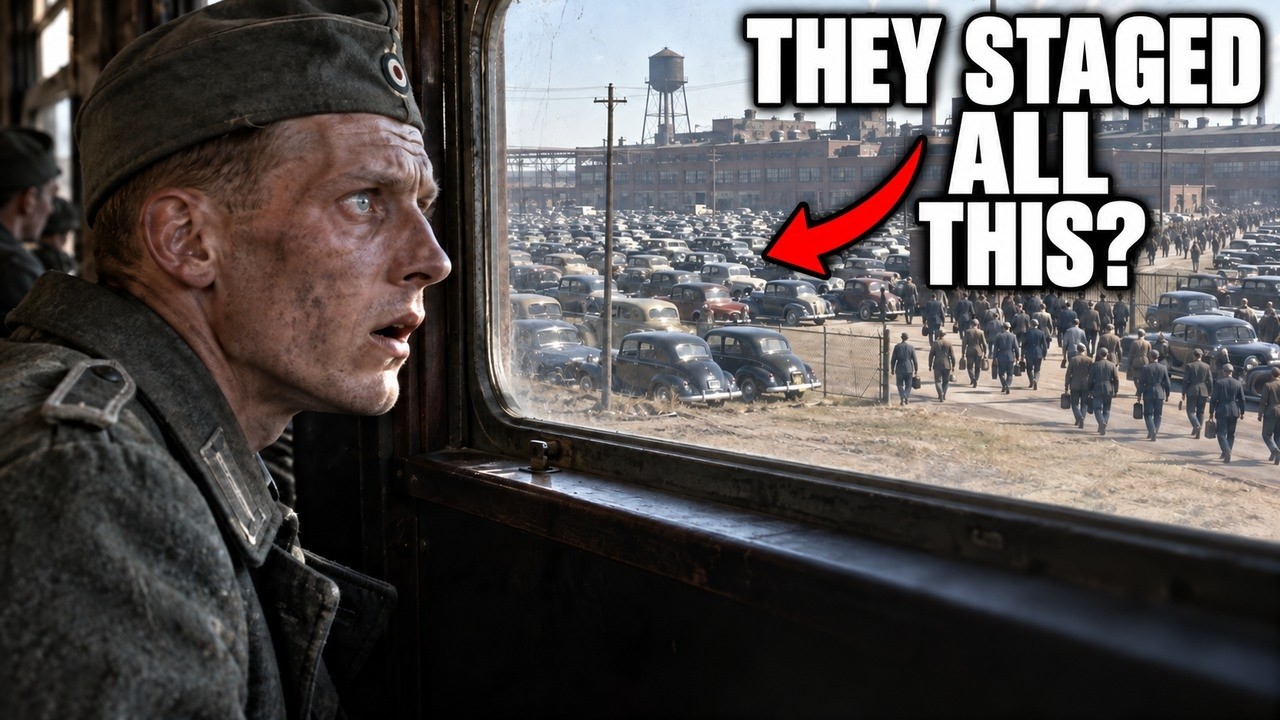 A staged row of cars might explain a single factory, but it was a far more difficult proposition to explain the next town, and the one after that, and the endless succession of working people who treated the machinery of American life as an ordinary, unremarkable fact.
Horst von Oppenfeld remembered that moment sixty years later, not as a sudden conversion but as the first crack in a carefully constructed wall of belief. He was thirty years old, an officer in the 10th Panzer Division, a formation that had been driven back across North Africa and finally compressed into the northeastern corner of Tunisia by May 1943. The public story of the Axis retreat was one of heroic resistance to the last cartridge, but the private condition of the men was far simpler and far more grim.
They were out of food and out of petrol. On May 12th, von Oppenfeld drove his commander toward the British lines on Cap Bon, a white shirt tied to the end of a carbine as a flag of surrender. Wolf-Dietrich Zander, another officer who spoke English, arranged the formal capitulation.
The North African war was over for them, and they were now entirely dependent on the mercy and logistics of an enemy they had been taught to despise and underestimate.
The journey into captivity was itself a lesson in the scale of the nation that held them. The prisoners traveled by rail to Casablanca, then boarded a ship without being told where their captivity would continue. When the voyage neared its end, von Oppenfeld reached the deck in time to see the Statue of Liberty rising ahead, a sight that stayed with him for the rest of his life.
There was little time to study New York. Guards transferred the men to a train, and the country began passing in pieces: houses, roads, factory walls, and people going to work. Many German soldiers knew America chiefly through Western novels, films, political caricatures, and wartime broadcasts.
They had arrived with a mental picture prepared for them by other people, a portrait of a soft and decadent nation that could not possibly sustain a long war. Now the windows kept editing that picture without asking permission, and the editing was relentless.
The claim about fuel was useful to the propagandists because it contained just enough truth to travel well. Americans were rationing gasoline, and they were also rationing tires. The national speed limit had been reduced to thirty-five miles per hour to preserve rubber.
An ordinary A sticker might allow a driver only a few gallons a week, and pleasure trips could cost a motorist his ration book entirely. But rationing by need was not the same as national paralysis. War workers who commuted and carried passengers could receive larger allocations, and car sharing was promoted everywhere.
 Old cars stayed on the road because production of new civilian models had largely stopped, so owners patched tires, planned errands, and watched the fuel gauge with a careful eye. What the prisoners saw near Akron was not the carefree America of a showroom advertisement. It was a society restricting private movement in order to keep its factories moving, and that distinction mattered enormously.
Propaganda had offered them a country that could no longer use its machines. The train showed them people organizing their lives around those machines, coming by road or rail before another shift began. The scale of the industrial effort was even less convenient to dismiss once they were inside the plants.
At Willow Run, aircraft fuselage sections moved above the factory floor on cranes. Women riveted panels while engines descended into place, and completed bombers rolled outside. The factory was impressive, but no single building explains American production.
Its power came from a network: steel mills feeding machine shops, railways feeding assembly plants, refineries feeding transport, and farms feeding the people on every shift. Other plants were turning out tanks and trucks, as well as guns and ships, in quantities that were difficult to imagine from Europe. By September 1943, an official American report counted 123,000 aircraft and more than 1.
2 million trucks delivered since the armament program began in 1940.
The numbers were not proof of an effortless system. American production had suffered shortages, missed schedules, and bottlenecks. The striking fact was that the bottlenecks were being attacked while output kept rising.
The prisoners did not have those totals in the carriage, and most would not have trusted an American handout containing them. They had something harder to dismiss: telegraph poles ticking past the glass, loaded tracks beside their own, factory gates opening for another morning, and civilians treating all of it as an ordinary working day. That was enough to make the argument inside the train sound increasingly desperate.
The man who claimed the cars were staged was not persuading anyone, because the evidence was too widespread and too consistent. A single deception could not account for the sheer volume of movement they were witnessing.
 Kansas supplied a different kind of evidence. Their destination, Concordia, was a farming town far from any famous industrial center. When the first four hundred German prisoners arrived on July 15th, residents crowded around the depot to see men captured from Rommel’s army.
Von Oppenfeld looked back at the local farmers and noticed their healthy, red-cheeked faces. Camp Concordia stood beyond the town on 158 acres of prairie. It had about three hundred buildings, including barracks, mess halls, a hospital, recreation rooms, and guard towers.
By November, it would hold more than four thousand German prisoners, more people than many nearby communities. Building it had required construction material and coal, medical supplies, American guards, and rail capacity for men whom the United States hoped to keep far from ports and sensitive industry. This was not a display built along a single railway line.
It was one part of a camp system spread across rural America, a logistical achievement that spoke to the nation’s capacity for organization and resource allocation.
For von Oppenfeld, the next contradiction arrived on a plate. He remembered citrus fruit, fresh vegetables, and raisins, along with dairy, meat, and fruit juice, foods he had not seen in Germany for years. The camp was still a prison with fences, searches, armed guards, and rules governing almost every movement.
The food was not a gift of friendship. Under the Geneva Convention, prisoners were to receive rations comparable to the troops guarding them. Some men gained so much weight that their German uniforms split at the seat.
They repaired the tear with a triangular piece cut from American uniform cloth, and the patch acquired a name: the victory wedge. It was barracks humor, and it was funny because the conclusion underneath it was not. Germany had sent these men into North Africa without enough petrol to continue fighting.
Their enemy could transport them across an ocean, move them halfway across a continent, house them in a new camp, and feed them until their uniforms needed altering.
 None of this caused an instant political conversion. Evidence rarely works that neatly. Hardline Nazi officers continued to enforce loyalty inside the wire, and prisoners who opposed Hitler learned to keep their opinions quiet.
In October 1943, Captain Felix Tropschuh was targeted after other prisoners treated his private diary as proof of treason. American camp officials failed to understand the danger until too late, and Tropschuh died in his cell. The same camp could therefore contain two very different reactions to the view from the train.
One man could watch the factory parking lots and revise what he believed. Another could invent a larger American deception and preserve the old belief intact. The human mind is capable of extraordinary contortions when faced with evidence that contradicts a deeply held worldview, and the prisoners were no exception to this rule.
Von Oppenfeld belonged to a small circle that spoke cautiously among themselves. He had gone into the army rather than join the Nazi Party and had served in Africa with Claus von Stauffenberg, who would later lead the attempt to 𝓀𝒾𝓁𝓁 Hitler. At Concordia, those facts did not make him safe.
Zander obtained copies of the New York Times and translated them in their room, while prisoners organized classes using the teachers, lawyers, doctors, and businessmen already inside the compounds. Instead of receiving another single official answer, they began encountering arguments that disagreed with one another. The process moved slowly and sometimes became dangerous.
It was also more durable than the story of one miraculous revelation. The cars outside Akron opened the crack. Newspapers and classes gave the men reasons to keep looking through it, and the slow accumulation of evidence began to reshape their understanding of the world.
Von Oppenfeld left captivity after the war, but his American story did not end at the port. He returned to the United States in 1948, studied agricultural economics at Cornell, later worked for the World Bank, and lived in the Washington area for more than four decades. The first American lesson he remembered was not delivered by an interrogator, a lecturer, or a propaganda film.
It was delivered before breakfast by people driving to work. One staged explanation could not survive the next parking lot, and the truth of American industrial power was written not in official pronouncements but in the mundane, unglamorous movements of ordinary citizens who refused to stop their machines. The prisoners who were willing to look saw a nation that was not paralyzed by rationing but mobilized by purpose, and that sight was far more devastating to their cause than any military defeat could have been.