
The word arrived with the finality of a judge’s gavel, a single syllable that could erase a woman from the social register faster than any scandalous photograph. In the drawing rooms of the British aristocracy, it was whispered with a mixture of pity and contempt, a label that followed its target from the grouse moors of Scotland to the ballrooms of London, ensuring that doors once opened with a curtsy were now slammed with a silent, decisive click. By 1967, that word—bolter—had been affixed to Frances Roche Shand Kydd, a 31-year-old mother of four who had dared to walk out on her marriage, her children, and her entire aristocratic existence for another man.
The British tabloids, ever hungry for a story that confirmed their readers’ prejudices, spent the next three decades treating her as a cautionary tale, a woman who had committed an unforgivable sin against the sacred codes of British decency. But the story they told was a grotesque simplification, a caricature that stripped away the layers of grief, coercion, and survival that defined her actual life. For the woman history tried to flatten into a footnote was not merely a runaway wife; she was the mother of the most famous human being of the late 20th century, a woman who buried an infant son who lived only ten hours, lost her other children in a courtroom where her own mother testified against her, watched her daughter become a princess, and then watched that daughter die in a Paris tunnel while the two of them were not speaking.
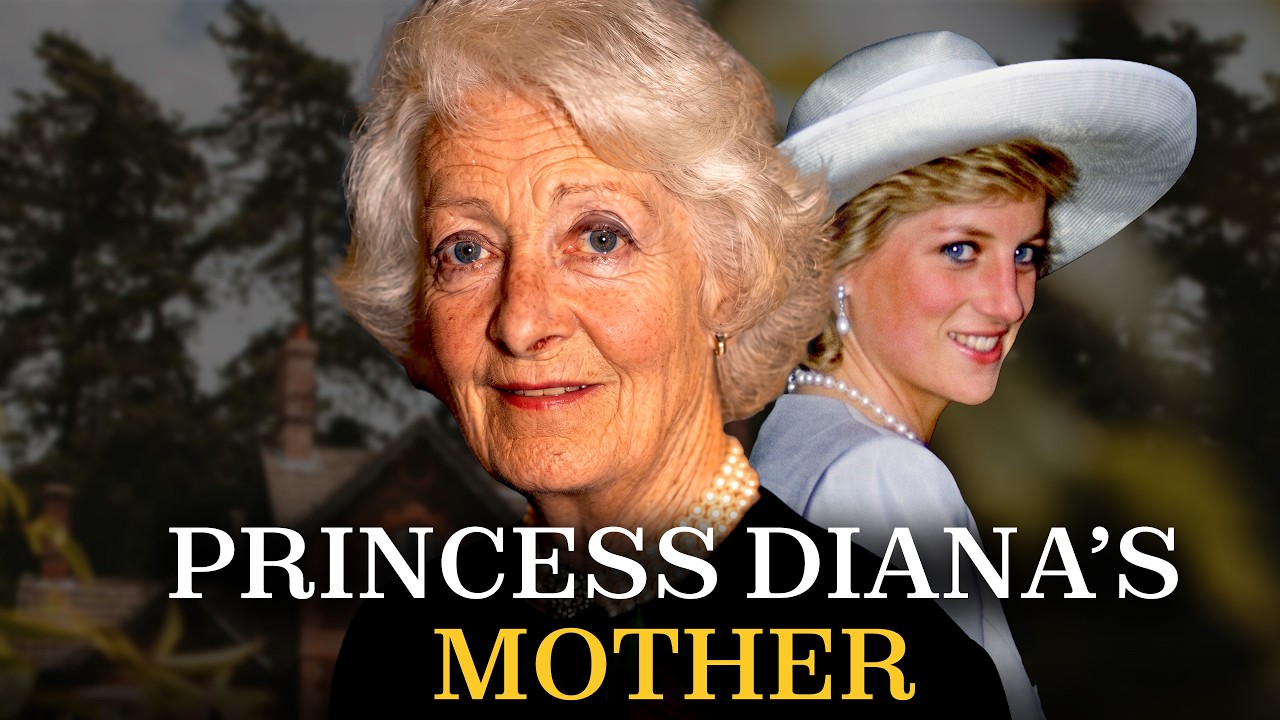 In her late fifties, she converted to Catholicism, and her final years were spent pushing wheelchairs through the grotto at Lourdes. So, yes, bolter seems a little reductive.
Frances Ruth Burke Roche was born on January 20, 1936, at Park House, a grand Victorian residence situated directly on the Sandringham estate, a mere stone’s throw from where the King of England actually lived. The house had been leased to her parents by King George V himself, a fact that instantly signaled the family’s position within the royal orbit. Her father, Maurice Roche, was the fourth Baron Fermoy, a Conservative MP with an Irish barony, while her mother, Ruth Gill, was a talented pianist whose steel spine would one day lead her to testify against her own daughter in a custody battle.
The Roche family lineage stretched back centuries into Irish Catholic aristocracy in County Cork, with the Fermoy barony having been established in 1856. But the more intriguing branch of Frances’s bloodline came from across the Atlantic, where her great-grandmother, Frances Ellen Work, was an American heiress. Her father, Frank Work, a New York stockbroker, harbored such a deep suspicion of European aristocrats marrying his money that he wrote a clause into his will stipulating that any descendant who accepted a British title would forfeit their inheritance.
The family took the title anyway, with Maurice Roche briefly renouncing his British connections to secure the American cash before quietly reclaiming the Fermoy barony when the dust settled. It was classic aristocratic maneuvering, a have-your-cake-and-eat-it-too approach to dynastic survival.
Frances grew up in a world where the royal children were playmates, not distant figures. She played with the future Queen Elizabeth II and Princess Margaret, a casual proximity that was simply the norm for a family living on the royal estate. Her mother, Ruth Fermoy, would go on to serve as a confidante and woman of the bedchamber to Queen Elizabeth, the Queen Mother, from 1956 until her death in 1993, a 37-year tenure that placed her at the very heart of the royal household.
Frances’s childhood was standard-issue British upper crust, filled with ponies, nannies, governesses, and boarding school. She attended Downham School in Hatfield Heath, Essex, a finishing institution that focused on deportment and French rather than any modern sense of education. A stint at a finishing school in Paris followed, because what was the point of being a baron’s daughter if you couldn’t order dessert in fluent Parisian?
By the time she returned home at 17, she was tall, blonde, strikingly pretty, and ready for the part of her life that would determine everything else: the 1953 London season. This was a bizarre, almost feudal ritual where debutantes from aristocratic families were formally presented at court and then paraded through a series of balls and house parties for several months with the unstated purpose of husband acquisition. The 1953 season was particularly significant, coinciding with the coronation of Queen Elizabeth II, making it the most high-profile season in a generation.
Into that circus walked a 30-year-old man named Edward John Spencer, Viscount Althorp, heir to the Earldom of Spencer and one of the most eligible bachelors in Britain. Johnny Spencer, as he was known, came from a family so old and so grand that it made the Roches look like new money. He had served as an equerry to King George VI and then to the young Queen Elizabeth II, and there had been a brief engagement to Lady Anne Coke before that fell apart.
Frances looked back. Their engagement happened fast; she was 18, he was 30, a 12-year gap that was mildly eyebrow-raising but not scandalous in the context of 1950s Britain. On June 1, 1954, they were married at Westminster Abbey, the very place where monarchs are crowned and buried.
Queen Elizabeth II attended, as did Prince Philip and the Queen Mother, because Ruth Fermoy was her best friend in the world. The newspapers called it the society wedding of the year, and for once, they weren’t exaggerating. Picture an 18-year-old girl walking down the aisle of Westminster Abbey while the Queen watches from the pews.
That was the starting line for Frances’s adult life.
As Viscountess Althorp, Frances moved into the Spencer family properties and got to work doing what 1950s aristocratic wives were expected to do: produce children, preferably male, preferably right now. She delivered her first child, a daughter named Sarah, on February 19, 1955. A good start, but girls were fine; the expectation was crystal-clear that the family needed an heir, a boy, to continue the title and the estate at Althorp.
Cynthia Jane arrived on February 11, 1957, another girl, healthy but, in aristocratic terms, not an heir. The pressure intensified. In families of this vintage, a woman who produced only daughters was quietly considered to be failing at her primary job.
It was never said to her face, but it was there in the silences and the pointed questions and the Harley Street specialists her husband would soon be booking appointments with. On January 12, 1960, a son, John, was born, named after his father. The child lived ten hours.
Medical records from the time are vague, and the family kept the details fiercely private, but what is known is that the baby was born with severe complications and died within the span of a workday. Frances never held her son conscious; she woke up from anesthesia to the news. What Johnny Spencer did next tells you everything about the marriage Frances was in.
Processing his own grief in his own way, he concluded that the problem was his wife, that her body was defective, and so he sent her to Harley Street, the famous London medical street, to undergo evaluations to determine why she hadn’t produced a healthy male heir. His wife had just lost a son, and his response was to have her medically investigated like a broken piece of livestock.
Frances went through the tests, endured the humiliation, and on July 1, 1961, she gave birth to another daughter. Her name was Diana. Diana Frances Spencer arrived in this world as what her parents considered another failure, a consolation prize, another girl when they needed a boy.
Frances would later reflect on how awful it was to see her newborn daughter greeted with such open disappointment in the delivery room. The most famous woman of the late 20th century, the princess whose face sold more magazines than anyone in history, was born into a room where her arrival was mourned as a setback. Finally, on May 20, 1964, Frances delivered the longed-for son, Charles Edward Maurice Spencer, the heir, the future ninth Earl Spencer.
But by 1964, something had already broken in her. The marriage, the miscarriages, the treatment, the grief, all of it had taken a toll she couldn’t keep hiding. She was still in her twenties, and she was done.
Her father, Maurice Roche, had died in 1955, which created an opportunity because the lease on Park House, Frances’s childhood home on the Sandringham estate, was passed to the Spencers. Frances, now Viscountess Althorp, moved back into the house she’d been born in. That should have been comforting; it wasn’t.
Park House became the scene of her marriage’s slow-motion disintegration. The kids were raised there, with Diana’s earliest memories being of Park House, running around those Norfolk lawns, playing with royal cousins next door. From the outside, it looked like a genuinely charmed childhood.
From the inside, it was a different story entirely. Their parents were increasingly unhappy, increasingly distant, increasingly bitter, with the bitterness leaking into every room of the house by the mid-1960s.
The accounts of what went on inside that marriage are contested, and the most explosive claims came out in 2024 when Charles Spencer published a memoir called A Very Private School. In that book, he alleged that he had witnessed his father physically 𝓪𝓫𝓾𝓼𝓮 his mother, framing her eventual departure as an act of self-preservation, not abandonment. Johnny Spencer died in 1992 and cannot defend himself.
 These allegations come from a son who was very young at the time of the events he describes, a son who has his own complicated feelings about his father, a son who also suffered horrific 𝓪𝓫𝓾𝓼𝓮 at a boarding school his father sent him to. Charles’s memoir is one man’s account of his own family, and it deserves serious weight, but it is also not a court record or an independently verified investigation. The upshot, however you slice it, is that by the mid-1960s, Frances was miserable in that marriage.
It is 1966, and Peter Shand Kydd enters the picture. He was Australian-born, heir to a successful British wallpaper business, and while wallpaper sounds like a joke punchline, it is genuinely where the family fortune came from. He was 41, married with three kids of his own, and by every account, the guy was fun, warm, relaxed, the opposite of Johnny Spencer’s stiff-upper-lip aristocratic energy.
Peter laughed, drank, told stories, and listened when women actually spoke. Frances fell for him. Their 𝒶𝒻𝒻𝒶𝒾𝓇 began sometime in 1966, and for the first few months they kept it quiet, because high society London in the 1960s was basically a village where everyone knew everyone’s business within 48 hours.
Then, in late 1967, Frances did the thing aristocratic women weren’t supposed to do. She left. Packing up the two youngest children, Diana and Charles, she moved to a house in Belgravia, London, with the idea in her own mind being that this would be a trial separation.
Johnny Spencer had other ideas. Christmas 1967 came and went. The children went to Park House for the holidays to see their father, and then, when Christmas was over, Johnny refused to send them back.
He had lawyered up, filed for custody, and the custody battle was on.
British wardship proceedings in the 1960s were sealed and largely still are, so there is no public transcript of what happened in that courtroom. What exists are second-hand accounts from biographers and family members that have 𝓵𝓮𝓪𝓴𝓮𝓭 out over the decades, and those accounts are not pretty. Frances expected to win custody because in her mind, the case was obvious.
She was the mother, the children were young, and she was the primary caregiver. But 1968 Britain was not modern Britain. The legal system of the time was more than willing to punish a woman who had left her marriage, especially for another man.
Adultery carried serious weight in family court, and character witnesses mattered enormously. Among the people called to provide evidence was Frances’s own mother, Lady Ruth Fermoy, devoted servant of the Queen Mother, keeper of aristocratic propriety, who stepped up for her son-in-law. The exact nature of her intervention has been debated by biographers for decades, but the outcome isn’t in dispute.
She sided with Johnny against her own daughter. Think about what that does to a person. You are fighting to keep your children, you are in a courtroom trying to prove you are fit to raise them, and the woman who gave birth to you walks in and tells the judge you are not.
Frances lost. All four children went to Johnny, with limited visitation as the only leftover thread. The divorce was finalized in April 1969.
She was 33 years old. The British press savaged her, over and over, using the word bolter. Aristocratic mothers whispered about her at dinner parties, guest lists pruned her out one by one, and Ruth Fermoy, her own mother, stopped speaking to her for years.
Meanwhile, her children were growing up at Park House, raised by nannies and boarding schools, with a grieving father raising them in his own distant way. Diana, in particular, never fully got over the loss of her mother. She told Andrew Morton in the famous biographical tapes that she remembered crying herself to sleep at Park House listening to her brother call out for a mom who wasn’t there.
The crunch of her mother’s car on the gravel the night she left stayed with her forever. Diana’s ambivalence about Frances would shape their entire relationship for the rest of both their lives.
On May 2, 1969, Frances married Peter Shand Kydd. Her second wedding was nothing like the first. No Westminster Abbey, no queen in the front row.
It was small, private, deliberately low-key because after what she’d been through, she wanted to disappear. A farmhouse on the Isle of Seil became their home, a small island off the west coast of Scotland connected to the mainland by a single stone bridge. Seil is beautiful in that particular Scottish way, where beautiful means cold, wet, and devastatingly isolated from anything resembling London society.
The island’s population is a few hundred people, and the nearest town of any size is Oban, about half an hour’s drive away on winding single-track roads. Frances loved it. Fishing for salmon became one of her great passions, and by every account, she got seriously good at it.
She walked the moors for hours, drank in the local pub with farmers, and her friendships with the local fishermen and shopkeepers grew deep precisely because those people had absolutely no idea or interest in her aristocratic background. For the first time in her life, Frances was just Frances. A gift shop in Oban became her next project, selling tweed scarves and shortbread and little woolen sheep and the usual Scottish tourist fare.
She ran it herself, stood behind the counter, chatted with tourists who had no clue they were being rung up by the mother of the future Princess of Wales. Her marriage to Peter was happy for about 15 years. They had a life together that nobody in her old London circles would have recognized, but it was hers, and that mattered more than recognition.
Her children visited when they could, and Diana, in particular, would make the trip up to Scotland when she was a teenager, visits that became precious to Frances, who tried her best to rebuild a relationship with her daughters that had been severed in that 1968 courtroom.
Then, in the late 1970s, something happened that pulled Frances back into the world she had spent a decade trying to escape. Diana started dating the Prince of Wales. In November 1977, Diana, 16 years old, met Prince Charles at a shoot at Althorp, where Charles was dating Diana’s older sister Sarah at the time.
By 1980, Charles and Diana were an item, and on February 1981, they were engaged. Frances, tucked away on her Scottish island, got sucked back into the spotlight whether she wanted it or not. On July 29, 1981, the royal wedding happened at St.
 Paul’s Cathedral, watched by 750 million viewers worldwide. Frances attended, of course, watching her daughter become the Princess of Wales. But the seating arrangements were a logistical nightmare because she and Johnny had been divorced for over a decade and couldn’t be anywhere near each other.
The organizers split Diana’s mother and father onto opposite sides of the cathedral. Johnny walked Diana down the aisle, having suffered a severe stroke that left his health fragile, but he made it through the ceremony on sheer willpower. Frances watched from her seat.
Her first grandchild, Prince William, would be born less than a year later. Throughout the entire 1980s, Frances occupied a strange position as the mother of the most photographed woman alive, but also a divorced aristocrat who had been publicly humiliated 20 years earlier and had deliberately chosen a life away from cameras. Interviews?
She didn’t do them. Quotes? She didn’t give them.
From Scotland, she watched. Diana’s marriage, meanwhile, was doing exactly what Frances’s had done, which was falling apart in slow motion. By the late 1980s, the whispers about Charles and Camilla were everywhere, along with Diana’s bulimia and her depression and her unhappiness and her isolation, all of it echoing patterns Frances herself had lived through a generation earlier.
You’d think this would bring them closer. Sometimes it did. Frances was genuinely supportive during the worst years of Diana’s marriage.
But here’s the thing about Frances as a mother: she was not, by temperament, a warm and nurturing type. Diana needed someone to hold her and tell her everything would be okay. Frances was better at telling her to buck up and go for a long walk.
Both types of mothers have their virtues, but they weren’t always the mother Diana needed, and Diana sometimes said so loudly.
Meanwhile, back on the Isle of Seil, the Kydd marriage was cracking up. By 1988, Peter had moved out and eventually married another woman, Marie-Pierre Palmer. Their divorce was finalized in 1990.
Frances, at 54, was divorced for the second time. Here’s where her life could easily have spiraled. Alone, twice divorced, estranged periodically from her now famous daughter, living on an isolated Scottish island with nobody to fish with anymore.
Instead, Frances did something nobody saw coming. In 1994, Frances officially converted to Roman Catholicism. For a woman of her background, raised Church of England, closely tied to the British royal family, this was a bigger move than it sounds.
The British royals had spent 450 years being professionally not Catholic. Ruth Fermoy, Frances’s own mother, was a pillar of Anglican propriety who had spent four decades at the Queen Mother’s side. Converting to Catholicism was Frances quietly telling her old world to get lost.
She took it seriously, and her Catholicism then channeled into a specific charity that became the center of her later life. The HCPT, the Pilgrimage Trust, is a British Catholic charity that organizes pilgrimages to Lourdes for sick and disabled children. Every year, volunteers take thousands of kids to the French shrine town where a 12-year-old girl named Bernadette claimed in 1858 to have seen the Virgin Mary.
Frances threw herself into HCPT with the kind of energy she’d once spent on salmon fishing. Year after year, she went to Lourdes even as her own health started to decline, pushing the wheelchairs of disabled children through the narrow streets of the town. Every single volunteer who worked with her in those years tells the same story: she refused special treatment.
Frances Shand Kidd, née Roche, debutante of 1953, mother of the Princess of Wales, in a rain slicker pushing a kid in a wheelchair through a French town because she believed it mattered.
Frances was not a saint, because she wasn’t, and she’d probably be the first person to tell you so. A complicated woman with complicated habits, one of which was driving way too fast on Scottish country roads while under the influence. In 1996, she pleaded guilty to drink-driving in Scotland, earned a 14-month driving ban, and paid a substantial fine.
Her incident became a national news story because of who she was, which she hated bitterly. For a woman who had spent decades trying to stay out of the papers, having her name splashed across every front page because she’d blown over the limit was a humiliation she genuinely didn’t deserve, but she’d brought it on herself and she knew it. She took the punishment without complaint, served out her ban by getting friends to drive her around the island, and paid the fine in full.
Diana’s marriage to Prince Charles had been officially over since August 1996, and the divorce settlement had stripped her of the HRH style, meaning she was no longer technically her Royal Highness, just Diana, Princess of Wales. Frances, now 61, gave an interview to Hello! magazine on the topic of her daughter’s divorce, and in that interview, she said something that she genuinely believed was supportive, but which Diana experienced as a knife in the back.
Her mother told the magazine she thought it was absolutely wonderful that Diana had lost the HRH, framing the loss as liberating, arguing that now her daughter could find her own identity. From Frances’s own perspective, this was a reasonable thing to say because she herself had spent her life trying to escape the constraints of aristocratic identity, and she saw the loss of the title as an opportunity rather than a wound. Diana did not see it that way.
She felt publicly demeaned by her own mother, and she reacted the way she often reacted when she felt betrayed, which was to cut off contact completely. Their phone calls that spring and summer got worse. The mother-daughter relationship, which had already been fragile since 1968, finally shattered.
Then came August 31, 1997. Princess Diana died in a car crash in the Pont de l’Alma tunnel in Paris in the early hours of August 31, 1997, at 36 years old. Frances and Diana had not spoken in months, and they would never speak again because somebody had to call Frances on Seil Island in the middle of the night and tell her that her daughter was dead, and that the last conversation they’d had was a fight.
Charles Spencer, Frances’s son, would later give the eulogy at Diana’s funeral at Westminster Abbey, the same cathedral where his mother had been married 43 years earlier. Frances attended, stone-faced, British stoic to the end because that’s what her generation did at funerals for daughters. Her relationship with William and Harry continued quietly in the years after, with occasional visits at Eton or Highgrove, private conversations that never made the papers because she refused to talk about them.
 Of all the things she managed to protect from the tabloids, her grandsons topped the list. But the years after Diana’s death were hard because Frances was dealing with the loss, with her estrangement, with the public autopsy of Diana’s life that went on and on. On October 2002, Frances, now 66, got called to testify at the theft trial of Paul Burrell, Diana’s former butler.
Burrell stood accused of stealing items from Diana’s estate. The trial became a tabloid circus in which every detail of Diana’s private life got dragged back into public view, and Frances had to take the stand. Under cross-examination, she was forced to discuss the breakdown of her relationship with Diana, confirming under oath that they had not spoken for months before Diana’s death, responding to claims from aides that she had been verbally abusive on the phone during those final conversations, claims she vehemently denied, but which were now part of the court record.
The damage was done regardless of what she said. The trial itself collapsed in November 2002 when the Queen suddenly recalled a conversation that exonerated Burrell, an absolute farce of an ending to a case that should never have been brought in the first place, but Frances had already been put through the wringer.
Frances was sick for longer than the public knew. Parkinson’s disease came first, then sometime in the early 2000s, she was diagnosed with a brain tumor. She continued to live at her home in Callanish on the Isle of Seil, continued for as long as she could to participate in parish life at the Catholic church in Oban, and continued to refuse interview requests from every newspaper in Britain.
On June 3, 2004, Frances Shand Kydd died at home. She was 68. Her funeral was held on June 1 at the Cathedral Church of Saint Columba in Oban, a gray stone building overlooking the harbor where she’d run her shop for so many years.
Princes William and Harry attended. Charles Spencer came with his sisters Sarah and Jane. Prince Charles, notably, did not come.
Frances was buried at Pennyfuir Cemetery on the outskirts of Oban. If you go there today, her grave is simple. A stone, a name, dates.
That’s it. No Westminster Abbey funeral for her, no royal carriage, just a Scottish burial in the town where she’d run her gift shop for 30 years, attended by the neighbors and family members who had actually known her rather than the avatar the tabloids had constructed. It’s the funeral she would have wanted.
It’s the funeral she got.
Who was Frances Shand Kydd? The tabloid version said she was a bolter, a woman who walked out on four kids for a wallpaper heir, a selfish aristocrat who got what was coming to her. The revisionist version, which has gained ground, especially since Charles Spencer’s 2024 memoir, casts her as a survivor, a woman fleeing an abusive marriage, a victim of a patriarchal legal system that punished her for leaving.
Both of these versions have truth in them. Neither of them is the whole story. The Frances that emerges from the scattered and contradictory sources is more layered than either of those takes allow.
She was, first and foremost, an ordinary woman born into extraordinary circumstances, which is actually the opposite of the usual biographical frame. Frances was not a genius, not a world historical figure, just a reasonably smart, reasonably athletic, reasonably good-looking British girl who happened to be born at Park House instead of in a terraced house in Newcastle. That accident of birth put her on a track she did not choose and could not really escape until she finally forced the issue at 31.
She made bad decisions. Marrying at 18 was a bad decision. Having an 𝒶𝒻𝒻𝒶𝒾𝓇 while married was an ethically ambiguous one.
The Hello interview in 1997 was tone-deaf and hurt her daughter badly. Her drink-driving in 1996 was dangerous and wrong. She was capable of being cold, and her children, especially Diana, sometimes experienced her as emotionally unavailable in ways that left marks.
But she also had real courage. Leaving Johnny Spencer in 1967 took nerve, whatever the exact trigger was. Living through the custody loss without completely falling apart took nerve.
Rebuilding her life in Scotland took nerve. Converting to Catholicism at 58 and spending her remaining years pushing wheelchairs through Lourdes took a kind of quiet moral seriousness that you don’t usually find in fallen debutantes. And she had enormous, unglamorous dignity.
No tell-all memoir, no paid interviews, no cashing in on being Diana’s mother when she could have made millions doing so. Year after year, when the chance came to become a tabloid fixture, she went back to her island and ran her shop. The phrase that keeps coming back, reading her own words, is something she said in one of her rare interviews: “I am not a recluse.
I just like my own company.” That’s maybe the closest thing to a self-description Frances ever gave. After everything the press did to her, after everything the aristocracy did to her, after everything the courts and her own mother and her first husband and her second husband and her most famous daughter did to her, she just wanted to be left alone with her salmon rod and her rosary and her Scottish weather.
She raised, partly at a distance, the most famous woman of the late 20th century, buried a son who lived 10 hours, lost three more children to a sealed courtroom in 1968, outlived her second daughter in the worst possible way a parent can, and died of two diseases at once in a stone house on a Scottish island in 2004. Through all of it, she found a gift shop in Oban and a grotto at Lourdes and a salmon river in the Highlands and a faith she had not been born into, and she built a life on the rubble of the one that was taken from her. Her grandsons, William and Harry, still speak warmly about their grandmother on the rare occasions they mention her at all.
William is now the Prince of Wales, holding the title Diana held. There’s one detail that keeps sticking. When Frances was dying, in the last months of her life, she was too sick to travel to Lourdes anymore.
A decade of annual pilgrimages, pushing the wheelchairs and singing the songs and believing whatever she believed about the water and the grotto and the Virgin Mary, and then in 2004, she couldn’t make the trip. So her friends from HCPT, the volunteers she had worked alongside for years, sent her a little container of water from Lourdes. They brought it all the way back to Seil Island, gave it to her at home.
She kept it by her bed until she died. A woman who had finally found something to hold on to after a lifetime of losing things, and who held on to it all the way to the grave at Pennyfuir.